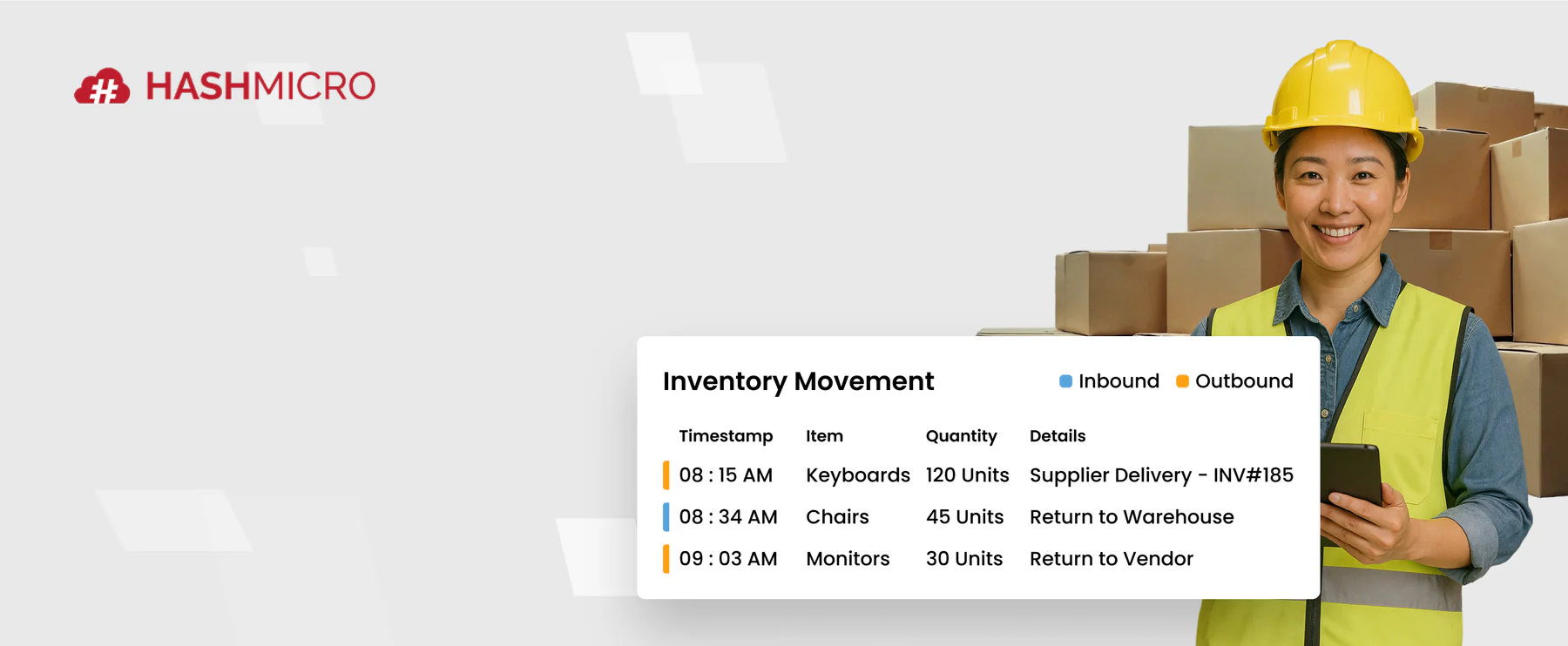

Warehouse management system cost in Australia ranges from a few thousand dollars a year for basic cloud software to more than AUD $400,000 for a complex on-premise deployment.
WMS pricing combines software, implementation, hardware, integrations, training, and support. Each cost changes with warehouse size, throughput, and system complexity.
Key Takeaways
WMS costs vary by deployment model, warehouse scale, throughput, and integration needs, with complex on-premise projects carrying the highest first-year cost.
Vendor pricing models determine how quickly expenses rise as users, locations, or transaction volumes increase.
Hidden WMS costs include data migration, custom development, hardware, go-live support, maintenance, and recurring staff training.
A three-year TCO calculation combines initial setup costs with subscriptions, support, maintenance, upgrades, and later integrations.
How Much Does a WMS Cost in Australia?
Prices vary by deployment model, warehouse scale, order volume, and integrations. The ranges below show what Australian businesses may need to budget in 2026.
1. Cloud WMS vs on-premise WMS cost
Cloud WMS subscriptions often range from AUD $500 to $3,000 per month. Peach Software lists AUD $365 for three users, AUD $490 for five, and AUD $790 for ten, including support and hosting.
On-premise projects can cost AUD $35,000 to over $400,000 in the first year. They suit complex warehouses that need greater infrastructure control and have dedicated IT support.
2. WMS cost by warehouse size and throughput
Small operations with up to five locations, fewer than 10,000 SKUs, and under 200 daily orders may spend AUD $5,000 to $30,000 in the first year. Basic warehouse management software and limited integrations keep costs lower.
Mid-sized warehouses processing 200 to 2,000 daily orders may spend AUD $30,000 to $150,000 in year one. Larger networks can exceed AUD $400,000 once automation and 3PL integrations are added.
How WMS Vendors Price Their Software
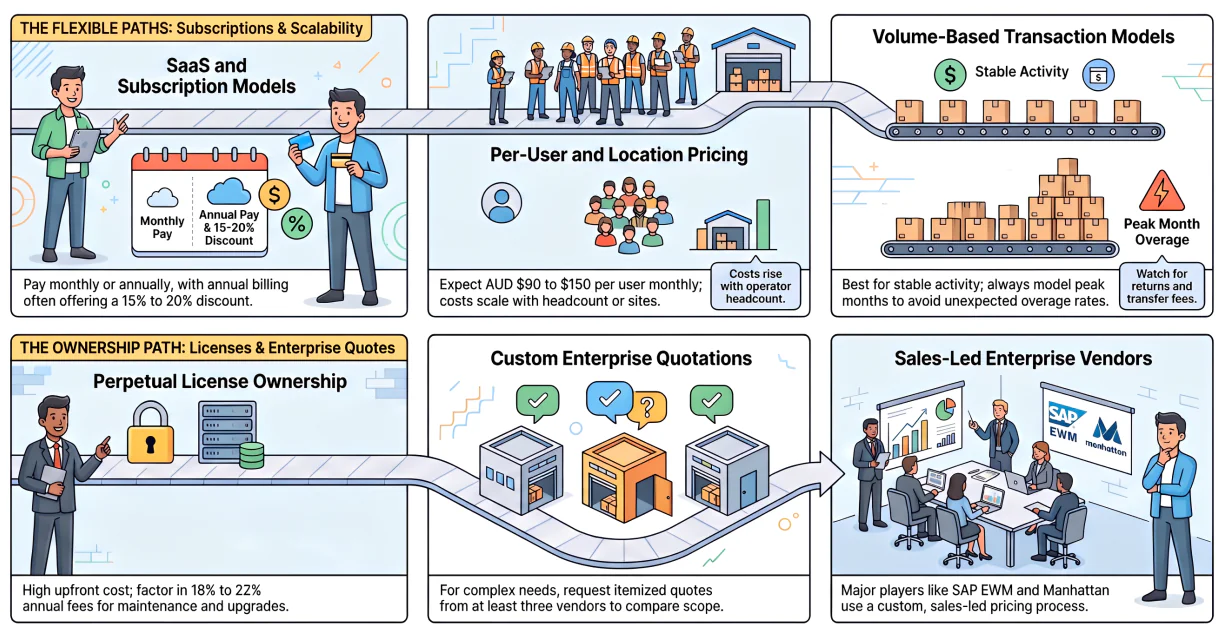
Knowing how a vendor charges shows how costs may change as your warehouse grows. Some models stay predictable, while others rise with users, locations, or order volume.
1. SaaS and subscription pricing
Under SaaS pricing, businesses pay monthly or annually instead of buying a perpetual licence. Fees may be based on users, warehouses, modules, or usage tiers.
Annual billing can reduce the effective price by around 15% to 20%, although discounts vary. Compare the contract term, renewal rate, and included support before committing.
2. Per-user and per-location pricing
Per-user pricing rises with operator headcount. At AUD $90 to $150 per user each month, ten licences would cost AUD $10,800 to $18,000 a year before implementation.
Per-location pricing may suit a large team at one site, but costs multiply across a network. Smaller operators should also compare inventory management software before choosing a full WMS.
3. Order or transaction volume-based pricing
Volume-based plans charge by orders, order lines, or transactions rather than users. They work best when activity is stable and the vendor clearly defines each billable event.
Seasonal warehouses should model an average month and a peak month. Check included volumes, overage rates, and whether returns, transfers, or cancelled orders count.
4. Perpetual licence pricing
A perpetual licence gives the business ongoing use of the software after a one-off purchase. It brings a larger upfront bill and usually requires internal infrastructure or hosting.
Maintenance, upgrades, and support are normally charged separately. If a vendor quotes 18% to 22% of the licence value each year, include that amount in the TCO.
5. Custom enterprise pricing
Enterprise vendors commonly price by quotation because scope varies by users, modules, warehouses, integrations, and service levels. HashMicro, SAP EWM, and Manhattan use a sales-led process.
Request itemised quotes from at least three vendors and provide each with the same requirements. This makes software, implementation, support, and integration costs easier to compare.
What Is Included in a WMS Price?
Quoted prices do not cover the same scope across vendors. Confirm each component below before comparing totals or treating one proposal as cheaper.
- Core WMS features: Entry plans often cover receiving, putaway, picking, and despatch. Wave picking, zone replenishment, labour tools, and multi-carrier routing may require an add-on.
- Integrations: Connectors for accounting, ERP, carriers, or 3PL services may be included or sold separately. Custom APIs and middleware are normally priced as separate work.
- Implementation, configuration, and training: Base subscriptions rarely include these services. Ask for a fixed scope covering deliverables, hours, exclusions, and go-live support.
- Hardware: Scanners, label printers, mounts, and warehouse-grade Wi-Fi are usually separate. Allow AUD $300 to $800 per scanner and AUD $500 to $2,500 per printer when planning.
What Factors Affect WMS Cost?
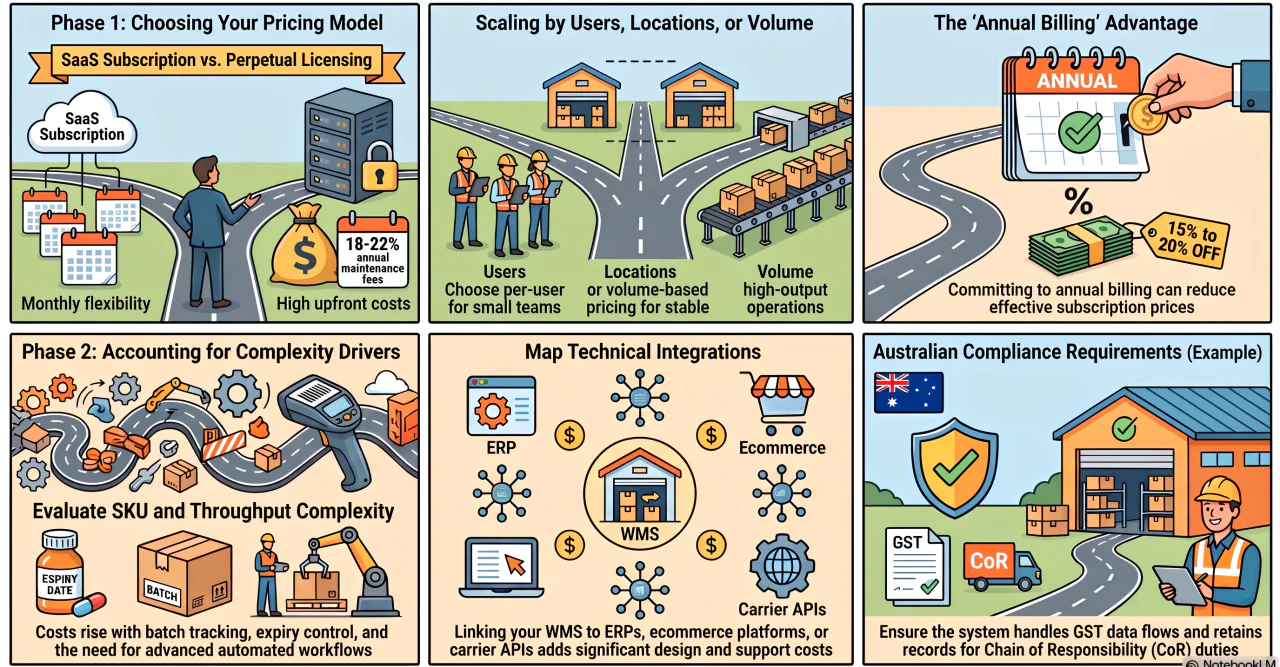
Two warehouses using the same platform can pay very different totals. Four factors explain most of the variation across Australian implementations.
1. Warehouse size, throughput, and SKU complexity
Larger sites process more orders and need more users, devices, storage, and workflow rules. Higher throughput may also require advanced picking, replenishment, and automation.
SKU complexity matters as much as volume. Batch or serial tracking, expiry control, temperature zones, and unit conversions can require a higher plan or custom setup.
2. Number of locations and users
Each added user raises costs under per-user pricing, while each warehouse raises them under per-location pricing. The cheaper model depends on team size and network structure.
Businesses operating across the eastern states and Western Australia should model current sites and planned expansion. Otherwise, a low starting price can become expensive as the network grows.
3. Integration complexity and customisation
A standalone WMS is simpler to deploy than one linked to an ERP, ecommerce platform, 3PL portal, and several carrier APIs. Every connection adds design, testing, and support work.
Custom workflows and reports add further cost and upgrade risk. Map each data flow across your supply chain management processes before requesting quotes.
Integration creates more value when connected data leads to timely action. The banner below shows how Hashy AI predicts shortages, prepares purchase orders, and supports replenishment before stock issues raise operating costs.






4. Australian compliance requirements
GST and imported-goods accounting usually sit in the connected finance or ERP system, not the WMS. Confirm how receipts, landed costs, and tax data move between systems.
CoR duties can apply to businesses that send, receive, pack, load, or schedule heavy vehicles. Review the NHVR Chain of Responsibility guidance and confirm which records your process must retain.
WMS vs Inventory Management Software: Which Do You Need?
Before requesting quotes, decide whether you need a full WMS or simpler inventory software. The two categories solve different problems and carry different costs.
Inventory software tracks quantities, locations, purchase orders, and basic movements. Plans may start at AUD $50 to $200 monthly, suiting simple stock and manual picking.
A WMS adds directed putaway, wave or batch picking, barcode-guided tasks, labour tools, carrier links, and bin-level visibility. It suits complex zones and higher order volumes.
| Factor | Inventory Software | WMS |
|---|---|---|
| Core use | Stock tracking | Warehouse execution |
| Picking | Manual or basic | Directed and barcode-guided |
| Visibility | Product or location level | Real-time bin level |
| Best fit | Simple, lower-volume sites | Complex, higher-volume sites |
If basic controls are enough, a WMS may add cost without enough value. Review what an inventory management system covers before investing in a full WMS.
Hidden and One-Off WMS Costs to Budget For
The subscription or licence price is only the starting point. Several costs sit outside the headline figure and can materially change the first-year budget.
- Data migration: Cleaning and transferring SKU records, stock balances, locations, and open orders takes time. Allow AUD $2,000 to $20,000 for planning, then confirm the scope with each vendor.
- Custom development: Non-standard workflows, reports, and integrations may be billed hourly or as fixed work. Early budgets may use AUD $150 to $300 per hour until a scoped quote is available.
- Hardware procurement and installation: Scanners, printers, mounts, charging equipment, and Wi-Fi upgrades may add AUD $5,000 to $50,000, depending on the site and existing equipment.
- Go-live support: On-site or remote support during launch may be charged separately, even under a fixed implementation fee. Confirm the included days, hours, and response arrangements.
- Annual maintenance: On-premise licences may carry separate maintenance. When quoted at 18% to 22%, an AUD $100,000 licence adds AUD $18,000 to $22,000 each year.
- Staff retraining: New starters and changing warehouse roles create recurring training needs. Budget for refresher sessions, updated procedures, and supervisor time after the initial rollout.
How to Calculate WMS Total Cost of Ownership
TCO captures the full cost of a WMS over several years, not only the subscription or licence. The formulas below cover most evaluations.
1. First-year WMS cost formula
Use this formula to estimate the cash required before the system is fully operational. Include one-off work even when the vendor places it outside the software quote.
Year 1 Cost = Software + Implementation + Hardware + Integrations + Training + Data Migration
2. Three-year TCO formula
A three-year view captures renewals, support, maintenance, and later changes. It also prevents a low entry price from hiding a more expensive ownership model.
3-Year TCO = Year 1 Cost + Year 2 Recurring Costs + Year 3 Recurring Costs + Later Upgrades and Integrations
3. Worked Australian warehouse scenario
This example uses a mid-market distributor with one warehouse, 15 users, 500 daily orders, and three integrations. Adjust each input to match your warehouse operations.
Year 1 totals AUD $63,000: AUD $18,000 for software, $25,000 for implementation, $12,000 for hardware, $5,000 for Xero integration, and $3,000 for training.
Software and support total AUD $21,600 in each later year, producing a three-year TCO of AUD $106,200. If avoided rework and returns save $70,000 annually, Year 1 payback is about 11 months.
"A WMS should be assessed through its total cost of ownership, not its subscription price alone. Implementation, hardware, support, and future integrations often determine whether the investment remains financially sustainable."
How to Compare WMS Quotes Fairly
WMS quotes are difficult to compare without normalisation. An implementation fee may include migration and training in one proposal but exclude both in another.
- Normalise the scope: Confirm what each implementation fee covers. Data migration, training, go-live support, configuration, and integration work should appear as named items.
- Use a WMS quote checklist: Request separate prices for software, implementation tasks, hardware, each integration, training, support, migration, and optional services.
- Question each vendor: Ask what triggers overage fees, how added users or sites are charged, whether implementation is fixed-price, and how your data can be exported after cancellation.
- Convert prices to AUD: Most global WMS vendors price in USD, creating currency risk. Confirm whether each quote includes GST and review the ATO guidance on accounting for GST before comparing totals.
Conclusion
WMS cost in Australia extends beyond software. A moderate mid-market project may require AUD $30,000 to $100,000 in year one and $15,000 to $40,000 annually for software and support.
HashMicro connects warehouse workflows with inventory, procurement, and financial reporting in one system. Book a free consultation to scope the modules, integrations, and implementation required.
Frequently Asked Questions About WMS Cost in Australia
Implementation time depends on warehouse size, data quality, integrations, custom workflows, and testing requirements. A small cloud rollout may be faster than a multi-site project involving automation and complex migrations.
Yes. Many WMS platforms connect with Xero, ecommerce platforms, ERP systems, and carrier services through native connectors or APIs. Confirm which integrations are standard and which require custom work.
Prepare accurate SKU masters, barcodes, units of measure, stock balances, bin locations, supplier records, and open orders. Cleaning these records before migration reduces testing issues and rework.
Cloud WMS availability during an outage depends on the vendor’s offline functions and the warehouse network design. Confirm how transactions are stored, processed, and synchronised when connectivity returns.
The contract should state how data can be exported, which formats are available, how long access remains open, and whether exit fees apply. Test the export process before signing or renewing.