




Tail spend can look minor on a purchase report. Yet across sites, branches, cards, and urgent requests, it can create supplier sprawl, invoice rework, approval noise, and weak procurement visibility.
Tail spend management identifies, segments, controls, and reviews low-value purchasing without blocking genuine operational needs. It helps finance, procurement, IT, and site teams work from shared evidence.
For Australian businesses, the issue often sits below strategic sourcing. A practical tail spend management strategy connects spend data, supplier rules, approvals, accounting, and reporting in one workflow.
Key Takeaways
Tail spend management controls fragmented, low-value purchases across the full request-to-invoice chain, not simply by dollar value.
Controlling tail spend is hard because fragmented suppliers, site and card buying, and high transaction volume scatter data across many systems.
Analysing and segmenting tail spend starts with one spend baseline, then grouping by category, value, frequency, and risk to set the right threshold.
Automation and ERP improve control by connecting purchasing, suppliers, approvals, and invoice matching in one workflow that removes blind spots.
What Is Tail Spend Management in Procurement?
Tail spend management is the discipline of controlling fragmented purchasing that has limited sourcing attention. It covers requests, suppliers, approvals, purchase orders, invoices, coding, and reporting.
In tail spend procurement, value is not the only test. A $300 service call can still need supplier checks, GST evidence, budget approval, invoice matching, and clean records for later review.
"When procurement teams cannot see where fragmented spend is going, they cannot decide which purchases deserve stronger control and which can stay operationally light."
1. The 80/20 Reality in Procurement
The 80/20 pattern is useful because it separates value from workload. A small spend share may still create many suppliers, transactions, exceptions, and support tickets for finance and procurement.
ABS business counts show a large, changing local business base, so supplier lists can expand quickly when onboarding is local. Use ABS data for market context, not for a spend threshold.
2. Why Tail Spend Falls Outside Strategic Sourcing
Tail spend falls outside strategic sourcing when teams focus on major contracts, regulated categories, or project-critical supply. Local buyers then solve small urgent needs through familiar suppliers.
That choice is not always wrong. The risk begins when the business cannot separate acceptable local buying from repeated off-contract demand, supplier duplication, or manual invoice work that needs review.
What Does Tail Spend Include, and How Is It Different From Maverick or Rogue Spend?
Tail spend includes low-value, low-frequency, recurring, urgent, or weakly sourced purchases. It may sit in office supplies, repairs, subscriptions, contractor services, parts, freight, or card spend.
The same purchase can be compliant or non-compliant depending on policy and context. This is why a tail spend management strategy should classify spend behaviour before adding heavier controls.
1. Common Examples of Tail Spend Transactions
Common tail spend transactions include emergency site parts, short-term hires, low-cost software, one-off repairs, and niche professional services. They look minor until they repeat across many locations.
In construction, mining, retail, healthcare, and distribution, speed often matters. Controls should capture the purchase reason, supplier choice, approval evidence, and later review outcome.
2. Tail vs Maverick vs Rogue Spend
Tail spend describes a segment of spend. Maverick spend describes buying that bypasses approved suppliers or workflows, while rogue spend signals unauthorised behaviour that needs investigation.
Clear labels matter because each problem needs a different response. A compliant low-value purchase may need visibility, while a deliberate bypass may need tighter access and audit action.
| Spend Type | Primary Meaning | Common Signal | Main Risk | Best Control |
|---|---|---|---|---|
| Tail Spend | Low-value, fragmented, or weakly sourced purchasing. | Many small suppliers, invoices, or card transactions. | Workload, weak visibility, and supplier duplication. | Segment spend, clean suppliers, and monitor KPIs. |
| Maverick Spend | Buying that bypasses approved suppliers or workflows. | Off-contract spend where a preferred option existed. | Price leakage, weak terms, and poor policy adoption. | Improve guided buying, catalogues, and exception review. |
| Rogue Spend | Unauthorised or potentially improper purchasing. | Unapproved supplier, unusual payment path, or missing reason. | Governance, audit, fraud, or compliance exposure. | Investigate, restrict access, and document remediation. |
Why Is Tail Spend Difficult to Control in Australian Enterprises?
Tail spend is hard to control because its causes sit across procurement, finance, operations, IT, and supplier master data. Reports show symptoms, but workflows usually create them over time.
Australian enterprises with many branches, projects, or remote assets face an extra challenge. Teams need fast purchasing paths, yet finance still needs consistent coding, ABN data, and approvals.
1. Fragmented Supplier Base and No Central Visibility
A fragmented supplier base often starts with practical decisions. One depot adds a repairer, one project adds a materials supplier, and another branch creates a duplicate record with incomplete fields.
Without central visibility, procurement cannot see category patterns and finance cannot reconcile records cleanly. Supplier reviews should compare ABN, category, location, payment, and spend history.
2. Site, Branch, and Corporate-Card Purchasing
Site and branch purchasing often reflects operational urgency. A buyer may use a corporate card or local supplier because the approved path is unclear, unavailable, or slower than the job requires.
The solution is not to remove local judgement. Tail spend management should define emergency paths, pre-approved supplier options, card coding rules, and review triggers after the need is met.
3. High Transaction Volume, Low Individual Value
Low individual value hides cumulative effort. Each invoice may still need coding, approval, matching, payment scheduling, exception handling, and records that support later reporting.
When hundreds of small transactions repeat, the workload can outweigh the purchase value. Tracking invoice-without-PO rates and approval exceptions shows where process cost is building.
What Risks Does Unmanaged Tail Spend Create?
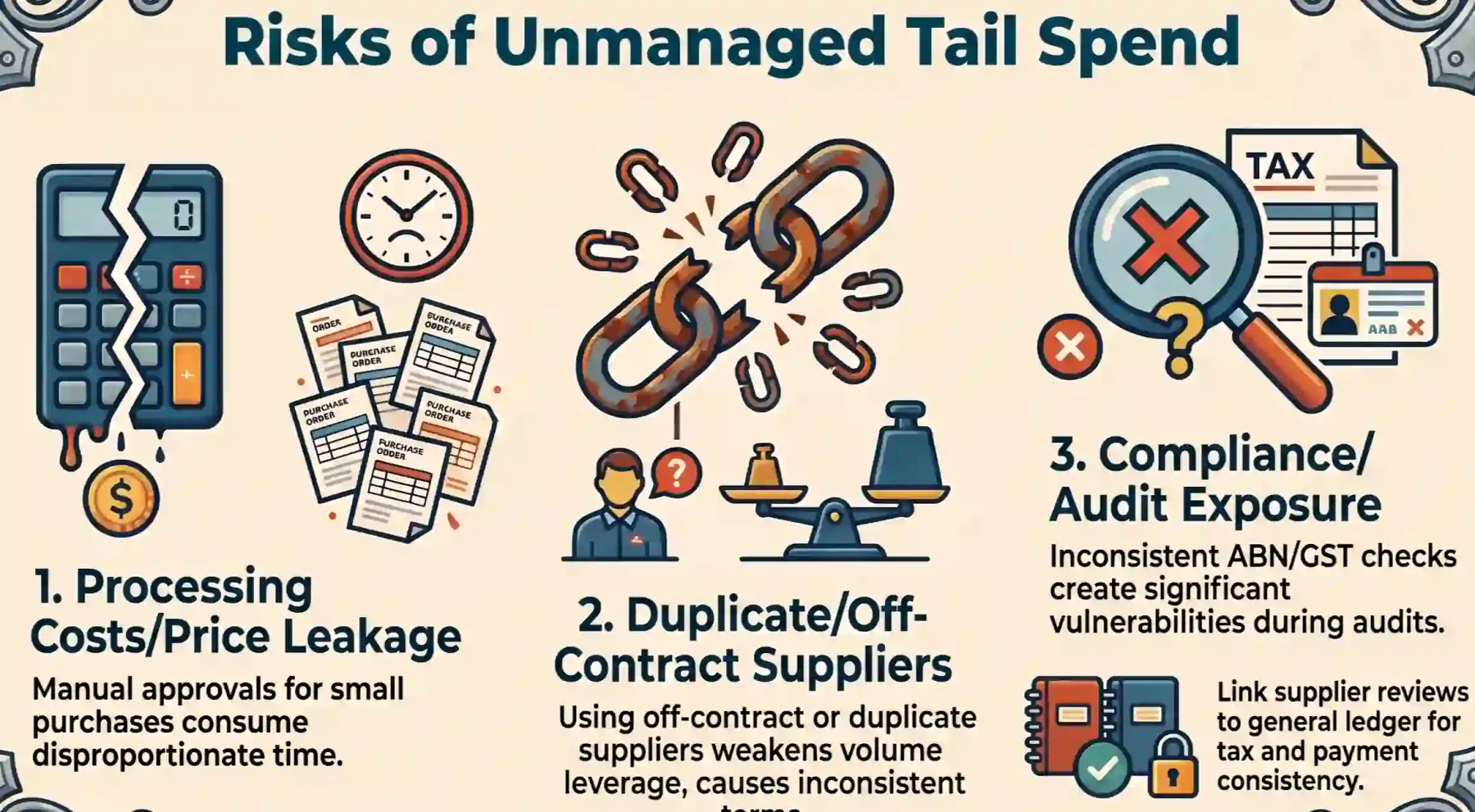
Unmanaged tail spend creates financial, operational, supplier, data, and compliance exposure. The impact is rarely one large failure; it is usually a pattern of small unmanaged decisions over time.
A stronger control model ranks risks by pattern, not only by value. Frequent off-contract purchases, duplicate suppliers, weak records, and manual approvals deserve targeted action.
1. Hidden Processing Costs and Price Leakage
Processing cost is easy to miss because each purchase feels small. Yet request clarification, supplier setup, approval, PO creation, invoice matching, payment, and reporting all consume time.
Price leakage appears when buyers miss preferred terms or split demand across similar suppliers. Review recurring tail spend before treating each purchase as a harmless exception in reports.
Use purchase price variance analysis when similar goods are bought through different suppliers. It helps show whether local buying is creating material price differences.
2. Duplicate and Off-Contract Suppliers
Duplicate suppliers weaken reporting and payment control. Slight name differences, missing ABNs, old bank details, or unclassified categories can make the same supplier appear as several records.
Off-contract suppliers create a second problem. Procurement loses volume leverage, while finance may process invoices with different terms, coding, tax details, or approval histories across entities.
Link supplier review with general ledger records so reports connect spend, cost centre, tax treatment, and payment history. That evidence makes consolidation less political.
3. Compliance, ABN, and Audit Exposure
Compliance risk rises when supplier setup and invoice checks are inconsistent. In Australia, teams often need ABN review, GST status checks, valid tax invoices, and records that support audit work.
Use ABN Lookup to validate public supplier details before payment, then store the outcome in the supplier record. This makes later reviews easier for finance and procurement.
The ATO explains tax invoice and record-keeping expectations for Australian businesses. Link AP checks to current tax invoice and record-keeping guidance before changing policy.
| Warning Signal | Affected Owner | Likely Impact | Practical Control |
|---|---|---|---|
| Many invoices without purchase orders | Finance and procurement | Manual matching, weaker approval evidence, and poorer visibility. | Require purchase requests or approved exceptions before processing. |
| Duplicate supplier records | Finance, procurement, and IT | Payment errors, poor reporting, and missed consolidation options. | Clean master data and apply onboarding validation rules. |
| Off-contract supplier use | Procurement and business units | Price leakage, inconsistent terms, and reduced buying leverage. | Route buyers to preferred suppliers and review exceptions. |
| Missing ABN or tax fields | Finance and supplier data owner | Onboarding delays, payment-control gaps, and audit pressure. | Make ABN, GST status, and payment fields mandatory where relevant. |
| Weak card-spend coding | Finance and business units | Reconciliation effort and unclear category reporting. | Set coding rules, receipt checks, and card-spend review cadence. |
Do not turn every risk into the same approval rule. Strong tail spend procurement controls vary by supplier maturity, category risk, transaction frequency, payment path, and business urgency.
How Do You Analyse and Segment Tail Spend?
Tail spend analysis builds the baseline that guides every later policy, supplier, catalogue, and system change. The aim is to classify fragmented buying so each segment gets the right owner and control.
1. Build a Spend Baseline
Start with purchase requests, purchase orders, invoices, supplier records, contracts, card data, cost centres, and approval logs. One source rarely explains the whole pattern on its own.
Use measures that point to decisions, such as active supplier count, transaction count, contract coverage, approval exceptions, and missing supplier fields. Each measure needs an owner and a baseline date.
2. Segment by Category, Value, and Frequency
Segmentation should tie each finding to an action, not just produce charts. A recurring low-value item needs a different control from a rare urgent repair or a small high-risk service purchase.
Use category, value, frequency, supplier risk, location, and channel together. This stops one blunt threshold from slowing simple work while missing repeated off-contract behaviour across sites.
| Segment | Data Needed | Typical Signal | Best Control |
|---|---|---|---|
| Recurring Low-Value Items | PO lines, invoice descriptions, catalogue data, and locations. | The same item is bought repeatedly by sites or branches. | Add preferred catalogue items or standing buying arrangements. |
| Supplier Fragmentation | Supplier master, ABN, category, payment, and transaction records. | Multiple vendors provide similar low-risk goods or services. | Clean supplier records, then consolidate after business validation. |
| Off-Contract Activity | Contract register, preferred supplier list, PO data, and invoices. | Purchases occur where an approved supplier already exists. | Use guided buying and review exceptions by category and location. |
| High-Risk Low-Value Services | Category risk rating, supplier qualification, and compliance records. | Cheap services in safety, clinical, or regulated categories. | Require supplier qualification even when the spend value is small. |
| Urgent Operational Buying | Location, request reason, delivery timing, and approval history. | Teams bypass process to keep a site, branch, or project running. | Create an approved emergency-buying path with post-purchase review. |
3. Set Your Tail Spend Threshold
There is no universal AUD threshold for tail spend. Test threshold options against transaction cost, approval effort, supplier risk, category frequency, contract coverage, and procurement capacity.
An SME may use one simple limit, while a large enterprise may need rules by category, entity, project, or channel. The right threshold separates useful control from avoidable friction, so review it each quarter.
Reviewing supplier, approval, purchase order, and invoice data together makes this testing easier. A central procurement platform lets teams compare scenarios before they commit to a rule.
What Benefits Does Tail Spend Management Deliver, and How Should You Measure Them?
Benefits should always be measured against a baseline, never assumed. Early wins often reflect better classification, cleaner supplier data, or fuller purchase order capture rather than instant savings.
1. Operational and Cost Benefits
The strongest gains mix control and efficiency, not just price. Expect better visibility, fewer duplicate suppliers, clearer approval paths, cleaner coding, and more reliable management reporting.
Cost benefits follow when recurring demand is consolidated, preferred pricing is used, or manual work falls. Finance should still confirm each outcome through agreed measures before claiming a saving.
Separate leading indicators from lagging outcomes. Catalogue adoption, approval compliance, and record completeness show the workflow is changing, while consolidation and coverage show real value landing.
2. KPIs to Track
Every claimed benefit needs a data owner, a calculation method, a baseline date, and a review cadence. Without those basics, a tail spend management strategy can read well yet stay hard to verify.
| Benefit Area | KPI Definition | Source System | Owner | Review Cadence |
|---|---|---|---|---|
| Greater Visibility | Spend under management: spend governed through approved controls divided by total relevant spend. | Procurement, contract, PO, and invoice records. | Procurement | Monthly, with quarterly governance review. |
| Better Compliance | Maverick spend rate: off-policy or off-contract transactions divided by total relevant transactions. | PO, invoice, catalogue, and approval logs. | Procurement and finance | Monthly. |
| Lower Manual Effort | Invoice-without-PO rate: invoices with no matching purchase order divided by total invoices. | Accounts payable and procurement records. | Finance | Monthly. |
| Faster Workflow | PO cycle time: time from approved purchase request to issued purchase order. | Procurement workflow logs. | Procurement and IT | Monthly by category and location. |
| Supplier Control | Active supplier count: suppliers used in the period, split by category and frequency. | Supplier master and payment records. | Finance and procurement | Quarterly. |
| Better Governance | Approval exception rate: non-standard approvals divided by total relevant approvals. | Approval logs and workflow system. | Finance and operations | Monthly, with quarterly root-cause review. |
How Do You Manage Tail Spend in Seven Steps?
A practical framework assigns an owner, input, action, output, and review measure to every control. In short, the steps are: consolidate, catalogue, guide, route, automate, monitor, and review each quarter.
| Step | Owner | Required Input | Action | Expected Output | Review Measure |
|---|---|---|---|---|---|
| 1. Consolidate Suppliers | Procurement | Segmented supplier and transaction baseline | Identify suppliers for consolidation, removal, or preferred status. | Clean supplier shortlist by category and location. | Supplier count and off-contract transactions. |
| 2. Build a Preferred Catalogue | Procurement | Approved suppliers, recurring items, pricing | Convert recurring low-risk demand into catalogue items. | Usable catalogue for common purchases. | Catalogue adoption and exception volume. |
| 3. Introduce Guided Buying | Procurement and IT | Category rules, supplier lists, user roles | Give users clear buying paths by category, risk, and location. | Policy-compliant buying that reduces guesswork. | Preferred-supplier adoption and maverick rate. |
| 4. Route Approvals | Finance | Approval matrix, budget rules, delegation limits | Configure approvals by value, category, budget, and risk. | Consistent workflow with documented exceptions. | Approval exception rate and cycle time. |
| 5. Automate PR to PO Workflows | Procurement and IT | Purchase requests, RFQ records, PO templates | Automate request, RFQ routing, PO creation, and tracking. | Traceable workflow from request to order. | PO cycle time and invoice matching quality. |
| 6. Monitor KPIs | Finance and procurement | Dashboards, PO, invoice, and exception data | Track agreed KPIs by category, department, and supplier. | Shared performance dashboard. | Spend under management and invoice-without-PO rate. |
| 7. Conduct Quarterly Reviews | Executive sponsor | KPI dashboard, exception log, unit feedback | Review results, adjust rules, and approve remediation. | Prioritised plan for the next quarter. | Action closure rate and KPI movement. |
The model works best when procurement leads sourcing, finance validates coding, IT supports integration, and business units confirm real needs. Clear purchase order and invoice discipline anchors the whole chain.
Should Tail Spend Be Managed In-House, With a Provider, or Through a Hybrid Model?
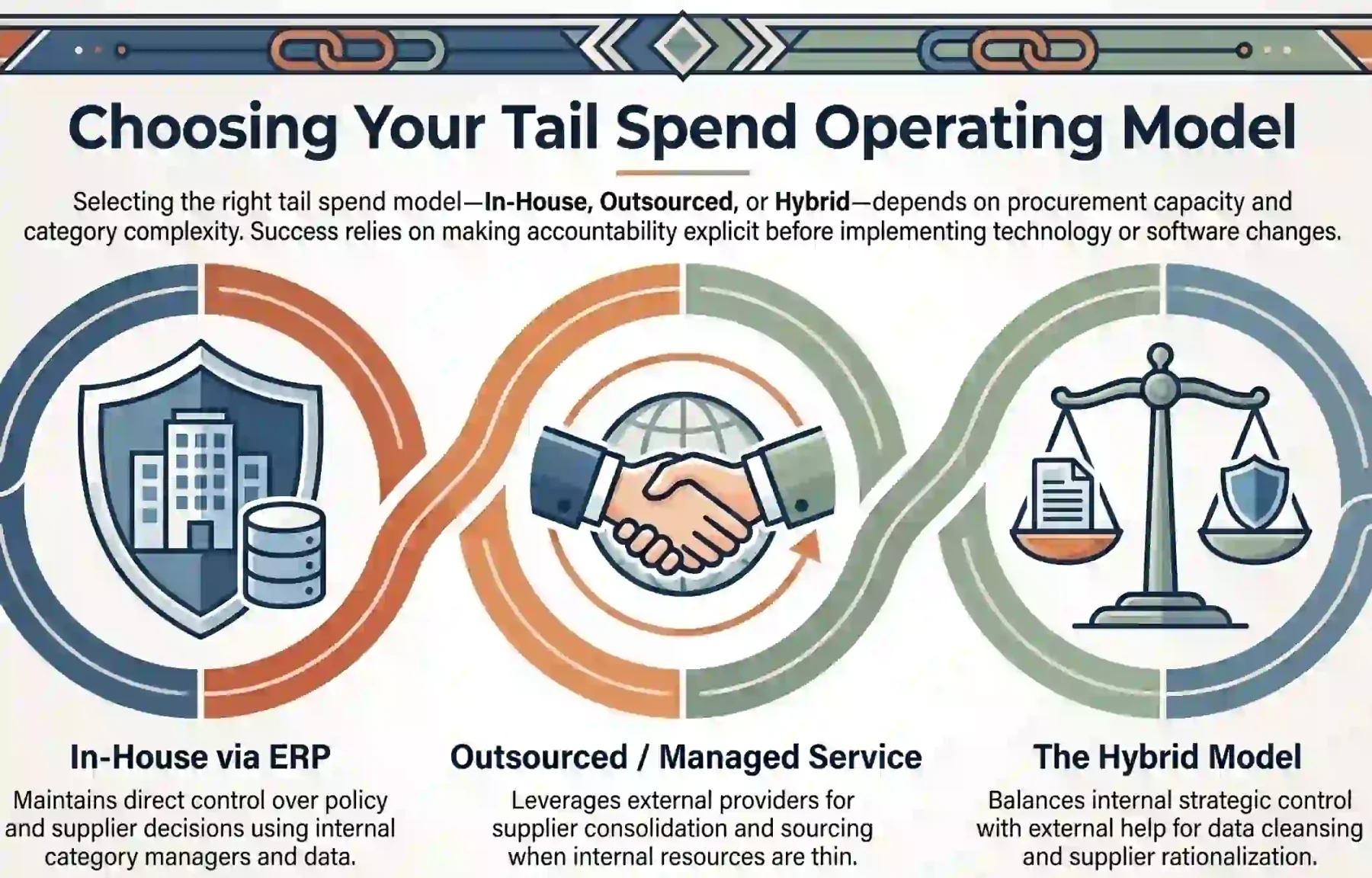
The right operating model depends on procurement capacity, data maturity, category complexity, and how fast business units must buy. Most Australian mid-market and enterprise teams pick one of three models.
1. In-House via ERP
An in-house model keeps ownership inside procurement and finance. It suits teams with capable category managers, reliable data, and enough IT support to maintain catalogues, approval rules, and dashboards.
The advantage is direct control over policy and supplier decisions. The limit is capacity, because tail spend can lose attention whenever strategic sourcing and major projects demand the same team.
2. Outsourced / Managed Service
An outsourced model hands parts of supplier consolidation, sourcing, or transaction support to an external provider. It can suit teams with highly fragmented indirect categories or thin internal resources.
The risk is that a provider may not feel local operational urgency unless governance and escalation rules are explicit. Define service levels, data ownership, and exit terms before any handover begins.
3. Hybrid Model
A hybrid model keeps policy, financial control, and strategic decisions in-house while using external help for data cleansing, category projects, or supplier rationalisation. It balances control with delivery.
For many Australian enterprises this is the most realistic tail spend procurement path, because it keeps accountability internal while buying in capacity for cleanup, analysis, and one-off sourcing work.
Whichever model you choose, make accountability explicit before any technology change, because software can enforce rules but it cannot fix unclear ownership. Agree the answers to these questions first:
- Who owns category policy and preferred supplier decisions?
- Who validates coding, tax fields, and payment controls?
- Who maintains suppliers, catalogues, integrations, and approval rules?
- Who handles urgent site, branch, or project exceptions?
- Who reports KPI movement to the executive sponsor?
How Can Automation and ERP Improve Tail Spend Management?
Automation and ERP help most when procurement, supplier, budget, approval, accounting, and reporting data run through one connected workflow. The real value is removing blind spots between systems.
Purchase requests can capture category, site, budget, and justification before a buyer commits. Supplier onboarding can force mandatory fields, ABN checks, and approval before any payment is released.
RFQ and purchase order workflows can steer recurring demand to preferred suppliers. Invoice matching can flag invoices without purchase orders, coding mismatches, and approval exceptions before they reach payment.
Connected finance data also supports cleaner audit evidence. Adopting eInvoicing through the ATO can cut manual keying and speed up matching for high-volume, low-value supplier invoices.
A phased rollout usually starts with supplier data, approval rules, and purchase order discipline, then extends into catalogues, RFQs, analytics, and quarterly governance once the control model is clear.
When procurement, supplier, and invoice records share one system, Hashy AI reads them together and flags the tail spend worth acting on, from off-contract suppliers to invoices with no purchase order.






Conclusion
Strong tail spend management should leave the business with clearer demand, cleaner supplier records, firmer approval discipline, and better evidence for procurement and finance decisions across every site.
The best programs stay practical, not punitive. They accept that some low-value buying is necessary across dispersed Australian operations, and they separate useful flexibility from fragmentation and manual rework.
If you want to learn more, you can book a free consultation with our experts today. Start anytime and start optimising your procurement.
Frequently Asked Questions
Indirect spend covers what you buy for operations rather than resale. Tail spend is defined by value, fragmentation, and limited sourcing attention. They can overlap, but either can exist without the other.
There is no universal AUD figure. Smaller businesses often use one simple limit tied to processing cost. Larger enterprises need several thresholds by category, risk, or site. Test scenarios against your data first.
Yes, if your procurement, accounting, supplier, and approval workflows already give enough visibility. Spreadsheets can support early analysis but often struggle once duplicate data and volume grow across sites.
ABN verification confirms supplier identity and registration before you pay, improving record quality and payment control. Check any GST or tax-invoice policy against current ATO guidance first.
Use shared governance. Procurement owns category policy and sourcing. Finance owns coding and reporting integrity. IT supports data, business units stay accountable, and one executive sponsor resolves trade-offs.
Avoid a fixed promise. Leading indicators like catalogue adoption can move soon after the baseline is set. Financial outcomes take longer and depend on data quality and review cadence.