








 Limited to 100 registrants

Retail merchandising software helps retailers decide which products to sell, where to place them, how much stock to hold, when to replenish, and which promotions deserve more investment.
With AI, merchandising becomes more predictive: the system can analyse sales history, inventory movement, outlet performance, and product pairings to recommend better retail actions.
For Australian retailers, this matters because margins get squeezed from several directions at once, labour costs, shifting demand, multi-location stock imbalance, and discount dependency.
Key Takeaways
Retail merchandising software helps teams plan assortment, replenishment, pricing, and promotions from one central place.
AI adds pattern detection: slow-moving stock, product pairings, outlet performance gaps, and checkout anomalies surface earlier.
Merchandising software and retail ERP solve different layers, and the boundary matters once data needs to move between them.
AI recommendations still need human approval on pricing, transfers, purchasing, and promotion decisions.
What Is Retail Merchandising Software?
Retail merchandising software helps retailers plan, manage, and optimise product assortment, pricing, promotion, inventory management inventory management, replenishment, and store-level product performance. It gives merchandising, inventory, and category teams one place to see how products are selling.
Traditional merchandising leans on sales reports, buyer experience, and periodic stock review. Those inputs still matter, but they're slow and fragmented compared to a system that brings product, sales, stock, and promotion data together.
AI adds pattern-finding across large volumes of data: identifying slow-moving items before they become dead stock, suggesting pairings, and recommending which categories deserve more focus per branch.
What Problems Does Retail Merchandising Software Solve?
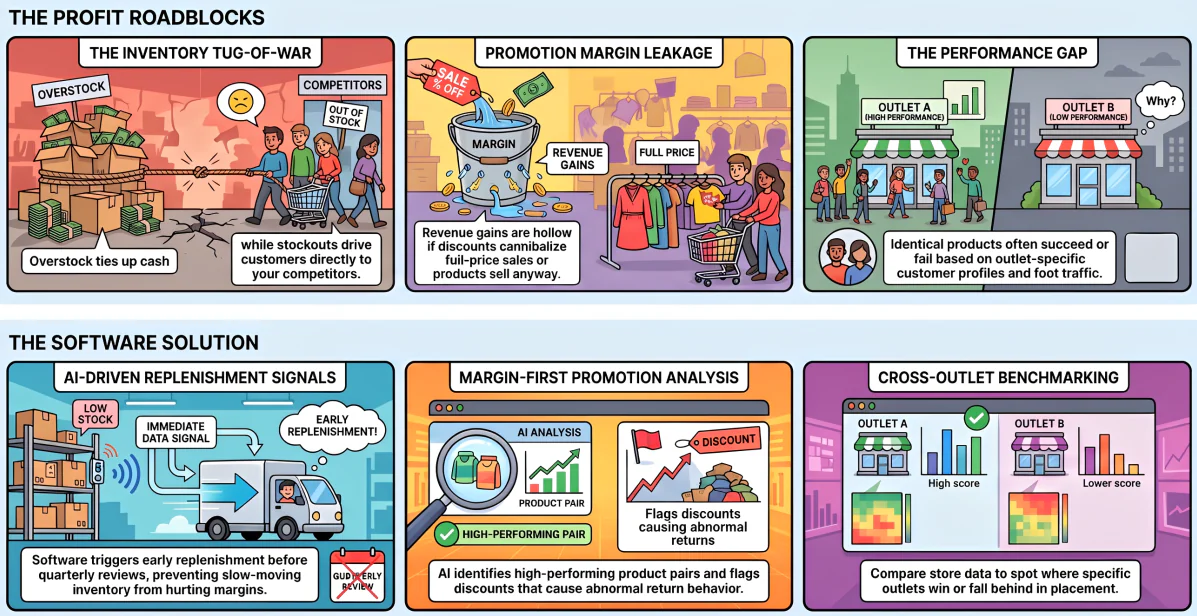
Retail merchandising software closes the gap between what retailers plan to sell and what actually happens at store, product, and customer level.
1. Overstock, stockout, and slow-moving inventory
Overstock ties up cash and increases the chance of markdowns; stockout causes missed sales and pushes customers toward competitors. Slow-moving inventory sits between the two, quietly becoming a margin problem.
Retail merchandising software helps teams monitor product movement by outlet, category, and sales velocity. AI can surface replenishment signals earlier, so managers act before a quarterly review forces the decision.
2. Promotion performance and margin leakage
A discount can look successful because revenue rises, while the retailer quietly loses profit if the promotion cannibalises full-price sales or moves stock that would have sold anyway.
AI can highlight which product pairs perform well together and which discounts create abnormal return behaviour, shifting the question from "did this sell" to "did this protect margin."
3. Product and store performance gaps
A product performing well in one outlet can fail in another because of customer profile, foot traffic, or display placement. Retail merchandising software helps compare outlets and spot where each store wins or falls behind.
Key Features to Look For
The best retail merchandising software supports planning, execution, and review together. A tool that only reports sales isn't enough; teams need recommendations they can turn into action.
1. Assortment and category planning
Assortment planning helps retailers decide which products and categories each store should carry, weighing customer demand, store format, margin, and available space.
AI can support this by identifying demand patterns that aren't obvious from top-line sales, such as one branch selling accessories strongly when paired with specific core products.
2. Replenishment and stock transfer recommendations
Replenishment features help identify reorder needs, low-stock risks, and branch-level imbalance. If one store has excess stock while another has stronger demand, transferring inventory can beat buying more.
3. Pricing, promotion, and product performance analytics
Merchandising software should review discount performance, basket impact, and promotional timing, while AI flags abnormal patterns such as repeated returns linked to certain products or outlets.
4. Planogram and visual merchandising support
Not every retailer needs advanced planogram tools; a small retailer may prioritise replenishment first. When evaluating this feature, check whether visual plans actually connect to sales and stock outcomes.
How AI Improves Retail Merchandising
AI turns historical and live retail data into recommendations, helping teams identify which products, outlets, and decisions deserve attention next.
1. AI-powered product recommendations
Customer-facing recommendations suggest related products or bundles; internal recommendations help teams decide what to promote, replenish, or pair together based on actual basket data.
If POS data shows coffee beans and grinders are frequently bought together, AI can flag that bundle opportunity before a merchandiser spots it manually.
2. Slow-moving stock and checkout anomaly detection
AI can compare product movement across stores and recommend transfer, markdown, or bundling before slow stock becomes a write-off risk. Checkout anomaly detection adds another layer entirely.
Return, void, and exchange activity can reveal recurring product issues or cashier behaviour patterns, giving supervisors a fuller picture than sales data alone.
3. Promotion, upsell, and replenishment insights
The value of AI sits in connecting these signals rather than reviewing them separately. A promotion that creates stockouts points to a replenishment gap, not just a marketing win.
"A promotion that boosts revenue but quietly cannibalises full-price sales is not a win. It just moves the loss somewhere harder to see on a weekly sales report."
Retail Merchandising Software vs Retail Management Software
Retail merchandising software and retail ERP are related, but they solve different layers of the retail operation entirely.
| Aspect | Merchandising software | Retail ERP / management software |
|---|---|---|
| Core focus | Product decisions: assortment, pricing, promotions | Full operation: POS, inventory, accounting, HR |
| Typical user | Merchandiser, category manager | Store operations, finance, IT teams |
| Data dependency | Needs POS, stock, and margin data from elsewhere | Generates and holds that data natively |
| Best fit | Product-focused decision layer | Businesses needing one connected system |
1. Where merchandising ends and retail ERP begins
A merchandiser may need sales history from POS, stock availability from records, and margin data from accounting. If the merchandising tool sits apart from these systems, teams still need manual exports and reconciliation.
2. When you need an AI Retail Agent instead
An AI Retail Agent becomes useful when teams need more than dashboards, letting a manager ask which products are underperforming in a specific outlet and get a straight answer. This doesn't remove human approval; the agent supports the decision, leaders still approve the action.
How to Choose Retail Merchandising Software
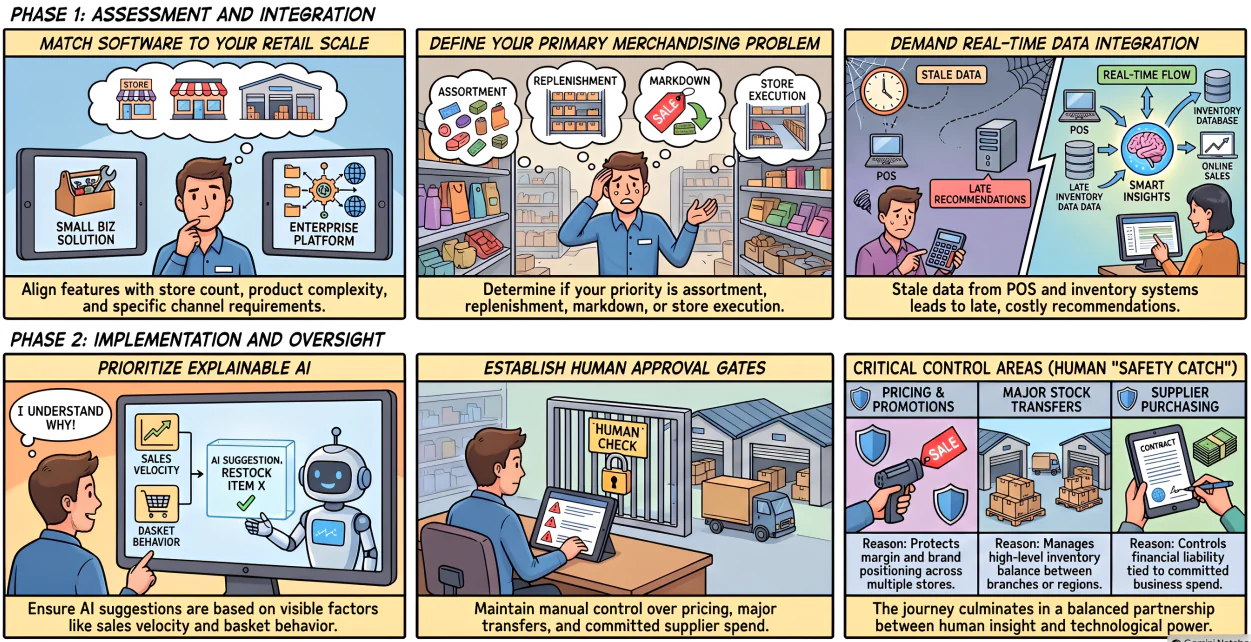
Choosing retail merchandising software should start with operational fit. A tool built for an ecommerce brand may not suit a multi-outlet retailer at all.
1. Store count, product complexity, and channel fit
A single-store retailer may need simple product performance and promotion reporting. A multi-store retailer needs outlet comparison, branch-level planning, and transfer recommendations.
Before choosing software, define the merchandising problem clearly: assortment, replenishment, markdown, promotion performance, or store execution, since each points to a different priority.
2. Data integration with POS, inventory, and sales
Retail merchandising depends on data quality. If the system can't see current sales and stock data, its recommendations arrive too late to act on. According to ABS household spending data, demand patterns shift enough month to month that stale integration quietly costs margin.
3. AI recommendations and human approval controls
AI recommendations should be explainable enough for teams to trust: sales velocity, stock level, margin, or basket behaviour, not a black-box suggestion. Human approval should still sit on:
- Pricing changes affecting margin or brand positioning.
- Major stock transfers between branches or regions.
- Supplier purchasing decisions tied to committed spend.
- Promotion plans that touch multiple stores at once.
This keeps merchandising decisions governed and accountable rather than fully automated. The Australian Retailers Association publishes broader sector guidance worth reviewing alongside any AI rollout.
How HashMicro AI Agent for Retail Helps
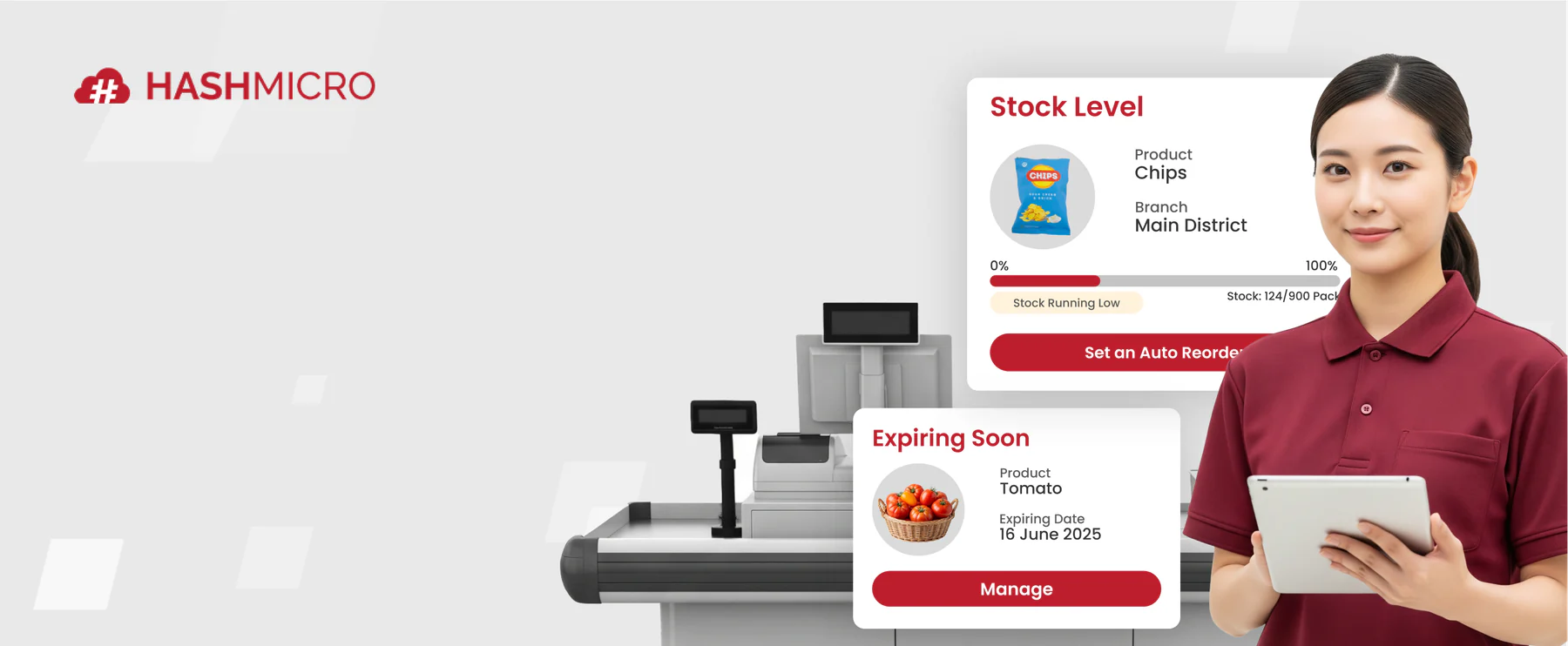
HashMicro AI Agent for Retail helps retailers turn POS, inventory, promotion, and product data into actionable business intelligence, strongest when decisions need to connect with broader retail operations.
1. Merchandising recommendations from retail data
HashMicro supports retail intelligence through product performance, outlet benchmarking, cross-selling patterns, and return or void analysis pulled from live POS and inventory data.
Instead of manually checking separate reports, retail managers can work from recommendations already grounded in current business data rather than last month's spreadsheet.
2. From insight to retail action
The value of retail AI isn't just insight, it's moving from insight to action. If a product is slow-moving, the next step might be a transfer, bundle, or markdown, not another report to read.
Conclusion
Retail merchandising software helps retailers plan products, manage stock movement, evaluate promotions, and understand store-level performance across every branch.
AI makes it more useful by detecting patterns, highlighting slow-moving stock, and helping teams move from reporting to action instead of reacting after margin is already gone.
The best solution depends on the operating model, so discuss your merchandising requirements with HashMicro's team to see how AI Agent for Retail fits your operation.
Frequently Asked Questions
Retail merchandising software helps retailers plan, manage, and optimise product assortment, pricing, promotions, replenishment, stock transfers, and product performance across stores or channels.
POS software records sales transactions at checkout. Merchandising software uses sales, stock, product, and promotion data to help retailers decide what to stock, promote, replenish, transfer, discount, or review.
Yes. AI can help analyse product movement, identify slow-moving stock, detect outlet performance gaps, recommend product pairings, flag anomalies, and support replenishment or promotion decisions.
Yes. Merchandising software can help identify slow-moving products earlier and support actions such as stock transfer, bundling, markdowns, promotion review, or purchasing adjustment.
HashMicro AI Agent for Retail can help interpret POS, inventory, product, outlet, and promotion data to surface merchandising insights such as product pairings, slow-moving stock, outlet performance gaps, and follow-up actions.