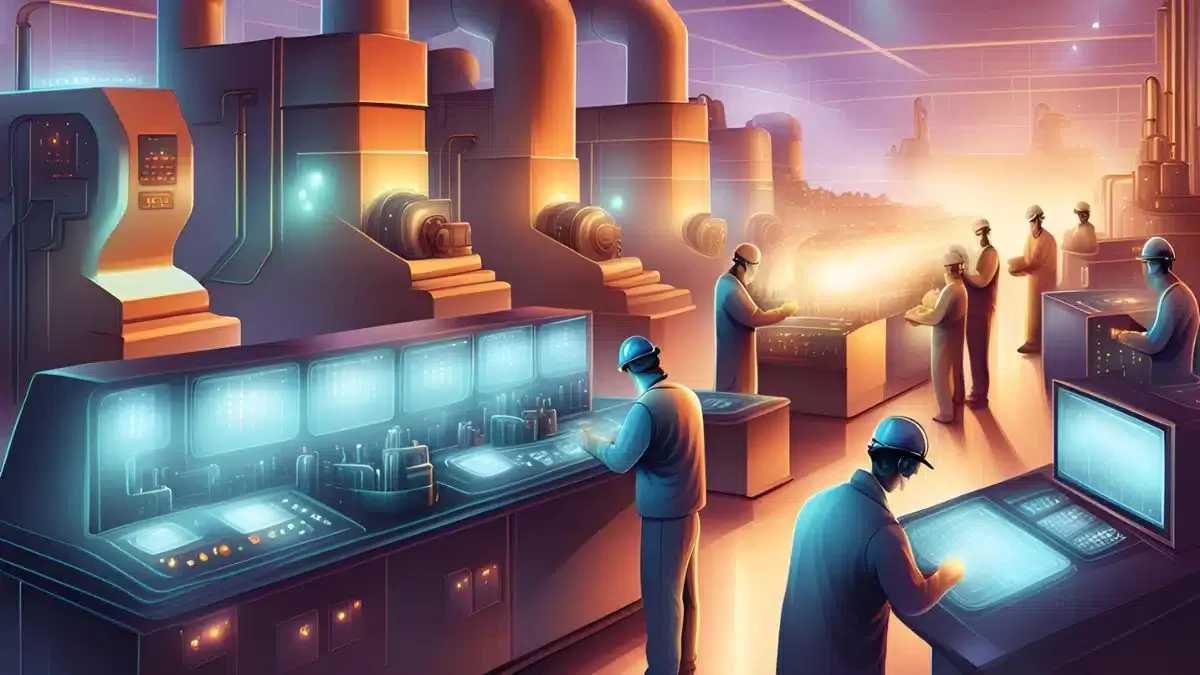

Every product has its own story, from the initial sketches to the end of its life on the market. It is difficult to control the whole process in cases where different specialists from engineering, manufacturing, marketing, services, and other fields take part in developing the same product, but do not have access to the same data and systems.
The practice that helps to organize everything mentioned above is called Product Lifecycle Management (PLM). The paper discusses the definition of PLM, its main phases, advantages, and the influence of new technologies on it.
Key Takeaways
PLM manages every stage of a product’s lifecycle: from initial concept and design to production, support, and retirement, through a centralised, reliable source of product data.
By connecting teams and information, PLM reduces errors and duplicated work, shortens development cycles, improves compliance, and helps businesses respond faster to market changes.
Modern PLM combines AI, generative design, and ERP integration to accelerate prototyping and automatically connect design changes with procurement, inventory, costing, and production planning.
What Is Product Lifecycle Management?
PLM is the process of managing the entire lifecycle of a product, starting with the initial idea to the point where the product reaches its end of life. The process does not view design, production, and maintenance as separate functions that sometimes coordinate their activities; instead, PLM connects them in a seamless flow of data.
The key principle of PLM is the idea of one single source of truth. Any specifications, drawings, BOM, changes, etc., are stored in one single location. Thus, when a design engineer replaces some component, the procurement and production departments are aware of that immediately, not a week later, when someone will remember about sending an email.
The Five Stages of the Product Lifecycle
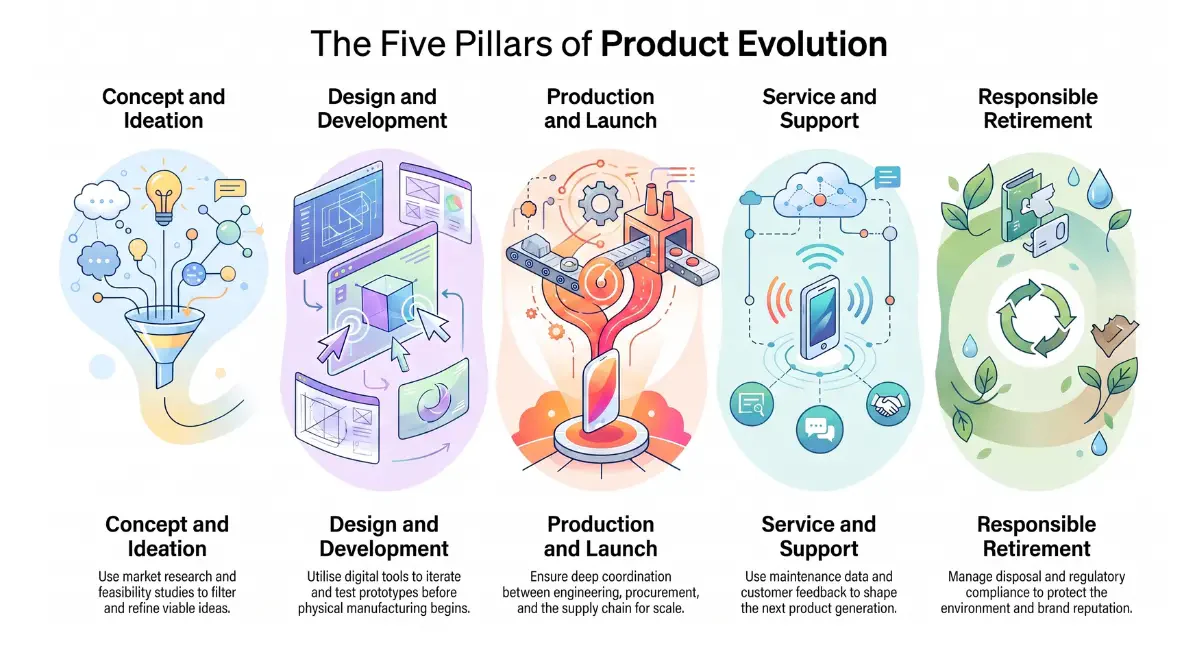
The specifics differ by industry, but most products move through roughly five stages.
Concept and ideation: Ideas get captured, argued over, and refined. Market research, customer feedback, and feasibility studies all feed the decision about which concepts are worth anyone's time.
Design and development: Engineers turn approved concepts into detailed designs, prototypes, and technical specifications. This is the stage digital tools have changed most dramatically. Teams can now test and iterate long before anything physical gets made.
Production and launch: The product is manufactured at scale, quality-checked, and released. Engineering, procurement, and the supply chain need to be genuinely coordinated here, not just cc'd on the same thread.
Service and support: The product is in customers' hands. It needs maintenance, spare parts, and someone to answer the phone. What you learn during this stage tends to shape the next generation of the product, if anyone is listening.
Retirement: Every product eventually reaches the end of its commercial life. Handling this well, responsible disposal, regulatory compliance, protects the brand and the environment. It's the stage most often ignored, right up until it isn't.
Why PLM Matters
When there is no proper methodology followed, product data becomes unorganized. Data gets dispersed into spreadsheets, emails, and six or seven individual tools that do not talk to each other. What follows next is obvious: version control issues, unnecessary rework, and time wasted looking for the document.
Centralising product data cuts errors and duplicated effort. Better collaboration shortens development cycles and lets teams react to market shifts before the opportunity closes. And keeping a complete record of every product decision turns compliance and reporting from a scramble into a lookup.
The change is most noticeable at smaller companies. The kind of structure and visibility that used to require an enterprise budget is now within reach of a twelve-person team.
How Technology Powers Modern PLM
The most important transformation of recent times is the part played by digital designing and artificial intelligence during the initial phases of the lifecycle process. While designing and developing products, designers do not depend entirely upon manual designing or time-consuming prototypes. Rather, they utilize Tripo AI 3D Model Generator to create product designs quickly and effectively.
Such intelligent design solutions enable designers to consider many alternatives, simulate product behavior in realistic scenarios, and identify errors before the cutting of any material. The outcome is faster iterations, reduced cost of creating prototypes, and improved quality of delivered goods.
In addition to design, contemporary PLM systems interact with ERP software that links the product data to purchasing, inventory management, accounting, and planning of manufacturing activities. With PLM and ERP integrated, any design modification is automatically reflected in costing, procurement, and scheduling, thus eliminating the space for human error.
Generative Design: From Idea to Prototype in Minutes
One of the most promising innovations during the design process is generative AI. Before, it took specific skills and considerable time to develop a 3D model based on a written brief. Now, this process is becoming less challenging very quickly.
Now there is a text-to-3D model tool for designers that can convert the text input about a certain component or product into a 3D model, so the designers can describe a part or product in a common language and receive a realistic 3D model instantly. One such instruction is "light-weight bracket with two mounting holes".
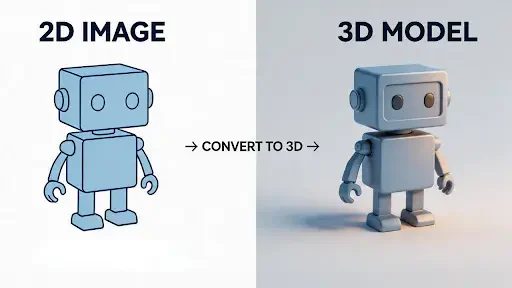
This way greatly reduces the difficulty in carrying out experiments at an early stage. Non-experts can propose their thoughts, the team can picture their ideas without spending much time, and everything in the organization will progress from imagination to prototype quickly.
In the context of PLM, these AI-driven designs can be directly plugged into the product history.
Key Features to Look For in a PLM Solution
Not all PLM systems apply to any particular company. There are a few aspects that one should consider prior to making a choice.
Compatibility: Is it possible to seamlessly integrate it with the existing ERP, accounting, and manufacturing systems you have in place? The PLM system that cannot communicate with the ERP system is just a very expensive file cabinet.
Scalability: Your product line and number of employees will eventually increase. Will the software allow for this, or will you have to make another migration after three years?
Collaboration: Do your department teams really collaborate on a shared set of data, or is collaboration limited to sending an attached PDF file via email?
User-friendly interface: If using the system requires a lengthy period of training, nobody will bother using it.
The strongest solutions don't behave like standalone tools. They act as part of a connected business platform, where product information flows into every other operation without anyone rekeying it.
Conclusion
PLM has moved from being an engineering specialty to a key business skill. By using the combination of structured product information with state-of-the-art technologies, one can be sure about managing all the stages of a product life cycle, starting from the initial concept and ending with saying goodbye to the product.
To really understand whether PLM is right for you, you must actually try it out. You can do demo for free and see how connected PLM can help improve the efficiency of your product lifecycle.