









 Limited to 100 registrants

An RFQ (Request for Quotation) is a formal procurement document used by businesses to request pricing, delivery terms, and service details from suppliers for specific goods or services. It helps buyers compare vendor quotes consistently and select the most suitable supplier more efficiently.
A good RFQ, supported by purchasing workflow automation software, helps buyers compare quotes side by side instead of handling inconsistent replies. When vendors respond in the same format, the right choice becomes clear faster.
For Australian buyers, an RFQ template also handles local must-haves like ABN checks, GST treatment, and insurance declarations. That keeps procurement compliant without slowing the buying cycle.
This guide walks through when to use an RFQ, what to include for the Australian market, downloadable templates by category, and a practical writing process you can copy today.
Key Takeaways
Standardised buyer requests turn vendor selection into a clean comparison instead of a guessing game across inconsistent supplier replies.
Australian compliance hinges on a few non-negotiables: ABN verification, GST treatment, insurance evidence, and clear payment terms before issuing a PO.
Three pre-qualified suppliers and a weighted scoring matrix usually deliver better outcomes than chasing the lowest single quote.
Downloadable templates by category cover standard, construction, IT, and government buys with the extra fields each one needs.

What Is an RFQ (Request for Quotation)
An RFQ is a formal document buyers send to shortlisted suppliers, asking for a specific price on a defined item or service. Suppliers reply with a binding quote covering unit cost, total cost, GST treatment, lead time, and payment terms.
Unlike a general price enquiry, an RFQ assumes you already know what you want. Therefore, the focus shifts from exploring options to comparing prices on a like-for-like basis.
When Should You Use an RFQ?
An RFQ works best when your requirements are clear and the main variable is price. For example, repeat orders of standard items, defined services with known scope, or any tender where multiple suppliers can deliver the same outcome.
It also fits well when you need a clean paper trail. As a result, finance, audit, and procurement teams have a clear record of who quoted what, and why a particular supplier was selected.
RFQ vs. Other Procurement Documents
To understand how procurement management works, teams use several documents during the buying cycle, and confusing them slows projects down. The three comparisons below show where an RFQ sits relative to the others.
Before walking through each comparison, here is a quick side-by-side view of how the four documents differ.
RFQ vs. RFP
An RFQ asks “how much will this cost?” once the scope is set. An RFP (Request for Proposal), on the other hand, asks “how would you solve this problem?” when the scope is still open and you want suppliers to bring ideas.
In short, use an RFQ for price-driven decisions and an RFP when you need to compare approaches as well as cost.
RFQ vs. RFI
An RFI (Request for Information) sits earlier in the cycle. Buyers use it to learn about supplier capability, market pricing, or product options before they commit to a tender.
Therefore, an RFI helps build your supplier shortlist, while an RFQ pulls firm prices from that shortlist.
RFQ vs. Purchase order
A Purchase Order (PO) is the contract you raise after picking a supplier. It locks in the agreed price, quantity, and delivery date based on the winning RFQ response.
In practice, the process moves from RFQ to PO, where quotes are gathered and the deal is finalised
What Must Be in an RFQ in Australia?
Every RFQ should give suppliers enough information to quote accurately on the first go. The three sections below cover the must-have details for Australian buyers.
1. Buyer details
Start with your registered business name, ABN, billing address, and the name of the procurement contact handling the request. Include a phone number and email for clarification questions.
Suppliers use this information to verify your business and address invoices correctly. Therefore, missing or incorrect details often delay quote responses.
2. Item or service specifications, quantities, delivery terms, and response deadline
List each item or service with a clear description, model number, unit of measure, and required quantity. Add delivery dates, drop-off locations, and any installation or service requirements.
Then state the quote response deadline so suppliers know how long they have to reply. A tight, clearly written brief reduces follow-up emails and improves quote quality.
3. Pricing format, GST instructions, payment terms, and evaluation criteria
Tell suppliers exactly how to present pricing: per unit, per box, total ex-GST, and total inc-GST. Confirm payment terms (for example, 30 days from invoice) and acceptable payment methods.
Finally, share your evaluation criteria so suppliers understand what matters beyond price, such as lead time, warranty, and local stock holdings.
"A clear RFQ template removes most of the friction from vendor selection. Once every supplier responds in the same format, evaluation becomes a side-by-side decision instead of a debate."
Types of RFQ Templates in Australia
Different industries have different must-haves, so one generic template rarely fits every job. Alongside broader procurement system options, the four RFQ template types below cover the most common Australian use cases.
1. Standard RFQ
A standard RFQ suits everyday goods and services where the scope is straightforward. It captures the basics: buyer details, item list, quantities, delivery, pricing, GST, and payment terms.
Most office, retail, and small distribution buyers can run their full procurement cycle with this version.
2. Construction and building RFQ
Construction RFQs add fields for materials, labour rates, site conditions, and project milestones. They also include sections for insurance, WH&S documentation, and licensed trade declarations.
These extras matter because building work involves higher risk and tighter compliance than standard purchasing.
3. IT and software RFQ
IT RFQs cover hardware specs, software licensing, support tiers, and data hosting locations. They also ask about cybersecurity standards, integration needs, and ongoing maintenance fees.
For example, a buyer comparing cloud platforms would want clear answers on uptime SLAs and Australian data residency before signing.
4. Government/Public sector RFQ
Public sector RFQs follow stricter rules around fairness, transparency, and probity. They include mandatory clauses on conflict of interest, modern slavery declarations, and ethical sourcing.
Therefore, suppliers must respond to a wider checklist than commercial RFQs typically require.
When to Use Procurement Software Instead of an RFQ Template
An RFQ template is a practical tool for creating and sending supplier requests, especially for businesses with a simple purchasing process. However, as procurement activities grow, manually comparing supplier quotations, tracking revisions, and managing approvals can become time-consuming and increase the risk of errors.
Procurement software streamlines the entire RFQ process by centralising supplier responses, quote comparisons, approval workflows, and purchase order creation in one system. This eliminates duplicate data entry, improves transparency, and helps procurement teams make faster and more informed purchasing decisions.
If your business only sends a small number of RFQs each month, a template may be all you need. But if multiple employees are involved, supplier evaluations require approvals, or your organisation needs a clear audit trail, investing in procurement software can improve efficiency, accuracy, and compliance while supporting future business growth.
Downloadable RFQ Templates Australia
Below are four ready-to-use templates that align with Australian compliance practice. Pick the one that matches your industry and customise it before sending out.
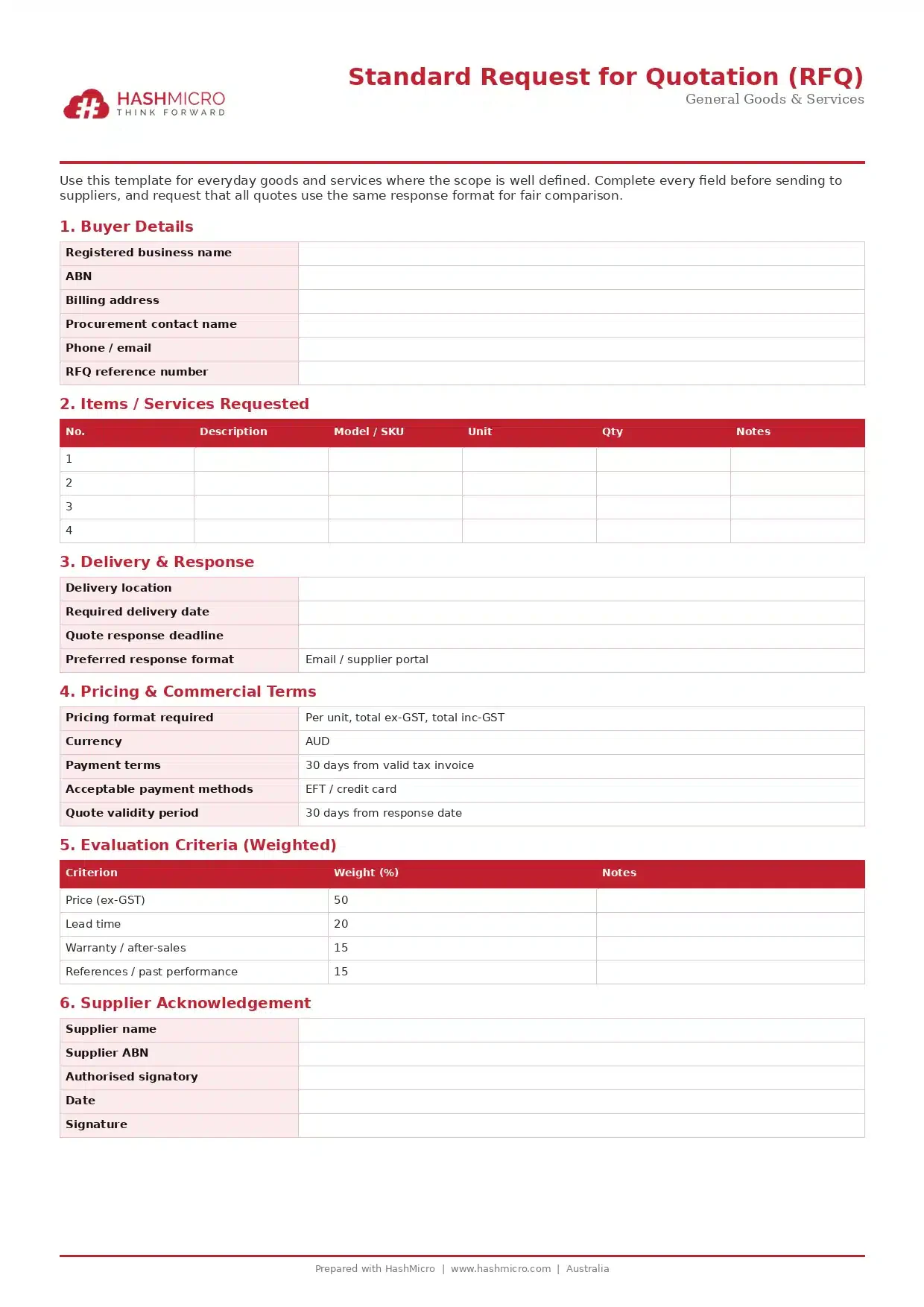
1. Standard RFQ template
Use this template for general goods and services with well-defined specifications. It includes ABN fields, GST-inclusive pricing rows, and a basic vendor comparison matrix.
Standard RFQ Template
2. Construction RFQ template
This version adds sections for site visits, WH&S statements, public liability insurance, and progress payment milestones. It suits builders, subcontractors, and trade procurement.
Construction RFQ Template
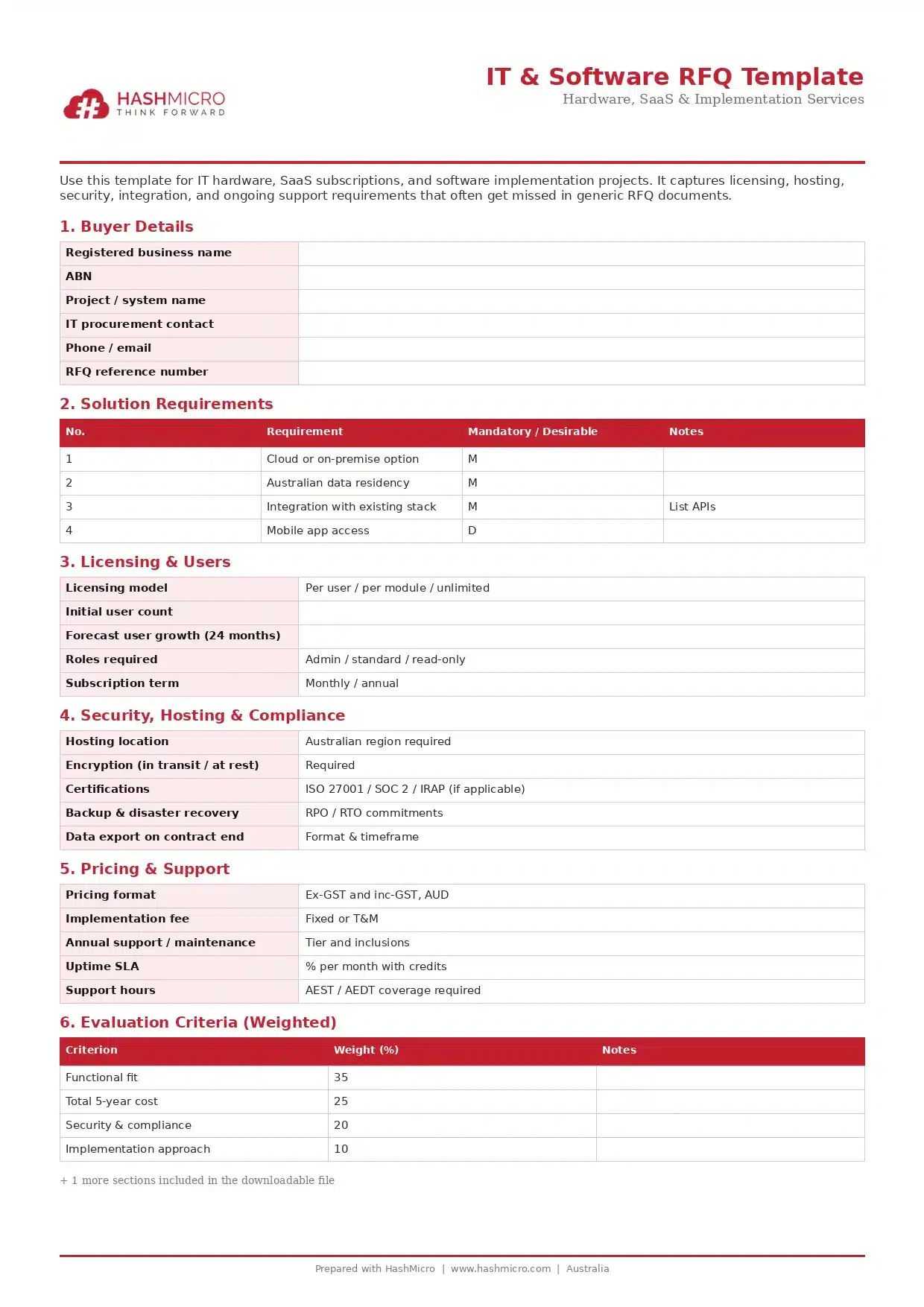
3. IT/Software RFQ template
This template captures licensing models, user counts, integration needs, and data hosting requirements. It works for SaaS purchases, on-premise systems, and hardware refresh projects.
IT/Software RFQ Template
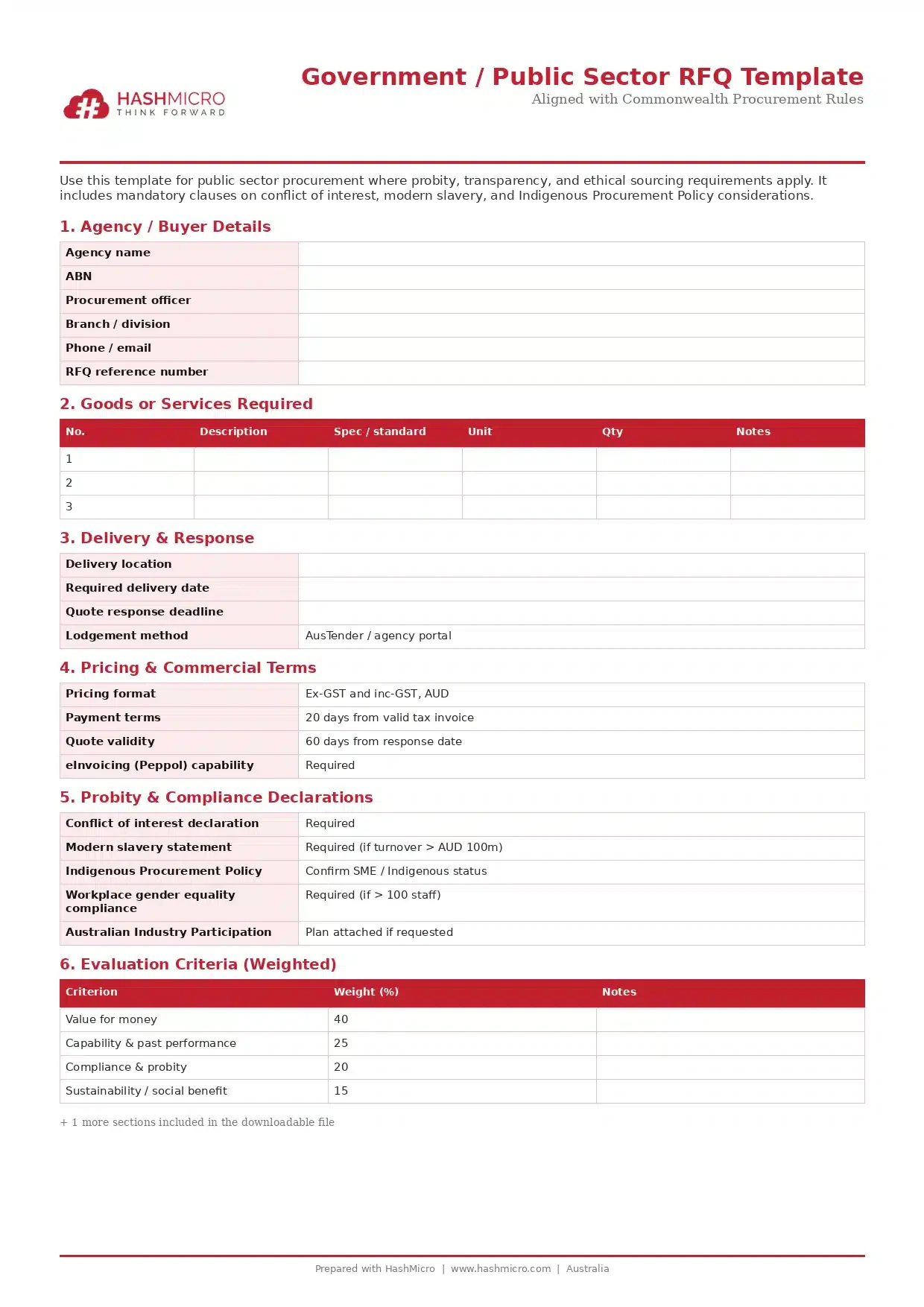
4. Government RFQ template
This template includes probity clauses, modern slavery declarations, and detailed evaluation criteria. It aligns with Commonwealth Procurement Rules and most state-level guidelines.
Government RFQ Template






How to Write an RFQ in Australia
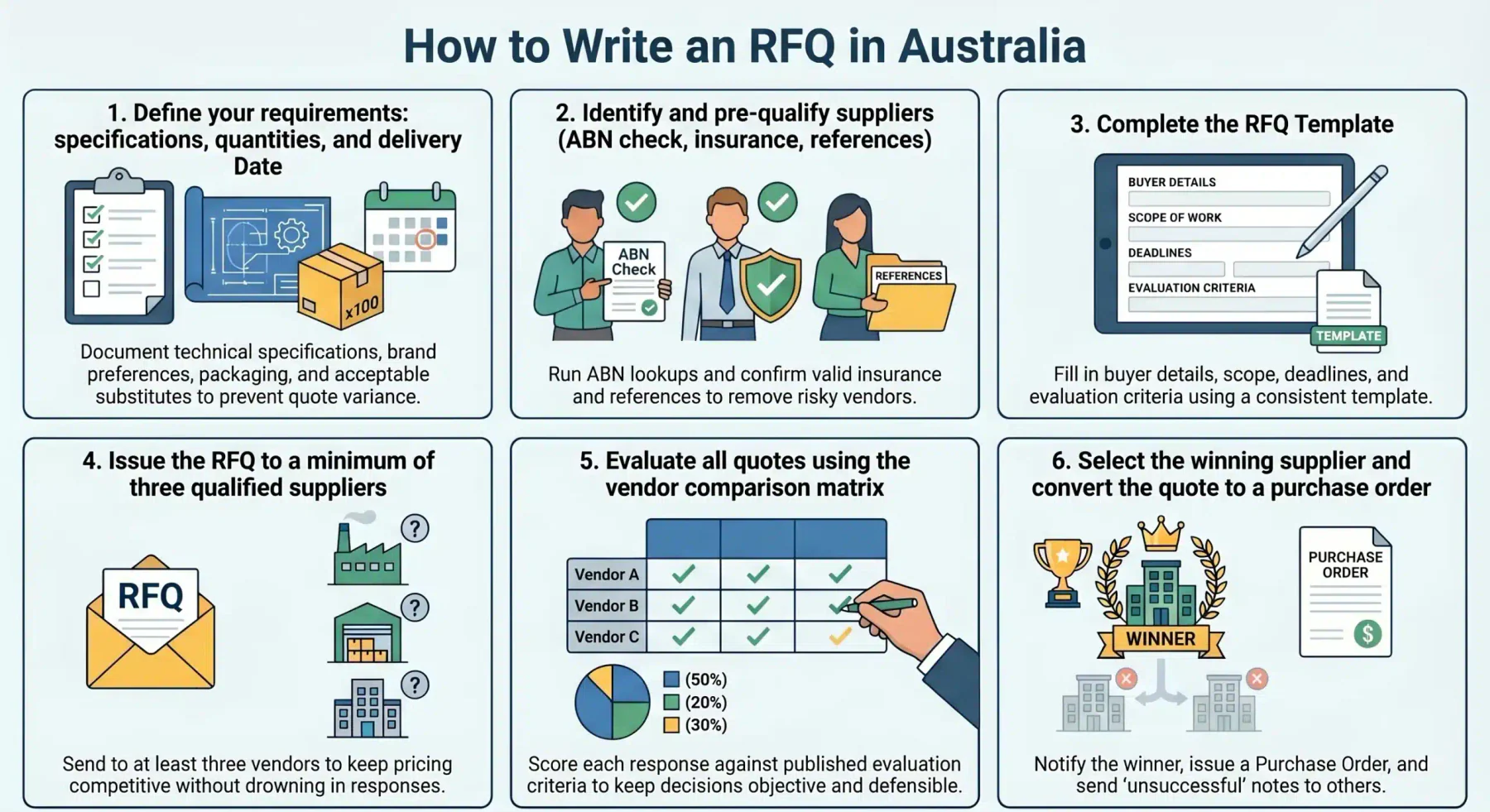
A clear writing process keeps quotes comparable and decisions defensible. The six points below walk through what good Australian buyers do every time.
1. Define your requirements: specifications, quantities, and delivery Date
Document exactly what you need, how much, and when. Include technical specifications, brand preferences, packaging, and acceptable substitutes.
A clear scope upfront prevents quote variance later. Therefore, suppliers price the same thing rather than guessing what you meant.
2. Identify and pre-qualify suppliers (ABN check, insurance, references)
Run an ABN lookup on each shortlisted supplier and confirm they hold valid insurance. Ask for two or three references from similar Australian projects, building stronger supplier relationships.
Pre-qualification removes risky vendors before pricing comes in. As a result, you compare credible suppliers only.
3. Complete the RFQ Template
Fill in your buyer details, scope, deadlines, evaluation criteria, and any compliance attachments. Double-check that every required field is complete before sending.
A consistent template also makes responses easier to compare side by side.
4. Issue the RFQ to a minimum of three qualified suppliers
Send the RFQ to at least three pre-qualified suppliers to keep pricing competitive. Use email or your procurement platform, and confirm receipt with each vendor.
Three quotes give you enough variation to spot outliers without drowning in responses.
5. Evaluate all quotes using the vendor comparison matrix
Score each response against your published evaluation criteria. For example, weight price at 50%, lead time at 20%, warranty at 15%, and references at 15%.
A scoring matrix keeps decisions objective and defensible if challenged later.
6. Select the winning supplier and convert the quote to a purchase order
Notify the chosen supplier in writing and convert the quote into a Purchase Order. Confirm delivery dates, quantities, and any final commercial terms.
Then send a courteous “unsuccessful this time” note to the other suppliers. It keeps the door open for future quotes.
Australian Compliance Requirements for RFQ
Australian buyers have specific compliance items to confirm before issuing a Purchase Order. The three areas below cover the essentials.
1. ABN verification
Always verify an ABN on the Australian Business Register before placing an order. If a supplier doesn't quote a valid ABN, you may have to withhold tax at the top marginal rate from their invoice.
This single check protects your business from messy tax adjustments later.
2. GST and invoicing
Confirm whether each quote is GST-inclusive or GST-exclusive, and request that totals appear both ways for clarity. A valid ATO tax invoice must include the supplier's ABN, the words "tax invoice", and the GST amount.
Therefore, asking for compliant invoicing upfront keeps BAS preparation simple at the end of the quarter.
3. Insurance, WH&S declarations, and professional indemnity requirements
Ask suppliers to confirm public liability and professional indemnity insurance, where relevant. For trades, also request WH&S declarations and current licence numbers.
These checks reduce risk on site and protect your business in the event of a claim.
Common RFQ Mistakes Australian Businesses Make

Even experienced buyers slip on the same few issues. The three traps below cover the most common ones.
1. Vague specifications
Loose scope leads to inconsistent quotes that aren’t really comparable. Suppliers fill the gaps differently, and the cheapest quote often hides the biggest exclusions.
Tight specifications fix this. For example, list exact model numbers, finish types, and acceptable equivalents.
2. Forgetting GST instructions and ABN requirements
Quotes that don’t show GST clearly create reconciliation pain at invoice time. Missing ABNs cause withholding tax issues that take weeks to unwind.
Therefore, build both into the RFQ template as mandatory fields.
3. Evaluating on price alone
Lowest price often comes with longer lead times, weaker warranties, or hidden extras. Cheap quotes rarely stay cheap once the work starts.
Use a weighted scoring matrix instead. As a result, you balance cost against quality, delivery, and supplier reliability.
When Should You Switch to Procurement Software?
Manual RFQ templates work well at low volume, but they strain once supplier lists, compliance checks, and quote comparisons grow. At some point, spreadsheets and email threads cost more time than they save.
1. Signs your manual process has outgrown templates
Warning signs include rising quote volumes, conflicting template versions across teams, and missed ABN or insurance checks. Each one adds delay and risk to every purchase.
2. What dedicated procurement software adds
Dedicated procurement and purchasing software centralises vendor records, validates ABN and GST automatically, and scores quotes side by side. It also keeps a clean audit trail from RFQ through to purchase order.
Conclusion
A clear, well-built RFQ keeps every supplier on the same page and turns vendor selection into a structured comparison rather than a guessing game. With ABN, GST, insurance, and evaluation criteria locked in upfront, procurement runs faster and stays compliant.
The biggest wins come from clear specifications, multiple qualified suppliers, and a scoring matrix that balances cost, quality, and delivery. You can request a no-cost consultation to streamline your procurement workflow.
Frequently Asked Question
An RFQ (Request for Quotation) template is a structured document buyers send to shortlisted suppliers to request firm prices for defined items or services. It standardises the format so every quote can be compared on the same basis.
Use an RFQ when your scope is fixed and price is the main deciding factor. Use an RFP when the scope is open and you want suppliers to propose how they would solve a problem.
At a minimum, include buyer details with ABN, item specifications, quantities, delivery terms, GST instructions, payment terms, response deadline, and evaluation criteria. Insurance and WH&S sections also matter for construction and trade work.
Three pre-qualified suppliers is the common minimum for competitive pricing. Going beyond five often slows down evaluation without improving the result.
An RFQ itself is a request, but the supplier's quote is usually binding for the period stated in their response. Once you accept the quote and issue a Purchase Order, it forms a contract on those terms.