




Artificial intelligence is changing how businesses collect, process, and interpret data. Instead of static reports and manual queries, AI tools detect patterns, forecast outcomes, and surface insights automatically.
For Australian businesses managing growing data volumes across sales, finance, and operations, AI analytics closes the gap between data collection and confident decision-making.
This article covers what AI for data analytics means, how it works, the key use cases, and how HashMicro brings AI-powered analytics into everyday operations.
Key Takeaways
How AI analytics turns raw data into insights: the process runs through four stages from data ingestion to insight delivery, with AI automating the analytical work once a clean data foundation is in place.
The four stages that determine AI accuracy: data preparation and model training matter more than the tool itself. Businesses with poor data quality will get poor insights regardless of the platform.
Use cases with the fastest returns: sales forecasting, inventory demand planning, and financial anomaly detection are where Australian businesses typically see measurable impact within the first operating period.
Built-in AI changes the implementation picture: HashMicro integrates Hashy OS directly into its ERP, meaning finance, inventory, and sales teams access AI insights inside the tools they already use.
What Is AI for Data Analytics?
AI for data analytics is the use of artificial intelligence, including machine learning and predictive modelling, to analyse datasets and generate insights at a speed and depth manual methods cannot match.
Traditional analytics relies on pre-defined queries and manual reporting. On the other hand, integrating a system with AI allows it to learn from patterns in the data, adapts over time, and surfaces findings that static tools would not identify on their own.
The result is that decision-makers receive accurate information without waiting for a data analyst. AI handles the analysis continuously, leaving teams to act on the output rather than produce it.
"AI for data analytics is not a future investment, it is a current operational advantage. Australian businesses pulling ahead are running AI inside existing systems, not alongside them in separate projects."
How Does AI Data Analytics Work?
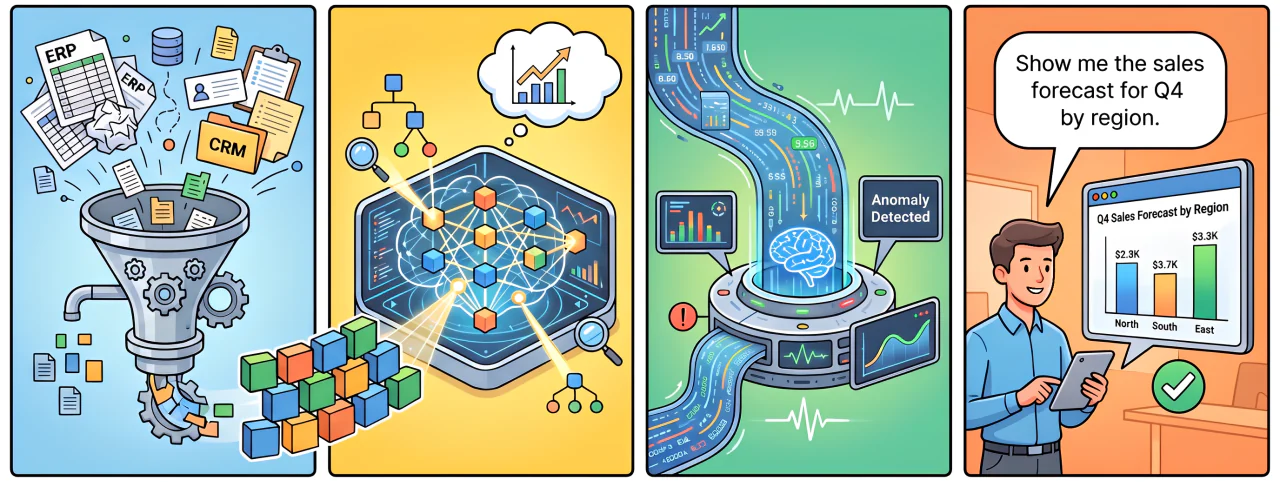
AI data analytics follows a structured process from raw data collection through to actionable output. Each stage adds a layer of processing that transforms disconnected data into reliable business intelligence.
Data is collected from multiple sources such as ERP systems, CRMs, spreadsheets, sensors, and external feeds. It is then cleaned to remove duplicates, fill gaps, and align formats across sources.
AI models are trained on the prepared data, learning which variables predict which outcomes. Once trained, they run continuously against live data, detecting anomalies and generating forecasts without manual input.
The final output reaches users through dashboards, automated alerts, or workflow integrations. A finance team might receive an alert when expense patterns deviate from forecast, without running a single manual query.
Teams get the most value when they can simply ask for an answer instead of building a report. The banner below shows how Hashy AI turns a plain-language question into a live analytics response.
Types of AI Analytics in Business
AI analytics covers four core stages, each adding a layer of intelligence to how raw data becomes a business decision.
1. Data ingestion and collection
Data ingestion pulls information from multiple source types into a central analytics environment. This includes internal systems such as ERP and CRM platforms, and real-time inputs from connected devices.
For businesses operating across multiple tools, automated ingestion removes the manual work of compiling data before analysis can begin.
2. Data preparation and cleansing
Data preparation transforms raw inputs into analysis-ready datasets. This covers removing duplicate records, resolving format inconsistencies, handling missing values, and standardising units across sources.
Poor preparation produces unreliable AI outputs. A model trained on inconsistent data will return inaccurate predictions regardless of how advanced the underlying algorithm is.
3. Model training and optimisation
Model training is where AI learns from historical data to identify patterns between variables. A forecast model learns which factors correlate most strongly with revenue changes over time.
Models are retrained as new data accumulates, keeping predictions relevant as business conditions change. Some platforms support continuous learning, updating models automatically as fresh data flows in.
4. Insight generation and delivery
Insight generation is where trained models process live data and produce usable outputs. These include dashboards, automated alerts, natural language summaries, or recommendations embedded in business workflows.
The quality of insights depends on the upstream stages. When ingestion and preparation are handled correctly, the insight layer becomes a reliable decision support tool rather than a source of noise.
Key Business Use Cases for AI Data Analytics
AI for data analytics applies across almost every business function. The following use cases represent where Australian businesses are seeing the clearest return on investment.
1. Sales and revenue forecasting
AI uses historical sales data, pipeline activity, and seasonal patterns to generate revenue forecasts at a granularity that spreadsheet models cannot replicate.
Sales teams can see which deals are most likely to close, which accounts are at risk of churn, and where quota gaps are emerging weeks before the end of a reporting period.
2. Inventory and supply chain optimisation
AI forecasts demand at the SKU level, accounting for lead times, supplier reliability, and seasonal variation. This reduces both overstock and stockouts, two costly problems for businesses managing physical inventory.
Supply chain disruptions were a significant challenge for Australian businesses in recent years. AI flags risk patterns before they escalate into fulfilment gaps, giving procurement teams time to respond.
3. Financial reporting and anomaly detection
AI analyses transaction records in real time and flags entries that deviate from expected patterns. This supports fraud detection, reduces reconciliation time, and improves the accuracy of financial statements.
Finance teams running manual reconciliation across multiple entities benefit most. AI-powered anomaly detection finds errors before they reach management, reducing rework and improving confidence in reported numbers.
4. HR and workforce analytics
AI for workforce analytics helps businesses understand retention risk, productivity patterns, and skills gaps. HR teams move from reactive headcount decisions to proactive workforce planning backed by actual data.
Predictive models can flag employees with elevated attrition risk based on engagement signals, tenure patterns, and role changes, giving HR leaders time to intervene before a resignation occurs.
5. Customer behaviour analysis
AI identifies patterns in how customers interact with a product, service, or platform, covering purchase frequency, product combinations, channel preferences, and lifecycle stage indicators.
Retail and e-commerce businesses in Australia use customer behaviour models to personalise offers, improve campaign targeting, and lower the cost per acquisition across digital channels.
6. Operational efficiency
AI monitors operational data from production lines, service workflows, or logistics networks to identify inefficiencies and predict maintenance needs before equipment fails.
For businesses with high fixed costs in equipment or facilities, predictive maintenance alone can generate a return that justifies the cost of AI analytics implementation.
Benefits of AI Data Analytics for Australian Businesses
Australian businesses across manufacturing, retail, and logistics are integrating AI analytics to improve operational performance and accelerate decision-making speed.
According to the Australian Bureau of Statistics, digital technology adoption among Australian businesses continues to grow, making data capability an increasingly important competitive differentiator.
The primary benefit is faster, more accurate decision-making. Businesses that previously waited days for management reports now access live dashboards updated in real time, reducing the lag between data and action.
AI also reduces the dependency on specialist staff for routine analysis. Finance, sales, and operations teams can query data directly or review auto-generated summaries without involving a dedicated analyst.
Cost control improves when AI detects billing discrepancies, procurement anomalies, and budget overruns early. Businesses catch these issues in the period they occur, not after the reporting cycle closes.
Challenges of Implementing AI Analytics (and How to Address Them)
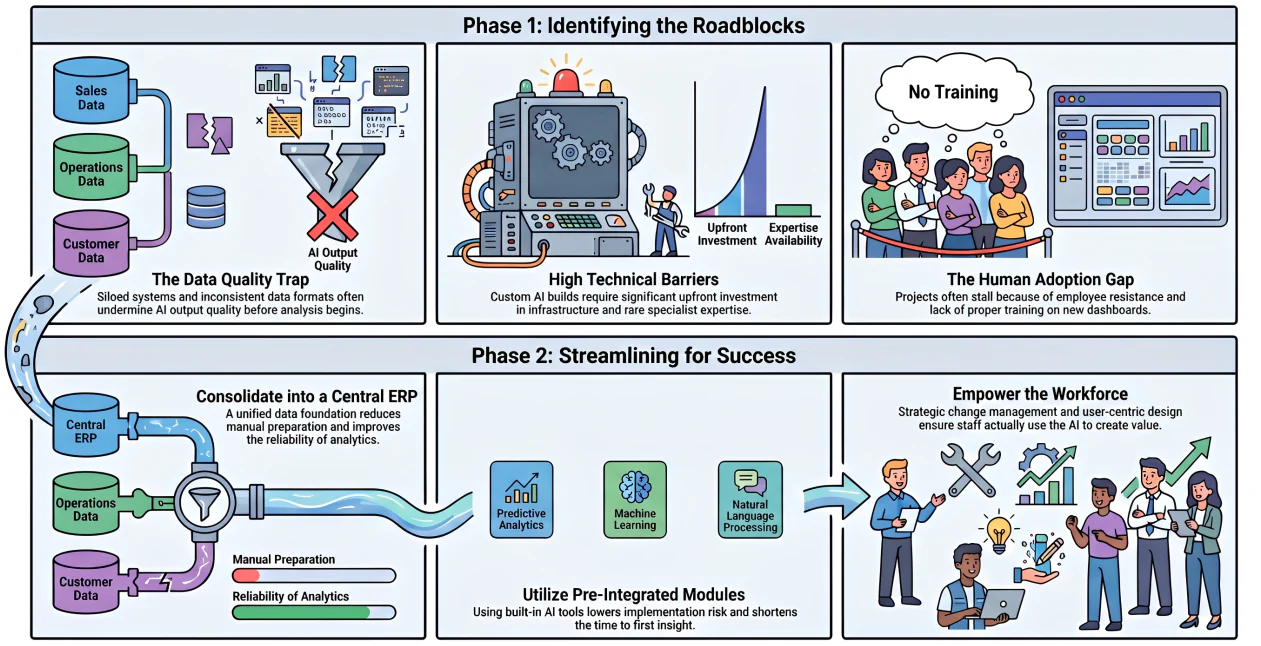
AI analytics delivers real benefits, but implementation comes with genuine obstacles. Understanding these challenges upfront allows businesses to plan for them rather than encounter them mid-project.
1. Data quality and siloed systems
Most businesses underestimate how much effort goes into data preparation rather than AI setup. When data lives in disconnected systems with inconsistent formats, those problems carry directly into the analytics output and can also create data protection risks if sensitive information is not properly secured.
The most effective starting point is consolidating data into a central platform, such as an ERP, before adding AI. A unified data foundation reduces preparation effort and improves output quality from the outset.
2. Implementation cost and technical complexity
AI analytics platforms vary in cost, and custom builds require expertise many businesses do not hold internally. Upfront investment in infrastructure, data pipelines, and model development can be substantial.
Starting with an ERP platform that includes built-in AI analytics reduces the need for specialist developers. Pre-integrated modules shorten the time to first insight and lower overall implementation risk.
3. Change management and user adoption
AI analytics only creates value when staff use it. Resistance to change, limited training, and poor dashboard design are common reasons why implementation projects stall after the technical build is complete.
Address this by involving end users in the design phase, keeping dashboards focused on decisions rather than data volume, and embedding AI outputs into the workflows staff use every day.
How HashMicro Uses AI for Business Data Analytics
AI data analytics follows a structured process from raw data collection through to actionable output. Each stage adds a layer of processing that turns disconnected data into reliable business intelligence.
Data is first collected from multiple sources: ERP systems, CRMs, spreadsheets, sensors, and external feeds. It is then cleaned to remove duplicates, fill gaps, and align formats across sources.
AI models are trained on the prepared data, learning which variables predict which outcomes. Once trained, they run continuously against live data, detecting anomalies and generating forecasts without manual input.
The final output reaches users through dashboards, automated alerts, or workflow integrations. Increasingly, that output is delivered by an AI coworker that reads the live data, explains what changed, and drafts the next action for the team to approve.
A finance team can simply ask the AI coworker why expense patterns deviate from forecast, and receive the answer with the supporting figures, without running a single manual query.






Conclusion
AI for data analytics moves businesses from reactive reporting to real-time decision-making. The gap between collecting data and acting on it narrows when AI handles the analysis continuously and at scale.
For Australian businesses, the strongest starting point is connecting AI analytics to existing systems. ERP platforms with built-in AI reduce implementation risk and deliver value faster than standalone tools.
HashMicro's ERP integrates Hashy OS to bring AI-powered insights into everyday business operations. Contact us for a free consultation to explore how AI analytics fits your business.
FAQ
Several AI techniques are used in data analytics, including machine learning for pattern recognition and forecasting, natural language processing for unstructured text, and neural networks for complex modelling. Most business platforms combine these techniques rather than relying on a single approach.
Yes. AI data analytics is no longer limited to large enterprises with dedicated data teams. Businesses of any size can access AI-powered analytics through ERP platforms and SaaS tools that include built-in analytics modules. The starting point is connecting your existing business systems to a central data environment.
Traditional business intelligence uses historical data and pre-defined queries to produce reports. AI analytics goes further by learning from data patterns to generate forecasts, detect anomalies, and surface insights that were not specifically requested. BI tells you what happened; AI analytics helps you understand why and predict what comes next.
The main risks are poor data quality producing inaccurate outputs, overreliance on AI recommendations without human review, and data governance concerns when sensitive business information is processed. Businesses manage these risks by maintaining a clean data foundation, establishing review processes for high-stakes recommendations, and using platforms with clear data handling policies.