






AI integration is transforming how modern ERP and enterprise management software support business operations. As companies manage growing volumes of data across finance, supply chains, and customer management, traditional ERP system architectures alone are no longer sufficient.
By embedding technologies such as machine learning, predictive analytics, and natural language processing, ERP systems can analyze data patterns, automate complex processes, and generate real-time insights for decision-making.
For businesses aiming to improve efficiency and agility, AI integration turns ERP systems from passive record-keeping tools into intelligent platforms that actively support strategic planning and operational optimization.
Key Takeaways
The role of AI in modern ERP systems highlights how traditional platforms evolve into intelligent systems that support automation and data-driven decision-making.
The way AI technologies operate inside ERP systems involves intelligent data processing, predictive analytics, and automated decision support.
The key applications of AI in ERP systems include demand forecasting, financial insights, supply chain optimization, and customer intelligence.
The key considerations for implementing AI in ERP systems cover data readiness, system integration, and organizational adoption.

The Role of AI in Modern ERP Systems
Artificial intelligence is reshaping modern ERP systems by enhancing how businesses analyze data, automate processes, and generate insights.
1. Traditional ERP System Foundation
Traditional Enterprise Resource Planning (ERP) systems centralize business data and connect departments such as finance, supply chain, and human resources, enabling unified operations and reporting.
2. Limitations of Manual and Historical Analysis
Traditional ERP systems rely on manual reporting and historical data analysis, requiring users to interpret past information before making decisions.
3. AI-Driven Transformation in ERP
AI integration shifts ERP systems toward proactive intelligence by analyzing patterns, forecasting outcomes, and supporting data-driven decision-making.
4. Automation Across ERP Workflows
AI introduces automation into key ERP processes, reducing manual workloads while improving speed, consistency, and operational efficiency.
5. Improved Data Accessibility with NLP
AI-powered Natural Language Processing (NLP) allows users to access insights more easily by interacting with ERP systems through simple, conversational language.
How AI Works in ERP Systems
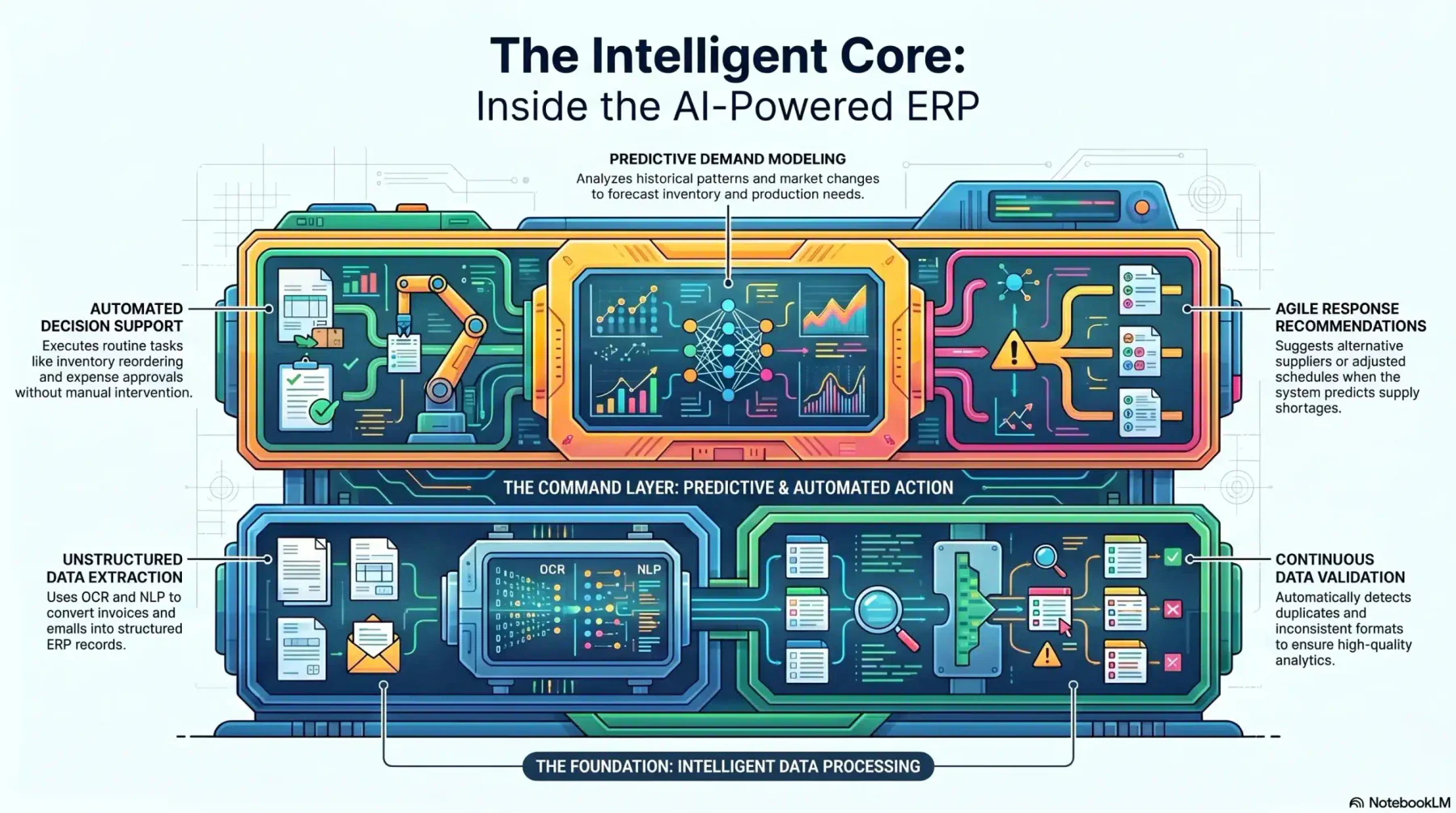
Artificial intelligence in ERP systems works by analyzing large volumes of business data and turning them into actionable insights. Instead of relying only on manual reporting, AI identifies patterns and helps businesses predict outcomes and improve operational decisions.
AI technologies combine machine learning, natural language processing, and predictive models across different ERP modules. By learning from historical and real-time data, these systems continuously improve forecasting, automation, and decision support.
1. Intelligent Data Processing
Enterprise data often comes from many sources, including invoices, emails, documents, and operational systems. Intelligent data processing allows AI to extract and structure this information so it can be analyzed within the ERP environment.
Technologies such as Optical Character Recognition (OCR), computer vision, and Natural Language Processing help convert unstructured data into structured records. This enables the ERP system to automatically capture information from documents without manual entry.
AI models can also detect duplicate records, incomplete entries, or inconsistent formats. By continuously cleansing and validating data, intelligent processing improves data quality and ensures that ERP analytics are built on reliable information. These capabilities can be further enhanced with solutions developed by a generative AI development company, enabling more accurate data management, automated insights, and smarter decision-making across enterprise systems.
2. Predictive Analytics
Predictive analytics allows ERP systems to forecast future outcomes using historical and real-time data. Machine learning algorithms analyze patterns across large datasets to identify trends that influence business performance.
For example, AI models can predict product demand by analyzing past sales, seasonal patterns, and market changes. These forecasts help businesses plan inventory, production schedules, and procurement activities more accurately.
Because machine learning models continuously update as new data enters the system, forecasts become more accurate over time. This allows companies to move from static planning cycles to more agile, data-driven decision-making.
3. Automated Decision Support
Beyond forecasting, AI can also recommend actions based on predicted outcomes. Automated decision support combines predictive insights with optimization algorithms to suggest the most effective response to business scenarios.
For instance, if the system predicts a supply shortage, the ERP platform can recommend alternative suppliers or adjust procurement schedules. This helps managers respond quickly to operational risks.
In some cases, businesses allow AI systems to execute routine decisions automatically. Tasks such as inventory reordering or expense approvals can be handled by predefined AI rules, allowing employees to focus on more strategic activities.
Key Applications of AI in ERP Systems
AI integration delivers the most value when applied directly to core ERP functions. By analyzing operational data across departments, AI helps businesses improve forecasting, automate processes, and support faster decision-making.
When embedded into ERP modules, artificial intelligence enables companies to optimize inventory, strengthen financial analysis, improve supply chain coordination, and gain deeper insights into customer behavior.
1. Demand Forecasting
Demand forecasting is one of the most valuable applications of AI in ERP systems. Instead of relying only on historical averages, AI models analyze multiple variables such as seasonal trends, promotions, and external market signals.
By combining internal sales data with external indicators, AI can forecast demand at a more granular level. This allows businesses to align production schedules, procurement plans, and inventory levels with expected market demand.
More accurate forecasts help businesses reduce excess inventory while preventing stock shortages. As the system continuously learns from new data, predictions become more precise over time.
2. Financial Insights
AI enhances financial management within ERP systems by automating analysis and improving forecasting accuracy. Machine learning algorithms analyze transaction patterns, payment behavior, and financial trends to generate deeper insights.
One key application is predictive cash flow forecasting. AI models evaluate receivables, payables, and historical payment behavior to estimate future cash positions and identify potential liquidity risks.
AI can also support anomaly detection by identifying unusual transactions or spending patterns. This allows finance teams to detect errors, prevent fraud, and maintain stronger financial control.
3. Supply Chain Optimization
AI integration improves supply chain optimization by analyzing operational data across procurement, logistics, and inventory systems. This visibility helps businesses identify inefficiencies and respond faster to disruptions.
Predictive analytics allows ERP systems to anticipate supply shortages, delivery delays, or demand spikes. With these insights, businesses can adjust purchasing plans and logistics strategies before problems escalate.
AI also supports prognostic maintenance in manufacturing environments. By monitoring machine data through IoT sensors, ERP systems can detect potential equipment failures and schedule maintenance proactively before disruptions occur.
4. Customer & Sales Intelligence
AI-powered ERP systems help businesses better understand customer behavior and sales performance. Machine learning models analyze purchase history, engagement patterns, and support interactions to generate deeper customer insights.
Lead scoring is one example of AI in sales intelligence. The system evaluates historical sales data to identify which prospects are most likely to convert, helping sales teams prioritize their efforts.
AI can also identify churn risks by detecting behavioral changes such as declining order frequency or increased support requests. These insights allow companies to take proactive actions to retain valuable customers.
For deeper VOC coverage, solutions such as Listen360 customer intelligence use NLP to read customer reviews and open-ended survey responses, map sentiment and themes, and feed these insights into ERP/CRM records to refine churn models and trigger targeted retention, upsell, and service workflows.
Industry Use Cases of AI-Driven ERP
According to ABS data, Australia’s manufacturing, retail, and healthcare sectors are high-value industries, contributing A$134,752 million, A$124,038 million, and A$152,072 million respectively in industry value added in 2023–24.
By combining operational data, predictive analytics, and automation, AI-enhanced ERP systems enable these industries to improve efficiency, optimize resources, and respond faster to changing market conditions.
1. Manufacturing
In manufacturing, AI integration helps companies improve production planning and equipment reliability. ERP platforms can support prognostic maintenance by analyzing data from machines and production systems to prevent unexpected downtime.
AI also improves supply chain coordination by forecasting material demand and identifying potential supplier disruptions. These insights help manufacturers maintain steady production while reducing excess inventory.
2. fRetail
Retail businesses rely heavily on accurate demand forecasting and inventory visibility. AI-driven ERP systems analyze sales history, seasonal trends, and customer behavior to predict product demand more accurately.
These insights allow retailers to maintain optimal stock levels across stores and warehouses. AI can also support personalized marketing by recommending promotions and product offers based on customer purchasing patterns.
3. Healthcare
Healthcare businesses manage complex operations that involve scheduling, billing, and patient data management. AI-enhanced ERP systems help optimize staff allocation and operational planning based on predicted patient demand.
Natural Language Processing tools can also assist with administrative tasks such as extracting billing information from clinical notes. This automation helps healthcare providers reduce administrative workload while improving operational efficiency.
Key Challenges and Considerations for AI Integration
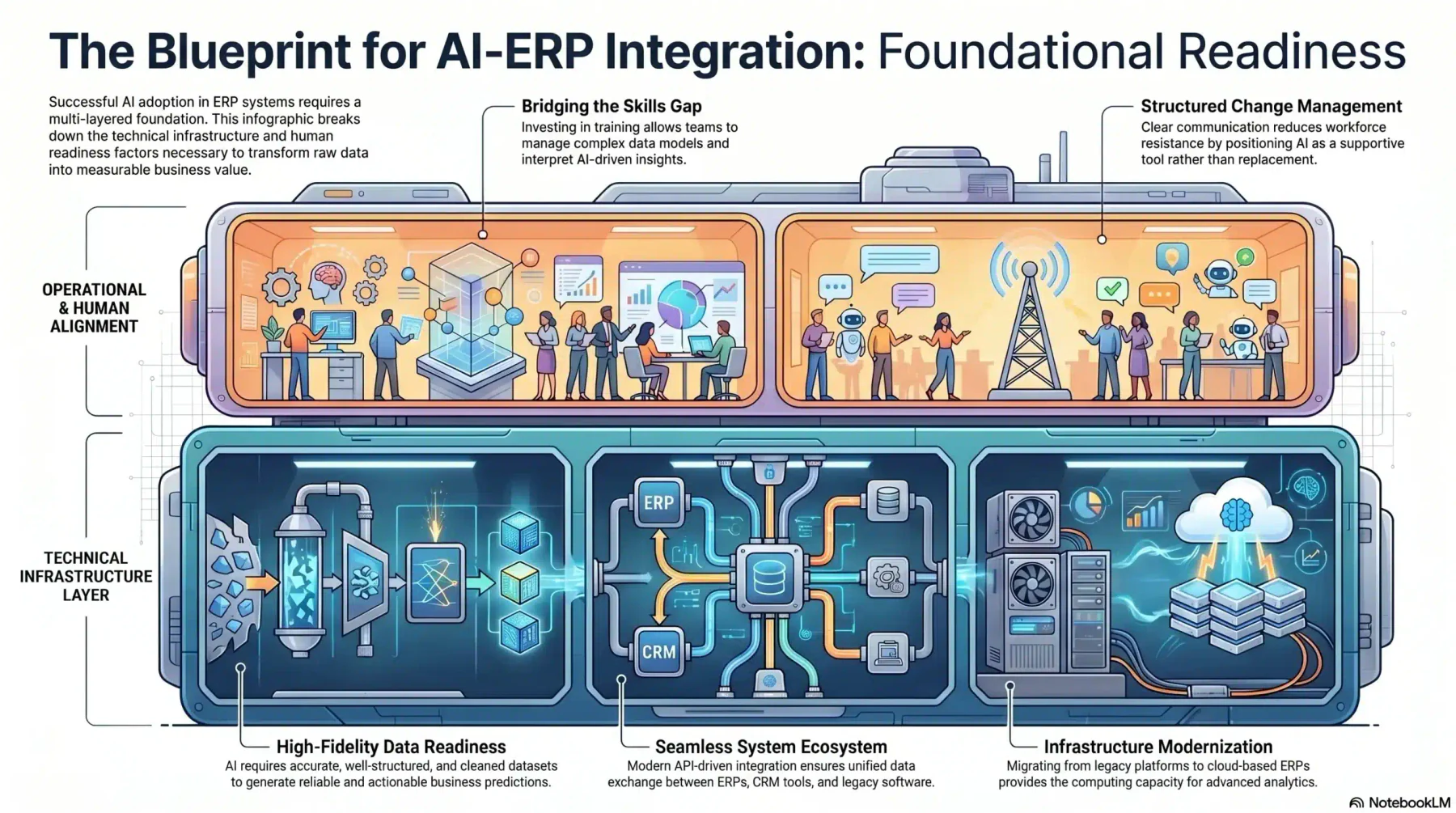
Although AI integration offers significant advantages, implementing it within ERP systems requires careful preparation. Businesses must evaluate both technical and operational factors before deploying AI-driven capabilities.
Successful adoption depends on data quality, system compatibility, workforce readiness, and the companie’s ability to adapt to new workflows. Addressing these challenges early helps ensure that AI initiatives deliver measurable business value.
1. Data Readiness
Artificial intelligence relies heavily on accurate and well-structured data. If ERP datasets contain duplicates, missing fields, or inconsistent records, AI models may generate unreliable predictions.
Before implementing AI capabilities, businesses should audit and clean their existing data. Establishing strong data governance practices helps ensure that future data remains consistent and reliable.
2. System Integration
Most businesses operate with multiple business applications beyond their ERP platform. These systems may include CRM tools, supply chain software, or legacy databases that store critical operational data.
For AI to generate meaningful insights, these systems must exchange data seamlessly. Modern ERP platforms with strong API capabilities make it easier to integrate external systems and maintain a unified data environment.
3. Skills Gap
Introducing AI into ERP systems requires new technical and analytical skills. Teams must understand how to interpret AI insights and incorporate them into operational decision-making.
Businesses often need to invest in training programs or hire specialists who can manage data models, integrations, and analytics workflows. Building these capabilities helps ensure that free AI tools are used effectively across departments.
4. Legacy Systems
Many businesses still rely on legacy ERP platforms or highly customized software that were not designed to support modern AI technologies. These systems often lack the computing capacity or integration flexibility required for advanced analytics.
In some cases, businesses may need to upgrade their infrastructure or migrate to cloud-based ERP platforms before implementing AI-driven capabilities.
5. Organizational Readiness
Beyond technical challenges, successful AI adoption depends on how well employees adapt to new processes. Some teams may initially resist AI tools due to concerns about job security or unfamiliar workflows.
Clear communication and structured change management can help build trust in AI-driven systems. When employees understand that AI supports their work rather than replacing it, adoption becomes significantly easier.
Positioning the technology as day-to-day operational support gives teams a practical reason to engage with it early.
"AI integration in ERP isn’t instant, but when you invest in data quality, process clarity, and people, the payoff is worth it."
AI Integration Implementation Roadmap
Implementing AI within an ERP system requires a structured approach rather than a full-scale deployment at once. A phased roadmap helps businesses manage risks, test capabilities, and gradually expand AI adoption across business operations.
By aligning technology implementation with business goals and operational readiness, companies can ensure that AI integration delivers measurable improvements in efficiency, decision-making, and process automation.
1. Strategic Assessment
The first step is defining the business objectives that AI integration should address. Businesses should identify operational challenges such as inaccurate demand forecasts, slow financial reporting, or supply chain inefficiencies.
Establishing clear goals and measurable performance indicators helps ensure that AI initiatives remain aligned with broader business strategy.
2. Data Audit
Before AI models can deliver reliable insights, businesses must evaluate the quality and structure of their existing data. ERP datasets should be reviewed for duplicates, inconsistencies, and missing records.
A comprehensive data audit helps ensure that machine learning models are trained on accurate information, improving the reliability of forecasts and automated processes.
3. Vendor Selection
Choosing the right ERP platform or AI solution is critical for successful integration. Businesses should evaluate vendors based on AI capabilities, integration flexibility, and long-term scalability.
Platforms that provide native AI features or strong API connectivity often simplify implementation and reduce the complexity of integrating third-party tools.
4. Phased Rollout
AI integration should typically begin with a pilot program in a single department or process. Starting small allows businesses to evaluate performance, gather feedback, and refine workflows before expanding adoption.
Once the pilot demonstrates measurable value, the businesses can gradually extend AI capabilities across additional ERP modules and operational functions.
Common Pitfalls in AI Integration
Although AI integration offers significant advantages, many businesses encounter obstacles during implementation. Without careful planning, AI projects can become costly, complex, and difficult to scale across business operations.
Understanding the most common pitfalls helps companies design a more realistic strategy and avoid mistakes that delay adoption or reduce the long-term value of AI within ERP systems.
1. Poor Data Quality
AI systems rely heavily on the quality of the data used to train machine learning models. If ERP data contains inconsistencies, duplicates, or missing records, the resulting predictions may become unreliable.
Businessess hould perform data cleansing and establish governance policies before deploying AI capabilities to ensure accurate analysis and forecasting.
2. Weak Change Management
AI integration often changes how employees interact with business systems and workflows. Without proper communication and training, teams may resist adopting new AI-driven tools.
Successful implementation requires clear leadership support, employee training programs, and communication that emphasizes how AI improves productivity rather than replacing jobs.
3. Insufficient Infrastructure
Advanced AI models require significant computing power, storage capacity, and reliable system performance. businesses that underestimate these requirements may experience slow system performance or operational disruptions.
Evaluating infrastructure readiness, including cloud capacity, data pipelines, and integration tools, is essential before deploying large-scale AI solutions.
4. Over-Customization of AI Models
Some businesses attempt to heavily customize AI algorithms to match outdated internal workflows. Excessive customization can increase complexity, delay implementation, and reduce system scalability.
Instead, businesses should align their processes with modern ERP best practices and use AI capabilities in ways that support long-term operational improvement.
Advanced AI Strategies for Future-Ready ERP
Basic AI integration is only the first step in building an intelligent ERP environment. Forward-looking businesses are now exploring advanced AI capabilities that allow ERP systems to continuously adapt, process data faster, and support more autonomous decision-making.
These strategies help businesses maintain long-term competitiveness by ensuring their ERP platforms remain scalable, intelligent, and responsive to evolving operational demands.
1. Continuous Learning
Traditional machine learning models require periodic retraining to remain accurate. Continuous learning models improve this process by automatically updating their algorithms as new data flows into the ERP system.
This allows AI models to adjust to changing market conditions, customer behavior, and operational trends without requiring constant manual intervention from data specialists.
2. Edge AI
Edge AI processes data closer to where it is generated rather than sending all information to centralized servers. In ERP environments, this approach is particularly useful for manufacturing, logistics, and warehouse operations.
By analyzing data directly from machines, sensors, or IoT devices, edge AI enables faster responses and near real-time decision-making across operational workflows.
3. AI Ethics
As ERP systems become more autonomous, businesses must ensure that AI-driven decisions remain transparent and fair. Ethical AI practices focus on minimizing bias, protecting sensitive data, and maintaining compliance with regulatory requirements.
Establishing clear governance policies helps ensure that AI systems operate responsibly while maintaining trust among employees, customers, and regulatory bodies.
Conclusion
AI integration is reshaping how ERP systems support modern business operations. By combining machine learning, predictive analytics, and intelligent automation, businesses can move beyond static reporting toward faster, data-driven decision-making.
However, successful AI adoption requires more than simply adding new technology. Companies must prepare their data, integrate systems effectively, and ensure employees understand how to use AI insights to improve operational performance.
For businesses evaluating AI-enabled ERP, a structured approach helps identify the most suitable strategy. If you need help exploring your options, request a free consultation with our team.

Frequently Asked Question
AI integration in ERP systems includes demand forecasting, predictive maintenance, automated invoice processing, fraud detection, and customer behavior analysis. These help improve efficiency and decision-making.
AI integration involves preparing quality data, selecting suitable AI tools, integrating them with ERP systems, and training teams. A phased approach helps ensure smooth adoption.
Native AI is built directly into an ERP system, while AI integration connects external AI tools. Native AI is easier to deploy, while integration offers more flexibility.
Businesses secure AI data through access controls, encryption, regular audits, and compliance with data regulations. Strong data governance is also essential.
ROI from AI integration is measured through efficiency gains, cost savings, reduced errors, faster decisions, and improved KPIs such as cycle time and customer satisfaction.