


Construction sites are among the most hazardous work environments in Australia, where heavy machinery, elevated structures, hazardous materials, and high-pressure deadlines create layered risk at every stage of a project.
Safe Work Australia consistently identifies construction as one of the highest-risk industries for workplace fatalities, placing legal, financial, and ethical obligations on every employer operating a site.
This article covers why construction site safety is critical, the most common hazards workers face, how safety software transforms risk management, and what the future of site safety looks like.
Key Takeaways
Construction site safety is the protocols and practices that protect workers and the public under Australian WHS legislation.
Six hazard categories of construction sites: falls, struck-by incidents, caught-in hazards, electrocution, respiratory risks, and ergonomic injuries.
Construction safety software replaces paper-based processes with digital inspections, real-time reporting, certification tracking, document management, and predictive analytics.
The future of construction site safety lies in predictive AI, IoT wearables, drones for hazardous inspections, and virtual reality training that trains workers.

What is Construction Site Safety?
Construction site safety is the set of protocols, standards, and practices that protect workers, visitors, and the public from injury, illness, and death during a construction project.
It covers every phase of a build, from excavation and structural framing through to finishing and handover, and applies to every person on the site, including principal contractors, subcontractors, and labour-hire workers.
In Australia, construction site safety is governed by the Work Health and Safety (WHS) Act 2011 and enforced by Safe Work Australia and state and territory regulators such as WorkSafe Victoria and SafeWork NSW.
Beyond legal obligations, effective safety management involves identifying hazards before work begins, controlling risks through engineering and administrative measures, and maintaining a culture of safety.
"Construction site safety is not a checklist you complete at the start of a project. It is a living system that has to be actively maintained every shift, on every level, by every person on site."
Why Construction Site Safety Is Critical
Safety on a construction site is not a compliance obligation to manage at minimum effort. It is a business-wide commitment that affects people, finances, legal standing, and long-term reputation.
The Australian Bureau of Statistics consistently places construction among the highest-risk sectors for serious workplace injury and fatality across the country.
1. Human cost
Construction workers operate in environments where a single misstep or mechanical failure can cause severe injury or death. The physical danger is real and constant at every stage of a project.
The impact extends beyond the injured worker to their family, their colleagues, and the morale of the entire site. A workforce that feels unsafe reports higher stress, lower job satisfaction, and higher turnover.
This compounds the labour shortages already affecting the Australian construction sector, making safety investment a direct workforce retention strategy as well as a moral obligation.
2. Financial implications
Workplace incidents carry significant direct and indirect costs. Direct costs include workers’ compensation claims, medical expenses, and legal settlements.
Indirect costs often exceed direct ones: project delays, investigation downtime, equipment repair, replacement worker training, and regulatory administration all compound quickly across a single incident.
A poor safety record also raises workers’ compensation premiums in Australia, cutting into project margins and reducing competitiveness when tendering for new contracts.
3. Regulatory and legal obligations
Safe Work Australia and state-level regulators including WorkSafe Victoria and SafeWork NSW impose strict obligations under Work Health and Safety (WHS) legislation.
Non-compliance can result in significant fines, stop-work orders, and in cases of serious negligence, criminal prosecution of company directors and site managers.
A rigorous safety program is the most reliable protection against regulatory action, ensuring every site operates within the legal framework that governs Australian workplaces.
4. Corporate reputation
News of a serious workplace incident spreads quickly. Clients, government bodies, and the public increasingly scrutinise the safety records of contractors before awarding work.
A poor safety history makes it difficult to win government contracts, which commonly require demonstrated compliance with WHS legislation and AS/NZS ISO 45001 certification.
A strong safety record becomes a competitive differentiator, signalling operational maturity and professionalism that commands higher contract values and more repeat client relationships.
Common Hazards on Construction Sites
| Hazard | Common causes | Primary controls |
|---|---|---|
| Falls | Roofs, scaffolding, ladders, open holes, excavations | Guardrails, safety nets, Personal Fall Arrest Systems (PFAS) |
| Struck-by hazards | Dropped tools, reversing vehicles, collapsing structures | Tool lanyards, exclusion zones, high-visibility clothing, reverse alarms |
| Caught-in or between | Trench collapses, unguarded rotating machinery | Trench shoring, Lockout/Tagout (LOTO), machinery guarding |
| Electrocution | Overhead powerlines, damaged cords, faulty tools in wet conditions | Safe approach distances, earthing, GFCIs, pre-use inspection |
| Health and respiratory | Silica dust, asbestos, chemical solvents, welding fumes | Wet cutting, mechanical ventilation, fit-tested respirators |
| Ergonomic hazards | Heavy lifting, repetitive motions, vibrating tools | Task rotation, mechanical lifting aids, manual handling training |
Construction site hazards shift as a project progresses from excavation through to finishing. Several categories recur across every project type and account for the majority of serious injuries and fatalities, including handling on-site activities involving elevated work, machinery, and hazardous materials.
1. Falls
Falls are the leading cause of construction fatalities in Australia. They occur from roofs, scaffolding, ladders, and structural steel, and include falls into open holes, trenches, and lift shafts.
Prevention requires physical barriers including guardrails and safety nets, Personal Fall Arrest Systems (PFAS) for elevated work, and structured training on the correct setup and inspection of ladders and scaffolding.
2. Struck-by hazards
Struck-by incidents occur when a worker is hit by a falling, flying, swinging, or rolling object, including dropped tools, reversing vehicles, and collapsing structures.
Prevention includes securing tools with lanyards, establishing exclusion zones around crane and lifting operations, and mandating high-visibility clothing across all site personnel.
All site vehicles should carry functioning reverse alarms and have designated spotters during reversing manoeuvres in areas with pedestrian foot traffic.
3. Caught-in or between hazards
These incidents involve a worker being crushed, pinched, or compressed between two objects. Trench collapses and unguarded rotating machinery are the most common causes in Australian construction.
Trenches must be shored, sloped, or shielded before any worker enters. Lockout/Tagout (LOTO) procedures must be enforced during equipment maintenance, and all machinery requires appropriate physical guarding.
Heavy machinery management controls, including LOTO procedures, physical guarding, and pre-start safety checks reduces the risk of caught-in incidents across all stages of construction.
4. Electrocution
Construction workers face high-voltage risks from overhead powerlines, damaged extension cords, and faulty power tools operated in wet conditions.
Safe Work Australia guidelines specify minimum approach distances to live powerlines. All equipment must be properly earthed before use.
Ground-Fault Circuit Interrupters (GFCIs) must be in place wherever electrical tools are used, and all electrical equipment requires a visual inspection before each shift.
5. Health and respiratory hazards
Silica dust from cutting concrete or stone causes silicosis, an incurable and potentially fatal lung disease. Asbestos in pre-1990 Australian buildings poses a serious cancer risk during demolition and renovation work.
Managing these risks requires wet-cutting methods to suppress airborne dust, mechanical ventilation in enclosed spaces, and mandatory use of fit-tested respirators matched to the specific hazard type.
6. Ergonomic hazards
Heavy lifting, repetitive motions, awkward postures, and prolonged use of vibrating tools cause musculoskeletal disorders that develop gradually and are frequently overlooked until they become disabling.
Rotating workers across different tasks, using mechanical lifting aids where available, and delivering structured training on correct manual handling technique are the primary controls for ergonomic risk.
How Construction Safety Software Improves Site Safety
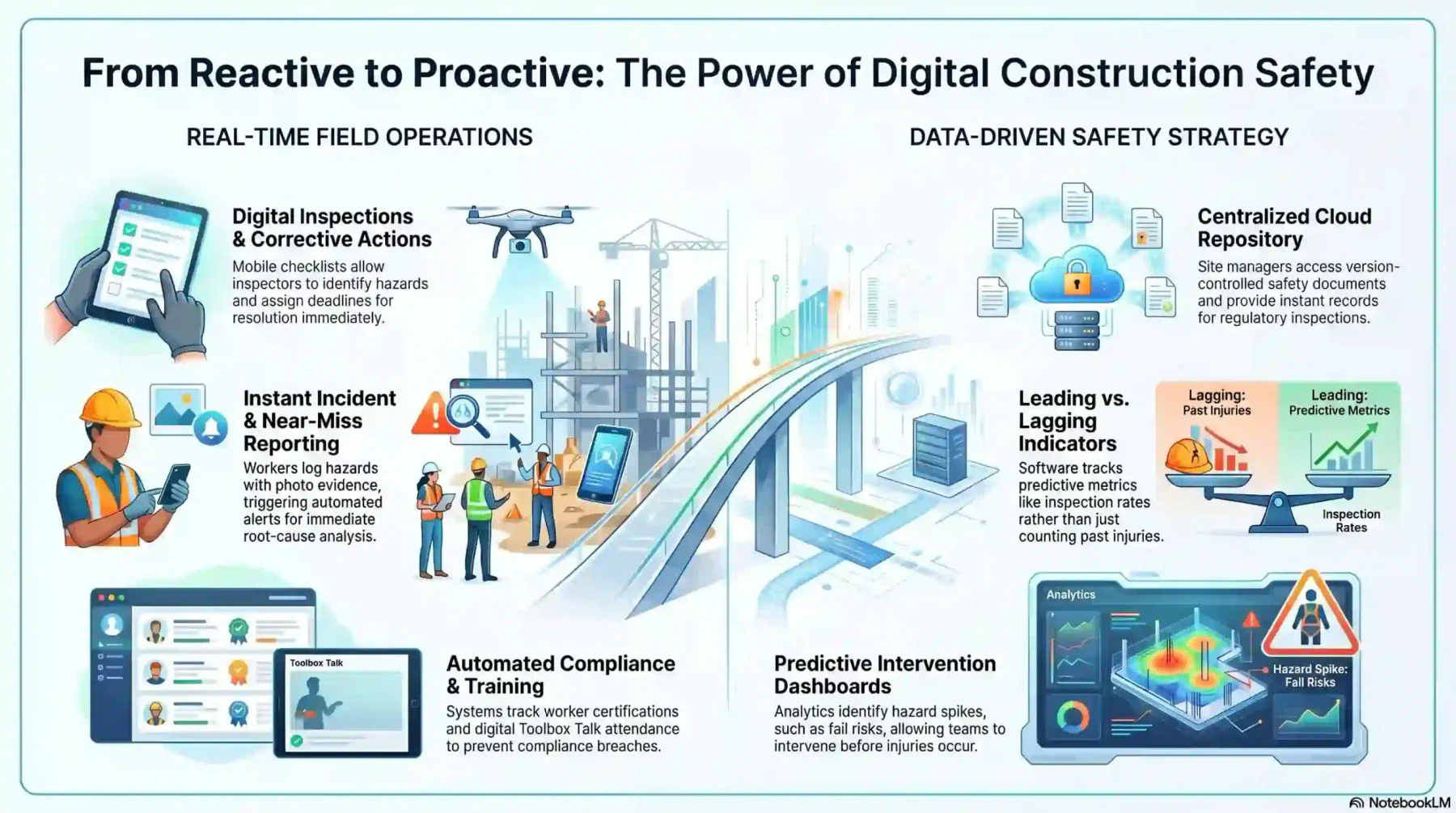
For decades, construction safety relied on paper-based processes that were slow, siloed, and reactive. Digital tools for contractors replace that model with structured workflows that identify and address risks before they become incidents.
1. Digital safety inspections and audits
Mobile inspection apps allow safety managers and site supervisors to complete checklists on smartphones or tablets in the field, tailored to the current project phase and trade type.
When a hazard is identified, the inspector assigns a corrective action to the responsible party with a deadline. The system tracks it until close-out, ensuring risks are resolved rather than just recorded.
Offline capability allows inspections to be completed in areas without connectivity, syncing automatically once a signal is restored, which is critical on remote Australian sites.
2. Real-time incident reporting
Workers can log an incident or near-miss immediately from any mobile device using a structured form that captures location, time, people involved, and photographic or video evidence.
Once submitted, the software triggers automated alerts to nominated personnel, including safety directors and project managers, initiating root-cause analysis faster than any paper-based process allows.
Near-miss reporting is especially valuable. Capturing incidents with no injury outcome provides the data needed to adjust protocols before a real consequence occurs.
3. Training and certification tracking
Every worker on a construction site must hold valid certifications for their tasks. Managing this across a large workforce on spreadsheets is both time-consuming and high-risk for compliance breaches.
Safety software automates this by sending alerts to workers and supervisors before certifications expire, and allowing project managers to verify qualifications before assigning specific tasks.
Toolbox talk attendance is recorded digitally via signature or QR code scan, with records stored securely and retrievable instantly for regulatory review or insurance purposes.
4. Document and compliance management
Construction projects generate a large volume of safety documentation, including Job Safety Analyses, Safety Data Sheets, site-specific safety plans, and regulatory compliance logs.
A cloud-based repository ensures staff always access the most current, approved version of any safety document. Version control eliminates the risk of workers following outdated procedures on site.
When a regulator arrives for an unannounced inspection, site managers can produce all required documentation on a tablet immediately, demonstrating compliance without delay or manual search.
5. Safety analytics and performance dashboards
Traditional safety reporting focuses on lagging indicators such as injury counts and lost-time rates. These measure what has already happened but offer no predictive value for preventing future incidents.
Modern software tracks leading indicators: inspection completion rates, corrective action closure rates, near-miss frequency, and hazard observation ratios. These predict future safety performance.
If the dashboard shows a spike in fall-hazard observations on a specific level of a project, the safety team can intervene before an injury occurs, turning safety from a compliance exercise into a dynamic improvement process.
Benefits of Using Construction Safety Management Software
The return on investment from a digital safety management system reaches well beyond the safety department. It affects project economics, legal exposure, communication, and workforce culture at every level.
1. Proactive risk mitigation and accident reduction
The most direct benefit is a measurable reduction in workplace incidents. Streamlined inspections, near-miss reporting, and predictive analytics allow hazards to be identified and removed before they cause harm.
Fewer incidents protect the physical wellbeing of the workforce and reduce the operational disruption that follows every investigation, medical response, and insurance claim.
2. Significant cost savings
Lower incident rates reduce workers’ compensation claims and medical costs directly. A demonstrably improved safety record lowers WHS insurance premiums over time, which compounds across a full project portfolio.
Administrative time saved by automating reporting, certification tracking, and compliance documentation translates into measurable reductions in safety management overhead each year.
3. Enhanced communication and collaboration
Construction sites involve multiple subcontractors, general contractors, and project owners working simultaneously. Centralised building project monitoring gives all parties a single shared source of truth they can access in real time.
When a hazard is reported, relevant parties are notified instantly, fostering a collaborative response rather than a siloed one that allows the risk to persist while information moves through manual channels.
4. Compliance and audit readiness
Every inspection, training session, and incident report is securely logged with a timestamp and digital signature, creating an unalterable record that satisfies WHS regulators and external auditors.
In the event of a legal dispute following an incident, comprehensive digital documentation proves that the business took all reasonably practicable steps to ensure a safe work environment for its workers.
5. A stronger safety culture
Implementing safety software signals to the workforce that the business values their lives and is willing to invest resources in demonstrating it. This shifts safety from a rulebook into a shared commitment.
When workers see that reporting a hazard through an app leads to swift corrective action, they become active participants in safety rather than passive subjects of rules written by someone else.
How to Choose the Right Construction Safety Software
The construction technology market offers a wide range of safety software options. Choosing the wrong one leads to poor adoption, wasted capital, and a false sense of coverage across the site.
1. Assess specific needs and pain points
Before evaluating vendors, audit your current safety processes internally. Identify where the biggest failures occur: lost inspection forms, expired certifications, delayed reporting, or fragmented data across systems.
Defining the core problems you are solving prevents purchasing a system that is either too basic for your scale or overly complex for your team to adopt and use consistently in the field.
2. Prioritise mobile-first functionality
Construction safety happens in the field, not behind a desk. The software must be intuitive on smartphones and tablets, requiring minimal training for workers who are not highly technology-focused.
Key mobile requirements include offline capability for remote sites, voice-to-text note input, and seamless camera integration for photo evidence capture during inspections and audits.
3. Evaluate customisability and flexibility
No two construction businesses operate identically. The software should adapt to your workflows and terminology, not force you to rebuild your processes around a rigid out-of-the-box structure.
Look for platforms that allow custom inspection checklists, form fields, and audit templates to be configured without requiring vendor support or code changes to adjust.
4. Check integration capabilities
Integrated project safety tools connect safety workflows with project management software, HR systems, and ERP platforms natively or via API.
Seamless data flow prevents duplicate entry and ensures safety metrics feed directly into overall project performance analysis rather than sitting in a disconnected standalone system.
5. Analyse reporting and dashboard features
The value of digital safety lies in the data it produces. Evaluate whether the platform generates automated reports for stakeholders and displays customisable dashboards for both leading and lagging indicators.
The ability to filter data by project, location, contractor, or hazard type is essential for identifying trends across a portfolio of sites rather than treating each site as an isolated data set.
The Future of Construction Site Safety
As digital transformation continues across the construction industry, safety management is moving from reactive documentation to predictive intelligence that prevents harm before it materialises.
1. Predictive analytics and AI
AI systems analyse historical incident data, project phases, weather conditions, and workforce patterns to forecast when and where an accident is most likely to occur on a given site.
This allows safety managers to deploy targeted interventions before a hazardous situation develops, shifting the role of safety from investigator to prevention specialist.
2. IoT and smart wearables
Smart helmets and high-visibility vests equipped with IoT sensors detect impacts, monitor air quality for toxic gases, and track biometric indicators such as heart rate and body temperature in real time.
If a worker falls or is exposed to dangerous heat levels, the wearable device alerts supervisors with the exact GPS location of the worker, enabling a significantly faster emergency response.
3. Drones for site inspection
Drones allow dangerous inspections to be performed without placing workers at risk. Roof integrity checks, crane boom inspections, and steep excavation surveys can all be completed from the ground.
High-definition cameras and thermal imaging give safety teams detailed visual data that would otherwise require a worker to access an unsafe or difficult-to-reach location personally.
4. Virtual reality safety training
VR training environments allow workers to experience realistic hazardous scenarios, such as navigating structural steel or responding to an equipment fire, in a fully safe and controlled setting.
Experiential learning improves hazard recognition and procedure retention far more effectively than safety videos or printed manuals, particularly for workers who are new to a specific site type.
Conclusion
Construction site safety is not a peripheral concern. It is the foundation on which every project, team, and business decision is built.
Businesses that invest in rigorous protocols, trained workforces, and integrated digital safety systems reduce harm, control costs, and build the kind of safety culture that protects every worker on site.
If you are interested in learning further on this topic, you can book a free consultation with our team to gain more business insight that you can use for your business.

FAQ About Construction Site Safety
A Safe Work Method Statement (SWMS) identifies high-risk construction work activities, the hazards involved, and the controls used to manage them. Under Australian WHS regulations, a SWMS is legally required before any high-risk construction work begins, including work at height, demolition, and excavation.
Under the Work Health and Safety Act 2011, penalties can reach $3 million for a corporation and $600,000 or five years imprisonment for an individual found guilty of a Category 1 offence involving reckless conduct. Civil penalties, improvement notices, and prohibition notices apply to lesser breaches.
Best practice involves daily or shift-based site walkthroughs for routine hazard identification, formal internal audits monthly or quarterly, and comprehensive external audits annually or before major project milestones. Frequency should increase during higher-risk project phases such as excavation or structural framing.
A SWMS addresses a specific high-risk activity, documenting its hazards and the controls applied to that task. A site-specific safety plan is broader, covering the overall safety management approach for the entire project, including emergency procedures, communication plans, and subcontractor obligations.
Yes, leading construction safety platforms offer integrations with BIM tools such as Autodesk Construction Cloud and Procore. This allows safety managers to link hazard observations and inspection data directly to model elements, giving project teams spatial context for risk identification and management.