









 Limited to 100 registrants

Construction planning determines how a project moves from approved drawings to a finished structure on time and within budget. Poor planning is one of the most common reasons Australian construction projects run over schedule, exceed costs, or fall short of compliance requirements.
This guide covers what construction planning involves, the key stages, methods commonly used across Australian projects, and how software supports the process from preconstruction through to handover.
Key Takeaways
Understand how construction planning defines scope, schedule, resources, compliance, and risk management across the full project lifecycle.
Review the five key stages from project initiation and feasibility through to execution monitoring and control on Australian construction projects.
Check the DA and CDC approval pathways, WHS obligations, SWMS requirements, and National Construction Code standards that affect Australian project planning.
See how construction planning software connects scheduling, procurement, compliance documentation, and cost management in one system.

What Is Construction Planning?
Construction planning is the process of defining the work needed to complete a project, allocating resources, setting a schedule, and establishing how the work will be managed and monitored. It creates a shared framework that contractors, subcontractors, consultants, and site teams can follow.
A construction plan typically covers scope, work breakdown, schedule, procurement, risk, safety, and compliance. Without it, teams often work from informal expectations that diverge under pressure, leading to delays, cost disputes, and rework.
For Australian projects, planning also involves local compliance requirements such as development application approvals, National Construction Code adherence, and Work Health and Safety obligations. These add layers of documentation that need to be built into the plan from the start.
Key Stages of Construction Planning
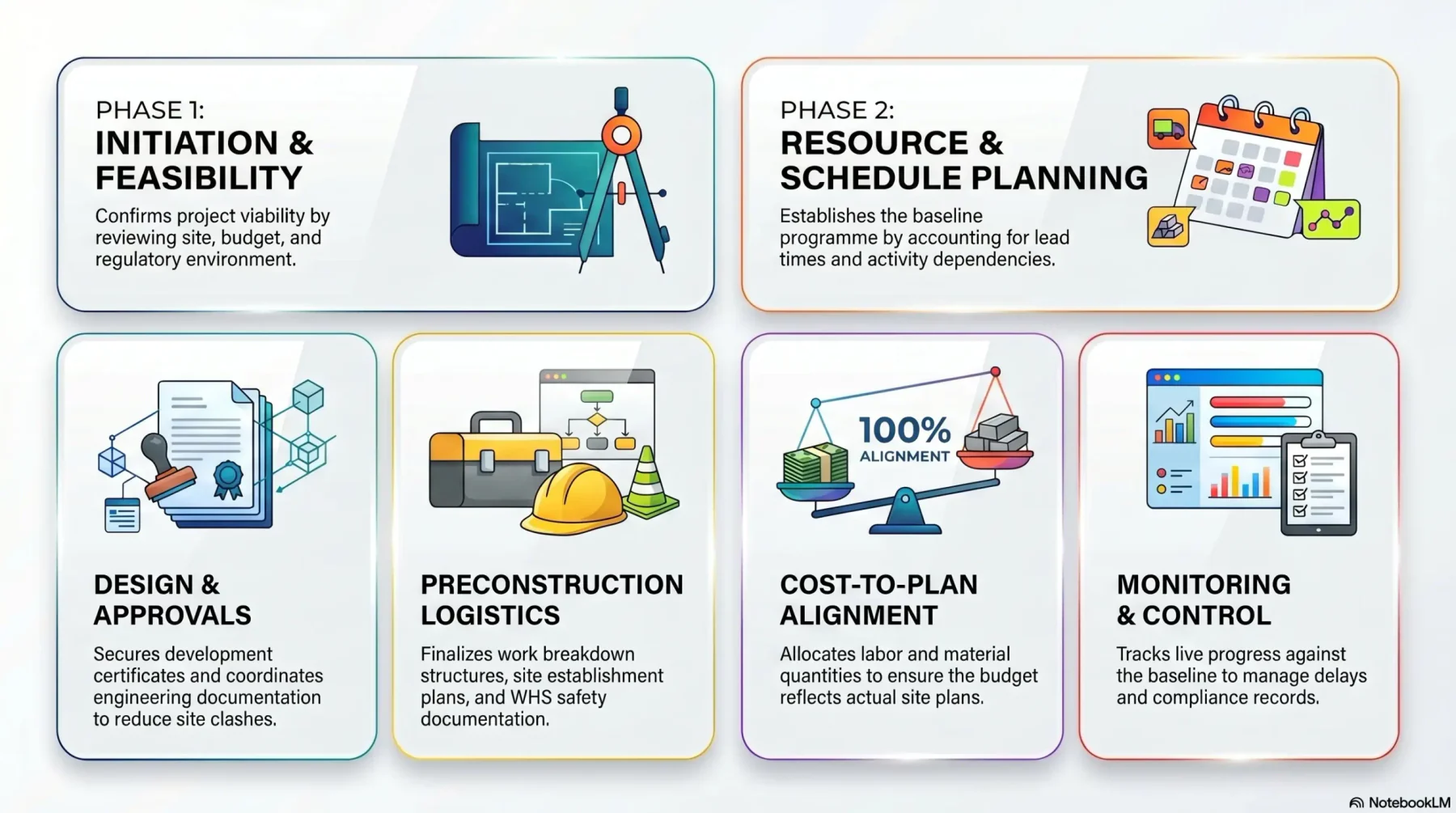
Construction planning covers more than the period before work begins on site. It runs through the full project lifecycle, from initial feasibility through to final handover.
The five stages below reflect how most Australian projects progress from concept to completion.
1. Project initiation and feasibility
Project initiation confirms whether a project is viable before significant resources are committed. This includes reviewing the site, the budget, the programme, and the regulatory environment.
A feasibility assessment helps clients and contractors understand whether the scope can be delivered within the expected time and cost parameters. Therefore, decisions made here shape everything that follows.
At this stage, teams also begin to identify risks, procurement strategy, and key stakeholders. Early engagement with consultants, planners, and local councils can prevent costly surprises later.
2. Design development and approvals
Design development translates the project brief into detailed drawings, specifications, and engineering documentation. This information becomes the basis for procurement, scheduling, and construction.
In most Australian states and territories, this stage also involves securing development approval or a Complying Development Certificate before work can begin. The approval process can take several weeks or months, so it must be factored into the overall programme.
Coordination between architects, engineers, and certifiers during this stage reduces the risk of clashes on site and avoids delays caused by design changes during construction.
3. Preconstruction planning
Preconstruction planning converts the approved design into an executable plan. This is where the project team finalises the work breakdown structure, procurement schedule, and construction methodology.
Site establishment plans, traffic management arrangements, and contractor inductions are typically confirmed here. Principal contractors also prepare their WHS documentation, including Construction Induction records and any required Safe Work Method Statements.
Preconstruction planning is one of the most detail-intensive stages because decisions made here directly affect site performance. Gaps in procurement or sequencing at this point tend to surface as problems during construction.
4. Resource and schedule planning
Resource and schedule planning defines who will do each part of the work, what equipment and materials are required, and when activities will be completed, while allocating site resources efficiently.
A well-built schedule accounts for lead times, subcontractor availability, weather risks, and dependencies between activities. For example, structural work cannot start until earthworks are complete, and internal fitout cannot start until the building is weatherproof.
Cost planning also connects closely to this stage. Labour, plant, and material quantities are allocated to activities so that the project budget reflects the actual plan rather than a high-level estimate.
5. Execution monitoring and control
Once construction begins, the plan shifts from a document into a live management tool. Site supervisors, project managers, and schedulers compare actual progress against the baseline to identify delays, resource shortfalls, or scope changes early.
Regular site meetings, progress reports, and schedule updates keep the team aligned. When variances appear, the team needs to assess the impact, update the programme, and adjust resource deployment accordingly.
Effective monitoring also supports compliance. Inspection records, SWMS sign-offs, variation approvals, and subcontractor documentation often rely on solutions for field operations to improve site visibility.
Construction Planning Methods
Several planning methods support different types of projects and team preferences. Each method has strengths that suit specific contexts, so many Australian project teams use more than one approach on the same project.
The four methods below are the most widely used across Australian construction.
Critical Path Method (CPM)
The Critical Path Method identifies the sequence of activities that determines the minimum project duration. Any delay to a critical path activity directly extends the project finish date.
CPM works by mapping all activities, their durations, and their dependencies. Then, the longest chain of dependent activities becomes the critical path, and that chain receives the most attention during scheduling and monitoring.
This method suits complex projects with many interdependent activities, such as commercial construction, civil infrastructure, and multi-stage developments. Most scheduling software supports CPM natively.
Gantt charts
A Gantt chart shows project activities as horizontal bars plotted against a timeline. It gives teams a clear visual overview of what is planned, what is in progress, and what is complete.
Gantt charts work well for communicating schedules to clients and subcontractors who need a straightforward picture without detailed scheduling logic. They are also easy to update and share during weekly progress meetings.
However, a basic Gantt chart does not automatically calculate critical path or show float. For complex projects, Gantt charts are most useful as a summary layer on top of a more detailed schedule.
PERT (Program Evaluation and Review Technique)
PERT is a scheduling method that incorporates uncertainty into time estimates. Instead of a single duration, each activity receives three estimates: optimistic, most likely, and pessimistic. These combine into a weighted average that reflects realistic delivery risk.
PERT suits projects where activity durations are uncertain, such as research-heavy, first-of-kind, or complex engineering projects. It helps project managers communicate schedule risk to clients and set more defensible programme dates.
In practice, PERT is less common on routine building projects than CPM. However, it can be a useful tool during early programme planning when detailed designs are not yet finalised.
Last Planner System (LPS)
The Last Planner System is a collaborative scheduling approach that involves the people doing the work in planning their own activities. Rather than issuing a top-down programme, the team builds a short-term plan together based on what can realistically be committed to.
LPS uses a rolling weekly look-ahead, a commitment meeting, and a process for tracking reasons when work is not completed as planned. This reduces assumptions and improves reliability across subcontractor interfaces.
LPS is increasingly common on Australian commercial and industrial projects, particularly where multiple subcontractors work in close sequence. It tends to reduce delays caused by coordination failures and builds stronger working relationships across the site team.
Construction Scheduling and How It Connects to Planning
"A construction schedule without a solid plan behind it will not survive the first month on site. Planning gives the schedule its logic; the schedule turns that logic into daily action."
Construction scheduling takes the scope and sequence defined during planning and turns it into a time-based programme. A plan without a schedule is a list of intentions; a schedule without a plan lacks the logic needed to hold up under pressure.
The two activities run in parallel and feed each other throughout the project. For example, if procurement lead times change during design, the schedule must be updated and the plan adjusted to reflect new sequencing. Similarly, when site conditions delay an early activity, the impact on all downstream work needs to be assessed immediately.
A detailed construction schedule typically includes activities for procurement, design approvals, site establishment, trade packages, inspections, commissioning, and handover. Each activity carries a duration, a start date, a finish date, a responsible party, and dependencies linked to predecessor activities.
Progress monitoring compares actual dates against planned dates and calculates the impact of any variation on the overall project finish, helping teams focus on keeping building projects on track.
Construction Planning in Australia

Australian construction projects operate within a specific regulatory environment that affects how planning is structured and documented. Compliance requirements vary by state and territory, but several common obligations apply across most Australian projects.
The sections below cover the most significant planning considerations for Australian contractors and developers.
Development Applications (DA) and Complying Development Certificates (CDC)
Most new construction projects in Australia require either a Development Application or a Complying Development Certificate before work begins. A DA goes through local council and involves a merit assessment; a CDC is faster because the proposed work meets a set of pre-established standards.
The choice between a DA and CDC depends on project type, site zoning, council requirements, and the applicable state planning legislation. For example, New South Wales uses the State Environmental Planning Policy (Housing) for CDC eligibility, while Victoria operates under a different framework.
Construction planning must account for the approval timeline. DA timeframes can vary significantly by council and project complexity, and construction cannot legally begin until the relevant approval is in place.
WHS Compliance and Safe Work Method Statements (SWMS)
Under the Work Health and Safety Act 2011, principal contractors on notifiable projects must ensure that WHS management plans are in place before construction begins. These plans document how safety hazards will be managed throughout the project.
Safe Work Method Statements are required for high-risk construction work, which covers activities such as work at height, work near excavations, structural alterations, and confined space entry. SWMS must be prepared before the relevant work starts and kept on site throughout.
Victoria follows the Occupational Health and Safety Act 2004 rather than the harmonised WHS framework. Therefore, project teams working across multiple states need to check the applicable legislation for each site.
Australian Standards and Building Codes
The National Construction Code sets performance requirements for building work across Australia, covering structural stability, fire safety, access, health, and energy efficiency. Compliance is a legal requirement, and construction planning must account for it from design through to final inspection.
Australian Standards referenced in the NCC and project specifications also apply to specific materials, methods, and systems. These affect procurement, contractor selection, and quality inspection requirements throughout the build, particularly when using a planning and execution platform for contractors.
State and territory building regulators may impose additional requirements for certain project types. As a result, project teams should confirm applicable codes and standards early in the design and approval process.
Common Construction Planning Mistakes
Even experienced project teams make planning errors that create problems during construction. Most of these mistakes are predictable and avoidable with better preparation.
The most common planning mistakes on Australian projects include:
- Setting a programme without confirmed lead times for long-supply items such as structural steel, electrical switchboards, or facade components
- Underestimating the time required for council approvals, heritage reviews, or building permit assessments
- Failing to identify and sequence subcontractor interfaces that affect multiple trades, especially on fitout and services-heavy projects
- Treating the initial budget estimate as fixed without reviewing it against the detailed scope as design progresses
- Not updating the programme when early delays occur, which allows a small issue to cascade into a significant overrun
- Omitting contingency allowances for weather, labour availability, and scope variations
- Starting site work before procurement is complete because of time pressure, then running into material shortages mid-construction
Each of these mistakes is addressable during early planning. The cost of correcting them at planning stage is significantly lower than managing them on site.
How Software Supports Construction Planning
Construction planning software helps project teams build, maintain, and communicate plans more efficiently than spreadsheets and manual processes allow. It also supports centralising construction project activities by connecting planning data to procurement, compliance, and cost management functions.
Scheduling tools let project managers build detailed programmes with dependencies, critical path calculations, and baseline comparisons. When activities change, the software recalculates the downstream impact automatically, saving significant time during project updates.
Document management functions keep approvals, SWMS, inspection records, and correspondence accessible to the whole project team. This supports WHS compliance, subcontractor management, and client reporting without manual filing across email and shared drives.
For growing construction companies, an ERP-connected platform can link project schedules to procurement, subcontractor contracts, financial reporting, and payroll. This gives management a live view of project performance across multiple sites without waiting for weekly status reports.
Conclusion
Construction planning gives Australian projects a structured framework for managing scope, schedule, resources, compliance, and risk from concept through to completion. Without it, the gap between the plan and what actually happens on site tends to widen quickly.
Good planning also involves ongoing monitoring, regular programme updates, and clear communication across the full project team. If you want to explore how the right software can support your construction planning process, consult our experts or book a free consultation with our team today.
Frequently Asked Question
Construction planning defines the scope, methodology, resources, and approach for delivering a project. Scheduling converts that plan into a time-based programme showing when each activity will start and finish. Both are essential and remain closely connected throughout the project lifecycle.
The five key stages are project initiation and feasibility, design development and approvals, preconstruction planning, resource and schedule planning, and execution monitoring and control. Each stage builds on the previous one and prepares the team for the next.
Most construction projects in Australia require either a Development Application through local council or a Complying Development Certificate from a private certifier. The right pathway depends on project type, site zoning, and applicable state planning rules. Always confirm requirements with the relevant council or planning authority before work begins.
CPM identifies the longest sequence of dependent activities in a project schedule. Any delay to an activity on the critical path directly delays the project finish date. Project teams use CPM to prioritise resources and manage risk on the activities that matter most to delivery.
Contingency levels vary by project type, complexity, and risk profile. Residential projects typically carry 5 to 10 percent contingency, while complex commercial, civil, or heritage projects may carry 15 to 20 percent or more. Contingency should reflect the specific risks identified during planning rather than a flat percentage applied to every project.