






Every modern skyline, highway, and industrial facility begins as a concept before evolving into a construction project. Success at that scale is never accidental. It is the result of meticulous planning, rigorous execution, and consistent oversight across every phase of the build.
At the heart of every successful build is a management framework that guides the initiative from the first feasibility study to final handover. When project managers, procurement specialists, and field engineers fall out of sync, cascading delays and budget overruns follow.
By learning how to properly managing construction project workflows, you can avoid these risks while achieving operational excellence. This blog will cover every important detail you need to know about construction projects and their implementation.
Key Takeaways
A construction project is a temporary, process of planning, designing, and assembling a structure or infrastructure asset. Unlike mass production, every build is unique.
The key phases of construction project are: initiation & feasibility, design & planning, procurement & contracting, construction & execution, and handover & closeout
Effective management requires defining and controlling the iron triangle, Assembling the right team, monitoring progress and mitigating risk proactively.
Best practices include Enforcing strict change-order processes, maintaining open communication between field and office, securing permits early, and pre-qualifying multiple vendors
What Is a Construction Project?

A construction project is a highly organized process dedicated to planning, designing, financing, and physically assembling a structure, facility, or infrastructure asset. It is undertaken to create something that adds tangible value to its owners and the surrounding community.
Unlike mass production, where identical items are manufactured on an assembly line, every construction initiative is a bespoke undertaking. Even two buildings sharing the same blueprints will differ in execution due to location, soil conditions, zoning laws, and supply chain availability.
"Generative design enables AI to create lighter, stronger, and more efficient components by exploring multiple design possibilities while ensuring they can be manufactured effectively."
Types of Construction Project
The scope of construction ranges from minor renovations to multi-billion-dollar megaprojects like international airports. The industry categorizes these initiatives into four types, each requiring specialized knowledge, unique procurement strategies, and tailored management approaches.
- Residential Construction
Residential construction covers the building, remodeling, and expansion of structures meant for human habitation, from homes to large apartment complexes. Procurement focuses on standardized materials, interior finishes, and managing relationships with local subcontractors.
- Commercial Construction
Commercial construction covers office buildings, retail centers, restaurants, hotels, and entertainment venues. These builds demand strict adherence to safety regulations and aggressive timelines, with procurement centered on specialized systems like commercial-grade electrical arrays.
- Industrial Construction
Industrial construction involves facilities used for manufacturing, power generation, and heavy storage, including oil refineries, chemical plants, and logistics warehouses. Function and structural integrity take priority, with procurement often requiring long lead times for custom-engineered machinery.
- Infrastructure and Heavy Civil Construction
Civil construction supports systems like highways, bridges, tunnels, railways, and water treatment facilities, often built on a site for infrastructure project. These large-scale projects require rigorous planning and assessment.
The success of the initiative relies entirely on the project management team’s ability to align the goals, schedules, and resources of all these groups into a single, cohesive workflow.
Key Phases of a Construction Project
The lifecycle of a construction project is divided into several distinct, sequential phases. While terminology may vary by contracting method or region, the fundamental progression remains consistent across every type of build.
Each phase serves as a critical gateway. The deliverables and decisions made in one stage directly dictate the success and viability of the next, making phase discipline essential for maintaining control over budget, schedule, and quality.
1. Initiation and Feasibility
The lifecycle begins long before a shovel touches the dirt. The initiation phase is where an owner or sponsor identifies a need, opportunity, or problem that construction can solve, whether that is a new hospital for a growing municipality or a headquarters to consolidate a workforce.
The primary objective at this stage is to determine whether the idea is viable from a financial, technical, and regulatory standpoint. The cornerstone of that determination is the feasibility study.
The feasibility study evaluates multiple dimensions of the proposed build. Financially, the team estimates total capital investment and calculates ROI or public benefit. Technically, engineers assess whether soil conditions, topography, and existing infrastructure can support the structure.
Legally, the team reviews zoning ordinances, environmental regulations, and preservation laws to confirm the build is permissible. All three dimensions must be clear before the project moves forward.
If the feasibility study yields positive results, stakeholders develop a business case and a project charter. The charter officially authorizes the project, outlines objectives, defines the preliminary scope, and appoints the core leadership team.
Without a rigorous initiation phase, projects move forward on flawed assumptions, setting the stage for financial losses or legal hurdles that are far more costly to resolve later in the lifecycle.
2. Design and Planning
Once authorized, the project transitions into the design and planning phase. This is the most critical stage for cost control, as decisions made here dictate the majority of expenditures during execution. The design process moves through three progressive sub-stages.
Schematic design is first. Architects and engineers work with the owner to translate concepts into rough sketches and spatial layouts, exploring options for the exterior facade, overall size, and interior flow.
Once a schematic direction is approved, the team moves into design development. Sketches are refined into detailed drawings, structural and mechanical systems are mapped out, material selections are finalized, and cost estimates are updated.
The phase culminates in the production of construction documents, the detailed technical blueprints that provide exact specifications for contractors to physically build the structure.
Alongside the visual designs, the planning team develops comprehensive project management plans. This includes a Work Breakdown Structure, a baseline schedule using critical path methodologies, a risk management plan, and a defined scope of work.
A well-executed design and planning phase minimizes ambiguity, which is the primary driver of costly change orders and disputes once the physical build is underway.
3. Procurement and Contracting
Procurement is the bridge between theoretical design and physical execution. It covers sourcing, negotiating, and acquiring all services, materials, and equipment needed to complete the build.
The procurement phase begins with soliciting bids. The project owner releases finalized construction documents to the market through a Request for Proposal or Invitation to Bid. General contractors review the documents, estimate costs, and submit formal bids.
Selection may be based on the lowest price, common in government projects, or on a best-value approach that weighs the contractor’s experience, safety record, and proposed methodology alongside cost.
Simultaneously, a material procurement effort must be orchestrated. Procurement managers analyze the bill of materials from the design documents and begin sourcing everything, accounting for lead times, commodity prices, and site storage capacity.
Contracting is the legal mechanism that binds the procurement process together. Construction contracts dictate how risks, responsibilities, and payments are allocated among all parties. The four most common contract models are:
- Lump Sum: The contractor completes the full scope for a single predetermined price, placing cost overrun risk on the contractor and giving the owner budget certainty.
- Cost-Plus: The owner pays all actual costs plus a fixed fee or percentage. Used when the scope is not fully defined, this model shifts financial risk to the owner.
- Guaranteed Maximum Price (GMP): A hybrid model where actual costs plus a fixed fee are covered, but total compensation is capped. Savings below the cap are typically shared between both parties.
- Time and Materials: Used for smaller scopes or emergency repairs, where the owner pays a set hourly labor rate plus the actual cost of materials.
Effective procurement and contracting align all parties legally and financially before the first piece of heavy machinery arrives on site.
4. Construction and Execution
This phase is where plans, designs, and procured resources converge into physical reality. It begins with mobilization, where the contractor sets up temporary facilities, establishes site security, implements safety protocols, and brings equipment onto the premises.
It starts with site preparation and earthwork, clearing vegetation, grading the land, and excavating for foundations. Once the earth is prepared, the foundation is laid with absolute precision, as any errors here compromise the integrity of everything built above it.
Following the foundation, the superstructure begins to rise. Depending on the design, this may involve erecting a steel skeleton, pouring reinforced concrete pillars, or framing with structural timber.
With the framework complete, the project enters the rough-in stage for mechanical, electrical, and plumbing systems. Electricians, plumbers, and HVAC technicians install the networks of pipes, conduits, and ductwork that serve as the building’s internal organs.
This stage requires exceptional coordination to prevent different systems from physically clashing within walls or ceilings. Once MEP rough-ins pass municipal inspections, the exterior is sealed with roofing, cladding, and windows.
The final stage focuses on interior finishes. The project management team tracks progress against the schedule, manages material deliveries, conducts safety briefings, and processes RFIs to resolve design ambiguities.
5. Handover and Closeout
The handover and closeout phase formally transitions the completed asset from the construction team to the owner or facility management team. Despite the heavy physical work being done, this phase is notoriously challenging and requires meticulous attention to detail.
The closeout begins with the punch list. The project manager, architect, and owner walk through the entire facility, noting any minor defects, incomplete work, or cosmetic issues. The general contractor is responsible for every item before final payment is released.
Simultaneously, the building undergoes rigorous testing and commissioning. All mechanical, electrical, plumbing, and life-safety systems, such as fire alarms and sprinklers, are tested under various conditions to confirm they operate correctly.
Commissioning is especially critical in commercial and industrial facilities, where system failures carry severe consequences for operations, safety, and regulatory compliance.
Once physical work is complete and the municipality issues a Certificate of Occupancy, the administrative closeout begins. The contractor hands over as-built drawings, operation and maintenance manuals, final lien waivers, and all active warranties.
Only when every physical and administrative task is complete, and the final financial accounts are settled, is the construction project officially closed.
How to Manage a Construction Project
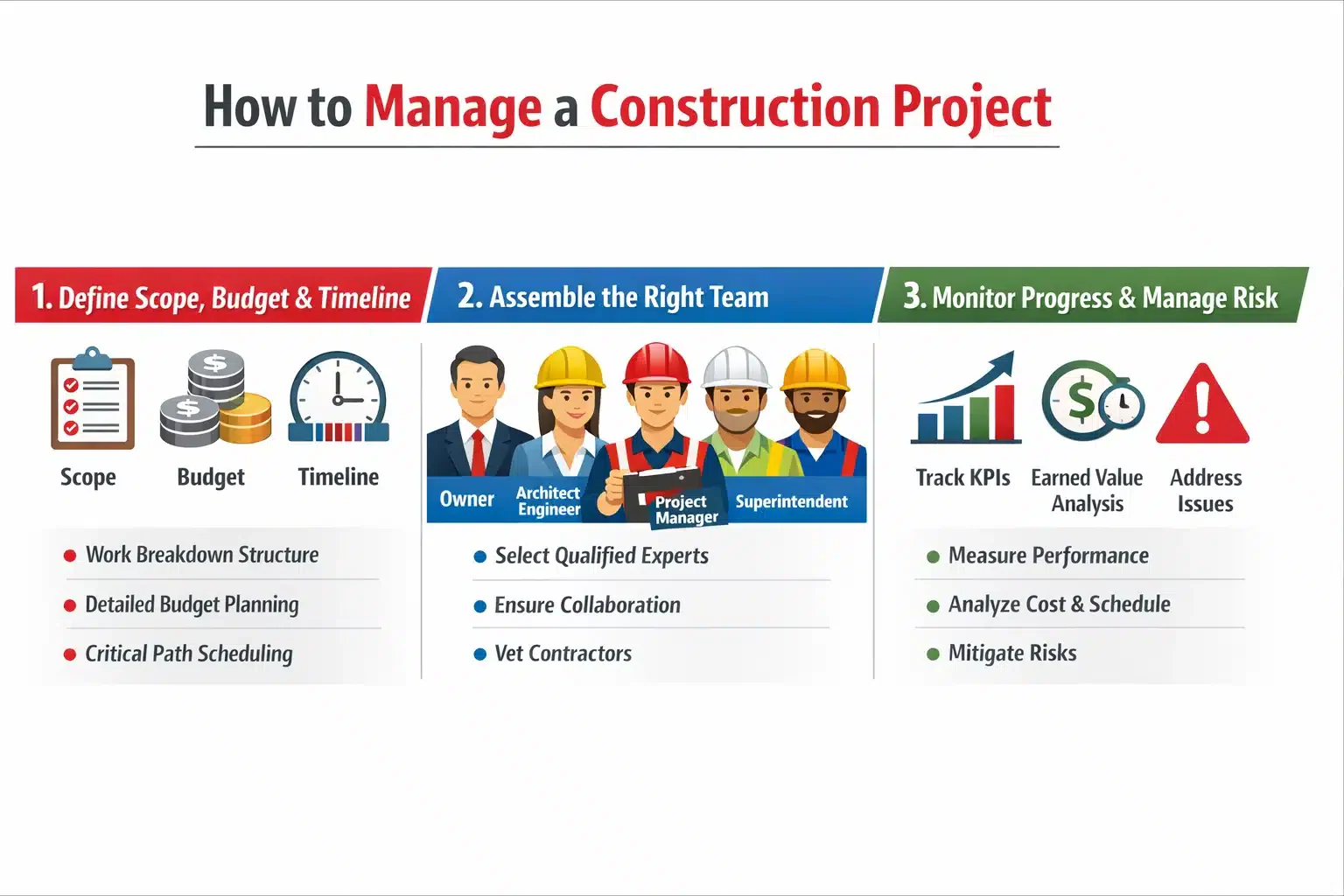
Managing a construction project requires a unique blend of technical knowledge, strategic foresight, financial acumen, and leadership. A project manager is essentially the CEO of a temporary business, balancing the competing constraints of scope, time, cost, and quality.
Without a disciplined management approach, even the most brilliantly designed builds will succumb to delays, budget overruns, and quality failures. Effective management requires structured methodologies across several key functional areas.
1. Define Scope, Budget, and Timeline
The foundation of effective project management lies in defining and controlling the project’s scope, budget, and timeline. These three elements form the iron triangle of project management. A change in one will always impact the other two.
Defining the Scope
The scope represents the totality of work required to complete the project. It must be explicitly detailed in project documentation to prevent scope creep, the slow unauthorized expansion of requirements that drains resources and destroys profitability.
Managers use a Work Breakdown Structure to decompose the project into smaller, manageable work packages. Breaking a high-rise build into tasks like “pour 3rd-floor concrete slab” allows resources to be assigned and progress tracked with granular precision.
Establishing the Budget
Construction budgeting is a complex forecasting exercise. Estimators calculate direct costs such as materials, equipment, and labor, alongside indirect costs like site security, temporary utilities, management salaries, and insurance.
Because construction spans months or years, budgets must account for inflation, fluctuating material costs, and currency exchange rates. A robust budget also includes contingency reserves to absorb the financial impact of unforeseen risks like soil contamination or sudden steel price spikes.
Developing the Timeline
Extended project durations mean higher overhead and delayed revenue for the owner. Project managers use the Critical Path Method to map the full sequence of activities and identify which tasks must be completed on time to meet the final deadline.
If any task on the critical path is delayed, the entire completion date shifts. Gantt charts and scheduling software visualize these dependencies, allowing managers to allocate resources efficiently and adjust dynamically as site conditions change.
2. Assemble the Right Project Team
A construction project is only as strong as the team executing it. The project manager’s role is to foster a collaborative environment where diverse specialists communicate effectively and work toward a unified goal.
- The Owner/Sponsor: Finances the project, defines the ultimate vision, approves budgets, and makes high-level strategic decisions.
- The Architect and Engineering Team: Responsible for aesthetic design and technical integrity. They remain engaged throughout the build to answer technical queries and approve material substitutions.
- The Project Manager: The central hub of communication and authority. The PM oversees the budget, schedule, and contract administration, acting as the primary liaison between the owner and field teams.
- The Construction Superintendent: The senior leader on the physical job site. While the PM manages business aspects, the superintendent coordinates subcontractors, oversees safety, and ensures quality control on the ground.
- Procurement Specialists and Estimators: The financial and supply chain backbone. Estimators predict costs while procurement managers source materials, negotiate with vendors, and manage delivery logistics.
- Subcontractors and Tradespeople: The specialized experts performing the actual labor, including excavation crews, ironworkers, electricians, plumbers, carpenters, and painters.
Assembling the right team goes beyond hiring people with the correct licenses. It requires vetting contractors for financial stability, safety records, and past performance. A weak link anywhere in the chain can disrupt the entire schedule.
3. Monitor Progress and Manage Risk
Construction is a highly dynamic environment where conditions change daily. Weather events, supply chain disruptions, labor shortages, and unexpected site conditions are constant threats to project stability.
Monitoring progress requires robust tracking systems. Managers use Key Performance Indicators to measure actual performance against the baseline plan and identify earned value variances before they compound into larger problems.
Earned Value Management is one of the most effective techniques for assessing project health. It combines measurements of scope, schedule, and cost into a single, objective picture of how the project is actually performing against what was planned.
By calculating metrics like the Cost Performance Index and Schedule Performance Index, managers can determine with precision whether the project is over budget or behind schedule, and by how much, allowing corrective action to be taken early.
Industry Use Cases for Construction Project Methodologies
While foundational project management principles apply universally, their specific application varies dramatically by sector. Different industries demand specialized approaches to planning, procurement, and execution.
- Healthcare Facilities: Hospital construction is among the most regulated use cases in the industry. Projects require specialized MEP systems, strict health department compliance, and careful phasing to keep active medical wings operational throughout the build.
- Renewable Energy Infrastructure: Solar farms, wind turbines, and hydroelectric facilities are often in remote environments. Teams must manage environmental impact, oversized component logistics, and land-use approvals across multiple government agencies.
- Commercial High-Rises: Urban developments require just-in-time delivery for materials like steel and glass due to zero lot lines and heavy traffic. Noise ordinances, pedestrian safety, and zoning compliance add further management complexity.
- Civil and Public Works: Publicly funded builds like highways, bridges, and water treatment plants require strict government procurement standards, transparent reporting, and phased execution plans that minimize disruption to traffic and public services.
Implementation Steps for a Robust Project Framework
Transitioning a conceptual design into a fully realized physical asset requires a deliberate, structured rollout. Following a systematic implementation strategy is crucial for any business looking to standardize its approach to complex builds.
Step 1: Define Organizational Standards and KPIs
Before breaking ground, leadership must establish clear KPIs and standardized project charters. This means creating unified templates for scope definitions, budget estimates, and risk assessments.
These baselines allow stakeholders to objectively measure progress across schedule variance, cost performance, and safety incident rates throughout the build.
Step 2: Deploy Centralized Management Software
Modern construction can no longer rely on decentralized spreadsheets and fragmented email chains. Implementing a construction management platform, such as ERP systems or dedicated project management tools, is essential.
The right platform creates a single source of truth for document control, RFI tracking, submittals, and real-time financial dashboards across the entire project team.
Step 3: Establish a Cross-Functional Communication Matrix
A project is only as strong as its communication network. A formal communication matrix should define reporting lines and escalation protocols between the superintendent, project manager, architects, engineers, and subcontractors.
Regularly scheduled coordination meetings and daily huddles must be mandated to ensure consistent alignment between the field and the back office.
Step 4: Execute Pilot Testing and Phased Rollouts
When introducing new methodologies or technologies, it is recommended to pilot the framework on a smaller, lower-risk build. This allows the team to identify bottlenecks and refine safety protocols.
It also ensures that both office personnel and field workers are fully trained before scaling processes to multi-million-dollar megaprojects.
Common Pitfalls and How to Avoid Them
Even with meticulous planning, construction initiatives are highly susceptible to derailment. The sheer number of variables involved means managers must remain vigilant against common traps that lead to budget overruns and schedule delays.
- Uncontrolled Scope Creep: Allowing design modifications without formally adjusting budgets and timelines is a primary cause of financial strain. Enforce a strict change-order process where every modification is quantified, priced, and approved before work commences.
- Fragmented Communication: When the field team and office operate in silos, misread blueprints and delayed RFIs cause expensive rework. Cloud-based mobile applications ensure field workers always have access to the most current drawings.
- Ignoring Local Regulations and Permitting: Failing to secure municipal permits early or underestimating zoning laws can halt a project. Compliance officers should be involved during the feasibility phase to map the regulatory landscape before design is finalized.
- Supply Chain Over-Reliance: Relying on a single vendor for critical long-lead materials leaves the project exposed to shortages and delivery failures. Pre-qualifying multiple vendors for essential materials acts as an insurance policy against procurement delays.
Advanced Practices Shaping the Future of Construction
To remain competitive in an increasingly complex industry, forward-thinking organizations are moving beyond traditional methodologies and embracing cutting-edge practices that enhance efficiency, safety, and precision.
Building Information Modeling (BIM)
Advanced BIM goes far beyond traditional 2D blueprints by incorporating 4D scheduling and 5D cost dimensions. Project teams can visually simulate the entire construction sequence before a single brick is laid.
This allows teams to identify spatial clashes between structural elements and MEP systems in a virtual environment. This will drastically reduce costly rework during the physical build.
Lean Construction Principles
Lean Construction adapts manufacturing principles to maximize client value while eliminating waste. It relies on pull-planning techniques where scheduling is driven by downstream demand rather than top-down mandates.
By optimizing workflow reliability and minimizing wasted materials, time, and labor, teams can deliver projects faster and more profitably without compromising quality.
Reality Capture and Drone Surveying
Drones equipped with high-resolution cameras and LiDAR technology have transformed site monitoring. Daily or weekly flights generate accurate topographical maps and point clouds of the active build.
These reality-capture models are overlaid onto BIM files, allowing managers to instantly verify that the physical build matches the digital design down to the millimeter.
Use of Software
Construction management software centralizes the tools teams need to plan, execute, and monitor complex builds. From scheduling and document control to procurement tracking and cost reporting, the right platform eliminates fragmentation.
ERP systems and dedicated construction platforms provide real-time visibility across every project phase. They ensure that decisions are based on accurate, up-to-date data rather than outdated spreadsheets.
Conclusion
A construction project is one of the most complex undertakings a business or government can pursue. From the first feasibility study to the final certificate of occupancy, every phase demands precision, coordination, and disciplined management.
The businesses and teams that invest in the right frameworks, tools, and people are the ones that deliver on time, within budget, and to a standard that creates lasting value for owners, communities, and the built environment.
If your business is in a related line of work, the information we have covered could potentially improve your business through its practical application. For this reason, we offer a free consultation service with our expert to guide you in enhancing your operations.
Frequently Asked Question
A construction project is a temporary, highly organized process dedicated to planning, designing, financing, and physically assembling a structure, facility, or infrastructure asset. Every construction initiative is unique, even when sharing the same blueprints, due to differences in location, soil conditions, zoning laws, and supply chain availability.
The five phases are initiation and feasibility, design and planning, procurement and contracting, construction and execution, and handover and closeout. Each phase serves as a critical gateway where the decisions made directly dictate the success and viability of the next stage.
The iron triangle refers to the three core constraints of construction project management: scope, budget, and timeline. These three elements are interdependent, meaning a change in any one of them will always impact the other two.
Earned Value Management is a technique that combines measurements of scope, schedule, and cost into a single objective picture of project health. By calculating metrics like the Cost Performance Index and Schedule Performance Index, managers can determine whether a project is over budget or behind schedule and act early.
A lump sum contract requires the contractor to complete the full scope of work for a single predetermined price, placing cost overrun risk on the contractor. A cost-plus contract has the owner pay all actual costs incurred plus a fixed fee, which shifts financial risk to the owner and is typically used when the project scope is not fully defined.