







Contract lifecycle management is the process of managing every contract stage from request and drafting through approval, execution, compliance, and renewal in one controlled system.
When contracts define pricing, supplier obligations, delivery milestones, and renewal terms, poor contract management quickly becomes a procurement, finance, and operational problem, not just a legal one.
Key Takeaways
Contract lifecycle management is a structured process for managing business contracts from creation and approval through to renewal and close-out.
Most CLM processes follow six core stages from initial request through to renewal, each carrying its own risk if left unmanaged.
Australian businesses need contract processes that reflect local procurement, consumer, and small-business protections.
The right choice depends on where contract value is created and how contracts connect with broader business operations.

What Is Contract Lifecycle Management?
Contract lifecycle management is a structured process for managing business contracts from creation and approval through to renewal and close-out, with the Commonwealth awarding around 70,000 contracts yearly worth $50–70 billion.
Unlike general contract management that starts after signing, CLM covers the full lifecycle from initial request through to close-out.
CLM software typically includes templates, clause libraries, approval workflows, e-signature integration, version control, and renewal reminders. The main value is process consistency across departments, not just digital storage.
The Six Stages of the Contract Lifecycle
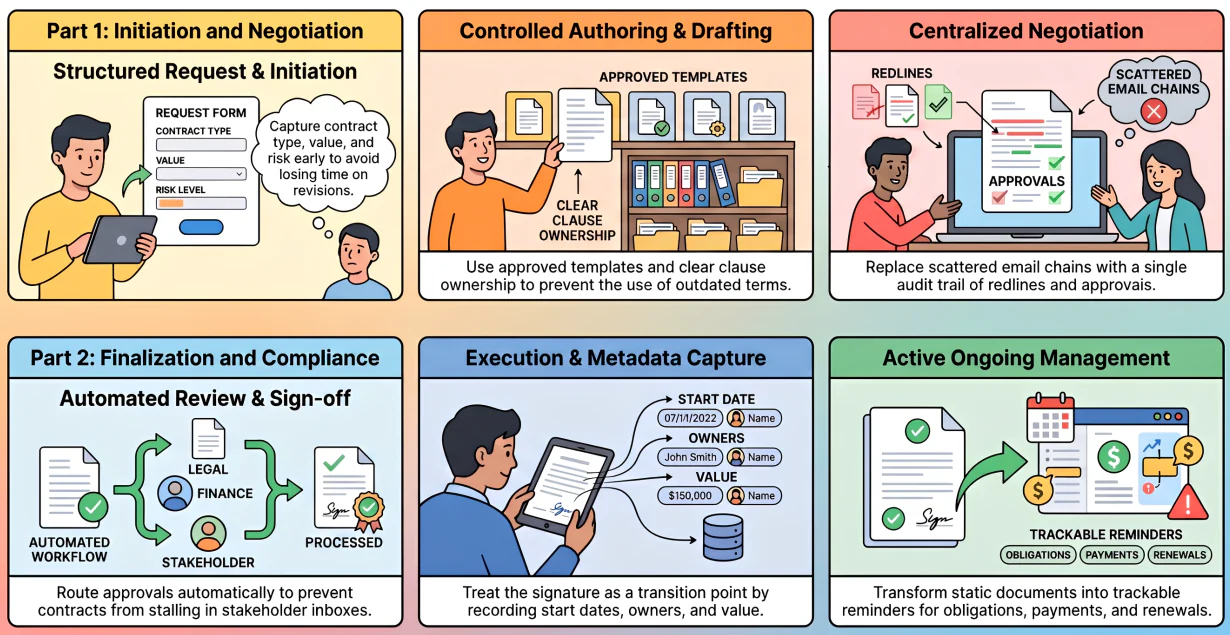
Most CLM processes follow six core stages from initial request through to renewal. Each stage carries its own risk if left unmanaged, and the gaps between stages are often where contracts go wrong.
1. Contract request and initiation
The lifecycle starts when a team identifies the need for a new contract, whether from procurement, sales, finance, or project management. A structured request should capture the contract type, counterparty, value, risk level, and approval requirements.
Incomplete requests lose time early. When legal, procurement, and finance receive different details, the contract cycles through revisions before drafting even begins.
2. Contract authoring and drafting
Contracts are created using approved templates, standard clauses, and defined risk controls. For repeatable agreements, templates reduce drafting time and help avoid inconsistent terms across similar contracts.
Clause ownership should be clear from the start. Without a controlled drafting process, teams often reuse old documents that no longer reflect current policy or regulation.
3. Negotiation and collaboration
Negotiation covers redlines, comments, and version changes. When teams exchange files through email, it quickly becomes unclear which version is current and who approved what.
For high-value contracts, a clear audit trail matters. CLM keeps version history and approval status in one place rather than scattered across inboxes.
4. Review, approval, and sign-off
Approval workflows ensure the right stakeholders review the contract before signature. Low-risk contracts may need one sign-off, while high-value agreements may require legal, finance, and executive review.
Manual approval processes stall when contracts sit in inboxes or proceed without proper sign-off due to deadline pressure. CLM routes approvals automatically and records every decision.
5. Contract execution and e-signature
Most businesses now use e-signature tools to complete contracts faster across locations. The shift CLM brings is treating execution as a transition point, not an endpoint.
Once signed, a contract should move into a repository with metadata including start date, end date, renewal date, owner, and value. Without that setup, post-signature management has no foundation.
6. Ongoing management, compliance, and renewal
Post-signature management is the most operationally important stage and the most commonly neglected. Obligations, payment terms, service levels, and renewal dates all need active monitoring, not passive storage.
CLM turns those obligations into trackable reminders rather than documents sitting in a shared folder until a dispute or audit forces a search.
Key Benefits of Contract Lifecycle Management
CLM improves speed, visibility, compliance, and financial control. The Department of Finance connects contract management with value-for-money outcomes, and the same principle applies to private companies managing supplier, customer, and project obligations.
- Faster contract turnaround: Standard templates, guided intake, and automated approvals reduce the time teams spend chasing information before work can begin.
- Improved risk visibility: Managers get a clearer view of high-risk contracts, non-standard terms, and deadlines that need action before they become problems.
- Centralised contract repository: Teams can find signed agreements, amendments, and renewal data without searching email threads or asking across departments.
- Reduced revenue leakage: Missed renewals, unapplied price increases, and unenforced service obligations become visible before they turn into financial losses.
For businesses evaluating tools to support these outcomes, this overview of contract management software covers what to look for when comparing platforms.
Spotting a missed renewal or an unapplied price increase manually means searching through contracts one by one. Hashy AI can surface these risks automatically.






"Contracts that are not actively monitored after signing are where businesses lose money quietly. Missed renewals, unapplied price increases, and unchecked obligations add up before anyone notices."
CLM and Australian Compliance Considerations
Australian businesses need contract processes that reflect local procurement, consumer, and small-business protections. Gaps in contract visibility can create regulatory exposure, not just operational friction.
Changes to unfair contract terms law took effect on 9 November 2023, introducing penalties for breaches. Protections apply where at least one party has fewer than 100 employees or less than $10 million turnover, covering many B2B contracts.
For government contracts, the Commonwealth Procurement Rules require post-award accountability. The Payment Times Reporting Scheme also requires large businesses to report payment timelines to small suppliers, and CLM helps keep those obligations traceable.
CLM vs ERP: Standalone System or Integrated Solution?
The right choice depends on where contract value is created and how contracts connect with broader business operations.
Standalone CLM works well when the main challenge is legal workflow, clause control, and high-volume negotiation. If contract activity sits mostly within the legal team, a dedicated CLM tool is often sufficient.
ERP-integrated CLM becomes more practical when contracts affect purchasing, billing, inventory, or project costing. For companies at that stage, the question shifts from which CLM tool to use to whether contract management should sit inside a broader ERP environment instead.
CLM Use Cases for Australian Businesses
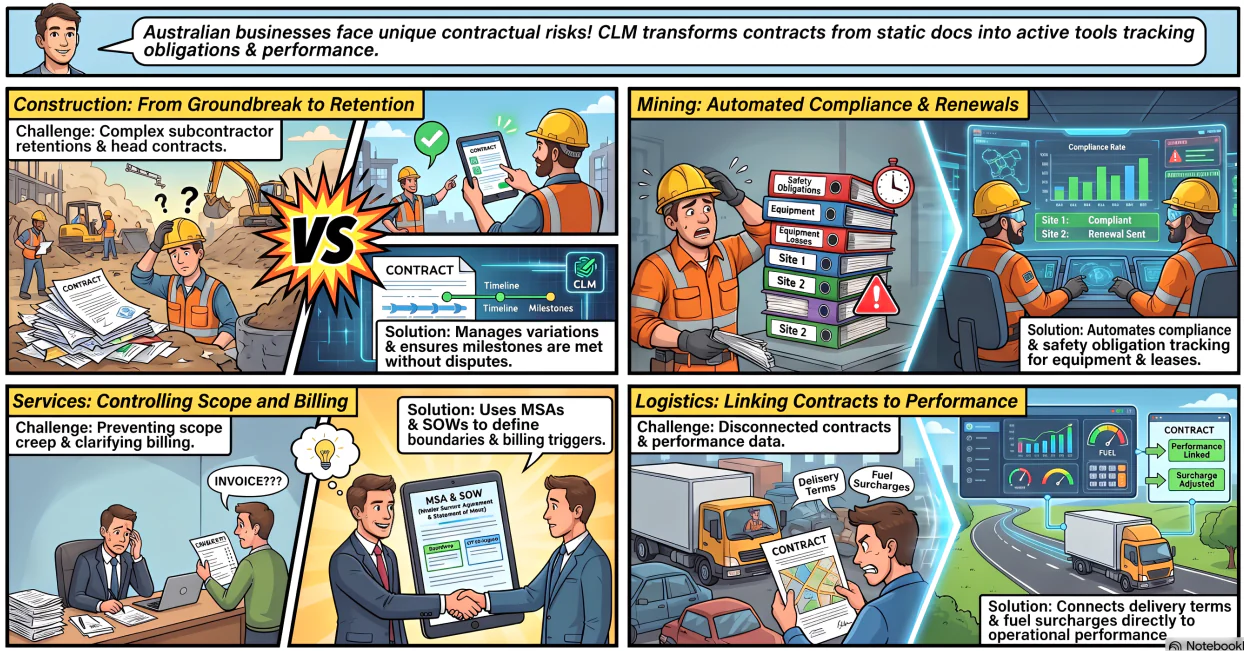
CLM applies wherever contracts carry financial, operational, or compliance obligations. How it is used varies significantly by industry.
1. Construction and infrastructure
Construction businesses manage head contracts, subcontractor agreements, equipment hire, variations, and retention terms across project phases. CLM keeps obligations visible and reduces disputes from missed milestones or unclear document ownership.
2. Mining and resources
Mining companies manage long-term supplier agreements, maintenance contracts, equipment leases, and contractor safety obligations across multiple sites. CLM keeps renewal dates and compliance evidence visible without manual tracking.
3. Professional services and consulting
Professional services firms rely on SOWs, MSAs, retainers, and confidentiality clauses where billing triggers and scope boundaries matter. CLM controls scope creep and keeps approval history clear before disputes arise.
4. Logistics and transport
Logistics businesses manage carrier contracts, SLAs, delivery terms, fuel surcharge clauses, and warehouse agreements. CLM connects contractual obligations with operational performance rather than treating them as separate records.
How to Build a CLM Process That Works
Effective CLM implementation starts with process cleanup, not software selection. Getting the foundations right before choosing a system saves significant time during rollout.
- Audit your current contract processes. Map where contracts are created, reviewed, approved, signed, and stored. Identify where delays happen and where records are incomplete or scattered across tools.
- Define which contracts need formal workflows. Not every agreement needs the same level of control. Focus first on high-value, high-risk, or high-volume contracts such as supplier agreements, customer contracts, subcontractor agreements, and leases.
- Standardise templates and approval rules. Before moving into software, agree on templates, clauses, approval thresholds, and exception rules across legal, finance, and procurement. Digitising a messy process only makes the mess harder to fix.
- Migrate contract data with proper metadata. Migration is not just uploading files. Each contract needs metadata such as owner, start date, end date, renewal date, value, counterparty, and status to be searchable and reportable.
- Connect CLM with operational workflows. Once the core process is stable, connect contract data with ERP, procurement, CRM, or project management workflows so teams can act on obligations rather than only storing documents.
Conclusion
Contract lifecycle management gives businesses control over the full contract journey, from request and drafting through to renewal and close-out. The strongest CLM process is not just about storing documents but keeping obligations, approvals, and compliance evidence traceable across departments.
For businesses where contracts connect with procurement, finance, or project operations, book a free consultation to see how HashMicro can support your contract management needs.
Frequently Asked Questions
CLM manages contract creation, approval, execution, obligations, and renewals. CRM manages customer relationships, leads, opportunities, and account history. The two can work together when customer contracts need to connect with sales pipelines and billing terms.
CLM is broader than basic contract management. Contract management often focuses on storing and monitoring signed agreements, while CLM covers the full process from request and drafting through approval, execution, compliance, renewal, and close-out.
Yes. CLM can integrate with ERP or accounting software when contract terms affect purchasing, billing, supplier payments, project costing, or renewal management. For many businesses, integration is what turns contract data into operational action.
Yes, especially when a business manages many supplier, customer, project, or service contracts. SMEs may not need complex enterprise CLM features, but they still benefit from renewal reminders, centralised storage, approval controls, and clear contract ownership.
The best CLM software depends on whether the business needs a standalone legal workflow platform or contract management connected with ERP operations. Businesses with contracts tied to procurement, finance, or projects should evaluate whether an integrated solution delivers more value than a standalone tool.