





Contract management in procurement is the process of overseeing supplier contracts after award, ensuring every party delivers exactly what the agreement promised. Most Australian businesses sign supplier contracts and then file them away. Value won during sourcing leaks out through missed milestones, scope creep, and weak follow-up over the contract term.
This article covers the full five-stage process, the roles involved, Australian compliance requirements, how procurement contract management differs from CLM, the metrics that matter, and how ERP software connects it all.
Key Takeaways
Contract management in procurement covers executing and monitoring supplier contracts to protect value, manage risk, and meet obligations.
The procurement contract management process runs five stages, from pre-award planning and supplier qualification through to closeout.
Contract management in Australia is shaped by Commonwealth Procurement Rules, ABS supplier cost data, and multi-jurisdiction compliance needs.
ERP software supports procurement contract management by centralising data, automating milestones, and linking contracts to finance workflows.

What Is Contract Management in Procurement?
Contract management in procurement is the process of executing and monitoring supplier contracts to protect value, manage risk, and meet obligations from award through to renewal or closeout. The contract is the starting line, not the finish. The real work is holding the supplier to every clause, milestone after milestone, until the term ends or the agreement renews.
Contract management sits inside the wider procurement process, not beside it. It picks up straight after award, turning signed terms into delivered goods, services, and outcomes your business can rely on. Contract administration is a task set within the broader discipline.
Contract management, as a part of CLM, covers filing documents, logging variations, and processing payments, but stops well short of performance monitoring or commercial judgement. Contract management encompasses administration and adds supplier relationship management, risk control, and the ongoing decisions that determine whether a contract delivers its intended value.
"Contract management in procurement is the discipline that determines whether sourcing value is ever actually realised. The signed contract is just the starting point."
The Procurement Contract Management Process
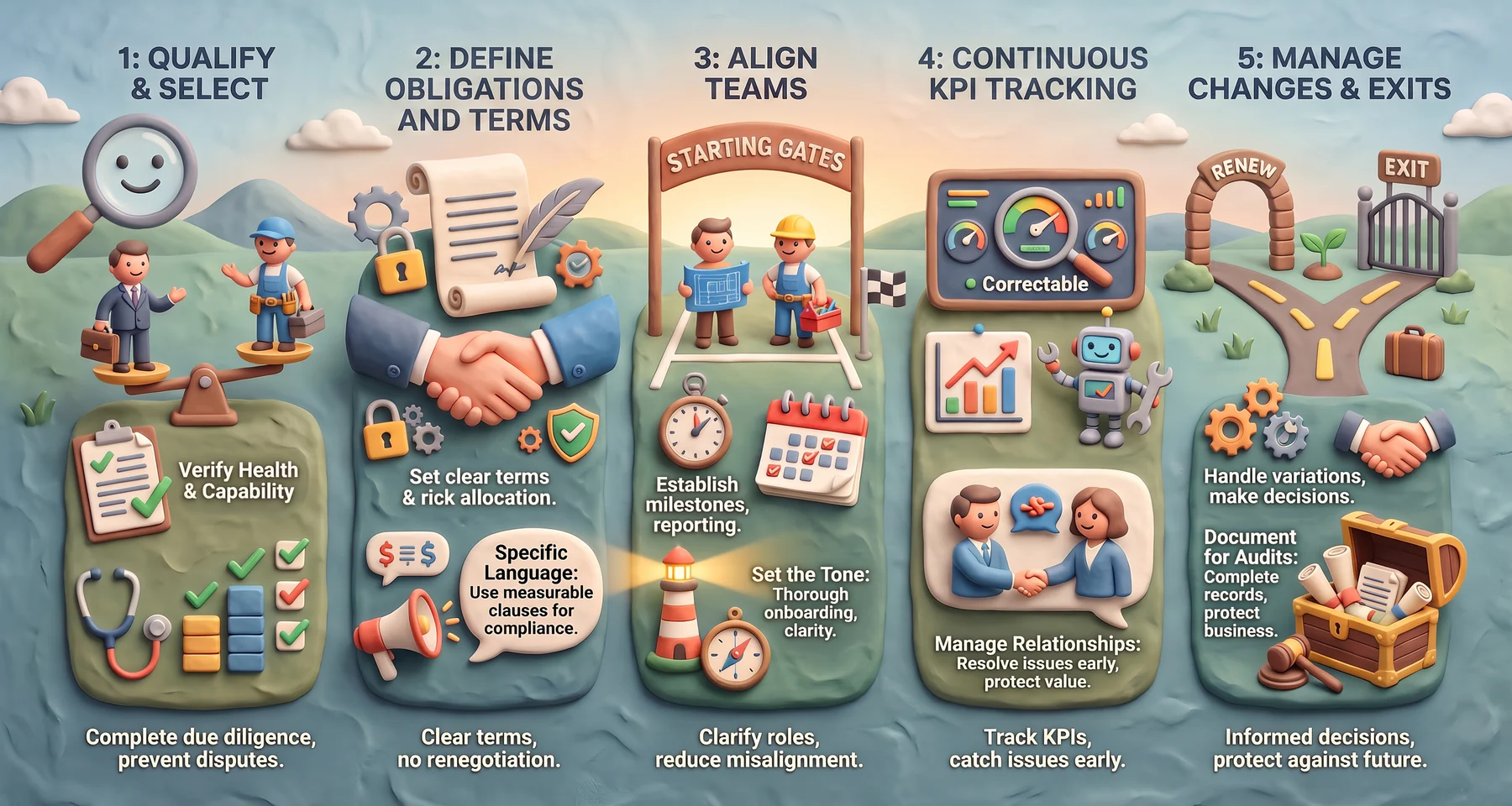
The procurement contract management process moves through five stages, from pre-award planning to closeout. Gaps at any one stage create risks that compound across the remainder of the contract term.
1. Pre-award planning and supplier qualification
Before any contract is drafted, you qualify suppliers, complete due diligence, and select the right contract type. Decisions made here shape every stage that follows and prevent most disputes before they arise.
Supplier qualification should cover financial health, references, and operational capability. A supplier that looks suitable on paper but cannot sustain delivery creates problems no contract clause can fully remedy.
2. Contract drafting and negotiation
This stage sets the obligations, payment terms, service levels, and risk allocation between both parties. Clear, measurable clauses make performance straightforward to track once delivery begins.
Vague language at this stage becomes costly later. Every key obligation should be specific enough that both parties can check compliance without requiring interpretation or renegotiation mid-contract.
3. Contract execution and supplier onboarding
Once signed, the contract moves into execution. A structured onboarding process aligns both teams on milestones, contacts, reporting cadences, and escalation paths before any delivery begins.
A thorough onboarding session reduces the risk of early misalignment. It gives the supplier clarity on what good performance looks like and sets the tone for the working relationship from day one.
4. Active performance monitoring and supplier management
This is where contract value is protected or lost. You track agreed KPIs, hold regular milestone reviews, manage the supplier relationship, and resolve issues before they escalate into disputes.
Performance monitoring should run continuously, not only when problems surface. Regular reviews catch underperformance early, while it remains correctable without formal escalation procedures.
5. Contract renewal, variation, and closeout
Contracts change and eventually end. This stage handles approved variations, makes renewal or exit decisions, and closes completed work with documentation that can withstand any later review or audit.
Closeout is frequently rushed or skipped entirely. Thorough records at this stage protect your business in future disputes, audits, and any re-tender process involving the same supplier. ㅤ
Key Roles in Procurement Contract Management
Three roles run procurement contract management: the contract owner, the contract manager, and the contract administrator. Clear boundaries between them prevent accountability gaps and missed obligations.
1. Contract owner
The contract owner holds commercial accountability. They approve major decisions, sign off variations, and act as the escalation point when performance or risk issues become serious.
This role operates above day-to-day delivery. The contract owner focuses on whether the contract continues to serve the business strategically, not whether each day's paperwork is in order.
2. Contract manager
The contract manager runs the day-to-day. They track performance, manage the supplier relationship, flag risks early, and keep delivery aligned with the agreed terms throughout the contract term.
Strong contract managers are proactive rather than reactive. They read early warning signs in delivery data and raise issues before they reach the contract owner or require formal remediation.
3. Contract administrator
The contract administrator maintains the records. They handle documentation, log variations, coordinate payments, and ensure nothing falls through gaps in the paper trail.
Accurate administration is the foundation that all other roles depend on. Without clean records, even strong supplier performance is difficult to prove when disputes or audits arise. ㅤ
Common Challenges in Procurement Contract Management
Most contract management failures trace back to five recurring problems. Recognising them early lets Australian businesses build controls before contract value starts to erode.
1. Poor contract visibility and documentation gaps
Contracts scattered across inboxes and shared drives create blind spots. Teams miss renewal deadlines, lose track of obligations, and cannot answer basic questions when audits arrive. Centralised contract storage is the first step toward real visibility. Without it, teams rely on individual memory, which creates single points of failure across the procurement function.
2. Supplier performance failures after contract signing
The gap between what was promised and what is delivered is where contracts lose value. Without active monitoring, underperformance becomes the quiet default rather than the exception. Catching performance gaps early keeps remediation manageable. Left unchecked, underperformance compounds into delivery failures, formal disputes, and reputational damage for both parties.
3. Contract variation and scope creep
Small, undocumented changes accumulate quickly. Unmanaged variations inflate cost, blur accountability, and gradually pull the contract away from the value for money it was designed to deliver. Every variation should follow a formal approval process, regardless of how minor it appears. Informal agreements create gaps that are very difficult to close once the relationship starts to deteriorate.
4. Compliance and regulatory obligations across Australian jurisdictions
Businesses operating nationally face different state procurement frameworks alongside Australian Consumer Law obligations. Missing these requirements creates legal exposure and erodes supplier trust. A consistent internal compliance process that respects local rules in each state is the only practical way to manage multi-jurisdiction contracts without significant rework and added risk.
5. Renewal complexity and missed contract expiry
Auto-renewals and forgotten expiry dates lock businesses into poor terms. A missed expiry can cost far more than the value the original negotiation ever delivered. Renewal should be a deliberate commercial decision, not an accidental default. A 90-day review trigger before every expiry gives your team time to renegotiate, re-tender, or exit on the right terms. ㅤ
Contract Management in Procurement in Australia
In Australia, the public sector sets the standard for contract management discipline. The Australian Government awards around 70,000 contracts worth between $50 billion and $70 billion each year. Private businesses face the same pressures at a smaller scale. Data from the Australian Bureau of Statistics shows supplier costs are a significant share of total operating expenses across most industries.
The Commonwealth Procurement Rules (Rule 2.10) tie contract management practice directly to value for money. Businesses supplying government must meet these obligations or risk contract termination. Even outside government supply chains, the same principles apply. Binding milestones, regular performance reviews, and formally approved variations protect value for any Australian business.
Australian Consumer Law and state-level regulations require businesses to maintain accurate contract records. Contracts, variations, and performance notes must remain accessible and audit-ready. ㅤ
Contract Management vs Contract Lifecycle Management (CLM)
Contract management is the discipline of running supplier contracts well. On the other hand, contract lifecycle management, or CLM, is the technology that automates it. Confusing the two leads businesses to buy software when the real problem is a weak process, or to delay a platform when contract volume has made manual tracking untenable.
1. What separates procurement contract management from CLM
Procurement contract management is the human work: tracking performance, managing supplier relationships, approving variations, and protecting commercial value across the full contract term. CLM is the software layer that stores contracts, sends automated alerts, routes approvals, and reports on portfolio compliance.
It speeds up execution but cannot substitute for sound process. The practice defines what good looks like and the system scales it. No CLM platform compensates for poorly defined roles, weak onboarding, or a team that has not established what to monitor.
2. When your business needs a CLM platform rather than better processes
A small team managing a handful of supplier contracts rarely needs dedicated software for managing contract. Good process, a shared contract register, and calendar alerts cover most of what matters. High contract volume, complex multi-party obligations, and operations across multiple sites are the signals that manual tracking has reached its limit. ㅤ
How to Measure Procurement Contract Management Performance
You cannot improve what you do not measure. Strong contract management tracks a focused set of metrics across supplier performance, compliance, and value rather than chasing every available number.
1. Supplier performance KPIs for procurement contracts
Track on-time delivery rate, defect rate, service level compliance, and supplier responsiveness. Together, these indicators show whether a supplier is performing or quietly falling behind.
Set a review cadence for each KPI at the outset, not after problems surface. Monthly supplier scorecards keep performance visible and give both parties clear data to discuss at each milestone review.
2. Contract compliance and risk metrics
Watch obligation completion rate, variation frequency, and dispute volume. Rising numbers in any of these are early warnings that a contract is drifting from its original terms.
A single escalating variation request is rarely isolated. When requests increase alongside slipping milestone completion, the root cause is usually poor onboarding or unclear obligation drafting.
3. Cost savings and value-for-money measures
Measure realised savings against the value targeted at contract award. This mirrors the Commonwealth value-for-money test and confirms the contract is still earning its keep.
Track cumulative variation cost against the original contract value. A contract that started on budget but drifted through unmanaged variations is a performance failure, even if delivery is technically on time.
How ERP Software Supports Procurement Contract Management

ERP software connects contract management to the systems that surround it. Unlike standalone CLM tools, an ERP links contracts to procurement, finance, and operations in one place, closing the data gaps that cost value.
1. Centralising contract data within your business systems
An enterprise management platform holds every contract, term, obligation, and milestone in a single source of truth. No more scattered spreadsheets, missed renewal dates, or version confusion across teams.
Centralised storage also supports audit readiness. When every record lives in one system, responding to a compliance query or supplier dispute takes minutes rather than days of document searching.
2. Automating milestone tracking and payment schedules
Automated reminders, approval workflows, and invoice matching keep milestones and payments on track. The system flags issues before they become missed dates or unintended overpayments.
Manual tracking relies on individuals remembering to act. Automated contract management alerts remove that dependency and ensure the business responds to contract events regardless of staff changes or workload.
3. Connecting contract performance to procurement and finance workflows
An ERP links purchase order, contract, invoice, payment, and performance data in one connected chain. Standalone CLM tools leave gaps between these systems that create reconciliation work and blind spots.
With everything connected, procurement and finance work from the same data. Decisions on renewal, variation, or exit are made on current numbers, not lagging reports from disconnected platforms. ㅤ
This connected data also gives Hashy the context to surface contract risks, flag overdue obligations, and summarise financial exposure before renewal or variation decisions.






Conclusion
Contract management in procurement is where sourcing value is protected or lost. For Australian businesses, that comes down to a clear process, defined roles, and the right system.
When contract data sits inside a connected ERP, procurement, finance, and operations all work from one source of truth. Explore HashMicro's contract management software to see it in action. To learn further regarding this topic, you can book a free consultation with us and scale your operations today.
Frequently Asked Questions
The four pillars are contract creation, execution, monitoring, and analysis. Together they move a contract from drafting through delivery to review, keeping obligations met and value protected across the full term.
The 5 C's are clarity, completeness, consistency, compliance, and commitment. They describe a well written contract: clear terms, full scope, consistent language, lawful obligations, and genuine commitment from both parties.
Strong negotiation, clear communication, attention to detail, and commercial judgement. They also need risk awareness and relationship skills to hold suppliers to account while keeping the partnership productive.
Project procurement management sits inside a single project and ends when it closes. Contract management runs every supplier contract across the business, including ongoing operational agreements beyond any one project.
Yes. Even without a dedicated contract manager, small businesses lose money to missed renewals and weak supplier performance. A simple, consistent process protects value and reduces legal and compliance risk.