







Contract management software gives Australian businesses a centralised platform to create, track, and enforce agreements throughout their lifecycle. It replaces inefficient manual processes with automated workflows.
Australian compliance requirements make this critical. The Commonwealth Procurement Rules, the Australian Consumer Law, and state-based construction legislation all impose strict obligations.
This article reviews the 10 best contract management software options available in Australia for 2026, covering each platform’s characteristics and how each addresses the needs of Australian businesses.
Key Takeaways
Contract management software automates every stage of a contract's life, using AI to turn static agreements into actionable business data.
Australian contract compliance covers Commonwealth Procurement Rules, Consumer Law, construction standards, and e-signature legality.
Ten contract management platforms serve different needs, from construction-specific tools to ERP-integrated systems for Australian businesses.

Best Because
A construction-focused CLM built for Australian builders, handling progress claims, variations, and ABIC/HIA subcontract workflows.



Best Because
A browser-native CLM platform for fast-growing tech businesses, enabling real-time collaborative contract creation and negotiation.
Best Because
An enterprise CLM with advanced workflow automation and AI-driven insights, built for high-volume complex contract operations.
What Is Contract Management Software?
Contract management software, also called contract lifecycle management software (CLM), is a digital platform that automates every stage of a contract's life.
It covers authoring, negotiation, approval, execution, renewal, and automated agreement tracking throughout the contract lifecycle. By centralising these processes, it reduces silos between legal, procurement, and sales teams.
Modern CLM platforms go beyond document storage. They use artificial intelligence to extract key metadata, including expiry dates, liability caps, and termination notice periods.
This turns static contracts into searchable, actionable data that the business can use proactively rather than reactively.
Collaborative editing and version control are also core features. Stakeholders work within a single secure environment rather than passing multiple document versions by email.
Every change is recorded in a full audit trail, which supports compliance and simplifies due diligence during internal or external audits.
That contract data becomes more useful when it triggers action before deadlines are missed. The banner below shows how Hashy AI identifies key clauses, flags upcoming renewals, and prepares follow-up tasks.






Why Most CLM Comparisons Don’t Work for Australian Businesses
Most online comparisons of contract lifecycle management software target North American or European audiences. They cover features but miss the specific requirements Australian businesses face. Here is where the gaps consistently appear:
- Commonwealth Procurement Rules (CPR): Any business supplying goods or services to the Australian Government must fulfill CPR compliance. Software designed for the US market rarely accounts for this, leaving businesses with incomplete guidance.
- Construction contract standards: The Australian construction industry relies on ABIC and HIA contract suites, which follow highly structured formats with specific legal logic. Generic CLM tools require costly customisation to accommodate these.
- Data sovereignty: The Australian Privacy Principles (APP) and the Security of Critical Infrastructure Act (SOCI) can apply depending on the entity and data involved. Some businesses may require Australian data residency or specific contractual safeguards. Requirements depend on the entity, data type, customer contract and applicable law.
- Local support coverage: Legal teams in Sydney, Melbourne, and Perth cannot afford multi-hour delays waiting for support desks operating in different time zones.
Who Needs Contract Management Software?
As a business grows, the complexity of its agreements grows with it. Mid-market and enterprise-level businesses in Australia find that legal contract management software is essential for efficient operation.
1. In-house legal & compliance teams
Legal departments are typically the primary advocates for CLM adoption. They use pre-approved clause libraries to allow other teams to generate contracts within safe parameters, reducing legal bottlenecks.
Additionally, the ability to search a full contract repository for specific clauses, such as force majeure provisions or data privacy obligations, is vital when responding to regulatory changes quickly.
2. Procurement & finance teams
For procurement teams, contract management supports procurement partner coordination, vendor performance tracking, and cost control. A CLM lets them track whether suppliers meet contractual obligations and verify agreed discounts or rebates.
Finance teams benefit from integrating contract data with ERP systems. This enables more accurate forecasting and automated billing based on contractual milestones, preventing unauthorised spending.
3. Operations & project managers
Project managers need clear visibility into deliverables, timelines, and responsibilities. Contract management software surfaces these obligations from the contract record, removing the need for manual follow-up.
For long-term service agreements, the software can trigger tasks such as quarterly reviews or safety audits. This ensures active management throughout the contract’s duration rather than a sign-and-forget approach.
4. Construction & property businesses
The Australian construction sector is one of the most contract-intensive industries in the country. Subcontractor networks, supplier agreements, and consultant engagements create significant exposure to legal disputes.
Construction firms needs a contract lifecycle management software that handles progress claims, variations, and security of payment legislation.
A CLM ensures head contract terms flow down correctly to all subcontractors, protecting the main contractor’s margins and legal position.
"CLM platforms have permanently changed how businesses interact with their contracts. Agreements are no longer static documents filed away after signing. Every clause, deadline, and obligation across an entire contract portfolio becomes real-time intelligence."
Australian Contract Compliance: What Your Software Must Handle
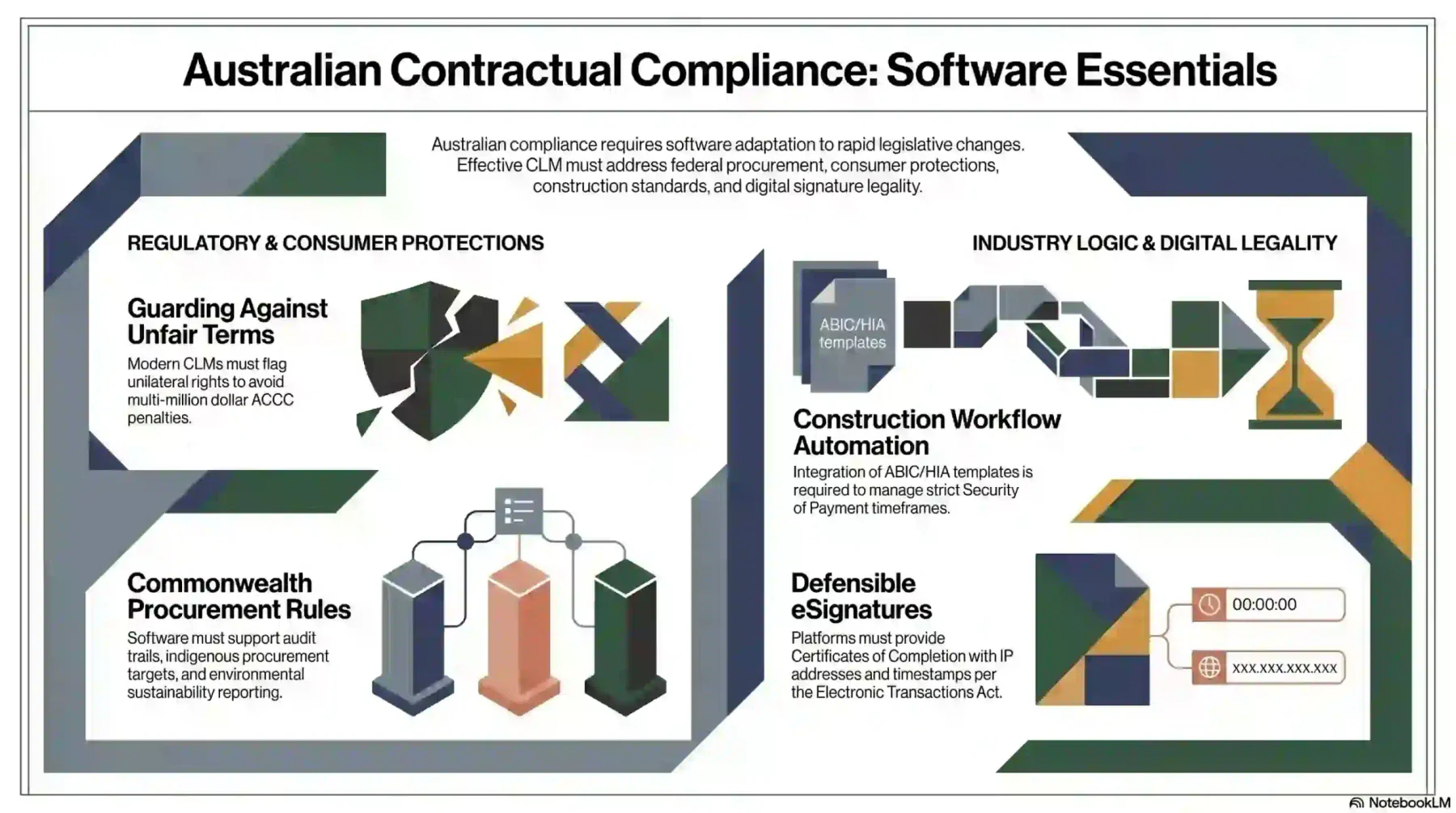
Compliance in Australia is multifaceted. Federal laws and state-specific regulations can change quickly, so contract management software must be flexible enough to accommodate ongoing legislative updates.
1. Commonwealth Procurement Rules (CPRs) for government suppliers
Any business providing goods or services to the Australian Government must comply with the CPRs. These rules require procurement to achieve value for money and maintain ethical conduct throughout the process.
Software used in government contracting must support rigorous documentation, audit trails, and reporting capabilities.
It should also facilitate tracking of indigenous procurement targets and environmental sustainability criteria, both of which are now mandatory components of many government tender evaluations.
2. Australian Consumer Law (ACL) contract obligations
The ACL includes strict provisions on unfair contract terms (UCT), particularly in standard form contracts with small businesses and consumers.
In late 2023, penalties for including such terms increased significantly, with fines reaching millions of dollars under updated ACCC unfair contract terms guidance.
A modern CLM helps legal teams flag potentially unfair clauses across their template library. Unilateral rights to vary terms and excessive termination fees are common examples of what to review.
3. Construction contracts: ABIC & HIA standards
In the building industry, standardised contracts from the Australian Building Industry Contracts (ABIC) and the Housing Industry Association (HIA) are widely used.
These contracts have specific logic around liquidated damages, extensions of time, and practical completion. A CLM for Australian construction firms must ingest these templates and automate the associated workflows.
This includes the formal notification processes required under state-based Security of Payment Acts, which carry strict statutory timeframes that cannot be missed.
4. E-Signature legality in Australia
The Electronic Transactions Act 1999 (Cth) and its state-based counterparts establish the legal framework for electronic signatures in Australia.
However, certain document types carry additional requirements. Deeds and documents requiring witnessing in specific jurisdictions, for example, go beyond a standard eSignature process.
A compliant platform must provide a Certificate of Completion that includes IP addresses, timestamps, and authentication methods. This evidence ensures that signatures are legally defensible.
HashMicro’s pricing varies with contract volume, workflow complexity, and required integrations. The banner below lets you review pricing options and request an estimate suited to your contract processes.
How We Evaluated The Selected Contract Management Software
This comparison is intended to help Australian businesses shortlist contract management software, not to declare one universal winner. Because HashMicro publishes this article and is included in the comparison, we disclose that a reader may request a HashMicro demo. We have therefore used the same criteria across the selected platforms, stated relevant limitations, and recommend validating features, security, integrations and total implementation cost with each provider.
We shortlisted and compared the selected platforms using these criteria:
- Core contract-lifecycle coverage: repository, authoring, approval workflows, e-signature, obligation and renewal tracking, and audit trail.
- Australian relevance: support for applicable Australian workflows, compliance requirements and local operating needs, without treating software as a substitute for legal advice.
- Integration evidence: publicly documented CRM, ERP, finance, productivity or API connections, including plan, region or implementation limitations.
- Pricing transparency: published pricing or a clearly stated quote-based model, plus visible implementation or usage assumptions.
- Best-fit use case: business size, industry, contract complexity and teams the platform is designed to support.
- Stated limitations: material capability, usability, deployment, integration or support constraints identified in public documentation.
10 Best Contract Management Software in Australia for 2026
The following platforms represent contract management solutions available to Australian businesses in 2026, evaluated by their primary strengths and target market fit. This is a use-case shortlist, not a complete market-share ranking. Products were included where we could document the stated criteria for Australian readers.
1. Procore
| Pros |
Cons |
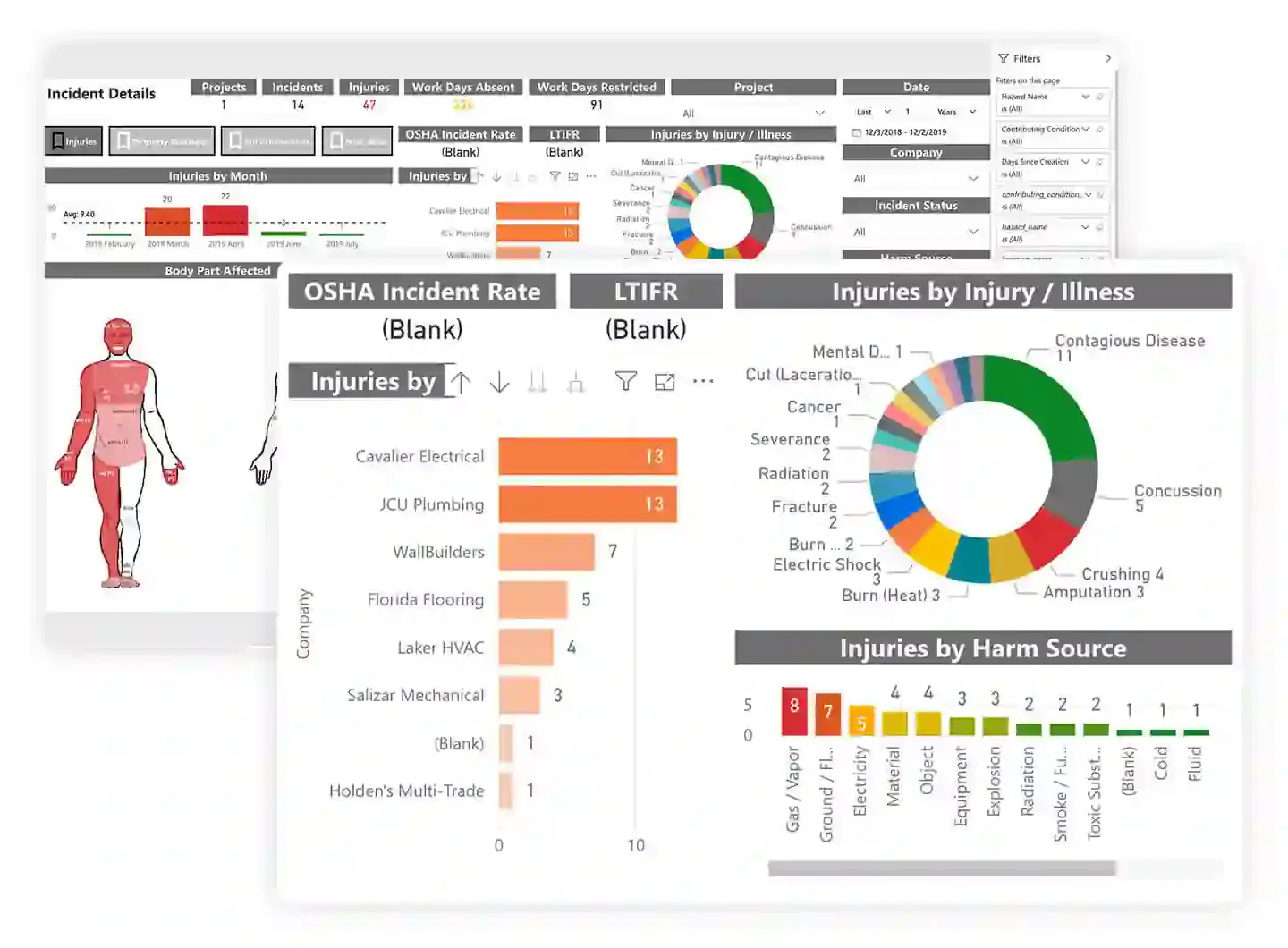
| ✓ Purpose-built for Australian construction workflows and regulatory requirements. | × Pricing is not transparent and can be high for smaller firms. |
| ✓ Real-time visibility for all project stakeholders, from the site manager to the CFO. | × Not suited for businesses operating outside the construction industry. |
| ✓ Strong integration with local financial packages and ABIC/HIA workflows. | × Implementation typically requires specialist support and dedicated onboarding time. |
Pricing: Contact Procore for a custom quote based on project value and user count.
2. HashMicro
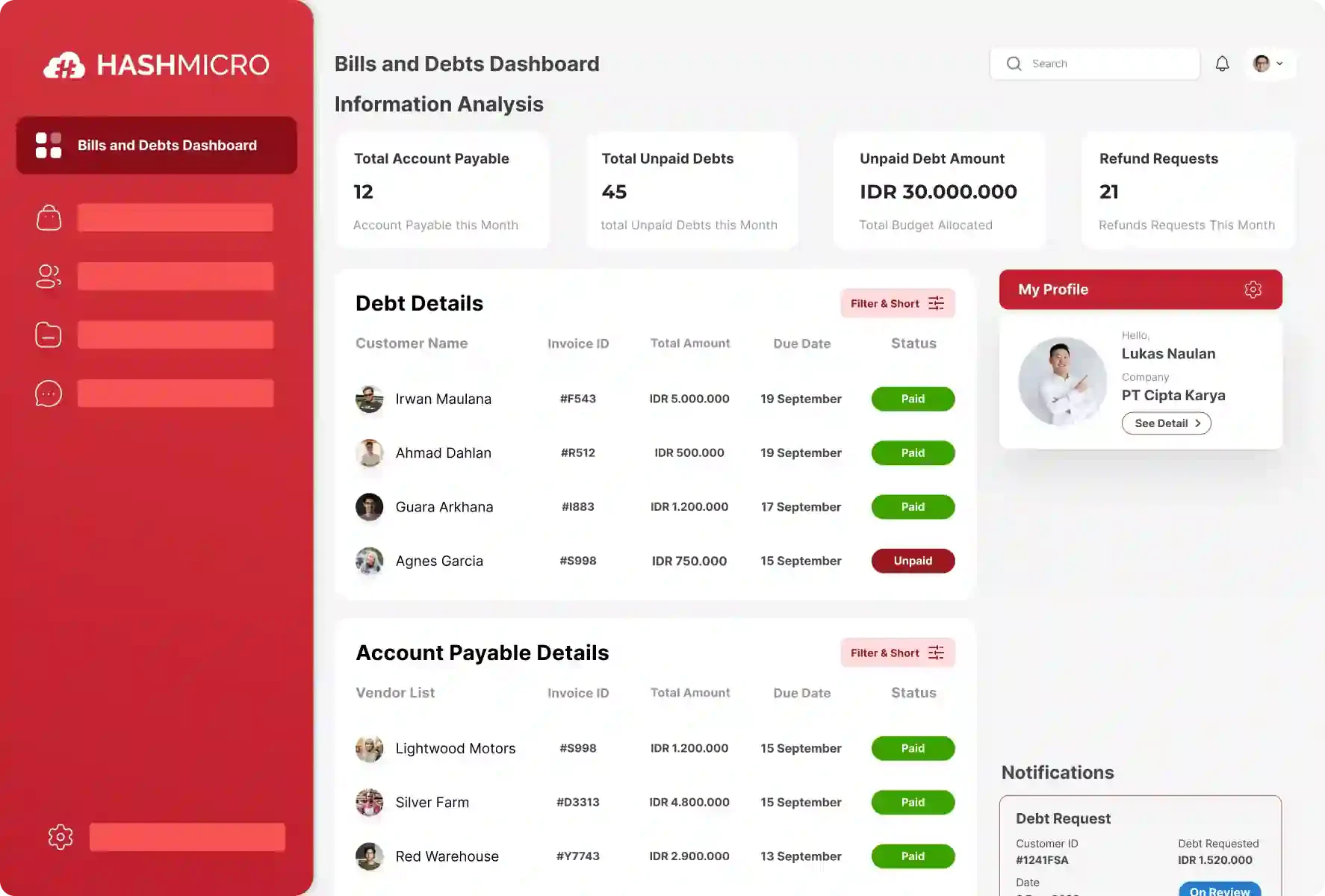
HashMicro is the only ERP-native CLM platform purpose-built for Australian mid-market operations. As an ERP-centric provider, it integrates contract management directly with business functions.
This is particularly valuable for businesses in logistics, manufacturing, and professional services where contract terms directly drive supply chain activity.
HashMicro is known for its user-friendly interface and its capacity for localisation to Australian businesses, such as GST handling and compliance reporting. It provides operational visibility that is hard to match for more than 3000 businesses.
Best for: Mid-market businesses in logistics, manufacturing, and professional services that need contract management integrated directly with ERP, finance, and operations.
| Pros |
Cons |
| ✓ Integrates contract management directly with ERP, finance, and operations in one platform. | × ERP-focused rather than feature-rich standalone CLM solutions. |
| ✓ Unlimited user model significantly reduces the total cost of ownership for growing teams. | × Requires internal implementation ownership, making it less suited to plug-and-play adoption. |
| ✓ Strong localisation for Australian compliance, including GST handling and reporting. | × Full automation capabilities are best unlocked with onboarding support. |
HashMicro’s pricing is structured around business size and module requirements. To find out what a tailored implementation would cost for your operation, explore HashMicro’s pricing options below.
3. Juro
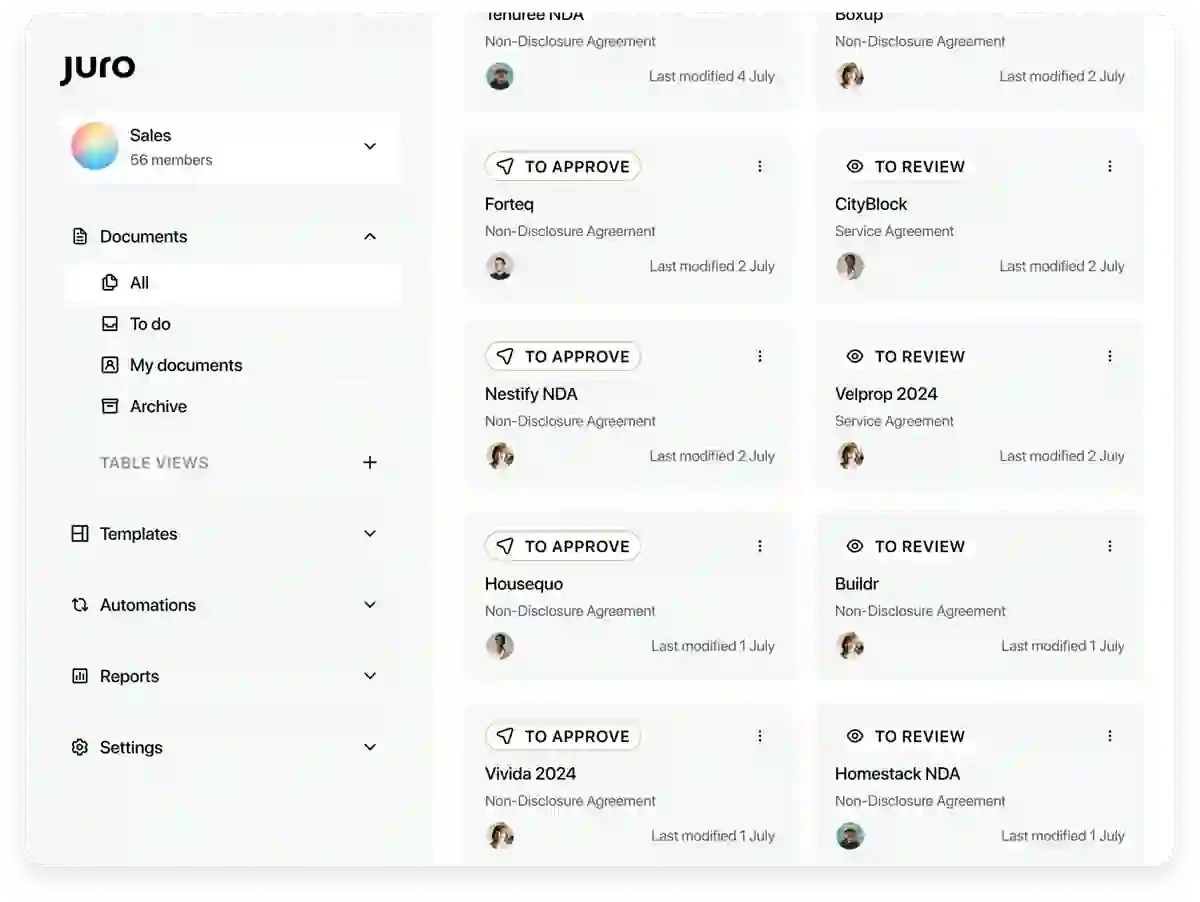
Juro has gained traction among Australian tech companies and fast-growing startups. Its browser-native approach allows users to build contracts directly in the platform rather than uploading Word documents.
This makes negotiation smoother, as both parties can comment and edit in real time within the same interface.
Legal teams also benefit from Juro’s self-serve automation, which allows sales teams to generate standard NDAs and service agreements without requiring manual legal involvement each time.
Best for: Tech companies and fast-growing startups that want browser-native contract creation and real-time collaborative negotiation without uploading Word documents.
| Pros |
Cons |
| ✓ Browser-native editing removes the Word document bottleneck entirely. | × Less suited to complex post-signature lifecycle management needs. |
| ✓ Self-serve automation reduces legal team involvement in routine contract generation. | × Limited depth for highly regulated or compliance-heavy industries. |
| ✓ Real-time collaborative negotiation interface works smoothly for both parties. | × Partner and implementation ecosystem in Australia is still developing. |
Pricing: Contact Juro for a custom quote. Plans scale with contract volume and user count.
4. Ironclad
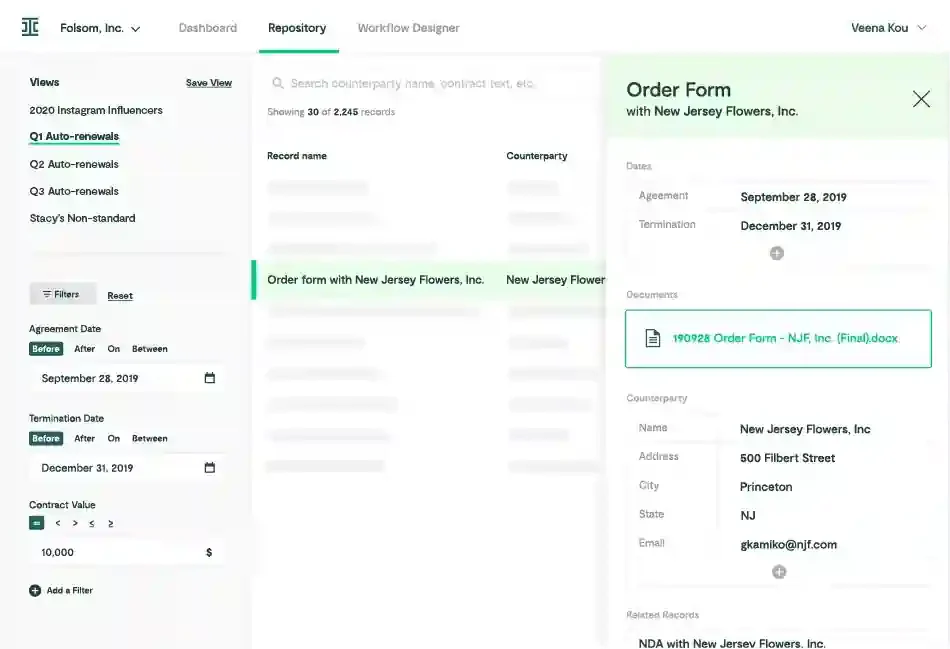
Ironclad is built for large enterprises with high contract volumes and complex approval hierarchies. Its Workflow Designer is one of the most powerful available, capable of mapping even the most complex processes.
In Australia, Ironclad is commonly used by large financial institutions and telecommunications businesses managing contracts across multiple business units.
Its AI-driven insights give executive leadership a high-level view of contract risk and opportunity, making it a governance tool as much as an operational one.
Best for: Large enterprises with high contract volumes and complex multi-team approval hierarchies that require enterprise-grade workflow automation.
| Pros |
Cons |
| ✓ Workflow Designer handles even the most complex multi-team approval hierarchies. | × Significant investment required in licensing and implementation. |
| ✓ AI-driven insights surface contract risk and opportunity across the full portfolio. | × Steeper learning curve for non-technical administrators. |
| ✓ Trusted by large financial institutions and telecommunications businesses in Australia. | × Scope and cost make it unsuitable for small or mid-market businesses. |
Pricing: Contact Ironclad for a custom enterprise quote.
5. DocuSign CLM
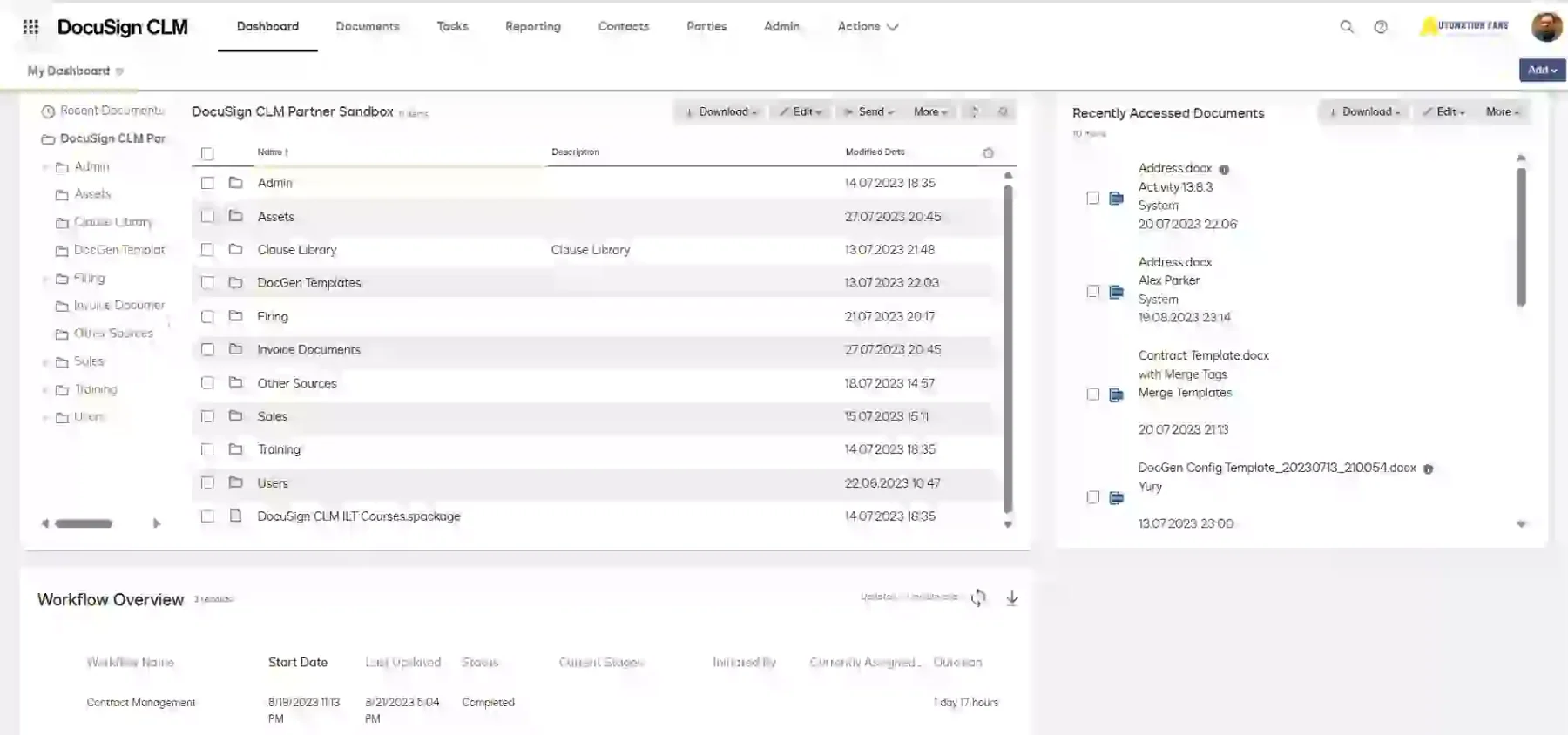
DocuSign CLM suits businesses already invested in the DocuSign ecosystem. It integrates the signing process directly with post-execution contract data management, keeping both in a single environment.
For Australian businesses, DocuSign’s long-standing regional presence means it understands local electronic transaction law.
It also offers local data residency options, which is a key requirement for regulated industries such as government and financial services.
Best for: Regulated industries and businesses already using DocuSign eSignature that need signing and post-execution contract management in one connected environment.
| Pros |
Cons |
| ✓ Seamless connection between eSignature and post-execution contract management. | × The CLM module is significantly more expensive than the eSignature tool alone. |
| ✓ Local data residency options available for regulated industries. | × Customisation can require specialist technical resources to configure. |
| ✓ Long-standing regional presence and understanding of Australian electronic transaction law. | × Support quality can vary depending on contract tier and region. |
Pricing: Contact DocuSign for a custom CLM quote. Pricing varies by modules and user count.
6. PandaDoc
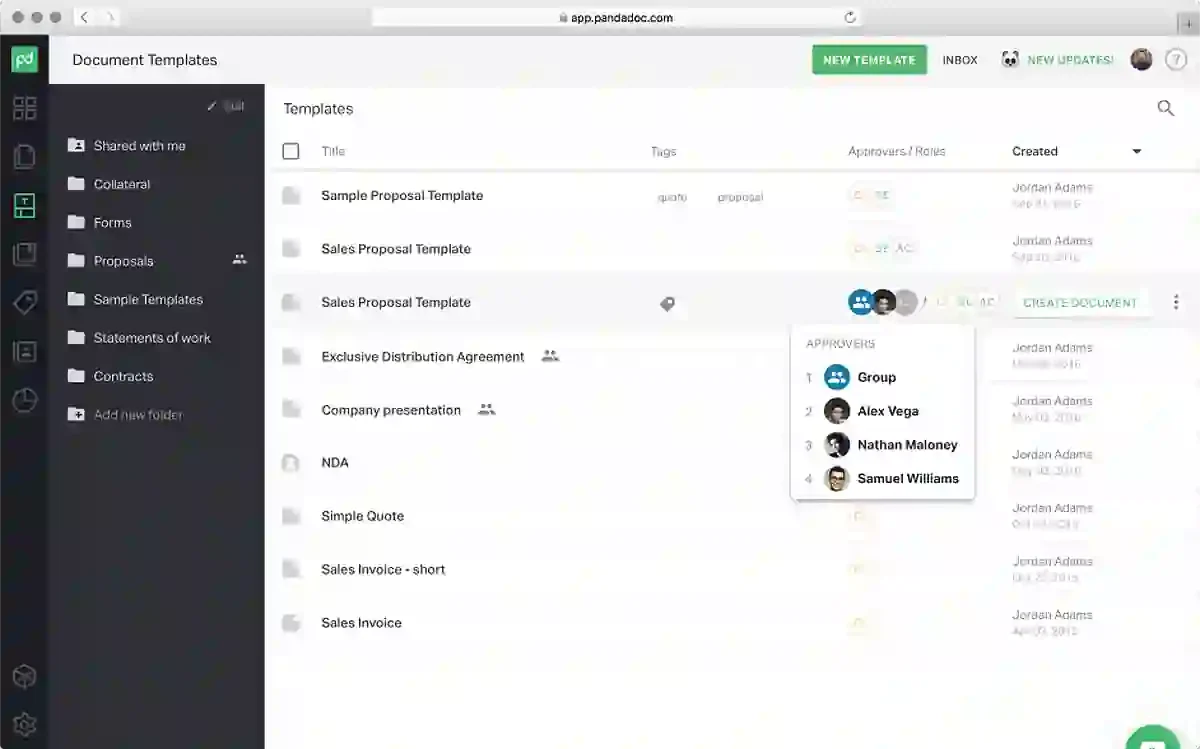
PandaDoc is favoured by sales and marketing teams across Australia. It focuses on the front end of the contract lifecycle, enabling teams to create professional proposals that convert directly into agreements.
Its CRM integrations with Salesforce and HubSpot are well regarded. While it lacks some of the deep post-signature management features, its speed and ease of use make it effective for B2B service providers.
Best for: B2B sales and marketing teams that need to produce professional proposals quickly and convert them directly into signed agreements.
| Pros |
Cons |
| ✓ Fastest proposal-to-signed-agreement workflow available in its price range. | × Post-signature contract management is limited compared to full CLM platforms. |
| ✓ Strong CRM integrations with Salesforce and HubSpot for sales-led teams. | × Not suited for complex multi-party or highly regulated contracts. |
| ✓ Transparent and accessible pricing suitable for smaller teams and growing businesses. | × Advanced analytics and reporting require higher-tier plans. |
Pricing: Business plan from approximately $75 AUD per user per month. Enterprise pricing on request.
7. Gatekeeper HQ
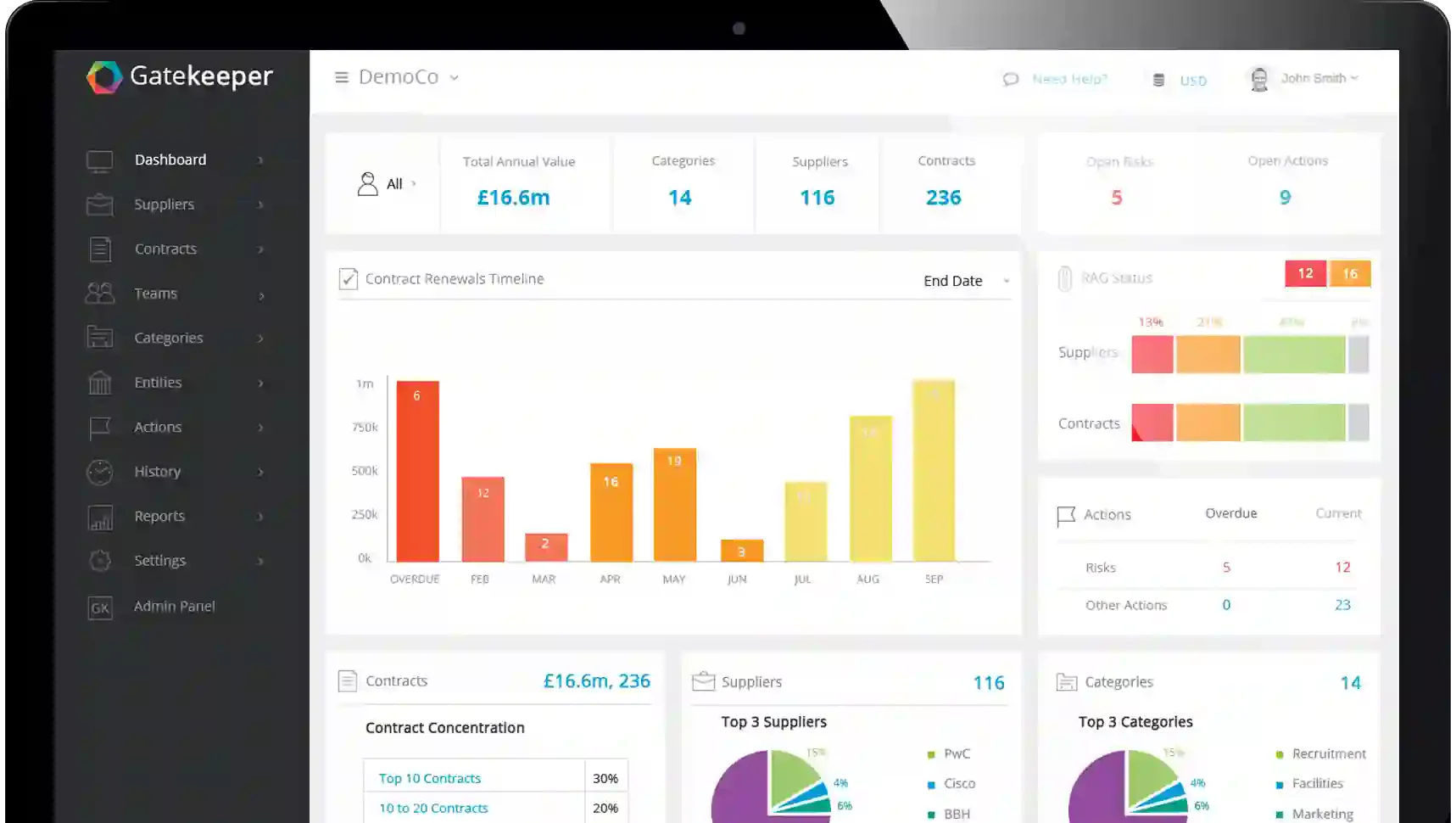
Gatekeeper HQ takes a vendor-centric approach to contract management. It manages the full lifecycle of a supplier relationship, from onboarding and risk assessment through to renewal.
For Australian businesses, its ability to track supplier compliance data alongside the contract record is a significant advantage.
Modern Slavery statements, insurance certificates, and ESG compliance data are managed in one place, making it well-suited for procurement teams with growing reporting obligations.
Best for: Procurement teams that need to manage vendor contracts alongside supplier compliance data, including Modern Slavery statements and ESG certificates in one place.
| Pros |
Cons |
| ✓ Manages supplier compliance data alongside the contract record in one place. | × Less suitable for businesses with complex legal drafting or authoring needs. |
| ✓ Strong fit for Modern Slavery and ESG reporting obligations facing Australian procurement teams. | × Reporting customisation can require significant configuration effort. |
| ✓ Clear visibility across the full vendor lifecycle from onboarding to renewal. | × Pricing on request only, which limits upfront budget planning. |
Pricing: Contact Gatekeeper HQ for a custom quote based on contract volume and user count.
8. WebCM
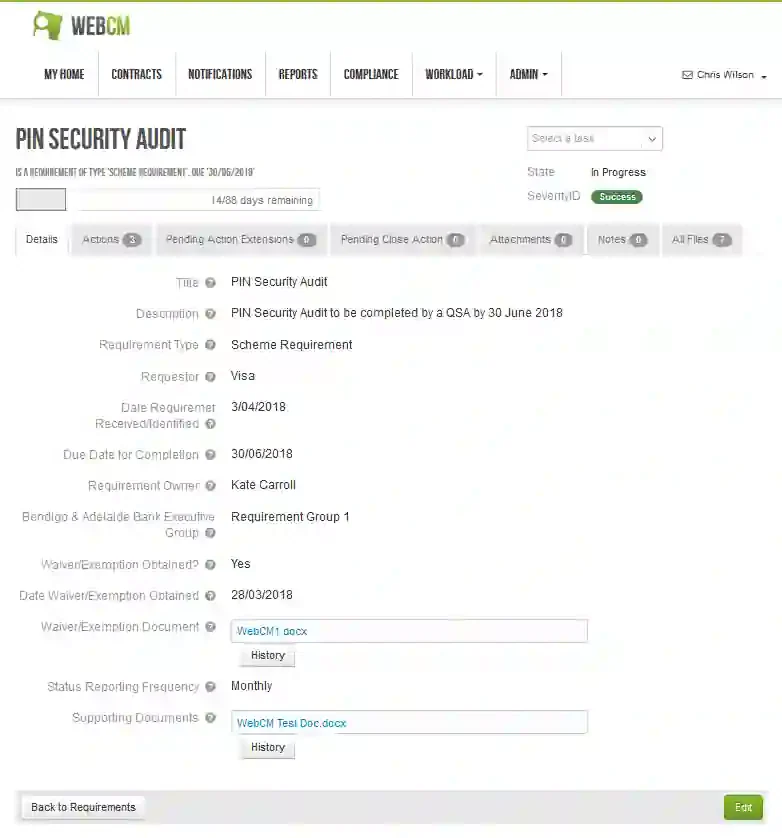
WebCM is one of the few platforms on this list that is genuinely Australian-owned and operated. This gives it a distinct advantage in terms of data sovereignty and local support responsiveness.
The platform is designed specifically for Australian government agencies and local councils. It meets the strict record-keeping requirements of the Australian public sector and is built to align with Australian standards.
For businesses that prioritise local ownership and public sector compliance, WebCM is a top contender.
Best for: Australian government agencies and local councils that require Australian-hosted, public-sector-compliant contract management with strict record-keeping.
| Pros |
Cons |
| ✓ 100% Australian-owned and hosted, meeting data sovereignty requirements fully. | × Limited suitability for private sector or commercial businesses. |
| ✓ Built specifically for public sector record-keeping and Australian government standards. | × Feature set is narrower than global enterprise CLM platforms. |
| ✓ Local support team operates in Australian time zones without overseas handoffs. | × Less emphasis on AI-driven contract intelligence and automation features. |
Pricing: Contact WebCM for a custom quote tailored to agency size and contract volume.
9. Agiloft
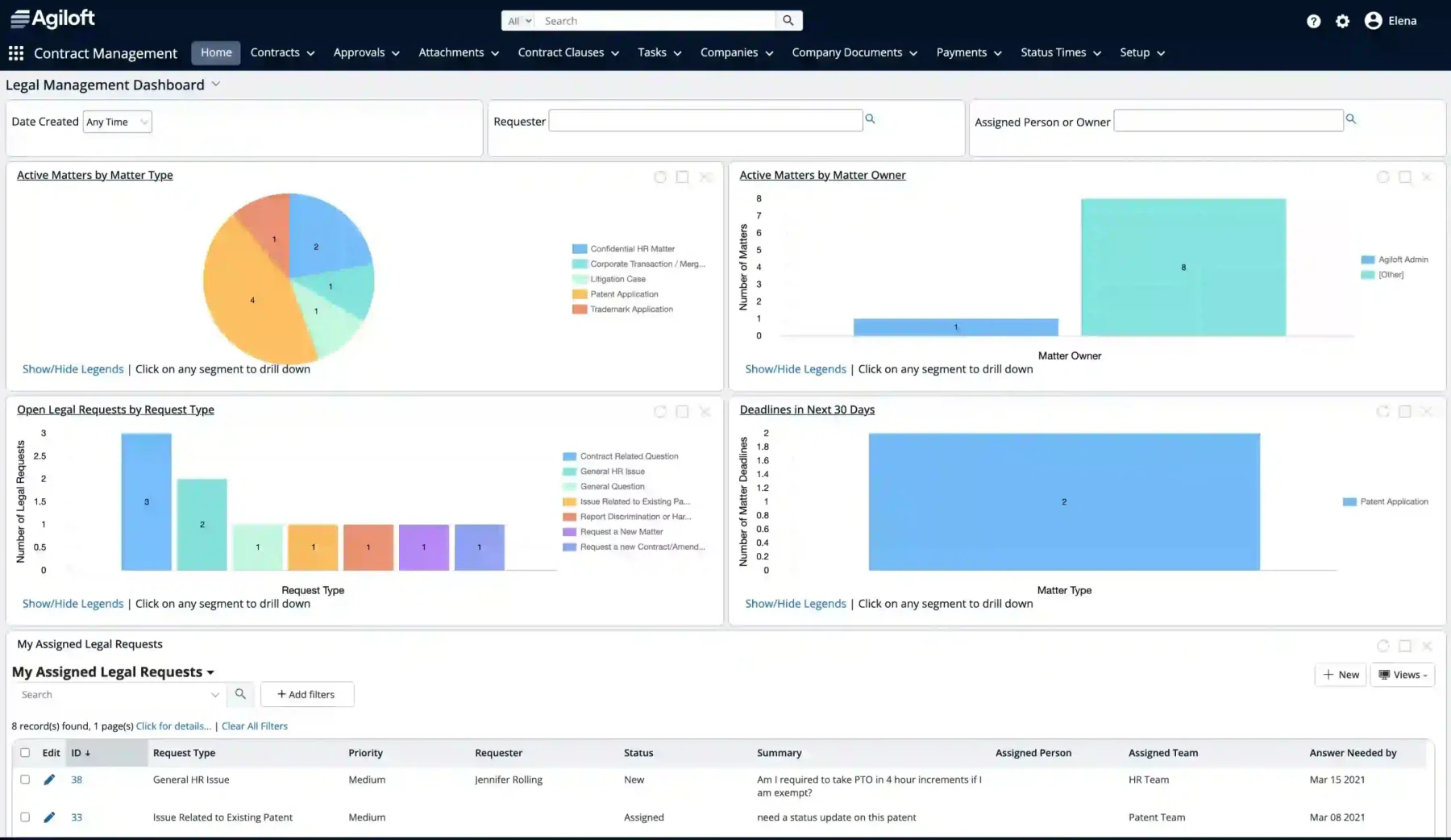
Agiloft is built on a no-code configuration platform that allows businesses to build custom contract workflows without developer resources. This flexibility suits Australian businesses with unique processes.
It handles complex royalty agreements in the mining sector, specialised research contracts in universities, and a wide range of other non-standard use cases.
Its integration capabilities also allow it to sit at the centre of a complex corporate IT stack, connecting with ERP and CRM systems as required.
Best for: Businesses with complex, non-standard contract workflows such as mining royalty agreements or university research contracts requiring deep customisation without developer resources.
| Pros |
Cons |
| ✓ No-code configuration enables deep customisation without developer resources. | × The complexity of configuration can extend initial setup and go-live timelines. |
| ✓ Handles complex, non-standard contract types across diverse industries, including mining and research. | × User interface is functional but less modern than newer cloud-native platforms. |
| ✓ Strong integration capabilities with ERP and CRM systems across a complex IT stack. | × Requires dedicated admin resources to maintain and update workflows over time. |
Pricing: Contact Agiloft for a custom quote. Pricing scales with the number of users and modules selected.
10. ContractWorks
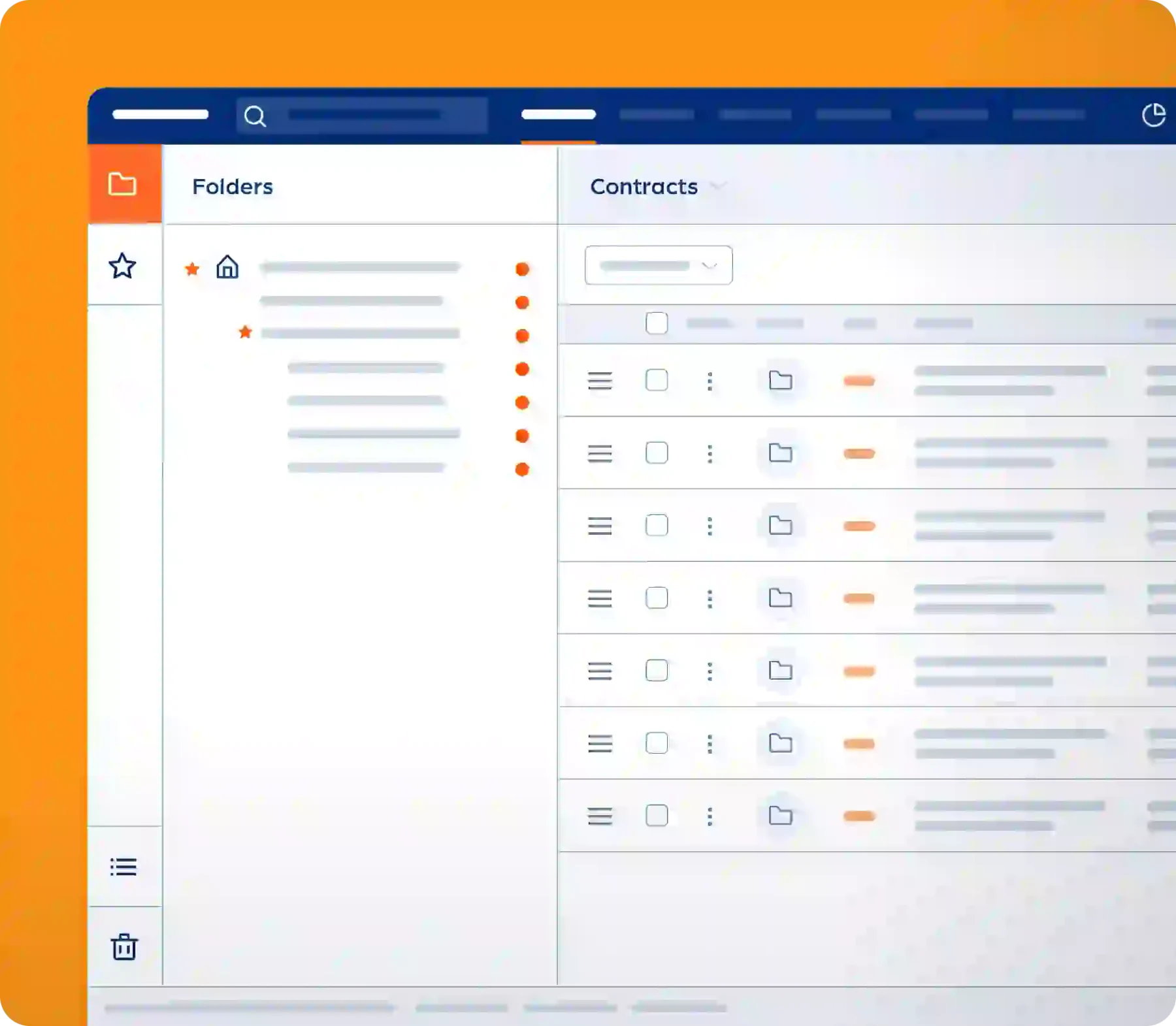
ContractWorks is an effective entry point for businesses beginning their CLM journey. It focuses on the repository function, offering high-speed OCR and AI-tagging that makes every word in every contract searchable.
It is valued for its simplicity and fast implementation time. Australian SMEs and legal firms moving away from shared network drives find it a practical first step toward structured contract management.
Best for: Australian SMEs and legal firms beginning their CLM journey that need a simple, fast-to-implement contract repository with strong AI-powered search.
| Pros |
Cons |
| ✓ Fast implementation with minimal setup, suitable for teams without technical support. | × Limited workflow automation compared to full CLM platforms. |
| ✓ High-speed OCR and AI-tagging make every word in every contract searchable instantly. | × Not designed to scale to high-volume enterprise contract operations. |
| ✓ Simple, accessible interface suitable for non-legal users across the business. | × Reporting and analytics are more basic than mid-range competitors. |
Pricing: Starter plan from approximately $1,100 AUD per month for up to two users. Higher tiers available on request.
Quick Comparison Table
Not every platform performs equally across the criteria that matter most to Australian businesses. The table below compares all ten platforms across five key areas to help you identify the right fit at a glance.
| Features | Procore | HashMicro | Juro | Ironclad | DocuSign CLM | PandaDoc | Gatekeeper HQ | WebCM | Agiloft | ContractWorks |
|---|---|---|---|---|---|---|---|---|---|---|
| User-Friendly Interface | ||||||||||
| Pricing | ||||||||||
| Contract Automation | ||||||||||
| Compliance & Audit Trail | ||||||||||
| Ease of Integration | ||||||||||
| Australian Compliance Fit | ||||||||||
| Contract Lifecycle Coverage | ||||||||||
| ERP & Finance Integration |
How Much Does Contract Management Software Cost in Australia?
Pricing for contract management software in Australia depends on the number of users, contract volume, and the level of automation required. Most providers now operate on a SaaS model with annual subscriptions.
Entry-level repository systems typically cost between $1,000 and $5,000 AUD per year. Pricing at this tier is generally based on seat count or document volume.
Mid-range automation tools such as Juro or PandaDoc typically range from $5,000 to $20,000 AUD per year, depending on the number of users who need template creation and editing access.
Enterprise CLM platforms such as Ironclad and DocuSign CLM represent a larger investment. Implementation costs can range from $20,000 to $100,000 AUD, with annual subscription fees often exceeding $50,000 AUD.
For large businesses, the ROI is found in the hours saved on manual review and the mitigation of high-value contractual risk. They should also account for currency exposure if the software is billed in USD.
The ranges above are indicative editorial estimates, not quotes. A free plan, free trial, demo or pricing consultation are different offers. Business needs to confirm duration, user/volume limits, storage, e-signature usage, support, implementation and renewal terms. Prices shown in AUD may be converted from another currency and can change.
Conclusion
For Australian businesses, the choice must account for local compliance requirements. The laws and legislation all shape a CLM platform capabilities. The 2026 market offers a purpose-built solution for every business.
By centralising contract data and automating the lifecycle, businesses transform their contracts from static legal documents into active assets that support faster, safer, and more confident growth.
If you want to gain further insight regarding contract management software, then you can book a free consultation with us and learn what is best for your company.

Frequently Asked Questions
Yes. Contract management software supports CPR compliance by automating documentation, maintaining full audit trails, and structuring approval workflows to meet procurement reporting obligations. Clause libraries, milestone tracking, and digital signing certificates directly address the transparency and value-for-money requirements the CPRs mandate.
Procore is the leading choice for Australian construction businesses, with purpose-built support for ABIC and HIA contract formats, progress claims, variations, and subcontract management. For firms that need contract management connected to broader ERP and finance workflows, HashMicro is a strong alternative for project-heavy operations.
A CRM manages customer and pipeline relationships, while a CLM manages the contract lifecycle from drafting and negotiation through approval, signature, obligations and renewal. They can complement each other through a verified integration, but a CRM record is not automatically a complete contract repository or obligation-tracking system.
Microsoft provides contract-related capabilities through products such as SharePoint, Microsoft 365 and Dynamics 365, but the exact workflow, approvals, e-signature and lifecycle coverage depends on the products, licences, configuration and connected services used. Businesses that need a contract lifecycle management platform that integrates with ERP can also evaluate solutions such as HashMicro alongside other CLM providers, based on verified workflow, security, integration and local operational requirements. Confirm each platform's current capabilities before making a selection.
There is no single universally most-used platform across Australian industries. Adoption varies by business size, legal and procurement workflow, existing ERP or CRM stack, implementation budget and compliance requirements. Use the comparison criteria in this article and current independent reviews rather than an unsupported market-share claim.