







Inventory forecasting helps businesses predict future demand so they can stock the right products at the right time. It combines historical data, trends, and planning methods to guide inventory decisions.
For Australian businesses, accurate forecasting supports smarter inventory planning, reduces excess stock, and prevents shortages. It is especially important in retail, manufacturing, and distribution.
In this guide, you will learn how inventory forecasting works, key metrics and formulas, forecasting methods, and how to improve demand planning.
Key Takeaways
Understand the foundational concepts of predicting stock needs.
Discover how precise predictions drive profitability and efficiency.
Explore the vital data points required for accurate analysis.
Learn about qualitative, quantitative, and trend-based approaches.

What Is Inventory Forecasting?

Inventory forecasting is the process of estimating future demand for products based on historical sales data, trends, and market conditions. It helps businesses decide how much inventory to order and when.
The goal is to maintain optimal stock levels without overstocking or running out of products. This improves both customer satisfaction and operational efficiency.
Forecasting can be done manually using spreadsheets or through automated inventory systems.
Inventory Forecasting Explained
Inventory forecasting combines data analysis and business insights to predict demand patterns. It considers factors such as past sales, seasonality, and external market changes.
Businesses use forecasting to plan purchasing, production, and replenishment while enhancing stock visibility. This helps align inventory with actual demand.
More advanced systems use real-time data and automation to improve accuracy and responsiveness.
"Accurate inventory forecasting helps businesses stay prepared, reduce waste, and make smarter decisions."
Why Inventory Forecasting Is Important for Businesses
Inventory forecasting plays a key role in maintaining efficient operations and meeting customer demand. It helps businesses make better decisions about stock levels and purchasing.
1. Prevents Overstocking and Stockouts
Accurate forecasting helps maintain the right balance of stock. It reduces the risk of excess inventory or running out of products. This ensures better product availability and customer satisfaction.
2. Reduces Inventory Holding Costs
Holding too much inventory increases storage and carrying costs. Forecasting helps optimise stock levels and reduce unnecessary expenses. This improves cost efficiency across the business.
3. Improves Cash Flow Management
Better forecasting allows businesses to avoid tying up cash in excess inventory. This frees up funds for other operational needs. It also supports more predictable financial planning.
4. Enables Faster Response to Demand Changes
Forecasting helps businesses identify trends and shifts in demand early. This allows quicker adjustments to inventory strategies. It improves agility in a changing market.
Inventory Forecasting vs Replenishment
Inventory forecasting focuses on predicting future demand, while replenishment is the process of restocking inventory based on those predictions.
Forecasting answers how much stock will be needed, while replenishment determines when and how to reorder. Both work together to maintain efficient inventory management and avoid stock issues.
How Inventory Forecasting Works
Inventory forecasting starts with collecting historical sales and inventory data. This data is analysed to identify patterns, trends, and seasonality.
Businesses then apply forecasting methods to estimate future demand. These estimates guide purchasing and production decisions. Modern systems, including top tools for inventory efficiency, can automate forecasting and update data in real time.






Core Metrics Used in Inventory Forecasting
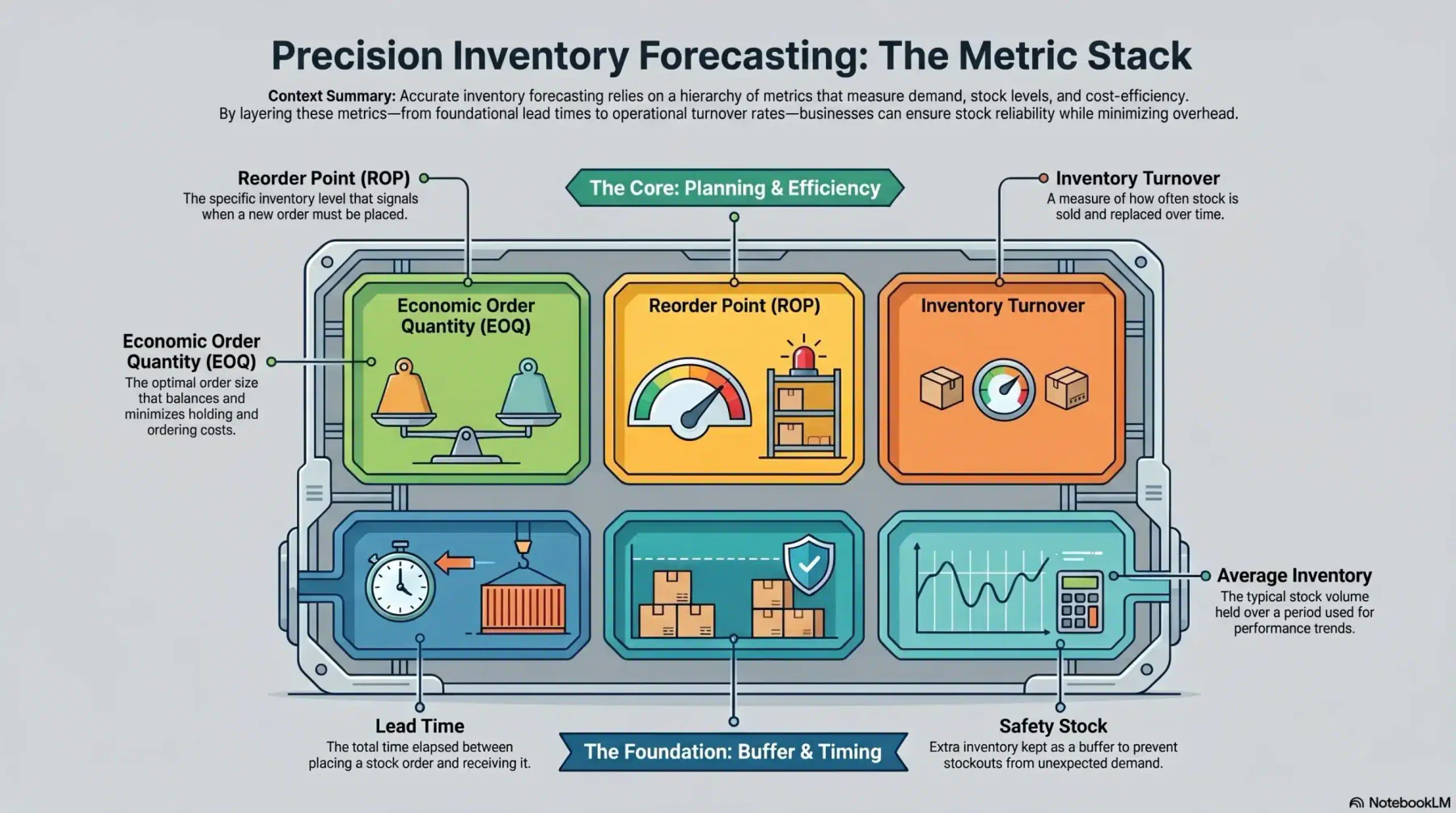
Accurate forecasting relies on key inventory metrics that help measure demand, stock levels, and efficiency.
1. Sales Velocity vs Average Sales
Sales velocity measures how quickly products are sold over time, while average sales provide a general baseline. Both help estimate demand more accurately. Understanding these metrics improves forecasting precision.
2. Lead Time
Lead time is the time it takes to receive stock after placing an order. It is critical for planning when to reorder inventory. Longer lead times require more accurate forecasting.
3. Economic Order Quantity (EOQ)
EOQ determines the optimal order size that minimises total ordering and holding costs. It helps balance efficiency and cost. Using EOQ improves inventory planning decisions.
4. Reorder Point (ROP)
ROP is the inventory level at which a new order should be placed. It ensures stock is replenished before it runs out. It is based on demand and lead time.
3. Inventory Turnover
Inventory turnover measures how often stock is sold and replaced over a period. Higher turnover indicates efficient inventory management. It also helps evaluate forecasting accuracy.
4. Average Inventory
Average inventory represents the typical stock level held over time. It is used in various calculations and performance analysis. This metric helps track inventory trends.
5. Safety Stock
Safety stock is extra inventory kept to prevent stockouts due to unexpected demand or delays. It acts as a buffer. Proper safety stock levels improve reliability.
Inventory Forecasting Methods
Different forecasting methods can be used depending on data availability and business needs. Choosing the right method improves accuracy.
1. Trend Forecasting
Trend forecasting uses historical data to identify patterns over time. It assumes that past trends will continue into the future. This method is useful for stable demand products.
2. Qualitative Forecasting
Qualitative forecasting relies on expert judgment and market insights. It is often used when historical data is limited. This approach is useful for new products.
3. Quantitative Forecasting
Quantitative forecasting uses mathematical models and data analysis to predict demand. It is more accurate when reliable data is available. It is widely used in larger businesses.
4. Seasonality Forecasting
Seasonality forecasting accounts for demand fluctuations during specific periods. This is common in retail and holiday-driven industries. It helps prepare for peak seasons.
5. Graphical Forecasting
Graphical forecasting uses charts and visual data to identify trends and patterns. It helps simplify complex data analysis. This method supports decision-making.
Inventory Forecasting Formulas
Key formulas are used to calculate demand, order quantities, and stock levels. These formulas support accurate planning.
1. Lead Time Demand Formula
This formula calculates expected demand during the lead time period. It helps determine how much stock is needed before replenishment. It is essential for reorder planning.
2. Economic Order Quantity (EOQ) Formula
EOQ calculates the ideal order quantity to minimise costs. It balances ordering frequency with holding costs. This improves cost efficiency.
3. Reorder Point (ROP) Formula
ROP determines when to reorder inventory based on demand and lead time. It prevents stockouts. This ensures continuous supply.
4. Safety Stock Formula
The safety stock formula calculates extra inventory needed as a buffer. It protects against uncertainty in demand or supply. This improves reliability.
Benefits of Inventory Forecasting
Inventory forecasting provides several advantages that improve business performance and efficiency.
1. Minimizes Stockouts
Forecasting ensures products are available when customers need them. This improves customer satisfaction and sales. It reduces lost revenue opportunities.
2. Reduces Inventory Holding Costs
Optimised stock levels reduce storage and handling costs. This improves overall profitability. It also minimises excess inventory.
3. Reduces Product Waste
Accurate forecasting prevents overstocking of perishable or slow-moving items. This reduces waste and losses. It supports sustainability.
4. Improves Operational Efficiency
Better planning supports reducing inventory discrepancies, improves coordination, and enhances productivity. This enhances productivity. It also supports smoother operations.
Common Challenges in Inventory Forecasting
Despite its benefits, inventory forecasting comes with challenges that businesses need to manage carefully.
1. Inaccurate or Incomplete Data
Poor data quality can lead to incorrect forecasts. Missing or outdated information reduces accuracy. Reliable data is essential for good forecasting.
2. Demand Volatility
Sudden changes in demand can make forecasting difficult. Unexpected trends may disrupt planning. Flexibility is important in managing this risk.
3. Poor System Integration
Disconnected systems can limit visibility into inventory and sales data. This affects forecasting accuracy. A centralised stock management system improves visibility and forecasting performance.
4. Lack of Real-Time Insights
Without real-time data, forecasts may become outdated quickly. This reduces responsiveness. Modern tools can help provide live updates.
Inventory Forecasting Examples
A retail business may use historical sales data and seasonality forecasting to prepare for holiday demand. This ensures enough stock is available during peak periods.
A manufacturing company may use quantitative forecasting and lead time calculations to plan production schedules. This helps avoid delays and shortages.
A distributor may combine multiple forecasting methods to optimise inventory across locations and improve supply chain efficiency.
Conclusion
Inventory forecasting helps businesses plan ahead, reduce risks, and improve inventory efficiency. By predicting demand accurately, businesses can maintain optimal stock levels and avoid costly mistakes.
For Australian businesses, using the right forecasting methods, metrics, and tools can improve cash flow, reduce waste, and support better decision-making.
As your operations grow, using inventory or ERP software can enhance forecasting accuracy and automation.
You can consult our experts to improve forecasting accuracy and inventory planning.
Frequently Asked Question
Inventory forecasting is the process of predicting future product demand using historical data, trends, and market insights to plan inventory levels.
Inventory forecasting is important because it helps prevent stockouts and overstocking, reduces costs, and improves cash flow and operational efficiency.
Common inventory forecasting methods include trend forecasting, qualitative forecasting, quantitative forecasting, and seasonality forecasting depending on business needs and data availability.
Forecasting predicts future demand, while replenishment focuses on restocking inventory based on those predictions to maintain optimal stock levels.
Businesses can improve forecasting accuracy by using reliable data, applying the right forecasting methods, monitoring key metrics, and using inventory or ERP software for automation.