










 Limited to 100 registrants

Inventory management becomes more complex when products have a limited shelf life. FEFO, or First Expired, First Out, focuses on moving items based on expiration dates rather than arrival order to reduce spoilage and maintain product quality.
By prioritising expiry dates, businesses can better control stock flow, minimise losses, and ensure that customers receive products within acceptable usage periods. This method is especially critical for industries where timing directly affects safety and value.
Key Takeaways
Explains how FEFO inventory method prioritises stock based on expiration dates to improve inventory accuracy and reduce waste.
Compares FEFO and FIFO approaches to help determine the most suitable method based on product shelf life and stock movement.
Highlights how FEFO reduces inventory loss, maintains product quality, and supports compliance for time-sensitive products.
Shows how businesses implement FEFO through system support, staff training, and continuous monitoring of stock movement.

What FEFO Means in Inventory Management
FEFO is an inventory management approach where products with the earliest expiration dates are prioritised for dispatch. Instead of relying on when items arrive, this method focuses on how long each product remains usable.
In practice, every batch is treated as time-sensitive. Items are tracked based on expiry data, ensuring that stock closest to its end of life is moved first. This reduces the risk of unsellable inventory and improves overall stock accuracy.
FEFO also supports quality control. By ensuring older stock is consistently rotated out, businesses can maintain product standards while aligning with customer expectations and regulatory requirements.
The Logic Behind Expiry-Based Inventory Flow
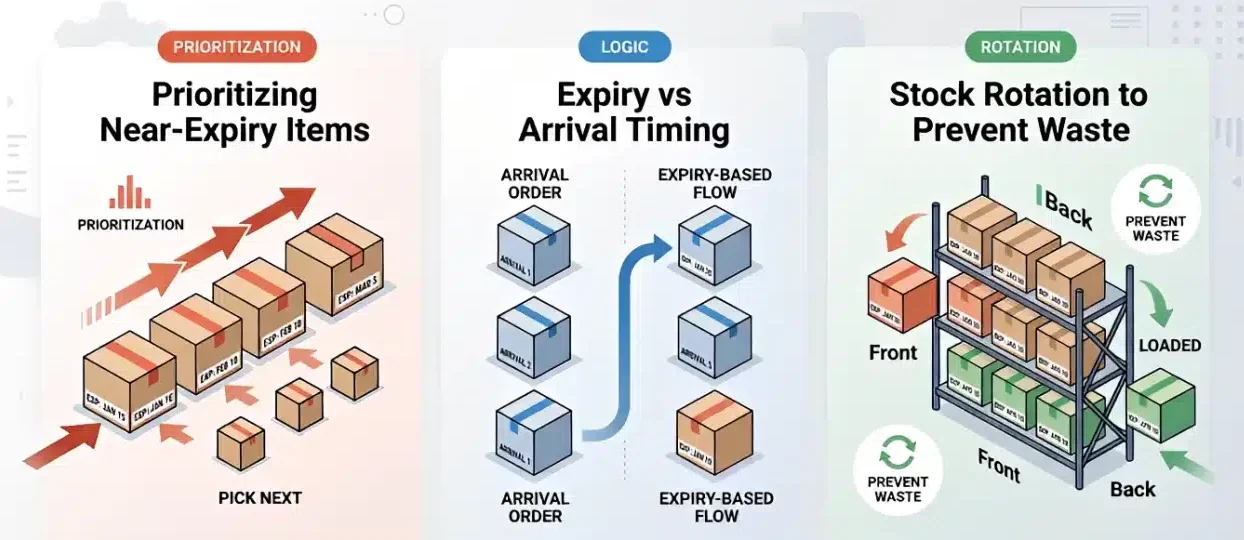
Expiry-based inventory flow is built on the idea that product value decreases over time. Managing stock based on expiration ensures that goods are used or sold before they lose their usability or compliance status.
Prioritizing products near expiration
Products approaching their expiration date carry the highest risk of becoming unsellable. Prioritising these items ensures they are moved out of storage before they lose value.
This approach turns inventory into a dynamic system rather than static stock. Teams are guided to focus on time-sensitive items, reducing the chance of overlooked or forgotten products.
Why timing matters more than arrival
In real operations, products do not always arrive in the same order as their expiration timelines. A newer shipment can expire sooner than older stock due to supplier or logistics variations.
Relying only on arrival order can lead to incorrect stock rotation. By focusing on expiration dates instead, businesses avoid holding short-life items for too long.
Preventing waste through rotation
Consistent rotation based on expiry helps prevent stock from sitting idle until it becomes unusable. This reduces write-offs and improves inventory turnover.
It also supports better space utilisation. Older stock is cleared regularly, making room for incoming products without creating hidden or stagnant inventory.
How FEFO Works in Warehouse Operations
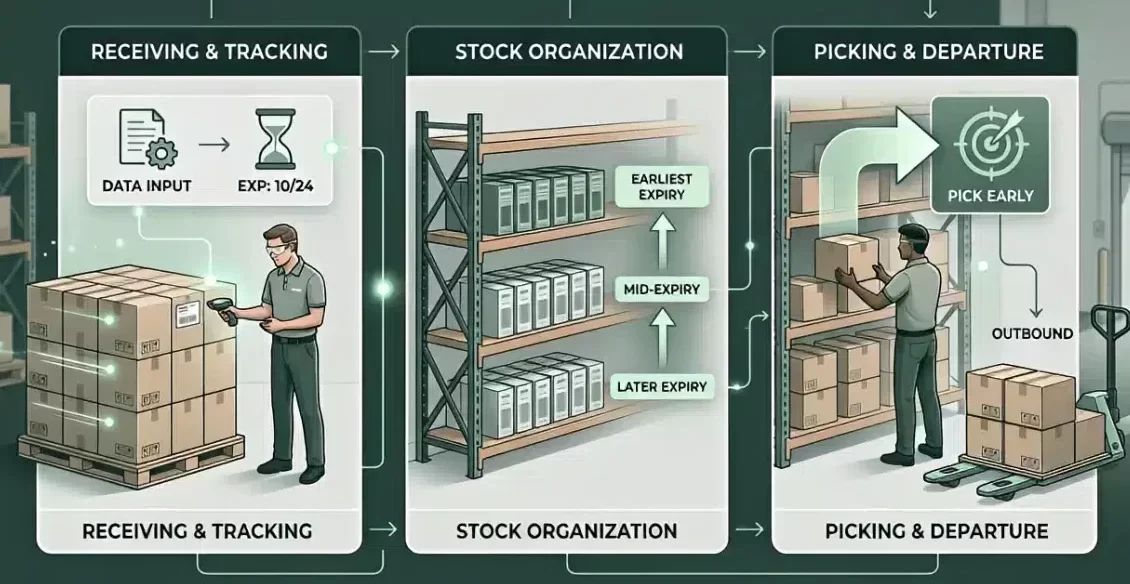
Applying FEFO in daily operations requires coordination between data tracking, storage organisation, and picking processes. Each stage must be aligned with an end-to-end inventory workflow.
Tracking expiry dates by batch
Each product batch must be recorded with its expiration date upon arrival. This data becomes the reference point for all inventory movements.
Accurate tracking ensures that the system can identify which items need to be prioritised. Without reliable data, the entire FEFO process becomes ineffective.
Organizing stock based on shelf life
Warehouse layout plays a key role in supporting FEFO. Items with shorter shelf life should be placed in easily accessible locations to simplify picking.
This reduces handling time and ensures that staff naturally select the correct stock. Proper organisation also prevents older items from being blocked by newer inventory.
Picking inventory based on expiration priority
When orders are processed, pickers are directed to select items with the earliest expiration dates. This ensures that stock rotation happens consistently.
Systems or procedures often guide this process to reduce human error. By enforcing expiry-based picking, businesses maintain accuracy and avoid accidental stock mismanagement.
Where FEFO Is Most Commonly Used
FEFO is widely used in industries where product lifespan directly affects usability, safety, and customer satisfaction. In these environments, incorrect stock rotation can lead to significant risks.
Food and beverage industry
Perishable goods such as dairy, fresh produce, and packaged food rely heavily on expiry-based rotation. Managing these products without FEFO can quickly lead to spoilage and financial loss.
Ensuring timely distribution also helps maintain freshness and compliance with food safety standards.
Pharmaceuticals and healthcare
Medications and medical supplies must be used within strict expiration limits. Using expired products can reduce effectiveness or pose health risks.
FEFO ensures that these items are consistently rotated, supporting both patient safety and regulatory compliance.
Cosmetics and perishable goods
Many cosmetics and personal care products degrade over time, especially those with active ingredients. Expired products can lose effectiveness or cause adverse reactions.
Applying FEFO helps maintain product quality and protects brand reputation by ensuring customers receive items within their usable period.
FEFO VS FIFO in Inventory Management
To decide whether FEFO is the right approach, it helps to compare it with FIFO. Both methods aim to manage stock movement, but they rely on different priorities when determining which items should be used or sold first.
The key difference lies in how inventory is prioritised. FEFO focuses on expiration dates, while FIFO follows a sequence-based stock rotation determined by the order in which goods are received.
This distinction affects how stock is rotated, especially for products with varying shelf life.
| Aspect | FEFO | FIFO |
|---|---|---|
| Basis rotation | Expiry date | Arrival order |
| Best for | Perishable goods | Non-perishable goods |
| Stock priority | Shortest shelf life first | Oldest stock first |
| Risk control | Reduces expiry risk | May ignore expiry timing |
| Operational complexity | Higher | Lower |
This comparison shows that FEFO provides better control for time-sensitive inventory, while FIFO remains suitable for products without expiration constraints.
Benefits of Using FEFO
After understanding how FEFO differs from FIFO, the next step is recognising its practical value. Businesses that implement expiry-based inventory flow gain stronger control over stock quality and financial performance.
Reducing waste and loss
FEFO helps minimise unsellable inventory by ensuring that items are used or sold before they expire. This directly reduces write-offs and improves stock turnover.
As a result, businesses can protect margins and avoid unnecessary disposal costs associated with expired goods.
Maintaining product quality
By consistently rotating stock based on expiration, businesses can maintain product standards. Customers are more likely to receive items within a safe and usable timeframe.
This also supports brand reliability. Delivering products with sufficient shelf life helps build trust and reduces the risk of complaints or returns.
Supporting compliance and safety
Many industries require strict control over product expiry. FEFO supports compliance by ensuring that products are distributed within acceptable limits.
This is particularly important for regulated sectors where improper stock handling can lead to penalties or safety risks.
"Managing inventory based on expiry dates allows businesses to reduce waste while maintaining consistent product quality and compliance across operations."
Challenges in Applying FEFO
While FEFO improves stock control, applying it consistently can be more demanding than traditional methods. Businesses need to manage both data accuracy and operational complexity to ensure the system works as intended.
Common challenges when applying FEFO include:
- Need for accurate expiry tracking
Incorrect or missing expiration data can lead to poor stock prioritisation and increase the risk of waste. - Complex warehouse handling
Stock cannot be picked based on location alone. Staff must follow expiry-based rules, which can slow down operations if not well organised. - Dependence on inventory systems
Manual processes are often insufficient. Businesses typically rely on this end-to-end inventory solution to track expiry dates and maintain consistency across operations.






Making FEFO Work in Daily Operations
After understanding the challenges, the next step is ensuring that FEFO can be applied consistently in real operations. This requires a combination of system support, clear procedures, and continuous monitoring.
To implement FEFO effectively, businesses typically focus on:
- Using inventory or WMS systems: Leading stock handling software help track expiry dates, manage batch data, and guide picking decisions. This reduces manual errors and ensures consistent stock prioritisation.
- Training staff on stock rotation: Warehouse teams need clear guidelines on how to prioritise inventory based on expiration. Proper training ensures that procedures are followed correctly.
- Monitoring expiry and stock movement: Regular reviews and a scheduled stock count method help identify slow-moving or at-risk stock. This allows businesses to take action before products become unsellable.
By combining these practices, businesses can maintain a stable inventory flow while reducing the risk of expired stock.
Conclusion
FEFO inventory method helps businesses manage time-sensitive stock more effectively by prioritising expiration over arrival. Without a structured approach, inventory waste and quality risks become harder to control.
To implement FEFO with better accuracy and visibility, consider using a system that supports expiry tracking and automation. Get free consultation to explore how it can improve your inventory operations.

FAQ About FEFO Inventory Method
Yes, but it is more difficult to maintain accuracy. Manual tracking can work for small inventories, but larger operations usually require a system to manage expiry dates consistently.
Products without fixed expiry dates are typically managed using FIFO or internal shelf-life estimates to maintain stock rotation and avoid long-term stagnation.
Inaccurate expiry data can disrupt stock prioritisation, leading to incorrect picking decisions and increased risk of expired inventory.
Yes, but it requires centralised tracking and synchronised data across locations to ensure consistent stock rotation and visibility.
Inventory should be reviewed regularly, depending on product type, to identify slow-moving items and prevent stock from reaching expiration.