






Stock management is the process of ordering, storing, tracking, and controlling the goods a business holds for sale or production, keeping supply aligned with actual demand.
Australian businesses face long supplier lead times, high warehousing costs in major cities, and seasonal demand swings that make manual tracking unreliable at scale.
This article explains what stock management is, how it differs from inventory management, the methods Australian businesses use, and how to measure and improve performance.
Key Takeaways
Stock management is the process of ordering, storing, tracking, and controlling goods across their full lifecycle, keeping supply aligned with demand and working capital protected.
Five stock categories require different handling: raw materials, work-in-progress, finished goods, safety stock, and dead stock, each carrying its own cost profile and risk of loss.
Five proven methods help Australian businesses optimise levels: FIFO, JIT, ABC Analysis, EOQ, and Vendor Managed Inventory.
Four practical steps to improve stock control: conduct regular cycle counts, set data-driven reorder points, diversify supplier relationships, and adopt real-time tracking software.

What Is Stock Management?

Stock management is the process of ordering, storing, tracking, and controlling a company’s goods across their full lifecycle, from procurement through to final sale and dispatch.
The goal is to hold enough product to meet customer demand without accumulating excess that ties up working capital, increases storage costs, or risks spoilage and obsolescence.
In practice, it means monitoring quantities on hand, identifying fast and slow movers, forecasting demand from historical data, and adjusting procurement schedules to match.
For Australian businesses, long lead times from overseas suppliers and the cost of transporting goods across vast distances make accurate tracking even more critical to daily operations.
Modern stock management also connects to finance, marketing, and procurement. When marketing launches a promotion, the system for managing stock and inventory must anticipate and prepare for the demand surge it creates.
"Stock management is ultimately about visibility. When you know exactly what you hold, where it sits, and how fast it moves, every decision from procurement to pricing becomes faster and more accurate."
Stock Management vs Inventory Management
Inventory and stock are often used interchangeably, but there is a practical difference that shapes how businesses structure their tracking and reporting processes.
Stock refers specifically to finished goods held for sale to customers. In a retail store, the products on shelves and in the backroom are stock. Managing it focuses on availability, pricing, and turnover.
Inventory is a broader term that covers finished goods, raw materials, components, work-in-progress items, and the supplies used to produce or support the business.
A retailer may only need stock management, while a manufacturer needs full inventory platform overview to track materials at every stage of production. The distinction determines which systems apply.
Why Stock Management Matters for Businesses
Effective stock management drives profitability, customer satisfaction, and operational resilience. Poor control creates consequences that reach well beyond the warehouse.
1. Prevents stockouts and overstock
A stockout occurs when a customer wants to buy, but the product is unavailable. In Australian e-commerce, most customers will abandon the order and purchase from a competitor instead.
Overstocking ties up capital in unsold goods that take up warehouse space, risk obsolescence or spoilage, and eventually force heavy discounting or write-offs.
Accurate stock management keeps levels balanced between these two extremes by triggering reorders before supplies run out and capping purchases before surplus builds.
2. Reduces holding costs
Holding costs include warehouse rent, utilities, insurance, security, and the wages of staff who manage stored goods. In Australian cities, commercial warehousing rates make these costs significant.
Tighter stock control reduces the volume on hand at any given time, allowing businesses to operate from smaller facilities and lowering the risk of shrinkage, depreciation, and storage damage.
The Australian Bureau of Statistics ranks transport and warehousing among the fastest-rising cost categories for goods-based businesses, making tighter stock control a direct lever on margins.
3. Improves cash flow
Unsold goods are cash locked in physical form. Every dollar sitting on a warehouse shelf is a dollar unavailable for payroll, marketing, debt repayment, or new investment.
Faster stock turnover converts goods back into revenue sooner, improving liquidity and giving the business more flexibility to negotiate supplier terms or absorb unexpected costs.
4. Boosts operational efficiency
A well-managed warehouse places fast-moving items near packing stations and stores slower lines further back. This layout reduces pick times and cuts labour hours per order fulfilled.
Barcode scanning and automated tracking eliminate manual counts and reduce picking errors. When fulfilment runs faster, the business can scale during peak seasons without proportional overhead increases.
Types of Stock
Different types of goods require different handling, storage, and tracking approaches. Categorising stock correctly is the first step toward applying the right management strategy.
This table summarizes the types of stock that businesses typically handle, with risks and examples that are worth knowing.
| Type | Definition | Example | Primary Risk |
|---|---|---|---|
| Raw Materials | Unprocessed inputs for manufacturing | Flour, sheet metal, timber | Shortage halts production immediately |
| Work-in-Progress | Partially completed goods are still in production | Assembled chair frame awaiting paint | High WIP signals production bottlenecks |
| Finished Goods | Completed products ready for sale | Packaged electronics on warehouse shelves | Obsolescence if the demand forecast is wrong |
| Safety Stock | Buffer held against supply chain uncertainty | Extra units for import delay protection | Excess raises holding costs unnecessarily |
| Dead Stock | Unsold goods with no realistic future demand | Discontinued seasonal product from prior year | Ties up capital and warehouse space permanently |
1. Raw materials
Raw materials are the unprocessed inputs a business purchases to manufacture finished products. For a bakery, that includes flour and eggs. For a steel fabricator, sheet metal and welding consumables.
Handling stock shortage is among the most operationally damaging challenges a manufacturer can face, as any gap in raw material supply risks halting production entirely.
At the same time, over-ordering drives up storage costs and increases spoilage exposure. Procurement teams must align deliveries precisely with production schedules to avoid both outcomes.
2. Work-in-progress (WIP)
WIP covers items that have entered the production process but are not yet finished. A chair frame assembled but waiting for paint and upholstery is WIP.
High WIP levels typically signal bottlenecks on the production line. Lean manufacturing aims to minimise WIP to reduce capital tied up on the factory floor and shorten overall lead times.
3. Finished goods
Finished goods have passed all production stages and quality checks. They are ready for sale and represent the highest-value state of the product, with all material, labour, and overhead costs invested.
Managing finished goods focuses on matching supply to demand through accurate forecasting, strategic pricing, and fast fulfilment to maintain customer satisfaction.
4. Safety stock
Safety stock is an extra buffer held to protect against supply chain uncertainty, such as unexpected demand spikes or delayed supplier shipments from overseas.
Calculating the right level involves analysing demand variability, lead time variability, and the target service level. Too much raises holding costs. Too few leaves the business exposed to stockouts.
5. Dead stock
Dead stock is a product that has sat unsold for an extended period with little prospect of future sale. It may be obsolete, out of season, expired, or simply a product that failed to connect with buyers.
Left unaddressed, the excess inventory issues compound over time, permanently tying up capital and warehouse space that could otherwise support active operations.
Regular audits help identify slow-moving products before they reach that point, and liquidation strategies such as deep discounts or bundling can recover partial value when dead stock does accumulate.
Stock Management Methods
The right method depends on product type, demand predictability, and supply chain reliability. Most businesses combine several approaches rather than relying on one alone.
1. FIFO (First In, First Out)
FIFO means the oldest goods enter the sales or production pipeline first. It is essential for perishables, pharmaceuticals, and any product with a shelf life or expiration date.
Beyond physical rotation, FIFO also affects accounting. In inflationary periods, recording older, cheaper goods as sold first lowers the cost of goods sold and raises reported profit on the income statement.
Implementing FIFO requires warehouse discipline. Flow racking systems and clear date labelling enforce the rotation so staff do not default to picking the nearest item.
2. Just-in-Time (JIT)
JIT aims to receive goods from suppliers exactly when they are needed, rather than holding large buffers in storage. The goal is to drive holding costs close to zero and free up working capital.
The trade-off is risk. JIT depends on reliable suppliers, accurate demand forecasts, and stable logistics. Any disruption can halt production or fulfilment immediately because there is no safety stock.
For Australian businesses importing from overseas, pure JIT is often impractical. Most adopt a hybrid model, keeping a small safety buffer while still minimising bulk storage.
3. ABC Analysis
ABC Analysis ranks stocks by financial impact using the Pareto principle. Category A items make up roughly 10 to 20 percent of volume but drive 70 to 80 percent of total value.
For category B, items sit in the middle: about 30 percent of volume contributing 15 to 20 percent of value. Category C items are the highest in volume but lowest in value, often simple consumables.
The method ensures management effort concentrates where it has the greatest financial return, rather than applying the same level of control to every single line item.
4. Economic Order Quantity (EOQ)
EOQ is a formula that calculates the order size that minimises total cost by balancing two competing expenses: ordering costs and holding costs.
Large orders reduce ordering frequency but inflate storage costs. Small orders keep storage lean but increase procurement admin and freight charges. EOQ finds the point where the combined total is lowest.
The model works best for products with stable, predictable demand. Businesses with highly seasonal or volatile sales patterns typically adjust EOQ with demand-weighted multipliers.
5. Vendor Managed Inventory (VMI)
In a VMI arrangement, the supplier monitors the buyer’s stock levels and decides when and how much to replenish. The buyer shares real-time sales and stock data instead of placing manual purchase orders.
For the buyer, VMI reduces procurement admin and virtually eliminates stockouts. For the supplier, it provides direct demand visibility, which improves their own production planning and logistics.
VMI is common in Australian supermarket chains, where large consumer goods companies manage their own shelf space and replenishment cycles directly within the retail stores.
Key Stock Management Metrics
Tracking the right numbers turns stock management from guesswork into a data-driven discipline. These four metrics give supply chain managers the clearest view of performance.
1. Stock turnover rate
Stock turnover measures how many times a business sells and replaces its goods during a period. The formula is cost of goods sold divided by average stock value.
A higher rate generally indicates strong sales and efficient purchasing. A low rate may signal overstocking, weak demand, or pricing issues that need attention before goods become dead stock.
2. Reorder point (ROP)
The reorder point is the stock level at which a new purchase order should be triggered. It accounts for average daily usage and supplier lead time so goods arrive before the shelf empties.
The basic formula is average daily sales multiplied by lead time in days, plus safety stock. Setting accurate ROPs prevents both stockouts and the panic buying that leads to overstocking.
3. Days on hand (DOH)
Days on hand estimates how many days current stock will last at the present rate of sale. The formula is average stock value divided by cost of goods sold, multiplied by the number of days in the period.
A rising DOH suggests goods are sitting longer than expected, which increases holding costs and obsolescence risk. A falling DOH may mean demand is outpacing supply and a stockout is approaching.
4. Stockout rate
Stockout rate tracks the percentage of orders or demand events that could not be fulfilled because the product was unavailable. It measures how often customers encounter empty shelves or backorder notices.
Even a small stockout rate compounds over time through lost revenue, damaged brand trust, and customers who switch permanently to competitors. Most businesses target a rate below two percent.
Common Stock Management Challenges
Even with the right methods and metrics, several recurring problems undermine stock accuracy and operational performance across Australian businesses.
1. Fragmented manual data entry
When staff record movements in spreadsheets or disconnected systems, phantom stock builds up, and reported quantities no longer match what is physically on the shelf.
2. Static reorder points
Demand patterns shift with seasons, promotions, and market conditions, but many businesses set reorder levels once and never revisit them, leading to preventable stockouts or surpluses.
3. Poor warehouse layout
When high-velocity items are stored far from packing stations, pick times increase, labour costs rise, and order accuracy drops under time pressure.
4. Supplier dependency without diversification
If a single supplier faces a disruption, there is no backup source, and production or sales halt until the issue is resolved.
How You Can Improve Stock Management
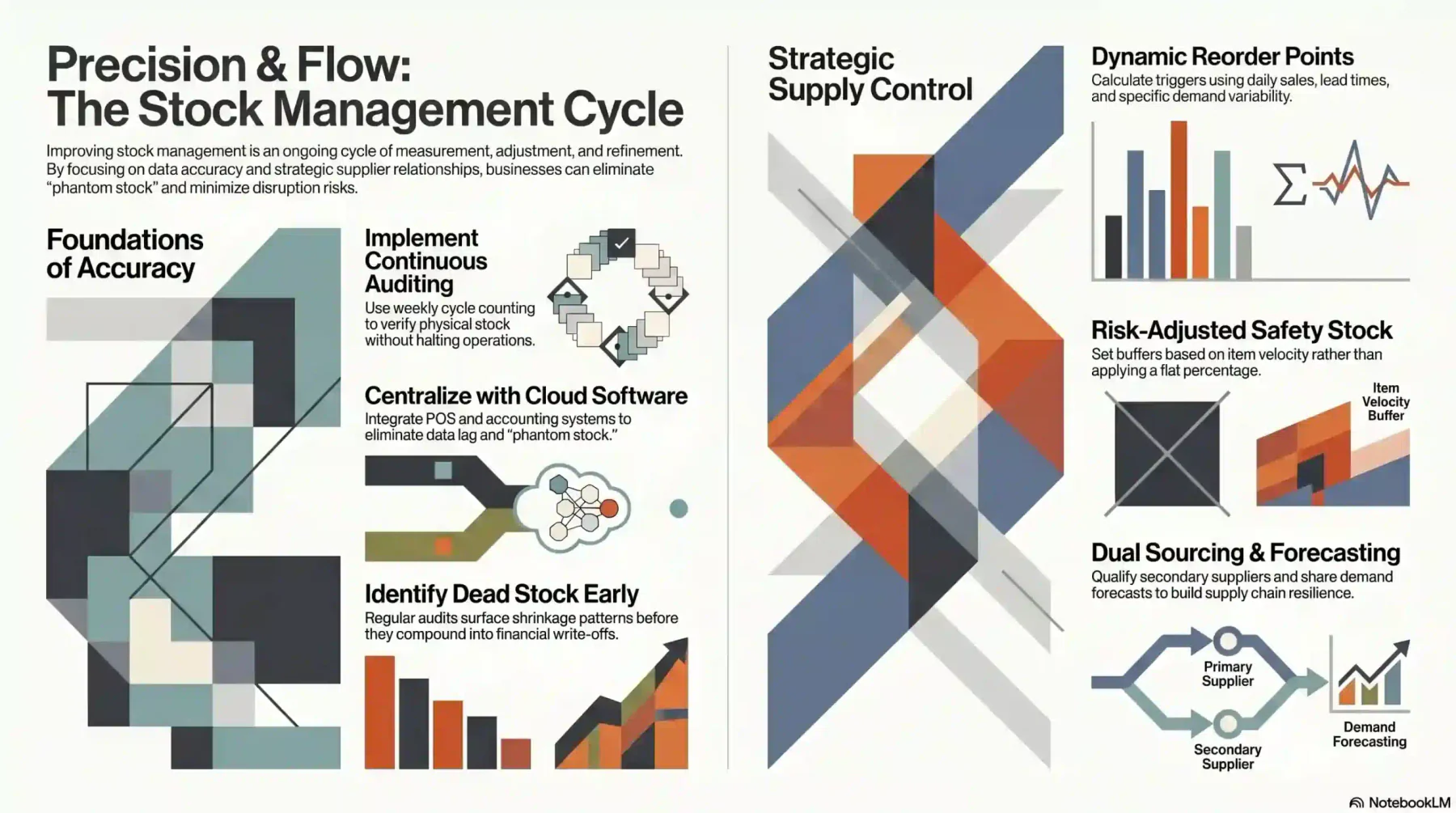
Improving stock management is not a single project but an ongoing cycle of measurement, adjustment, and process refinement across the supply chain.
1. Conduct regular stock audits
Physical counts verify that recorded quantities match what is actually on the shelf, and the ATO’s record-keeping obligations require supporting documentation to be retained for five years.
Cycle counting spreads this across the year by auditing a small section of stock each week rather than shutting down for a full annual count.
Audits also surface dead stock, misplaced items, and shrinkage patterns early, giving the business time to act before the problem compounds into a write-off or a stockout.
2. Set reorder points and safety stock levels
Calculate reorder points for every active SKU using average daily sales, supplier lead time, and demand variability. Review these figures quarterly and after any major demand shift, such as a new product launch or seasonal peak.
Safety stock levels should reflect how much supply chain uncertainty the business actually faces, not a flat percentage applied across every product. High-value, high-velocity items warrant tighter buffers than slow-moving consumables.
3. Streamline supplier relationships
Share demand forecasts with key suppliers so they can plan production and allocate capacity in advance. Transparent communication reduces lead time surprises and strengthens negotiating positions on price and payment terms.
Where possible, qualify at least two suppliers for critical materials. Dual sourcing adds resilience without requiring large safety stock buffers to cover single-supplier disruption risk.
4. Use stock management software
The leading stock management system in Australia can automate reorder triggers, track movements in real time across multiple locations, and produce reports that manual spreadsheets cannot generate at speed or scale.
Cloud-based platforms integrate with point-of-sale, accounting, and procurement systems so every transaction updates stock levels instantly. This eliminates the data lag that causes phantom stock and double-ordering.
Conclusion
Stock management connects procurement, warehousing, sales, and finance around a single operational discipline. When it runs well, goods flow smoothly, cash stays liquid, and customers find what they need.
For Australian businesses facing long supply lines and high warehousing costs, tightening stock control is one of the most direct ways to protect margins and build resilience against disruption.
If you are interested in improving your own stock management process, you can book a free consultation with us to get business advice that will aid your business in the long-run.

FAQ About Stock Management
No. Stock management focuses on what to order, how much to hold, and when to replenish. Warehouse management focuses on the physical operations inside the facility, such as storage layout, picking routes, packing workflows, and shipping logistics. The two disciplines overlap but serve different functions.
The ATO requires businesses to report the value of trading stock on hand at the end of each financial year. You can value stock at cost, market selling value, or replacement value. The method you choose directly affects taxable income, so accurate records and a consistent approach are essential to avoid compliance issues.
Periodic tracking updates stock records at set intervals, usually through scheduled physical counts. Perpetual tracking updates records in real time as each transaction occurs, typically through barcode scanning or integrated software. Perpetual systems offer greater accuracy but require more upfront investment in technology.
Common trigger points include frequent count discrepancies, rising stockout or overstock rates, expanding to multiple storage locations, or spending excessive staff hours on manual reconciliation. If any of these apply, the cost of software is typically recovered quickly through reduced errors and faster operations.
Yes, if the business holds any physical materials to deliver its services. A cleaning company tracks consumable supplies, a repair workshop tracks spare parts, and a catering business tracks ingredients. The same principles of reorder points, turnover tracking, and demand forecasting apply at any scale.