





A receipt template gives Australian businesses a ready-made structure for recording payments, so every transaction captures the right details without starting from scratch.
The ATO requires specific information on receipts, from ABN to GST breakdowns, and missing any field can trigger withholding rules or rejected deduction claims for buyers.
This article covers what a receipt template is, what it must include under Australian law, five industry templates to download, and how to fill one out correctly.
Key Takeaways
A receipt template is a pre-formatted document that proves payment was completed, giving both buyer and seller a verifiable record.
Australian receipts must include the business name, ABN, sequential receipt number, transaction date, item descriptions, GST breakdown, total amount paid, and a signature block to satisfy ATO rules.
These downloadable templates cover general payments, cash transactions, internal receipt tracking, rent collection under state tenancy law, and charitable donations for DGR-endorsed entities.
Six steps to fill out a receipt starts from entering business details and assigning a sequential number through to filing the duplicate for the mandatory five-year retention period.

What Is a Receipt Template?

A receipt template is a pre-formatted document that records the essential details of a completed payment between a buyer and a seller.
Understanding the differences between invoice and receipt documents is straightforward: an invoice requests payment before funds transfer, while a receipt confirms money has already changed hands. It closes the transaction cycle and gives both parties a verifiable record.
Using a template means staff do not need to remember which fields to fill in every time. The structure prompts them to capture dates, amounts, GST, item descriptions, and payment methods consistently.
Receipts also serve as internal controls. Daily receipts help reconcile cash drawers with recorded sales, resolve disputes, support warranty claims, and feed accurate data into bookkeeping systems.
"A receipt template is not just a record of payment; it is the smallest unit of your audit trail. Get this one document right and every reconciliation, BAS lodgement, and customer dispute becomes simpler to resolve."
What a Receipt Template Must Include in Australia
The ATO sets strict documentation standards for Australian businesses. A valid receipt must contain specific identifiable fields, and missing them can trigger compliance issues or withholding rules.
1. Business name, ABN, and contact details
Every Australian receipt must display the registered business name or trading name, plus the 11-digit Australian Business Number. The ABN proves legitimacy within the tax system.
If a business omits its ABN on a transaction over $82.50, including GST, the buyer may be required to withhold 47% of the payment and remit it to the ATO under PAYG withholding rules.
Include your business address, phone number, and email so customers can reach you for returns, warranty claims, or follow-up queries without needing to search.
2. Receipt number for ATO record-keeping
Each receipt must carry a unique, sequential identification number. The ATO looks for unbroken numbering when auditing to verify that all income is declared and no transactions are missing.
Sequential numbering also helps bookkeepers cross-reference receipts with bank deposits. If a customer queries a past purchase, the receipt number lets staff retrieve details instantly.
3. Date of transaction and payment method
Record the exact date payment was received, not the date you complete the paperwork. The date determines which financial quarter the income falls into for BAS reporting and annual returns.
Document whether the customer paid by cash, credit card, EFTPOS, bank transfer, or cheque. Tracking methods help reconcile the till at day’s end and pinpoint discrepancies between cash and terminals.
4. Description of goods or services supplied
Provide a clear, specific description of what was purchased. Vague entries like ‘miscellaneous goods’ or ‘services rendered’ are unacceptable if the buyer claims a business deduction.
For multiple items, use an itemised table showing quantity, description, unit price, and line total. This granularity matters when selling a mix of GST-applicable and GST-free goods on the same receipt.
5. Amount paid, GST breakdown, and total
State the total amount paid clearly. If your business is GST-registered, you must show how much GST is included in the price.
You can either state ‘Total price includes GST’ or break the subtotal, GST amount (10% of taxable items), and final total into separate lines. B2B customers need the exact GST figure to claim input tax credits.
6. Signature or authorisation block
A signature or staff ID in the authorisation block adds accountability, especially for high-value transactions, cash payments, or receipts written in the field.
In property management and charitable sectors, an authorised signature is often a legal requirement to validate the document. Build a dedicated space into your template so this step is never skipped.
When to Use Software Instead of a Receipt Template
A receipt template is suitable for recording occasional transactions, but creating, tracking, and managing receipts manually becomes more time-consuming as transaction volumes increase.
Receipt software automatically generates receipts from completed transactions, calculates GST, maintains sequential receipt numbers, and stores records in one system. This improves accuracy, simplifies reconciliation, and helps businesses maintain organised financial records.
If you only issue receipts occasionally, a template may be sufficient. However, if your business processes daily transactions, has multiple staff issuing receipts, or requires accurate record-keeping for accounting and compliance, receipt software can save time and reduce administrative errors.
Download Free Receipt Templates
Different business scenarios call for different documentation. A single generic receipt rarely covers every transaction type a growing business handles. This table summarizes the differences between each template.
| Template | Best For | Key Differentiator | Signature Required |
|---|---|---|---|
| General Payment Receipt | Retail, consulting, wholesale, B2B/B2C sales | Doubles as a tax invoice for sales over $82.50 | Recommended |
| Cash Receipt | Physical currency transactions, petty cash | Only proof of payment when no digital trail exists | Yes |
| Receipt Log and Tracker | Internal admin, bookkeeping reconciliation | Master spreadsheet, not customer-facing | No |
| Rent Receipt | Landlords, property managers, real estate agents | Must state rental period and property address per state tenancy law | Yes (legally required) |
| Charitable Donation Receipt | DGR-endorsed not-for-profits and charities | Must confirm DGR status and separate gift from material benefit | Recommended |
1. General payment receipt template
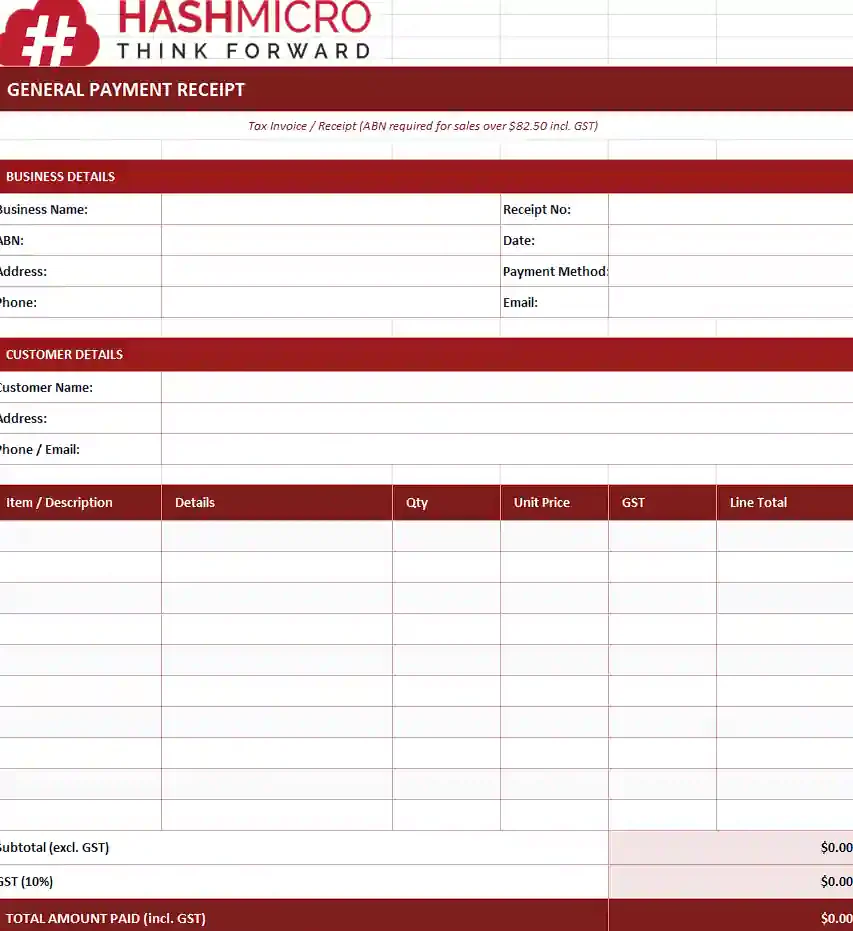
It includes space for your logo, full business details, an itemised table with quantities and unit prices, and a clear GST breakdown, making it a practical invoice for business transactions that doubles as a tax invoice for sales over $82.50.
| Item / Description | Qty | Unit Price | GST | Line Total |
|---|---|---|---|---|
| Office desk chair (ergonomic) | 2 | $495.00 | $90.00 | $990.00 |
| Monitor arm mount | 2 | $89.00 | $16.18 | $178.00 |
| Delivery fee (Sydney metro) | 1 | $55.00 | $5.00 | $55.00 |
| Subtotal (excl. GST) | $1,111.82 | |||
| GST (10%) | $111.18 | |||
| TOTAL AMOUNT PAID (incl. GST) | $1,223.00 | |||
It includes space for your logo, full business details, an itemised table with quantities and unit prices, and a clear GST breakdown that doubles as a tax invoice for sales over $82.50.
General payment receipt template
2. Cash receipt template
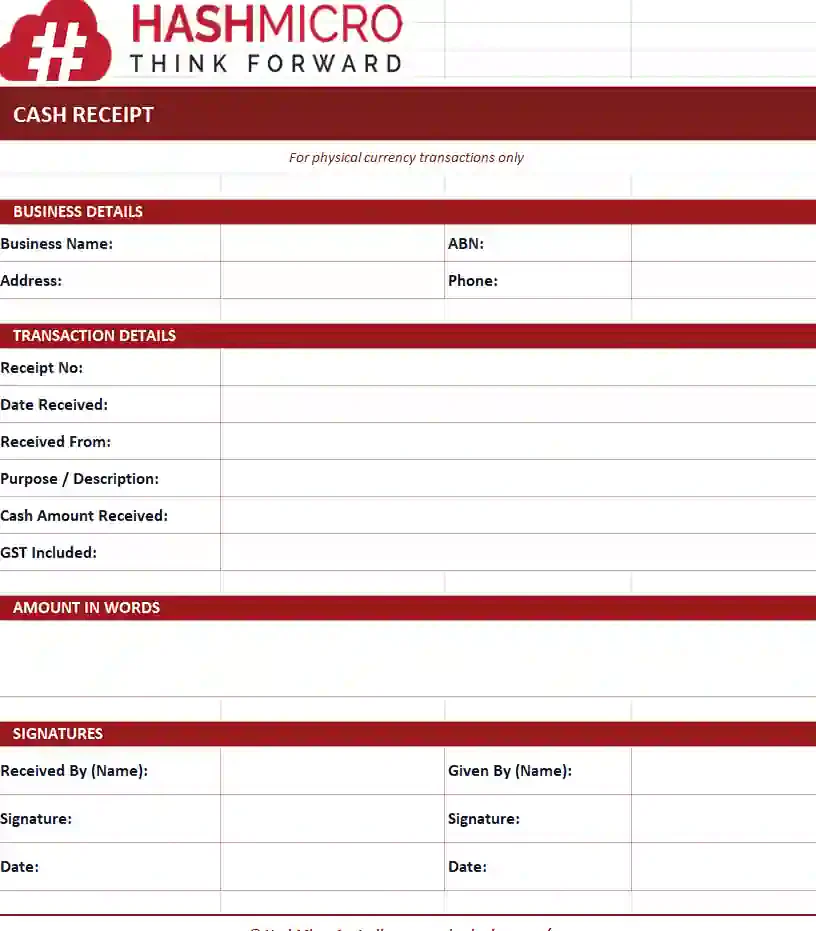
Cash leaves no automatic digital trail, so the physical receipt is often the only proof that a cash transaction occurred. This template is tailored for that scenario.
| Cash Receipt — Sample | |
|---|---|
| Receipt No | CR-0047 |
| Date Received | 14/04/2026 |
| Received From | James Whitfield |
| Purpose | Emergency plumbing parts (office kitchen tap) |
| Cash Amount | $132.00 |
| GST Included | $12.00 |
| Received By (Signature) | ____________________ |
It focuses on the date, exact cash amount, and a signature from the person receiving funds. Businesses also use it for petty cash disbursements to keep the cash drawer reconciled with the ledger.
Cash receipt template
3. Receipt log and tracker
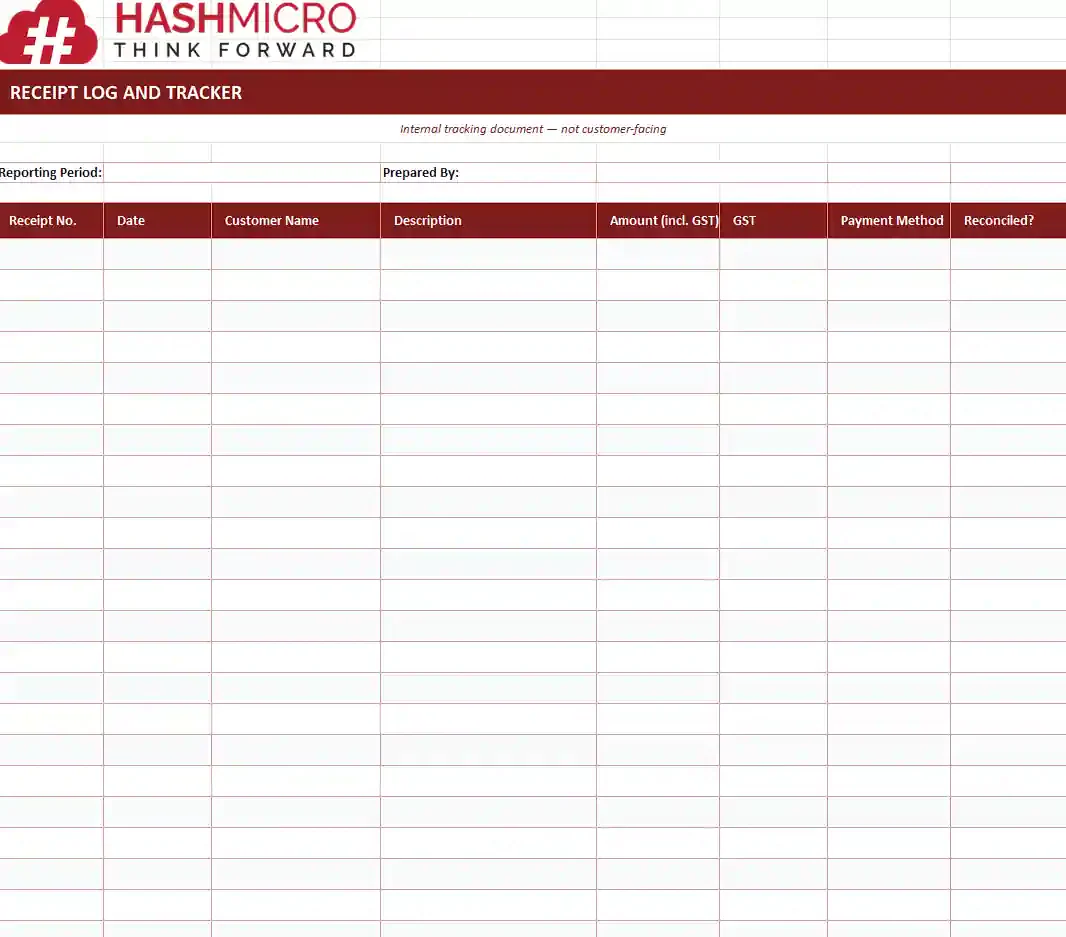
This is an internal spreadsheet template rather than a customer-facing receipt. Your admin team uses it to record the key details of every receipt issued during a given period.
| Receipt No. | Date | Customer | Amount | GST | Method | Reconciled |
|---|---|---|---|---|---|---|
| REC-1001 | 01/04/2026 | Greenfield Pty Ltd | $2,420.00 | $220.00 | EFTPOS | Yes |
| REC-1002 | 01/04/2026 | Sarah Chen | $165.00 | $15.00 | Cash | Yes |
| REC-1003 | 02/04/2026 | Horizon Builders | $8,910.00 | $810.00 | Bank Transfer | No |
| TOTALS | $11,495.00 | $1,045.00 | ||||
Columns typically include receipt number, date, customer name, total, GST collected, and payment method. The log bridges the gap between point-of-sale records and formal accounting software.
Receipt log and tracker
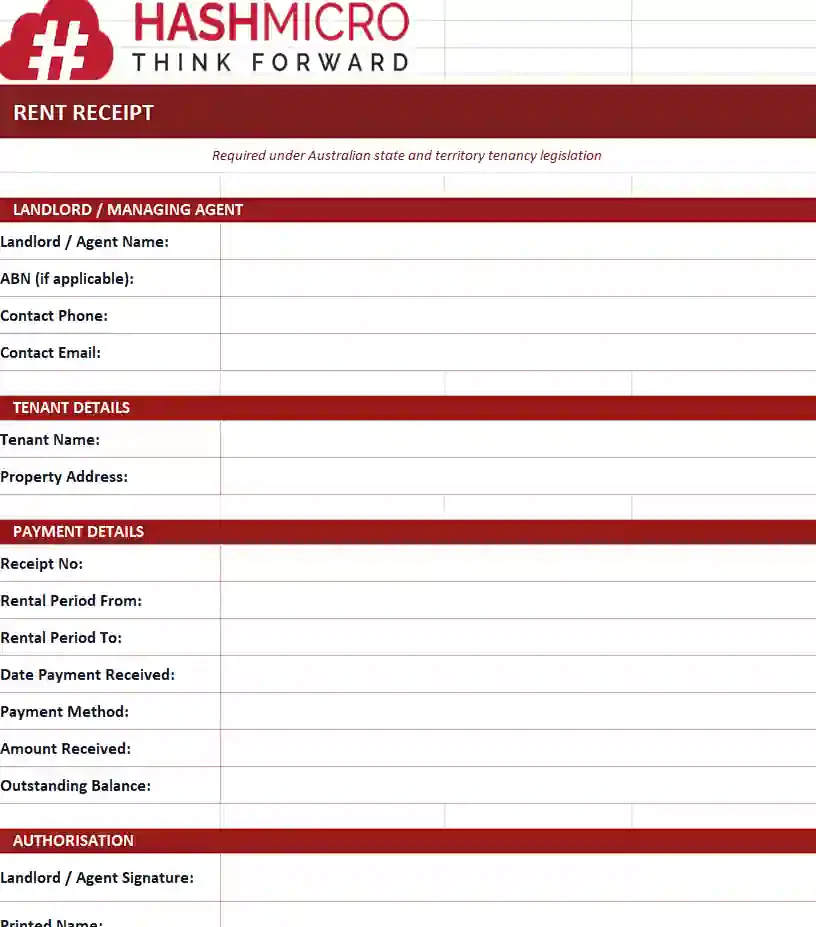
4. Rent receipt template
Australian landlords must issue a written receipt when tenants pay rent in cash. State tenancy laws specify the required fields, and failing to comply can result in tribunal fines.
| Rent Receipt — Sample | |
|---|---|
| Receipt No | RR-0112 |
| Tenant Name | Emma Richardson |
| Property Address | Unit 4, 78 Bourke St, Melbourne VIC 3000 |
| Rental Period | 01/04/2026 to 14/04/2026 |
| Date Payment Received | 31/03/2026 |
| Payment Method | Cash |
| Amount Received | $975.00 |
| Landlord Signature | ____________________ |
The template includes the tenant’s name, property address, the specific rental period the payment covers, the date received, and the landlord’s or agent’s signature.
Rent receipt template
5. Charitable donation receipt template
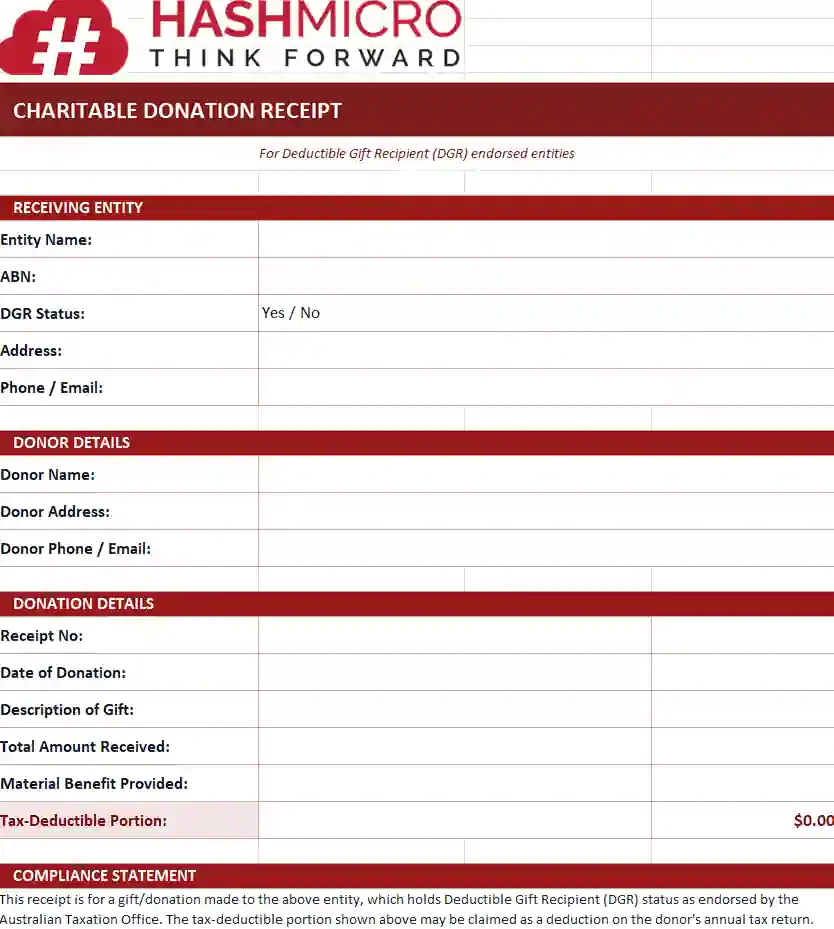
If your entity holds Deductible Gift Recipient status from the ATO, donors rely on your receipt to claim tax deductions. The wording must be exact.
| Charitable Donation Receipt — Sample | |
|---|---|
| Receipt No | DN-2026-0034 |
| Donor Name | David Huang |
| Date of Donation | 10/04/2026 |
| Total Amount Received | $500.00 |
| Material Benefit Provided | $75.00 (gala dinner ticket) |
| Tax-Deductible Portion | $425.00 |
| DGR Status Confirmed | Yes |
| Authorised Signature | ____________________ |
The template must state the ABN, confirm DGR status, record the donation date and amount, and separate the deductible gift portion from any material benefit the donor received in return.
Charitable donation receipt template
An integrated AI-powered accounting system centralises records, automates routine checks, and highlights missing data earlier. Try our free demo and consultation to see how it supports your workflow.






How to Fill Out a Receipt
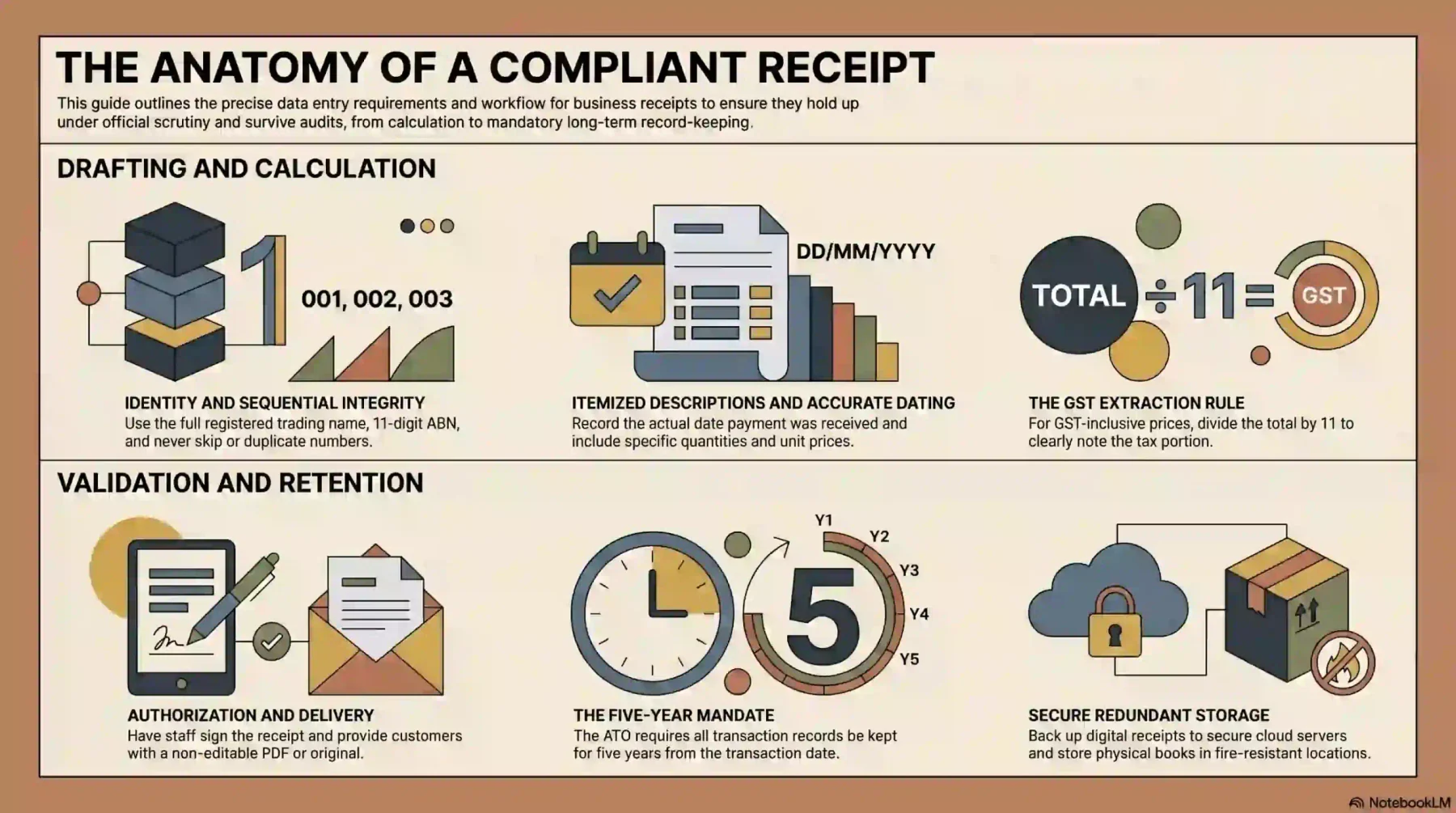
Having a template is only half the equation. Consistent data entry determines whether your receipts hold up under ATO scrutiny or during a customer dispute.
1. Enter your business name, ABN, and contact details
If using a digital template or pre-printed book, this section may already be filled. For blank templates, enter your full registered trading name without informal abbreviations.
Add your 11-digit ABN and double-check for transposed digits. A wrong ABN causes issues when customers verify your business on the ATO lookup tool. Include address, phone, and email below it.
2. Assign a receipt number and record the date
Assign the next number in your sequence. If the last receipt was #1045, this one is #1046. Never skip or duplicate numbers. If you void a receipt, keep the voided copy to explain the gap.
Enter the date payment was actually received, not the date you complete the paperwork. Use DD/MM/YYYY to remove ambiguity, particularly for transactions near the end of a BAS quarter.
3. Describe the goods or services paid for
In the itemised section, enter quantity first, then a specific description. Write ‘2 hours IT network consulting’ rather than just ‘consulting’. A reader should understand the transaction months later.
Enter the unit price for each line, then calculate the line total by multiplying the quantity by the unit price. If providing a service, include the dates the work was performed alongside the description.
4. Record the amount, GST, and payment method
Sum all line totals to reach the subtotal. If GST-registered, calculate the tax portion. For prices already including GST, divide the total by 11 to extract the GST amount and note it clearly.
Write the final total in large, clear numerals. Below it, record the payment method: cash, Visa, Mastercard, EFTPOS, or direct deposit. For cheque payments, note the cheque number for tracing.
5. Sign or authorise the receipt and provide a copy
The staff member who processed the transaction signs or initials the authorisation block. This confirms that an authorised representative verified and received the payment.
For digital templates, or when using invoicing software for receipts making, export as a non-editable PDF and email it directly. Confirm the customer received the document before concluding the interaction.
6. File the receipt copy for ATO record-keeping
Retain a duplicate of every receipt issued. The ATO requires businesses to keep transaction records for at least five years from the date they are prepared or the transaction occurs.
For digital receipts, back up copies to a secure cloud server with automatic versioning. For physical books, store them in a dry, fire-resistant location where ink and paper will not degrade over time.
ATO Receipt Record-Keeping Rules for Australian Businesses
Beyond issuing receipts correctly, Australian businesses must also store and manage them according to the ATO’s retention and legibility standards.
1. How long must you keep receipts?
The ATO requires you to keep records for five years from the date you lodge the tax return that includes the relevant transaction. For capital assets, keep records for the life of the asset plus five years.
If you claim a deduction or report income from a transaction, the supporting receipt must be retrievable and legible for the entire retention period. Losing it does not excuse the obligation.
2 . What receipts does the ATO require for claiming tax deductions?
To claim a work-related or business expense, you need a receipt showing the supplier’s name, amount, nature of the goods or service, date, and proof of payment.
For expenses under $10, or where a receipt is not practically obtainable, you may use other records such as bank statements or diary entries. For everything above that threshold, the receipt is mandatory.
3. Does the ATO accept digital and scanned receipts?
Yes. The ATO accepts electronic invoicing records and digital copies, provided they are a true and clear reproduction of the original. Scanned images, photos, and electronically generated receipts all qualify.
The digital copy must be legible, stored securely, and accessible to the ATO on request. If the original is paper, you may destroy it once a compliant digital copy exists in your records system.
4 Receipt Mistakes Australian Businesses Make
Even with a solid template, common errors can compromise compliance or frustrate customers who need the receipt for their own tax purposes.
1. Issuing receipts without a GST breakdown for taxable supplies
GST-registered businesses must show the GST amount on receipts for taxable supplies. Omitting it prevents B2B buyers from claiming input tax credits on their BAS.
The ATO can also penalise the issuer for failing to provide compliant documentation. If your business crosses the $75,000 revenue threshold, update every template to include the GST breakdown immediately.
2. Confusing a receipt with a tax invoice when a customer claims a GST input credit
A receipt proves payment was made. A tax invoice is the document the ATO actually requires for a buyer to claim a GST credit. For sales over $82.50, the document must meet tax invoice requirements.
If your receipt does not include the words ‘Tax Invoice’, your ABN, and the GST amount, your customer’s claim may be rejected. Ensure your template doubles as a compliant tax invoice where needed.
3. Not issuing rent receipts when required by state tenancy law
In most Australian states, landlords must provide a written rent receipt within a set timeframe when tenants pay in cash. Failure can result in fines from the relevant tenancy tribunal.
Some landlords assume bank transfer records are sufficient, but tenancy legislation in several jurisdictions requires a separate formal receipt regardless of payment method. Check your state’s rules.
4. Storing receipts in a way that fails the ATO’s legibility and retention standards
Thermal paper receipts fade within one to two years, destroying the only record of the transaction. If you rely on thermal prints, always offer a digital copy or photograph the receipt for backup.
Storing paper receipts in damp or sunlit environments also causes degradation. The ATO requires records to remain legible for the full five-year retention period, so invest in proper filing or go digital.
Receipt errors become harder to control as transaction volumes grow, especially when numbering, GST details, approvals, and document storage depend on separate manual steps.
When Should You Move from Manual Receipts to Accounting Software?
Manual templates work well for low-volume businesses. But as transaction counts rise, the gap between a Word document and a purpose-built system becomes a compliance risk.
1. Signs your manual receipt process is creating ATO compliance risk
If you regularly find gaps in receipt numbering, miss GST breakdowns, or struggle to locate past receipts during BAS preparation, your manual process is failing.
Other warning signs include staff entering inconsistent descriptions, duplicate numbers appearing across locations, and reconciliation taking hours instead of minutes at month-end.
2. What accounting software can a Word template not
Digital invoicing systems auto-generate sequential receipt numbers, calculate GST instantly, reconcile against bank feeds in real time, and store every document in a searchable, ATO-compliant archive.
They also flag missing fields before a receipt is finalised, sync data across locations, and produce BAS-ready reports without manual re-entry. The template stays consistent regardless of which staff member uses it.
Conclusion
A well-structured receipt template protects Australian businesses from compliance gaps, gives customers the documentation they need, and keeps daily reconciliation manageable.
As transaction volume grows, the shift from manual templates to integrated accounting software removes the human-error risks that static documents cannot prevent.
If you too are interested in using these templates, then you can schedule a free consultation with us and let us assist you in the process.

FAQ About Receipt Templates
Businesses are not legally required to issue a receipt for every transaction unless the customer requests one. However, the ATO strongly recommends issuing receipts for all transactions to maintain a complete audit trail and support accurate BAS reporting.
Yes, many Australian businesses issue a single document that functions as both a tax invoice and a receipt. It must include your ABN, the words ‘Tax Invoice’, the GST amount, and confirmation that payment was received. This approach reduces paperwork while satisfying ATO requirements.
If you lose a receipt, check whether the supplier can re-issue a copy. Alternatively, the ATO may accept other evidence, such as bank or credit card statements, provided the expense is clearly identifiable. For amounts over $10, a receipt or equivalent record is generally required.
Yes, handwritten receipts are legally valid as long as they contain all ATO-required fields: business name, ABN, date, description of goods or services, amount, and GST where applicable. The ATO does not mandate a specific format, only that the information is complete and legible.
The ATO requires records to be in English or easily convertible to English. If you issue receipts in another language, you must be able to provide an English translation if requested during an audit or review.