









 Limited to 100 registrants
A tax invoice is an official document issued by a GST-registered business that records the sale of goods or services and shows the GST charged on the transaction. It is a legal requirement in Australia for purchases over $82.50 (including GST) and helps businesses maintain accurate records, comply with ATO requirements, and claim GST credits during BAS reporting.
Issuing the right paperwork keeps your GST claims clean and your business out of trouble with the ATO. A tax invoice in Australia is the single most important document for any GST-registered seller, because it gives the buyer the proof they need to claim a GST credit on their next BAS lodgement.
This guide walks you through the rules, the formats, and the practical workflow. You will also find free templates, a clear breakdown of recipient-created tax invoices, and tips on eInvoicing through Peppol so your business stays ready for 2026.
Key Takeaways
What Is a Tax Invoice? It is the GST-registered seller's proof of a taxable sale, and it is the document that lets your buyer claim a GST credit on their next BAS.

What Is a Tax Invoice?
"We used to spend hours each week chasing missing tax invoice details and reconciling GST before BAS lodgement. Since switching to HashMicro, every invoice ships with the right ABN, GST line, and Peppol payload, so our quarterly BAS now takes minutes rather than days"
A tax invoice is a document a GST-registered supplier issues to a buyer when goods or services change hands.
It records the sale, shows the GST amount, and triggers the buyer’s right to claim a GST credit. Understanding the basics of invoicing is essential for compliance and accurate record-keeping.
The ATO sets out exactly what the document must contain. Without those mandatory details, the buyer cannot claim the credit, and the seller risks penalties during a review.
Tax Invoice vs. Regular Invoice in Australia
Many small businesses confuse the two, yet the difference matters for tax purposes. A regular invoice is simply a request for payment, while a tax invoice also acts as evidence of GST charged on the sale.
If your business is not registered for GST, you cannot issue a tax invoice at all. Instead, you issue a regular invoice without the words “Tax Invoice” and without any GST line. Therefore, your registration status decides which document you produce.
The distinction also shapes how your customer treats the document at their end. With a valid tax invoice, a GST-registered buyer can claim a GST credit on their next BAS, whereas a plain invoice gives them no such entitlement.
For example, a tradie registered for GST who installs a hot water system for a builder must issue a tax invoice so the builder can recover the GST. On the other hand, a hobbyist seller below the $75,000 threshold simply issues a regular invoice without any GST line. As a result, picking the correct format protects both parties and keeps the BAS figures accurate.
Invoice vs Receipt: What’s the Difference in a Procurement Workflow?
A tax invoice and a receipt are often treated as the same document, yet they play different roles in a procurement workflow. The difference goes well beyond GST.
| Tax Invoice | Receipt |
|---|---|
| Requests payment for goods or services supplied. | Confirms that payment has been received. |
| Issued before or at the point of sale. | Issued after payment is made. |
| Shows the GST charged and supports a GST credit claim. | Proves the transaction is settled, not the GST position. |
| Issued by the supplier (or buyer in an RCTI). | Issued by whoever receives the payment. |
| Drives matching and approval before payment. | Closes the loop once delivery is confirmed. |
One asks for payment and records the GST on a sale, while the other confirms that payment or delivery has actually happened. The mini table below sets the two side by side.
In a procurement workflow, the invoice starts the matching process. Finance teams check it against the original purchase order to confirm pricing, quantity, and terms before anything moves forward.
Next comes the three-way match across the purchase order, the invoice, and the goods receipt. Only once all three align does the invoice get approved for payment release.
The receipt then closes the loop. It confirms that the goods or services were actually delivered, which lets the finance team reconcile the payment against accounts payable.
A receipt also strengthens the audit trail. During an ATO review, it provides proof that the transaction was completed, not simply invoiced and left open.
Quality integrated financial software automates this three-way match between purchase order, tax invoice, and receipt, cutting manual reconciliation before BAS lodgement.
What Must Be on a Tax Invoice in Australia?
The ATO is specific about the information a tax invoice must show. Missing even one field can delay your customer’s GST claim, so accuracy here protects both parties.
Below, we cover the seven required fields, the rules that apply once a sale crosses $1,000, simplified invoices for low-value sales, and the 28-day rule.
8 required fields for a Standard Tax Invoice
For sales under $1,000, the ATO requires every tax invoice to display the following details:
- The words “Tax Invoice” shown clearly.
- The seller’s identity and trading name.
- The seller’s Australian Business Number (ABN).
- The date the invoice was issued.
- A brief description of the items sold, including quantity and price.
- The GST amount payable, or a statement that the total includes GST.
- The extent to which each sale on the invoice is a taxable sale.
- The buyer’s name and ABN if the purchases are $1,000 or more.
Many businesses use a platform for automating tax invoice process to ensure these fields are never missed.
Large tax invoice
When the total sale reaches $1,000 or more, the rules tighten. In addition to the seven fields above, your invoice must also show the buyer’s identity or ABN.
This extra detail helps the ATO match the credit on the buyer’s BAS to the GST you collected. As a result, large invoices need a quick double-check before they go out.
Simplified invoice
For sales under $82.50 (GST inclusive), the ATO does not require a full tax invoice. A receipt or docket from the till is enough for the buyer to claim the GST credit.
Many businesses still use invoicing systems or an end-to-end invoicing solution to standardise both full and simplified invoices for consistency.
The 28-day rule
If a customer asks for a tax invoice, you must provide one within 28 days of the request. The clock starts on the day the request is made, not the day of the sale.
Missing this window can attract ATO penalties, so train your team to log requests promptly. A clear invoicing policy helps you stay on the right side of the rule.
Why Tax Invoice Matters for Australian Businesses
Tax invoices are a legal requirement for GST-registered businesses in Australia when a sale is worth AUD $82.50 or more. They help ensure transactions are recorded correctly and comply with ATO requirements.
For sellers
Issuing a compliant tax invoice makes it easier to track GST collected and prepare accurate Business Activity Statements (BAS). It also provides a clear record of sales and supports a professional business image.
For buyers
A valid tax invoice is needed to claim Input Tax Credits (ITCs) on eligible business expenses. If required information is missing or incorrect, the ATO may reject the claim, resulting in higher GST costs.
Types of Tax Invoices in Australia
Not every sale uses the same kind of tax invoice. The ATO recognises several formats, and choosing the correct one keeps your records compliant.
Here are the four most common formats Australian businesses issue every day.
Full tax invoice
A full tax invoice is the standard format used for most B2B and B2C sales. It carries every required field and works for sales of any value, whether under or over $1,000.
If you only want to maintain one template, this is the one to choose. It covers every scenario without forcing you to swap formats mid-day.
Simplified tax invoice
A simplified tax invoice suits low-value sales, typically point-of-sale receipts under $82.50. It still shows the seller’s ABN, the date, and the GST amount, but in a shorter layout.
Cafés, retailers, and service kiosks rely on this format because it suits high-volume, low-value transactions. Therefore, it keeps queues moving without breaching ATO rules.
Recipient-Created tax invoice (RCTI)
An RCTI flips the usual flow because the buyer issues the tax invoice instead of the seller. It is common in industries where the buyer determines the value of the goods or services, such as agriculture or government contracting.
Both parties must agree in writing before any RCTI goes out. We will cover the full RCTI requirements in a later section.
Instalment tax invoice
For long-running contracts paid in stages, an instalment tax invoice records each scheduled payment. Construction firms, consultants, and software providers often use this format to bill milestones.
Each instalment shows the GST attributable to that portion of the contract. As a result, the buyer can claim GST credits as the project progresses rather than waiting for completion.
Download Free Tax Invoice Templates for Australia
To save you time, we have organised seven ready-to-use templates that match the ATO requirements. Each one covers a different scenario, so you can pick the layout that fits your sales workflow.
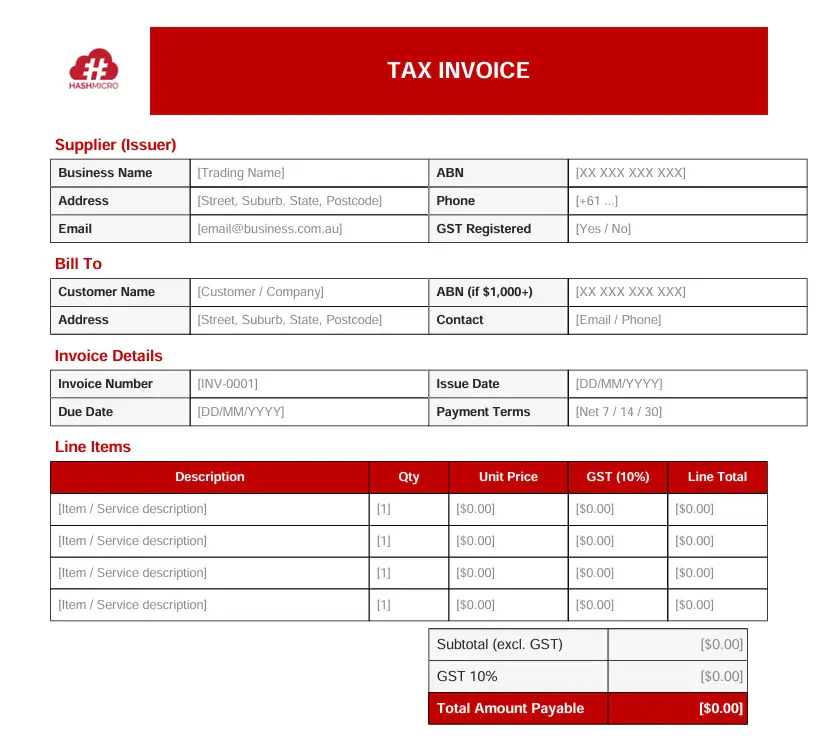
Standard tax invoice template
This is the all-purpose template most businesses need. It covers all seven mandatory fields, accepts any sale value, and works for both products and services.
Customise the header with your logo, ABN, and bank details, then save it as your default. You can re-use it daily without further edits.
Standard Tax Invoice Template
Tax invoice for professional services
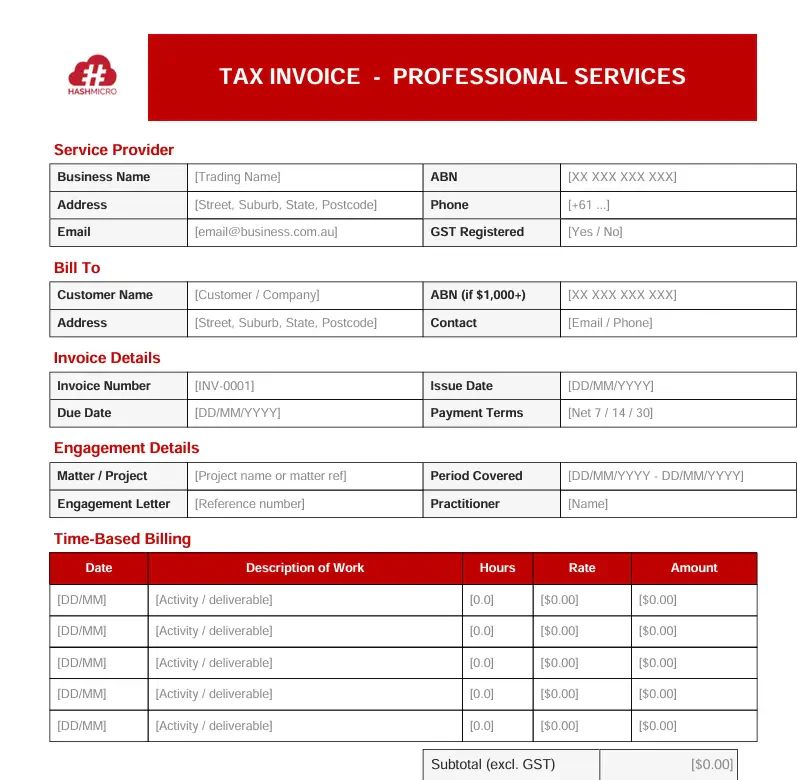
Designed for consultants, lawyers, accountants, and freelancers, this template includes a time-based line item layout. It records hourly rates, hours worked, and project descriptions in a single view.
It also leaves space for retainer notes and payment terms. Therefore, clients can see exactly what they are paying for before they release funds.
Tax invoice for Professional Services Template
Tax invoice for products/retail
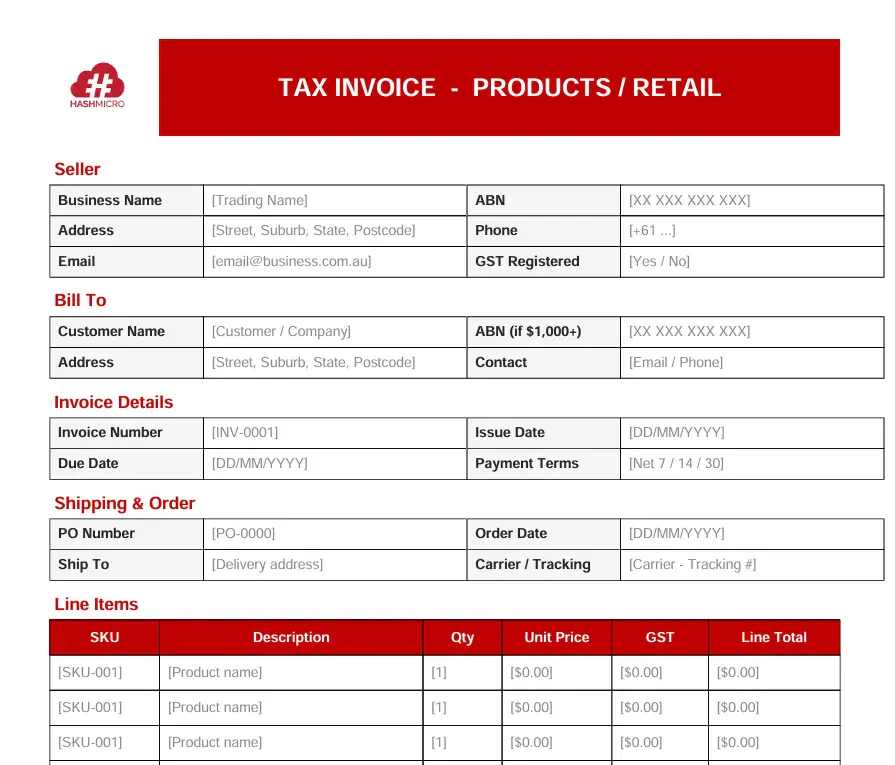
This template focuses on goods rather than services. It includes columns for SKU, quantity, unit price, and GST per line, which suits wholesalers and retailers.
You can map it directly to your inventory system. As a result, stock and accounting records stay aligned without manual reconciliation.
Tax Invoice for Product/Retail Template
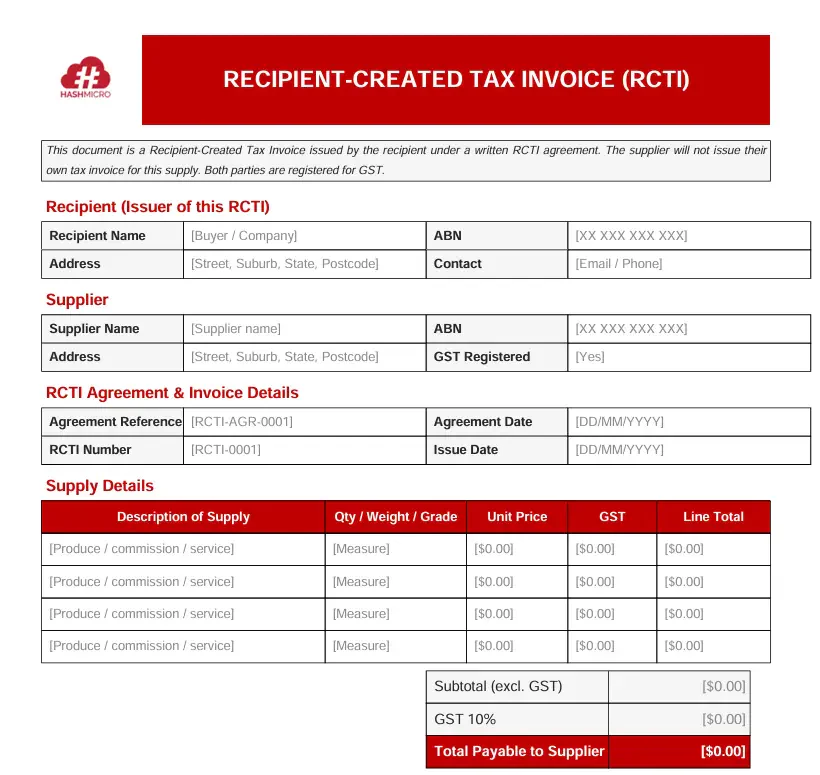
RCTI template
Use this template when you act as the buyer issuing the invoice on behalf of the supplier. It includes the mandatory wording stating that the recipient is creating the tax invoice.
It also leaves room for the written agreement reference between both parties. Without that reference, the RCTI is not valid in the eyes of the ATO.
RCTI template
Adjustment note template
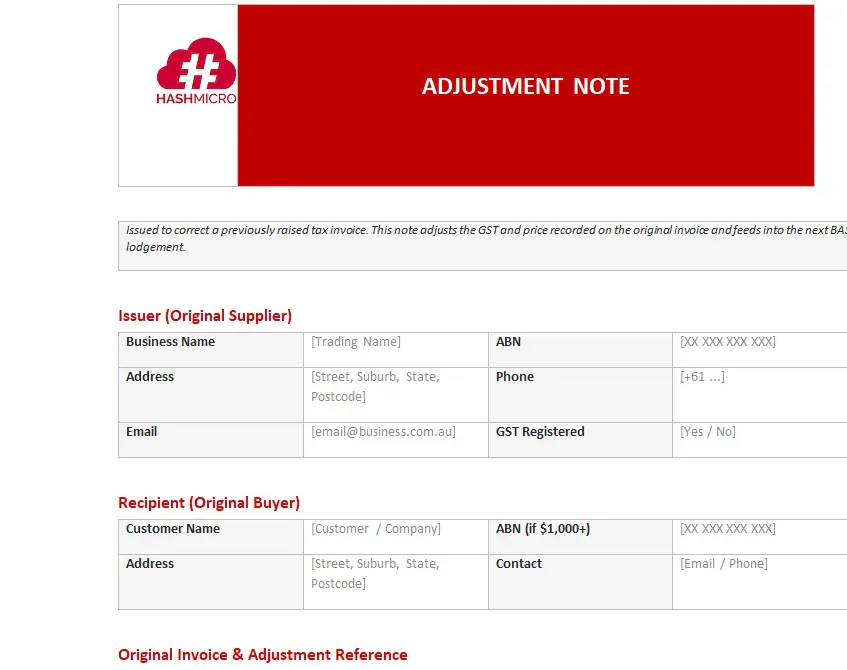
When you need to correct a previously issued tax invoice, an adjustment note is the right document. It records the difference in price or GST without cancelling the original sale.
This template links back to the original invoice number for a clean audit trail. Therefore, your BAS lodgement reflects the corrected GST position cleanly.
Adjustment Note template
Instalment tax invoice template
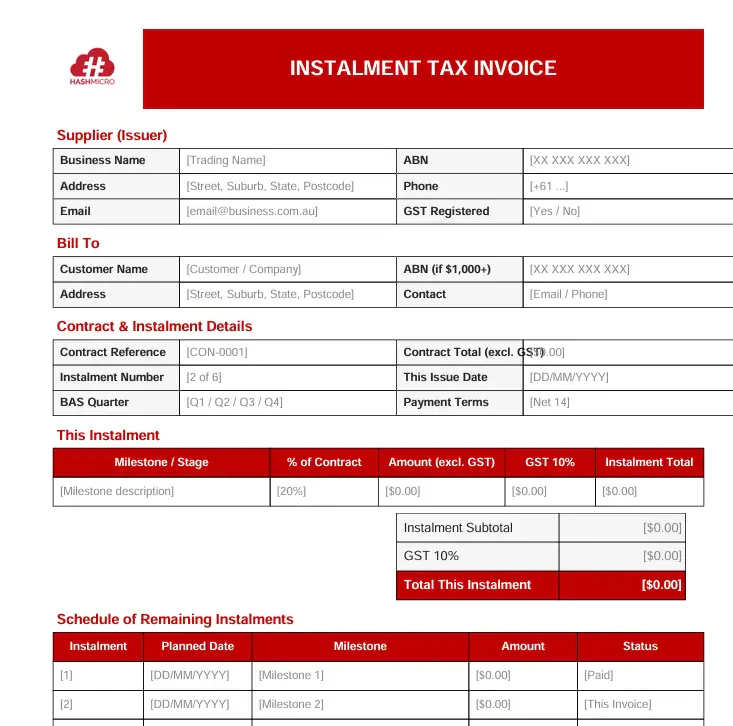
Built for staged billing, this template lists each instalment, its due date, and the GST split per payment. It works well for project-based engagements that span several BAS quarters.
Each row stands on its own as a valid tax invoice. Consequently, your client can claim the credit as each instalment is paid.
Instalment tax invoice template
Sole trader tax invoice template
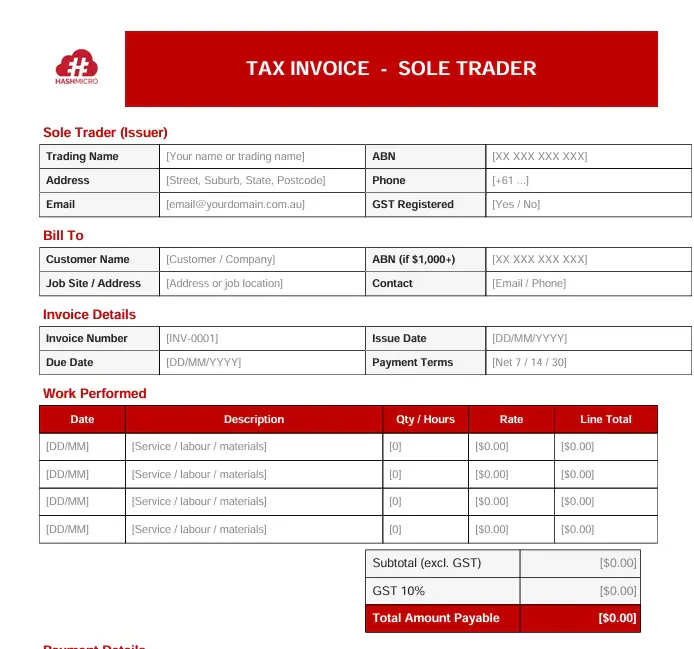
If you trade under your own name with an ABN, this template gives you a clean, branded layout. It includes space for your ABN, business name, and personal bank details for direct deposit.
It suits tradies, freelancers, and contractors who bill multiple clients each week. You can also customise the colour scheme to match your branding.
Sole Trader Tax Invoice template
How to Create a Tax Invoice in Australia
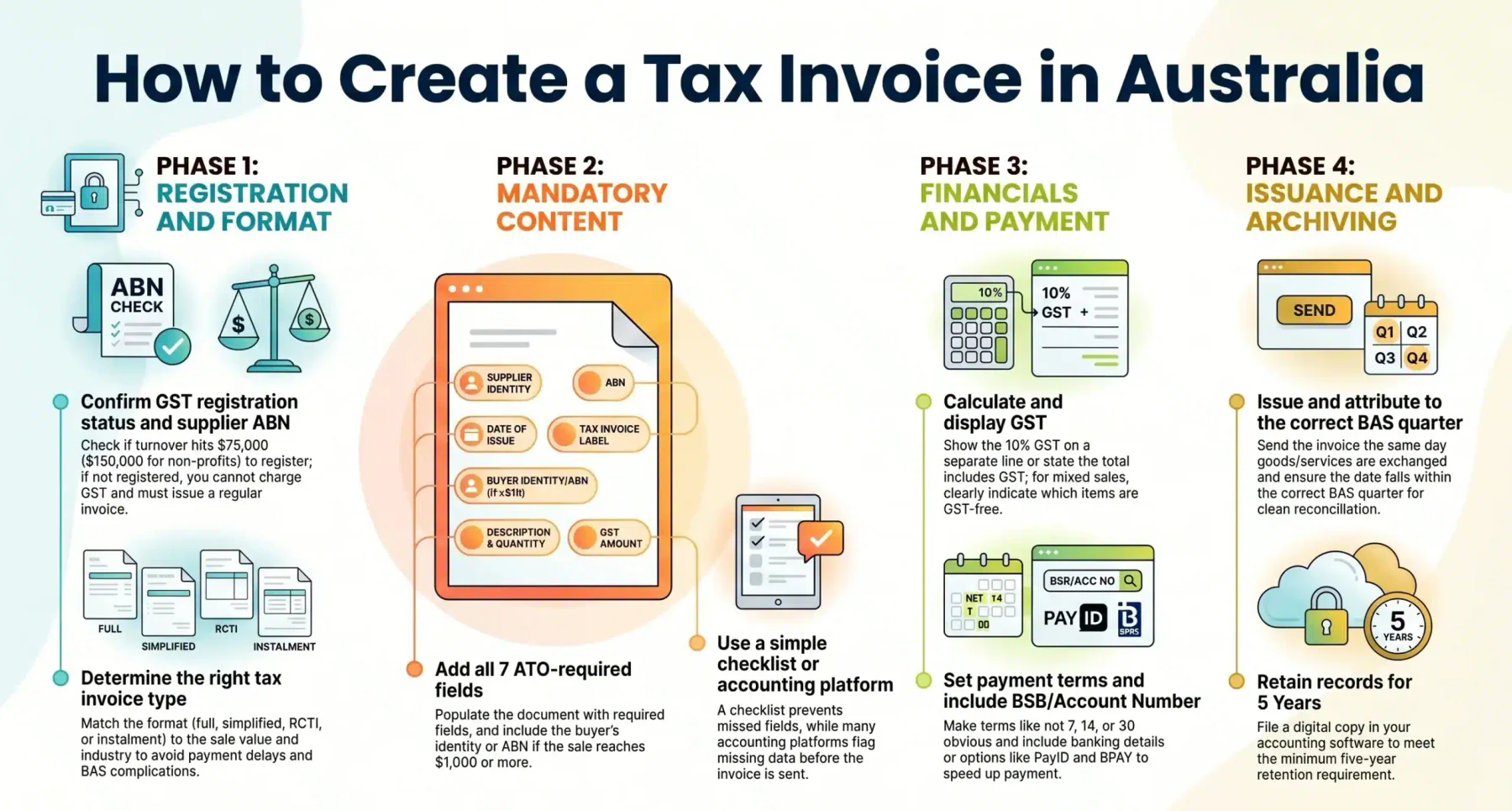
Creating a compliant tax invoice is straightforward once you know the sequence. The points below cover everything from confirming your GST status to lodging the invoice into the right BAS quarter.
1. Confirm your GST registration status and supplier ABN
Before issuing anything, check whether your business is registered for GST. You must register once your turnover hits $75,000, or $150,000 for a not-for-profit.
If you are not registered, you cannot charge or display GST. In that case, issue a regular invoice rather than a tax invoice.
2. Determine the right tax invoice type
Decide whether the sale calls for a full tax invoice, a simplified version, an RCTI, or an instalment invoice. The sale value, the contract type, and the industry usually point to the right answer.
Picking the wrong format can delay payment and complicate your BAS. Therefore, take a moment to match the format to the situation.
3. Add all 7 ATO-required fields
Populate the document with the seven required fields covered earlier in this guide. If the sale reaches $1,000 or more, also include the buyer’s identity or ABN.
A simple checklist on your invoicing template prevents missed fields. Many accounting platforms also flag missing data before you send.
4. Calculate and display GST
Show the GST amount on a separate line, or state clearly that the total price includes GST. The standard rate is 10 per cent on most taxable supplies.
For mixed sales, indicate which line items are GST-free and which are taxable. As a result, the buyer’s bookkeeper can split the entries correctly.
5. Set payment terms and include BSB/Account Number
Make payment terms obvious: net 7, net 14, or net 30 are the most common across Australia. Include your BSB and account number so the buyer can pay by direct deposit.
You can also add PayID, BPAY, or card payment options. The easier you make payment, the faster you get paid.
6. Issue, retain for 5 Years, and attribute to the correct BAS quarter
Businesses using integrated financial software can automatically sync invoices with BAS reporting, ensuring GST is correctly recorded and reconciled.
Make sure each invoice carries a date that falls within the BAS quarter it belongs to. Therefore, your GST collected and claimed reconcile cleanly when you lodge.
Recipient-Created Tax Invoices (RCTI) in Australia

RCTIs are a unique part of the GST system, designed for situations where the buyer is better placed to determine the value of goods or services. The points below explain when they apply and how to issue them correctly.
What is an RCTI and why does the buyer issue the invoice?
An RCTI is a tax invoice produced by the buyer rather than the seller. It applies when the buyer holds the data needed to calculate the price, such as weight, grade, or commission rates.
Both parties must sign a written RCTI agreement before the first invoice goes out. Without that agreement, the document is not a valid tax invoice.
ATO requirements for a valid RCTI
A valid RCTI must include all the standard tax invoice fields, plus a statement that the recipient created the invoice. Both parties must also be registered for GST at the time of issue.
The agreement must state that the seller will not issue their own tax invoice for the same supply. Furthermore, the parties must keep it current and review it whenever either side changes its GST status.
Industries that use RCTIs in australia
RCTIs are common in agriculture, where buyers grade and weigh produce on arrival. Mining, government grants, and large media commissions also use them frequently.
In each case, the buyer holds pricing data the seller does not. As a result, letting the buyer issue the invoice is faster and more accurate.
Tax Invoice Record-Keeping and BAS Requirements
Once an invoice goes out, your obligations do not end. The ATO expects you to keep tax invoices on file and link them correctly to your BAS lodgements.
1. 5-Year ATO Record-Keeping Obligation for Tax Invoices
The ATO requires you to retain every tax invoice for at least five years from the date it was issued or the related transaction was completed, whichever is later. The records must be in English and easy to access during an audit.
Digital storage works fine, provided the files cannot be altered. Many businesses use cloud accounting platforms because they handle retention automatically.
2. How Tax Invoices Flow into Your BAS: GST Credits and GST Collected
Every tax invoice you issue feeds into the GST collected line of your Business Activity Statement. Likewise, every tax invoice you receive supports the GST credits you claim back.
Reconciling these two figures each quarter prevents over- or under-payment. Therefore, accurate invoicing forms the foundation of an accurate BAS.
3. eInvoicing via Peppol: Australia’s Digital Tax Invoice Standard for 2026
The ATO is rolling out eInvoicing through the Peppol network as the national standard. Instead of emailing PDFs, your accounting software exchanges structured invoice data directly with your buyer’s system.
These e-invoicing standards reduce errors, improve speed, and support real-time validation of invoice data.
4. How invoice and receipt matching supports procurement audit trails
In a procurement workflow, the tax invoice and the receipt must match to prove that each payment lines up with the goods or services actually received.
The ATO expects every GST credit claim to rest on a valid tax invoice plus evidence of supply. The receipt is that evidence of supply, not a replacement for the tax invoice itself.
Businesses that keep both documents connected through accounting software lower their audit risk and speed up BAS reconciliation each quarter.
Tax Invoice Best Practices for Australian Businesses
Beyond the legal minimum, a few practical habits make invoicing smoother and reduce disputes. These tips suit sole traders and growing companies alike.
Always write “Tax Invoice” verbatim
The ATO is strict about wording, so the document must show the words “Tax Invoice” exactly. Variations such as “Invoice for Tax” or “Tax Bill” do not satisfy the rule.
Place the words at the top of the page in a clear font. As a result, the buyer’s accounts team can identify it instantly.
Issue tax invoices promptly
Send the invoice on the day of supply, or at the very latest the next business day. Prompt invoicing improves cash flow and avoids the 28-day request rule altogether.
It also keeps your accounting data current. Therefore, your BAS preparation each quarter becomes much faster.
Use “Adjustment note” when correcting a tax invoice
Never overwrite or delete an issued tax invoice. Instead, raise an adjustment note that references the original invoice and records the change.
This approach preserves the audit trail the ATO expects. It also stops your BAS figures from drifting out of line with your sales records.
Use invoice software to streamline tax invoicing
Manual templates work, but dedicated invoicing software removes most of the risk. The right platform automatically fills in mandatory fields, calculates GST, imports order and customer data, and stores records for the required five years.
HashMicro’s accounting and invoicing solutions, for example, support Peppol eInvoicing, RCTI workflows, and BAS-ready reporting out of the box. Consequently, your team spends less time on paperwork and more on growing the business.
Conclusion
A compliant tax invoice protects your GST credits and keeps your BAS clean every quarter. Get the seven required fields, the right format, and the 28-day rule sorted, and most audit risk disappears.
Manual templates only stretch so far once volumes grow. HashMicro’s accounting software automates GST, RCTI, Peppol eInvoicing, and five-year retention in one platform. Book a free consultation with our team today to see how it fits your business.

Frequently Asked Question
A tax invoice records the original GST-charged sale, while an adjustment note corrects a tax invoice that has already been issued. Use an adjustment note whenever the price, quantity, or GST changes after the original invoice has reached the buyer, since it preserves the audit trail the ATO expects.
No. For taxable sales under $82.50 (GST inclusive), the ATO accepts a receipt or till docket as enough evidence for the buyer to claim a GST credit. Many businesses still issue full tax invoices for smaller sales because it looks professional and keeps records consistent.
An RCTI is a tax invoice produced by the buyer rather than the seller, used when the buyer holds the data needed to price the supply, such as weight or grade. Both parties must be registered for GST and sign a written RCTI agreement before the first invoice goes out.
The ATO requires you to keep every tax invoice for at least five years from the date the document was issued or the related transaction was completed, whichever is later. Records must be in English and easy to retrieve during an audit, so cloud accounting storage is the safest option.
Peppol is the international network the ATO has adopted as the national eInvoicing standard, allowing structured invoice data to flow directly between accounting systems. It is not yet mandatory for every business, but federal government suppliers and many large enterprises already require it, so adoption is climbing quickly.