





Mining safety is the system of controls, procedures, PPE, inspections, and records used to protect workers and keep mining operations running safely across surface sites, underground workings, and processing areas.
This article covers the most common mining hazards in Australia, essential PPE, underground safety controls, compliance frameworks, and how software can support safer site management across teams, contractors, and assets.
Key Takeaways
Mining safety covers the controls, procedures, PPE, inspections, and records used to protect workers across surface mines and contractor zones.
Mining hazards vary by site and operation, but all require documented controls and consistent review.
Every site needs procedures practical enough for daily use and detailed enough to serve as audit evidence.
Mining safety cannot sit separately from operational workflows covering inventory, maintenance, and contractor management.

What Is Mining Safety?
Mining safety covers the controls, procedures, PPE, inspections, and records used to protect workers across surface mines, underground workings, processing areas, and contractor zones. In 2024, Australia recorded 188 worker fatalities, with mining reporting a fatality rate of 3.4 deaths per 100,000 workers, according to Safe Work Australia's Key Work Health and Safety Statistics Australia 2025, making it an operational priority, not just a compliance obligation. Without clear records, a business cannot prove controls were applied during an audit. Each hazard, corrective action, and contractor document needs an owner, a deadline, and a closeout record.
Common Mining Safety Hazards in Australia
Mining hazards vary by site and operation, but all require documented controls and consistent review. Safe Work Australia reported machinery operators had a fatality rate of 6.7 deaths per 100,000 workers, accounting for 32% of all worker fatalities in 2024.
1. Mobile plant and vehicle incidents
Haul trucks and underground equipment often operate in low-visibility environments, making traffic management plans, separation zones, and pre-start checks essential.
Managers need live records of which equipment is fit for use and which defects remain open before each shift.
2. Ground instability and rock falls
Slope failure threatens open-cut operations, while roof falls create immediate underground hazards. Both require ground control plans, geotechnical inspections, and documented escalation procedures.
3. Dust and airborne exposure
Drilling, blasting, crushing, and processing expose workers to contaminants that create long-term respiratory risks. Ventilation, monitoring, and respirator fit checks must all be consistently recorded.
4. Fire, explosion, and hazardous materials
Fuel, blasting, gas, and hot work require permit controls and emergency response plans. Fire systems and gas monitors need scheduled inspections, not just a purchase record.
5. Fatigue and remote site risks
Remote worksites and FIFO arrangements make fatigue a direct safety risk, particularly where it intersects with vehicle operation or night work. Roster design and trend analysis help identify patterns early.
Essential Mining Safety Equipment and PPE
Effective PPE requires task-risk matching, training, and inventory visibility as part of mining operations management. Without those systems, it becomes a compliance exercise rather than genuine protection.
1. Head, eye, and face protection
Hard hats, safety glasses, and face shields protect against different hazards. Selection should be task-specific and documented in a matrix reviewed whenever site risks change.
2. Respiratory protection
Respirators must match the exposure type and be supported by fit testing and filter replacement schedules. They complement engineering controls like ventilation, not replace them.
3. Hearing and hand protection
Hearing protection should align with noise assessments, not general site rules. Hand protection must also be task-specific as cut-resistant, chemical-resistant, and heat-resistant gloves are not interchangeable.
4. High-visibility clothing and protective footwear
Both should be part of site access control, with a clear process for contractors arriving without correct PPE rather than informal workarounds.
5. Gas detection and emergency equipment
Gas detectors and fire systems need calibration, inspection, and maintenance records beyond a purchase date. Managers should confirm equipment status before each shift, not only after an incident.
Underground Mining PPE and Safety Controls
Underground conditions present a fundamentally different risk profile from surface operations, with confined spaces, poor visibility, atmospheric hazards, communication limits, and more complex emergency evacuation requirements.
Underground PPE must connect with training records, not just issue logs. A worker may have the correct equipment but still need instruction on inspection, fitting, and emergency use before entering a controlled area.
Supervisors need a reliable way to confirm PPE compliance before workers enter underground areas, particularly for contractors and short-term workers whose induction records may not be current.
"Underground PPE is only as effective as the training and records behind it. Equipment without documented inspection, fitting, and emergency use training is a liability, not a control."
Mining Safety Procedures Every Site Should Manage
Every site needs procedures practical enough for daily use and detailed enough to serve as audit evidence under state and territory WHS frameworks.
1. Hazard identification and risk assessment
Hazard identification should happen before work starts and continue throughout operations. The workflow is: identify the hazard, assess the risk, assign controls, name an owner, set a deadline, and record closeout evidence.
A hazard register with no owner or deadline is a record of awareness, not a record of action.
2. Site inspections and safety audits
Inspections verify that controls are working across vehicles, equipment, PPE, emergency systems, and contractor zones. The inspection record is as important as the checklist itself.
Managers should see which inspections are overdue, which issues remain open, and which recurring findings point to a wider control failure.
3. Incident reporting and corrective actions
Incident reports should capture what happened, where, who was involved, which controls failed, and what corrective actions are required. A report without action ownership rarely improves safety.
Corrective actions need responsible persons, deadlines, and closeout evidence to prevent repeat incidents and give management visibility into risk trends.
4. Contractor safety management
Contractors bring their own risks, licences, and compliance requirements. Mining businesses need to manage inductions, insurance records, licences, PPE compliance, and site access documentation.
When these records sit across email and spreadsheets, supervisors can easily miss expired documents before a contractor accesses site.
5. Equipment maintenance and safety readiness
A machine with overdue maintenance or unresolved defects should not be treated as available simply because it is physically on site. Maintenance schedules, pre-start checks, and defect logs should connect with operations planning.
This helps managers avoid deploying unsafe equipment to meet short-term production targets.
Mining Safety Compliance in Australia
Mining safety compliance sits across national WHS principles and state or territory frameworks. Businesses need to understand requirements that apply to their operating location, mine type, and risk profile.
Safe Work Australia sets national model WHS laws for mining. In Western Australia, the Work Health and Safety (Mines) Regulations 2022 apply, while Queensland operations fall under the Mining and Quarrying Safety and Health Act 1999. NSW operations are covered under the Work Health and Safety (Mines and Petroleum Sites) Act 2013.
Compliance requires evidence that controls were applied, not just policies on paper. When records are scattered, audits become harder even when the work has been done.
How to Improve Mining Safety Management
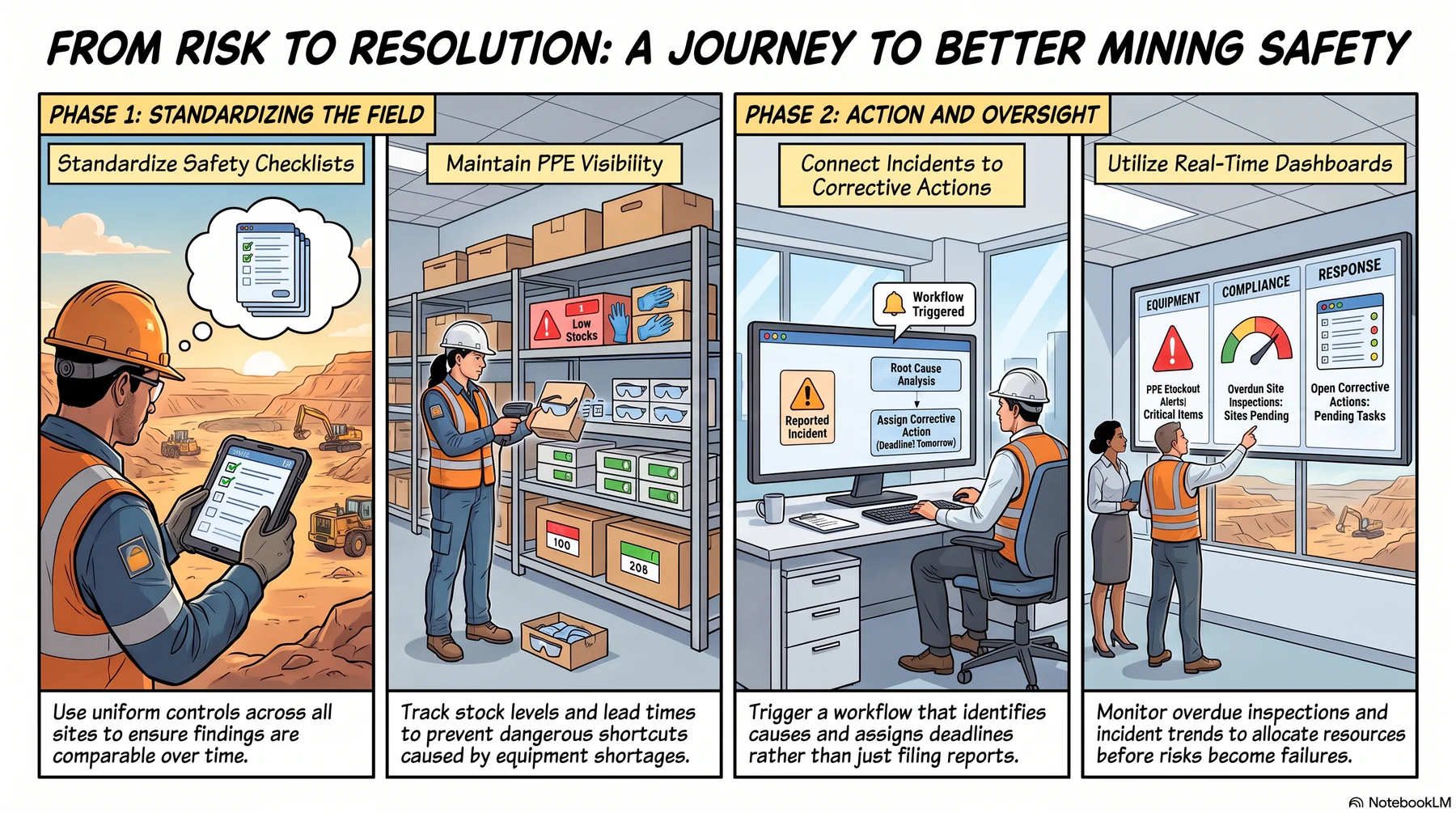
Safety management improves when businesses standardise checklists, centralise records, and connect corrective actions with owners. Business Queensland focuses on accident and incident data to help the industry identify priority areas, and the same logic applies internally.
1. Standardise safety checklists across sites
Standardised checklists help ensure each site inspects the same critical controls, making findings comparable across teams and time periods. Standardisation should not remove site-specific detail, as a processing plant, haul road, and underground panel each need different checks.
2. Keep PPE and safety equipment stock visible
PPE shortages can delay work or lead to unsafe shortcuts. Mining businesses should track stock levels, issue history, reorder points, and supplier lead times for critical safety equipment.
If safety stock is managed manually, teams may only discover shortages when work is about to start.
3. Connect incidents with corrective actions
Each incident should trigger a clear workflow: review the event, identify the cause, assign action, set a deadline, verify completion, and record evidence. Repeated findings should be visible as a trend, not buried in old reports.
A business that documents incidents without closing actions is not managing safety, it is managing paperwork.
4. Use dashboards for safety performance
Dashboards support mining automation by helping mining leaders see safety performance without waiting for manual reports. Useful metrics include overdue inspections, open corrective actions, PPE stockouts, contractor document expiry, and incident trends.
If an executive sees corrective actions overdue across several sites, they can allocate resources before the risk becomes a larger failure.
How Mining Safety Software Supports Site Operations
Software turns safety management from scattered documentation into a trackable operational workflow. For mining businesses with multiple sites, contractors, and asset-heavy operations, a connected system reduces blind spots that manual processes tend to miss.
- Inspection checklists and site audit records
- Incident reporting and corrective action tracking
- PPE inventory, issue records, and reorder points
- Equipment maintenance and pre-start inspection records
- Contractor licences, inductions, and compliance documents
- Safety dashboards for management reporting
For businesses evaluating broader operational systems, HashMicro's overview of mining management software covers how software can support assets, procurement, inventory, finance, and project control alongside safety.
How HashMicro Supports Mining Safety Management
Mining safety cannot sit separately from operational workflows. PPE availability depends on inventory and purchasing, equipment safety depends on maintenance records, and contractor safety depends on document control and site access approvals.
When those workflows are managed in separate systems, safety teams spend too much time chasing records across tools. HashMicro mining solution connects safety-related workflows with procurement, inventory, asset maintenance, HR, and reporting in one ERP environment.
- PPE and safety equipment inventory connected with purchasing
- Equipment maintenance schedules and inspection records
- Contractor document control, onboarding, and site access
- Incident reporting connected with task ownership and corrective actions
- Management dashboards for safety performance visibility
Conclusion
Mining safety requires more than PPE and written procedures. It depends on hazard controls, equipment readiness, contractor compliance, and records that can prove the work was done when it matters most.
For Australian mining businesses that need safety connected with broader operations, book a free consultation to see how HashMicro can support your site management needs.

Frequently Asked Questions
Mining safety is the system of controls, procedures, PPE, training, inspections, and records used to protect workers and maintain safe operations across surface mines, underground workings, processing areas, equipment use, and contractor zones.
Common mining safety hazards include mobile plant interaction, vehicle incidents, ground instability, dust and airborne exposure, fire and explosion, fatigue, and contractor-related risks. Each hazard requires documented controls, assigned ownership, and closeout records.
Mining PPE commonly includes hard hats, safety glasses, face shields, respirators, hearing protection, gloves, high-visibility clothing, protective footwear, and gas detectors. Selection should be based on task risk and site conditions rather than general site rules.
Underground mining PPE includes cap lamps, self-rescuers, gas detectors, respirators, communication devices, and high-visibility clothing. It should be managed alongside training records, ventilation controls, and emergency response procedures.
Software can improve mining safety management by centralising inspections, incident reports, corrective actions, PPE stock, contractor documents, and equipment maintenance records, helping managers identify open risks and overdue actions faster.