

Mining projects carry risks that most industries never face. Remote sites, volatile geology, regulatory complexity, and capital commitments that can run into billions of dollars create conditions where effective mining project management determines whether a project reaches production on schedule or becomes a cautionary tale of cost overruns and delayed approvals.
Australian mining sits at the centre of global commodity supply chains, and the pressure on project managers reflects that position. Whether the project spans iron ore in the Pilbara, coal in Queensland, or lithium across Western Australia, the management framework must keep complex, moving parts aligned from the first drill hole through to final rehabilitation.
Key Takeaways
Mining project management covers planning, execution, cost control, procurement, workforce management, and compliance across a project's full lifecycle.
The five phases are scoping and exploration, feasibility and approval, project execution, commissioning and handover, and mine closure and rehabilitation.
Common challenges include cost overruns, contractor coordination, remote site management, geological uncertainty, and strict safety and environmental compliance obligations.
HashMicro connects finance, procurement, inventory, HR, and project data in one platform to reduce reporting gaps and improve cost visibility across mining operations.

What Is Mining Project Management?
Mining project management is the structured discipline of planning, executing, and controlling the activities required to deliver a mining operation from concept through to closure. It covers everything from initial geological studies through feasibility analysis, construction, production, and eventually site rehabilitation.
At its core, the role involves coordinating engineering, procurement, construction, regulatory approvals, environmental compliance, and workforce planning within defined cost and schedule parameters. Therefore, mining project managers operate across disciplines rather than within a single functional area.
The discipline draws from general project management principles but applies them to a context where the ground itself can change the plan. Geological variability, equipment constraints, and shifting commodity prices create conditions that general frameworks handle poorly without specific adaptation.
How Mining Project Management Differs from General Project Management

General project management principles apply across industries, but mining introduces conditions that standard frameworks do not account for by default. The points below outline where mining project management diverges most sharply from standard practice.
- Remote and FIFO site coordination: Most mining projects operate far from major population centres, which means fly-in fly-out (FIFO) workforces, rotational rosters, and logistics chains that add cost and coordination complexity. Camp management, transportation, and worker welfare become project-critical functions.
- Geological uncertainty and changing site conditions: Unlike a construction project with fixed ground conditions, mining projects encounter live geological data throughout execution. Ore grades, fault lines, and groundwater can change the scope mid-project and require rapid re-planning.
- Heavy equipment and asset dependency: Mining operations depend on large capital equipment including haul trucks, excavators, drilling rigs, and processing plant. Equipment downtime affects project timelines directly, so asset management in mining becomes part of project governance.
- Multi-contractor workforces: Large mining projects typically involve dozens of specialist contractors working concurrently. Managing interfaces between contractors, subcontractors, and the owner's team requires detailed planning and active oversight.
- Strict safety and environmental compliance: Australian mining operates under state and federal safety legislation, environmental approvals, and social licence obligations. Non-compliance can halt a project and carry significant legal and financial consequences.
- Long project timelines and high capital exposure: Mining projects can span five to twenty years from exploration through closure. Capital exposure at each stage is high, and cost overruns tend to compound over time in ways that shorter industrial projects do not experience.
Key Phases of Mining Project Management
Mining projects do not follow a single linear path, but they share a common management sequence. Each stage carries distinct deliverables, decisions, and risk profiles that shape how the next stage begins.
1. Scoping and exploration planning
The scoping stage establishes whether a mineral deposit is worth pursuing further. Geologists collect surface and sub-surface data, while project teams develop early cost and schedule estimates that inform the decision to proceed.
This stage also involves community and stakeholder consultation in many Australian jurisdictions. Therefore, project managers must coordinate technical and social workstreams from the outset rather than treating engagement as a later activity.
2. Feasibility and approval
The feasibility stage converts exploration data into a defined project concept with a bankable estimate of capital and operating costs. Prefeasibility and definitive feasibility studies benchmark the project against investor and lender requirements.
Regulatory approvals run in parallel, covering environmental impact assessments, native title processes, and state or federal mining approvals. These approval timelines can extend this stage significantly, and teams must build them into the project schedule from the beginning.
3. Project execution
Execution covers detailed engineering, procurement, and construction. At this point, project teams are at their largest, contractor activity peaks, and cost exposure is at its highest. Schedule control and scope management are the primary concerns during execution.
Changes in geological conditions, contractor performance, or equipment supply can create cascading delays if the project team does not identify and respond to them quickly.
4. Commissioning and handover
Commissioning begins when construction is sufficiently complete to introduce ore or process media into the plant. This stage tests equipment, validates throughput targets, and transitions the project from a construction environment to an operational one.
Handover to the operations team requires clear documentation, training, and performance verification against design parameters. As a result, project managers must plan the commissioning sequence well before construction completes to avoid delays at this transition.
5. Closure and rehabilitation
Mine closure is a formal project stage that Australian regulators require mining companies to plan and fund from the start. It covers decommissioning equipment, rehabilitating disturbed land, and meeting environmental performance standards set out in the original approvals.
Closure costs can run into hundreds of millions of dollars for large operations, and state regulators now require progressive rehabilitation throughout the mine life rather than at the end. Therefore, closure planning must inform decisions made in every earlier stage.
Common Challenges in Mining Project Management
"In mining, the project rarely fails on the technical side. It fails when finance, procurement, and site teams work from different numbers. Connect that data, and you give project managers the one thing the ground never gives them: certainty."
Safety and compliance risks
Mining remains one of Australia's most safety-critical industries. Site hazards including ground movement, explosives handling, heavy vehicle interaction, and confined space entry require active safety management systems and ongoing workforce training.
Compliance obligations extend beyond workplace safety to environmental monitoring, heritage protection, and water management. Project managers must ensure that all regulatory conditions remain current and that any non-compliance is identified and reported promptly.
Cost overruns and budget visibility
Capital cost overruns are common in mining projects, particularly where scope is not tightly defined before execution begins. Scope changes during construction, commodity price movements, and labour market pressures all contribute to budget variance.
Effective budget management requires real-time cost visibility, not just monthly reporting. Project teams that rely on delayed or incomplete cost data cannot take corrective action early enough to prevent overruns from compounding.
Contractor and subcontractor coordination
A large mining project may involve twenty or more specialist contractors working concurrently across different areas of a site. Coordinating interfaces, managing shared resources, and resolving schedule conflicts between contractors is a significant management task.
Contract management must cover not only scope and schedule but also safety performance, reporting obligations, and variation management. Therefore, owner project teams require clear processes for reviewing contractor performance and managing commercial risk throughout execution.
Remote site and workforce management
FIFO workforces introduce challenges that permanent site workforces do not generate. Roster and workforce management, camp logistics, mental health support, and travel coordination all require planning and resourcing that add to project overhead.
High workforce turnover on FIFO projects increases training costs and reduces continuity of knowledge. Project managers must design induction and handover processes that preserve institutional knowledge even as individual workers rotate in and out.
Geological and environmental uncertainty
Geological uncertainty is inherent in mining and cannot be fully eliminated through study. Unexpected fault zones, variable ore grades, acid rock drainage, and groundwater intrusion all have the potential to change project economics mid-execution.
Environmental conditions can also shift. Extreme weather events, changes in groundwater levels, and revised environmental standards during a project's life can require additional approvals or design changes. As a result, project risk registers must account for both geological and environmental scenarios throughout the project.
Mining Project Management in Australia: WA and QLD Considerations
Western Australia and Queensland account for the majority of Australian mining output and host the most active project pipelines. Each state has its own regulatory environment, industry culture, and infrastructure challenges that shape how projects are managed in practice. In Western Australia, the iron ore, gold, and lithium sectors drive most project activity.
The Pilbara region involves remote operations with long supply chains and large FIFO workforces. State regulations under the Mining Act 1978 and the Environmental Protection Act 1986 govern approvals, while the Environmental Protection Authority oversees environmental impact assessments for major projects. Queensland's coal, copper, and critical minerals sectors operate under a different framework.
The Mineral Resources Act 1989 and the Environmental Protection Act 1994 apply, and projects near agricultural or water-sensitive areas face additional scrutiny. The Department of Resources manages mining leases and approvals, while the Department of Environment and Science oversees environmental conditions.
Both states have seen significant investment in critical minerals projects tied to battery supply chains. For project managers, this means navigating accelerating approval timelines alongside complex technical requirements for processing and infrastructure that differ from established commodity pathways.
Best Practices for Managing Mining Projects
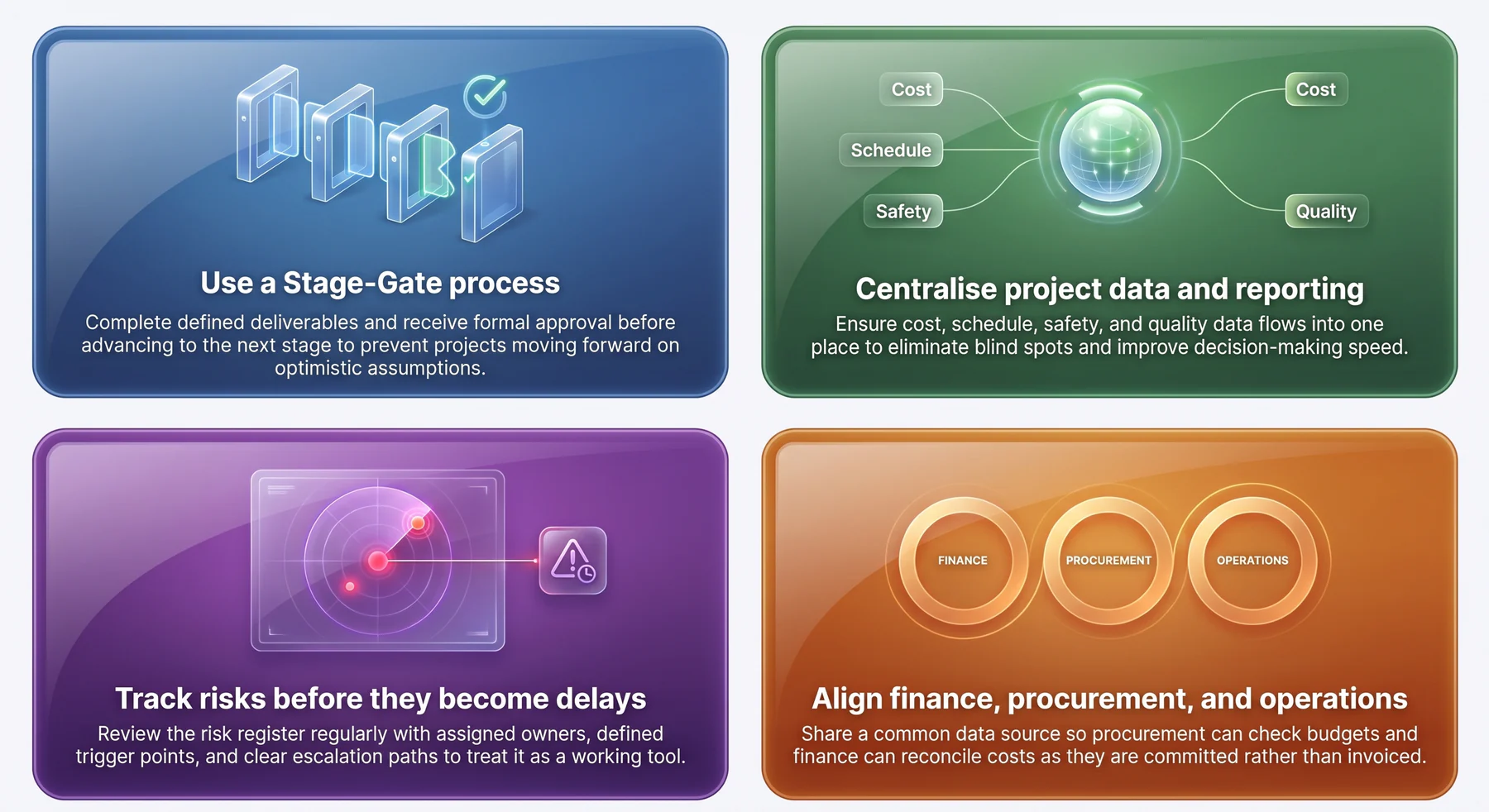
The mining projects that consistently meet their cost and schedule targets share a number of management practices. These are not theoretical frameworks but approaches that experienced project teams apply across different commodity types and project scales.
Use a Stage-Gate process
A Stage-Gate process requires project teams to complete defined deliverables and receive formal approval before advancing to the next stage. It prevents projects from moving forward on optimistic assumptions and gives investors and boards confidence that each commitment is supported by adequate data.
For example, a project that has not completed a definitive feasibility study should not proceed to detailed engineering, even under schedule pressure. Enforcing these gates reduces the risk of expensive design changes later in the project life.
Centralise project data and reporting
Project data scattered across spreadsheets, email threads, and individual contractor systems creates blind spots for the project manager. A centralised system ensures that cost, schedule, safety, and quality data flows into one place and is available for reporting in real time.
Centralised reporting also improves decision-making speed. When a project manager can see current cost and schedule performance against baseline in one dashboard, they can identify trends earlier and escalate risks before they become schedule events.
Track risks before they become delays
A risk register is only useful if the team reviews it regularly and assigns clear owners to each risk. Too many mining projects treat the risk register as a document for investors rather than a working tool for the project team.
Effective risk tracking includes scheduled reviews, defined trigger points, and clear escalation paths. For example, a risk around a key equipment delivery should be reviewed monthly, with a clear owner responsible for monitoring the supplier and updating the project schedule if a delay is confirmed.
Align finance, procurement, and operations
Finance, procurement, and operations teams often work in separate systems on large mining projects. This creates version control issues, approval delays, and commercial decisions that do not reflect accurate cost data.
When these functions share a common data source, procurement can check budget availability before committing to a purchase, finance can reconcile costs as they are committed rather than invoiced, and operations can plan maintenance around procurement lead times. The result is fewer surprises at month-end and better capital efficiency across the project.
What Software Is Used for Mining Project Management?
Mining project teams use a range of software tools to manage scheduling, cost control, procurement, asset tracking, and reporting. The specific mining management tools depend on project scale, owner preferences, and the maturity of the project management function within the business. The table below summarises the main software categories used across mining projects and what each one covers.
Many mining project teams rely on a combination of scheduling and cost tools that do not share data automatically. Therefore, finance and project controls teams spend significant time reconciling information between systems that should be connected by design.
How HashMicro Supports Mining Project Management
For mining businesses that need tighter integration between project finance, procurement, inventory, and workforce management, HashMicro provides a comprehensive mining management software that connects these functions in one system rather than across disconnected tools. HashMicro's procurement module supports the full purchasing cycle, including RFQ management, vendor comparison, multi-level approval workflows, and goods receipt tracking.
For mining projects with large contractor and supplier bases, this removes the manual processes that slow purchasing down and create cost visibility gaps at month-end. The inventory and asset management modules help project teams track materials, equipment, and spare parts across multiple site locations.
Combined with the accounting module, project cost data flows from purchase order to ledger entry without requiring manual reconciliation between separate platforms. For teams managing FIFO workforces, HashMicro's HR module covers attendance, leave, payroll, and employee records, with direct connection to project cost codes. This gives project managers visibility over labour costs alongside materials and contractor expenditure in a single reporting environment.
Connecting procurement, cost, inventory, and workforce data in one system creates the foundation. Hashy, HashMicro's AI Coworker, draws on that connected data through the Company Nexus to help project managers surface cost variances, flag overdue approvals, and answer operational questions without manually pulling reports from multiple modules.






Conclusion
Mining project management requires a framework built for the specific conditions of the industry: geological variability, FIFO workforces, multi-contractor coordination, and long capital exposure across project stages that can span decades. Australian mining projects add further complexity through state-specific regulatory requirements in Western Australia and Queensland, alongside increasing community and environmental expectations.
For mining businesses looking to reduce data gaps between finance, procurement, and operations, a connected ERP system can support better decision-making from feasibility through closure. If you want to see how HashMicro can support your mining project management, book a free consultation with the team today.
Frequently Asked Questions
A mining project typically moves through five management stages: scoping and exploration planning, feasibility and regulatory approval, project execution covering engineering and construction, commissioning and handover to operations, and finally closure and rehabilitation. Each stage has distinct deliverables and decision gates that determine whether the project should advance.
Project management in mining controls how capital, time, and people are used across a project that may span years and involve hundreds of contractors and suppliers. Without structured project management, cost overruns, schedule delays, safety incidents, and compliance failures become more likely. The discipline provides the governance that keeps complex, high-stakes projects on track.
The biggest risks in mining project management include geological uncertainty that changes project economics mid-execution, cost overruns driven by scope changes or labour market pressures, contractor performance failures, safety and environmental incidents, and regulatory delays that extend construction timelines. Remote site conditions amplify most of these risks by reducing the speed at which problems can be identified and resolved.
Mining project teams use a combination of scheduling software, cost control systems, procurement platforms, asset management tools, and HR systems. Many projects also use integrated ERP software to connect finance, procurement, inventory, and workforce data in one place. The choice of software depends on project scale, integration requirements, and the level of real-time cost and schedule visibility the project team needs.