






Manufacturing businesses today face increasing pressure from supply chain disruptions, changing customer demand, and fluctuating raw material costs. As operations become more complex, effective production planning plays a bigger role in maintaining efficiency and reducing operational risk.
Research from Vifada also highlights the importance of structured production planning. The study found that better planning can improve resource utilisation, reduce lead times, and help businesses respond more effectively to changing production conditions.
Without a clear production plan, businesses may face excess inventory, production delays, or inefficient resource allocation. This article explains the key elements of production planning and how businesses can optimise manufacturing operations more effectively.
Key Takeaways
Production planning is comprehensive definition covering the strategic allocation of resources, time, and labor to optimize manufacturing output.
A PPIC dashboard centralises production, inventory, and procurement data, helping teams detect bottlenecks across multiple sites.
Integrated manufacturing systems improve planning through real-time visibility, automated scheduling, and coordinated multi-site operations.

What is Production Planning in Manufacturing?

Production planning is the process of organising materials, labour, equipment, and schedules to ensure products can be manufactured efficiently and delivered on time. It helps businesses balance production capacity with customer demand while reducing delays and resource waste.
At its core, production planning acts as a guide for manufacturing operations. It determines what products need to be produced, how much is required, when production should happen, and which resources are needed to complete the process.
The scope of production planning usually covers the “5 Ps” of production: Product, Plant, Process, Program, and People. When these elements are aligned properly, businesses can improve workflow efficiency, reduce downtime, and maintain more consistent production output.
Many manufacturers are also adopting intelligent fabrication technologies to improve automation, production visibility, and operational efficiency even further.
"Production planning is more important than ever, with scalability being the focus of the current business landscape for major enterprises."
Types of Production Planning
The processes of manufacturing vary heavily from one industry to another. Consequently, understanding the your own operation is vital for selecting the right type of production planning.
1. Job-Based Planning
Job-based planning is used for custom or low-volume production where each order has different requirements. It is commonly used for specialised machinery, custom furniture, or project-based manufacturing.
Because every order is unique, planning focuses on coordinating materials, labour, and schedules to ensure each job is completed on time.
2. Batch Production Planning
Batch production planning involves manufacturing groups of identical products at the same time before switching to another batch. This method is commonly used in food production, pharmaceuticals, and consumer goods manufacturing.
Planners need to manage batch sizes, production timing, and equipment changeovers efficiently to maintain output and reduce downtime between batches.
3. Flow or Continuous Planning
Flow or continuous planning is used in industries with high-volume and low-variation production, such as oil refining, paper manufacturing, and chemical processing. Production runs continuously with minimal interruption.
Planning focuses heavily on maintaining steady operations, securing raw material supply, and preventing downtime because even small disruptions can be costly.
4. Mass Production Planning
Mass production planning is commonly used for large-scale assembly manufacturing where products move through standardised production lines. Automotive and electronics manufacturing are common examples.
The goal is to balance production across workstations so no single stage slows the entire process. Manufacturers often use takt time to align production speed with customer demand.
How Production Planning Contributes to Operation
Implementing a production planning system yields benefits for the entire company. When machinery, labor, and materials are synchronized, the cost-per-unit decreases, and resources are used optimally.
1. Enhanced Inventory Management
Production planning helps businesses maintain the right balance of raw materials and inventory. Too much stock increases storage costs, while insufficient materials can delay production.
With accurate demand forecasting and scheduling, companies can apply Just-in-Time (JIT) practices to reduce excess inventory, improve cash flow, and minimise waste.
2. Improved Customer Service
Effective production planning helps manufacturers deliver products on schedule and provide more accurate lead times. This allows sales teams to set realistic expectations and improve customer satisfaction.
Consistent delivery performance also helps strengthen customer trust and long-term business relationships.
3. Better Quality Control and Standardisation
Disorganised production processes can lead to mistakes, rushed work, and inconsistent product quality. Production planning creates structured workflows that allow time for inspections, maintenance, and quality checks.
Standardised schedules also help workers and machines operate more consistently, improving overall product reliability.
4. Data-Driven Decision Making
Production planning provides valuable data on machine usage, labour productivity, and material consumption. Businesses can use this information to identify bottlenecks, improve efficiency, and support continuous operational improvement.
These insights also help management make more informed decisions about process improvements, resource allocation, and future investments.
Steps Involved In Production Planning
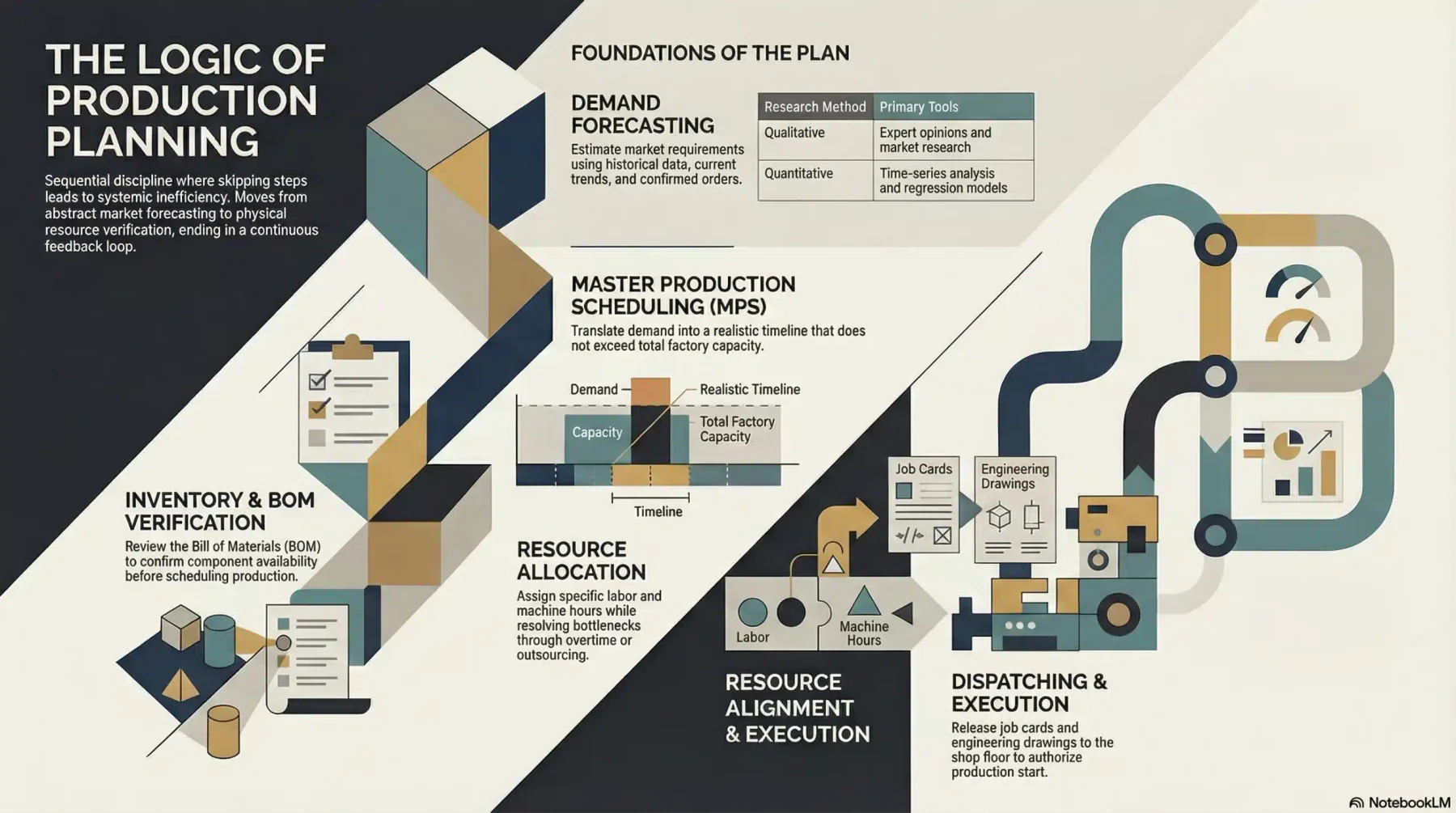
Effective production planning is a sequential process. Skipping steps or performing them out of order typically leads to inefficiencies. While software for factories automates much of this, understanding the logic is essential to avoid human mistakes.
1. Demand Forecasting
Production planning starts with estimating future product demand using sales history, market trends, and customer orders. Accurate forecasting helps businesses prepare materials, labour, and production capacity more effectively.
Forecasting methods may include market research, expert input, historical trend analysis, or data-based forecasting models.
2. Inventory Control and Availability Checks
Once demand is estimated, businesses need to verify whether the required raw materials and components are available. Production cannot run smoothly if key materials are missing or delayed.
Planners review inventory levels and the Bill of Materials (BOM) to identify shortages early. If stock is insufficient, purchase orders must be arranged before production begins.
3. Production Scheduling (MPS)
The Master Production Schedule (MPS) converts demand forecasts into a detailed production timeline. It outlines what products will be manufactured, in what quantity, and within specific time periods.
Scheduling must also match actual production capacity, including machine availability, maintenance time, labour hours, and operational efficiency.
4. Resource Allocation and Capacity Planning
At this stage, planners assign labour, machines, and materials based on production requirements. Material Requirements Planning (MRP) and Capacity Requirements Planning (CRP) help ensure resources are available when needed.
If bottlenecks appear, businesses may need to adjust schedules, approve overtime, outsource work, or redistribute workloads to maintain production flow.
5. Dispatching and Execution
Dispatching involves releasing production orders to the factory floor and providing operators with the required documents, instructions, and materials to begin production.
Once production starts, manufacturing activities are carried out according to the approved schedule and operational requirements.
6. Monitoring and Control
The final stage focuses on tracking production performance against the original plan. Businesses monitor KPIs such as production output, machine utilisation, and schedule adherence to identify delays or inefficiencies.
When issues arise, planners can adjust schedules and resource allocation to keep production running as smoothly as possible.
Production Planning Strategies
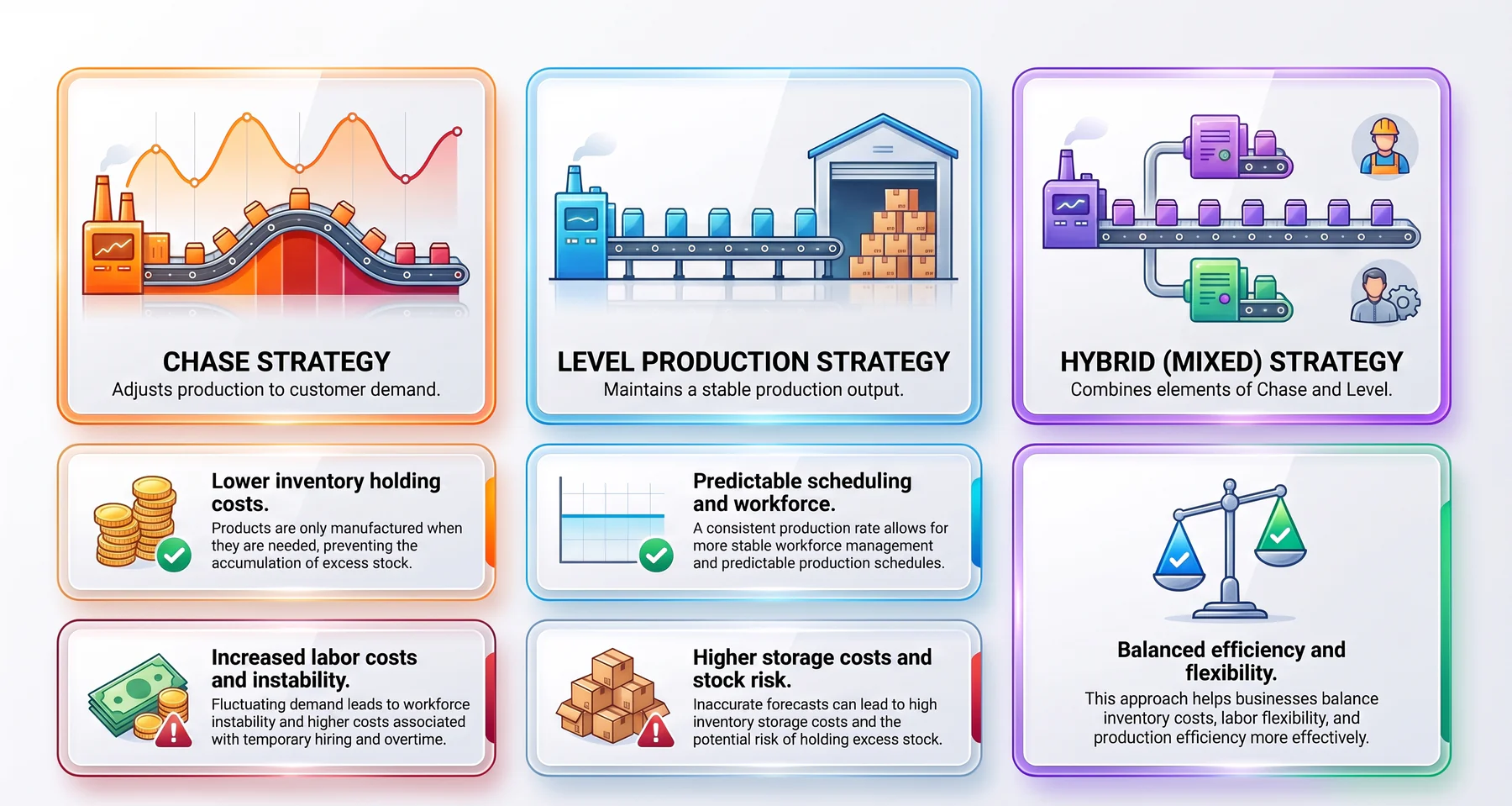
Beyond the mechanical steps, successful manufacturers adopt specific strategies to align production with business goals. These strategies determine how your company responds to demand fluctuations and inventory policies.
1. Chase Strategy
The Chase Strategy adjusts production levels based directly on customer demand. When demand increases, businesses may add overtime, hire temporary workers, or expand production capacity. When demand falls, production is reduced to avoid excess inventory.
Pros: Lower inventory holding costs because products are only produced when needed.
Cons: Labour costs and workforce instability can increase during periods of fluctuating demand.
2. Level Production Strategy
The Level Production Strategy keeps production output stable regardless of demand changes. Businesses produce at a consistent rate and store excess inventory during slower periods to prepare for future demand increases.
Pros: More stable workforce management and predictable production scheduling.
Cons: Higher inventory storage costs and potential risk of excess stock if forecasts are inaccurate.
3. Hybrid (Mixed) Strategy
Many businesses use a Hybrid Strategy that combines elements of both chase and level production planning. Companies maintain relatively stable production while using overtime, temporary labour, or outsourcing during peak demand periods.
This approach helps businesses balance inventory costs, labour flexibility, and production efficiency more effectively.
Make-to-Stock (MTS) vs. Make-to-Order (MTO)
Production planning isn’t only about scheduling, but also about deciding how production meets demand efficiently. The choice between Make-to-Stock (MTS) and Make-to-Order (MTO) determines how businesses manage inventory, production, and delivery optimally.
Understanding and choosing the right production model will reduce inventory risk, improve resource utilization, and ensure operations align with your product type and market demand.
| Aspect | Make-to-Stock (MTS) | Make-to-Order (MTO) |
|---|---|---|
| Production Trigger | Production is based on demand forecasts. | Production begins only after a confirmed customer order. |
| Inventory Strategy | Products are manufactured in advance and stored in warehouses or showrooms. | Finished goods inventory is minimal since items are produced on demand. |
| Delivery Time | Faster delivery because products are already available. | Longer lead times due to production starting after purchase. |
| Inventory Risk | Higher risk of overstocking or unsold goods. | Lower inventory risk because production matches real demand. |
| Product Characteristics | Standardized, high-volume products. | Customized or specialized products. |
| Typical Industries | Consumer electronics and apparel. | Heavy machinery, aerospace, and specialized equipment. |
The choice between MTS and MTO directly shapes production planning. MTS requires reliable demand forecasts, inventory targets, and capacity planning, while MTO relies on confirmed orders, flexible scheduling, material availability, and realistic delivery lead times.
Challenges of Production Planning
Despite the best strategies, planners face persistent hurdles. Identifying these challenges is the first step toward mitigating them.
1. Forecasting Inaccuracies
One of the biggest challenges in production planning is predicting customer demand accurately. When forecasts are incorrect, businesses may face excess inventory, stock shortages, delayed deliveries, or wasted resources.
To reduce forecasting errors, companies often update forecasts regularly and rely on shorter planning cycles supported by real-time data.
2. Supply Chain Disruptions
Production planning depends heavily on the timely delivery of raw materials and components. Delays caused by supplier issues, transportation problems, or global disruptions can interrupt production schedules.
Many businesses now reduce this risk by working with multiple suppliers and building more flexible supply chain networks.
3. Data Silos and Communication Gaps
Production planning becomes more difficult when departments work with separate systems or outdated information. Poor communication between sales, inventory, procurement, and production teams can lead to delays, inaccurate schedules, and operational inefficiencies.
A solution for manufacturing businesses is using integrated systems that centralise operational data across departments. This improves collaboration, increases visibility, and helps teams make faster and more accurate production decisions.
4. Machine Downtime and Maintenance
Unexpected machine breakdowns can disrupt production schedules and reduce overall efficiency. Older equipment and reactive maintenance practices often increase the risk of downtime.
To minimise disruptions, many manufacturers use preventive or predictive maintenance strategies and include planned maintenance time in production schedules.
5. Skill Gaps and Labour Shortages
Many manufacturers face ongoing labour shortages and difficulties finding skilled workers. High employee turnover and staff absences can also affect production capacity and scheduling.
Cross-training employees helps improve workforce flexibility by allowing workers to support multiple production areas when needed.
Production planning involves coordinating large volumes of operational data across multiple departments. Hashy, HashMicro's AI assistant, helps businesses retrieve information faster, reduce manual work, and provide actionable insights, enabling production teams to make quicker and more informed planning decisions.






How a PPIC Dashboard Supports Production Planning
A PPIC dashboard supports production planning by consolidating live production, inventory, procurement, and demand data into one interface. Planners can compare scheduled output with actual progress, confirm material availability, and identify risks before they disrupt production schedules.
For manufacturers operating across multiple sites, the dashboard also provides a consolidated view of capacity, stock, and work orders. This visibility helps teams coordinate resources, resolve bottlenecks, and keep production aligned with demand and delivery commitments.
Core components of a PPIC dashboard
A practical PPIC dashboard should display the information needed to monitor and adjust production efficiently:
- Production order status
- Planned versus actual output
- Raw material and finished goods stock
- Procurement status and supplier lead times
- Demand and material consumption
- Capacity and bottleneck alerts
- Multi-site production overview
How Manufacturing Systems Improve Production Planning for Australian Factories
According to the Australian Bureau of Statistics, the manufacturing sector employed around 902,000 people and generated A$134.8 billion in industry value added during 2023–2024. Despite its scale, sector earnings declined by 7.1% during the same period while wages and salaries increased by 5.8%, placing additional pressure on operating margins.
These conditions make efficient production planning more important for Australian manufacturers. Rising costs and tighter margins mean businesses need stronger control over labour allocation, inventory usage, machine capacity, and production schedules to maintain profitability.
As a result, manufacturing systems that compliant to regulations are becoming increasingly important for supporting production planning in modern factories. A solution for manufacturing businesses is using integrated software that connects inventory, production capacity, and demand forecasting in one platform.
This helps reduce manual work, improve planning accuracy, and minimise operational delays and waste.
- Real-time visibility: Live updates on stock levels, machine availability, and work-in-progress allow planners to make faster scheduling decisions without relying on manual counts or end-of-day reports.
- Automated scheduling: The system allocates jobs to machines based on current capacity and available materials, removing guesswork and reducing bottlenecks that inflate lead times.
- Compliance alignment: Systems built for Australian operations can be configured to account for GST obligations and ATO reporting requirements alongside day-to-day production planning.
- Multi-site coordination: For manufacturers running more than one facility, a centralized system allows production schedules, stock transfers, and capacity sharing to be managed across all locations in real time.
Conclusion
Production planning helps manufacturers align production capacity, materials, labour, and customer demand more effectively. Strong planning processes reduce operational inefficiencies, improve resource utilisation, and help businesses maintain consistent production performance.
As manufacturing operations become more complex, many businesses are moving from manual planning methods to integrated digital systems.
Companies that improve coordination across inventory, production, and workforce planning are generally better positioned to respond to changing demand and maintain long-term operational stability.
With that being said, you can get expert advice at no cost with us to help you find the best ERP software for your business needs. By integrating these systems, you can be the market leaders of the future and surpass your competitors today!

Frequently Asked Question
The primary objective is to ensure the efficient allocation of resources, materials, and time to meet customer demand while minimizing costs and waste.
Planning is the strategy phase that determines what to produce and when, while control is the execution phase that monitors actual performance against the plan and makes adjustments.
ERP software integrates data from sales, inventory, and procurement, providing real-time visibility that allows planners to create accurate schedules and respond quickly to changes.
Aggregate planning is a medium-term strategy that balances capacity and demand over a 6 to 18-month period by adjusting variables like employment levels and inventory.
Accurate forecasting predicts future sales, allowing manufacturers to procure materials and schedule labor in advance, preventing both overstocking and stockouts.