









 Limited to 100 registrants

Australian supply chains face relentless pressure from rising freight costs, port congestion, labour shortages, and volatile demand. Spreadsheet-driven planning can no longer keep pace with this complexity.
Artificial intelligence in supply chain offers a practical answer that mid-market operators already deploy across food, retail, mining, and manufacturing. It automates decisions and sharpens forecasts.
This article shows how supply chain AI works and the six use cases that deliver measurable value. It also covers the challenges local businesses face and why ERP is the natural first step.
Key Takeaways
AI in supply chain applies machine learning, generative AI, and agentic AI to automate decisions, predict outcomes, and optimise daily operations.
AI is used across six core cases: demand forecasting, inventory, logistics, supplier risk, procurement automation, and warehouse operations.
Benefits for Australian operators include 10-15% lower freight spend, leaner inventory, sharper demand plans, and earlier disruption warnings.
HashMicro unifies procurement, inventory, logistics, and finance in one ERP, with native AI for forecasting, reorder points, and supplier scoring.

What Is AI in Supply Chain Management?
AI in supply chain management applies machine learning, generative AI, and agentic AI across the full supply chain lifecycle. It automates decisions, predicts outcomes, and optimises day-to-day operations.
Unlike traditional software that runs fixed rules, these systems learn from historical patterns and improve continuously. A demand model grows more accurate with every sales cycle it observes.
For Australian businesses, the value concentrates in three areas. AI stretches small planning teams further, absorbs demand swings without overstocking, and tames freight costs that sit structurally high.
"AI in supply chain management does not just automate rules. It learns from every sales cycle and supplier interaction, growing sharper with the data it processes."
1. The Three Types of AI Used in Supply Chain
Understanding the three types of AI helps a business match the right tool to its current maturity. Each type solves a different class of supply chain problem, and most operators adopt them in sequence.
| Type of AI | What It Does | Supply Chain Example | Maturity in 2026 |
|---|---|---|---|
| Predictive AI (machine learning) | Analyses historical data to forecast what happens next | Demand forecasting, reorder points, lead-time and defect prediction | Mature and widely deployed |
| Generative AI | Creates new content and plans from learned patterns | RFQ templates, supplier summaries, scenario narratives | Scaling quickly |
| Agentic AI | Executes multi-step actions without step-by-step prompting | Monitors stock, drafts a PO, routes approval, follows up | Entering production |
Most local operators start with predictive AI, already built into modern ERP. They then layer in generative AI for planning documents and pilot agentic AI as autonomous workflows become auditable.
How Is AI Used in Supply Chain Management?
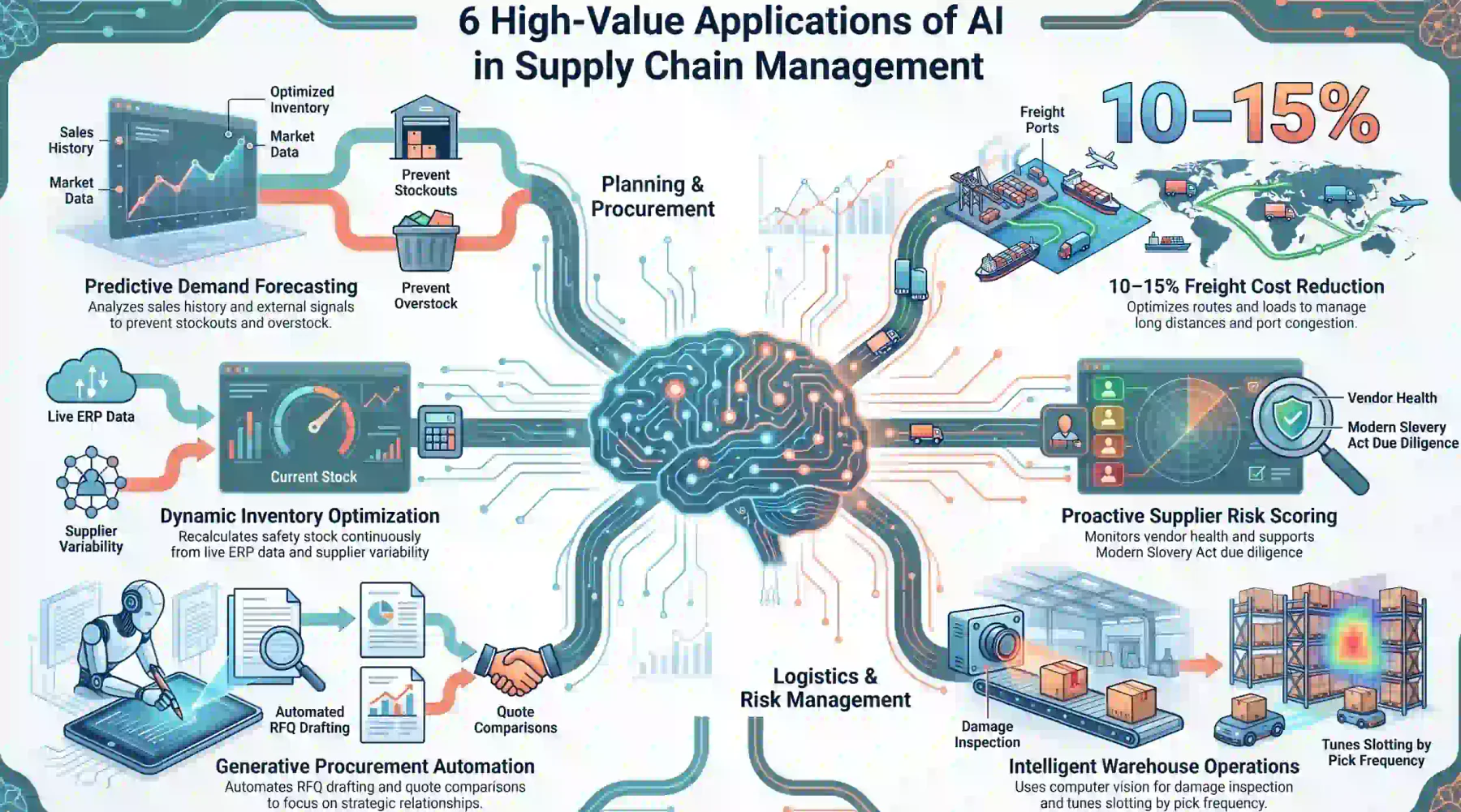
AI is used across supply chain management to forecast demand, optimise inventory, route freight, score supplier risk, automate procurement, and lift warehouse output. These six cases return the clearest value.
1. Demand Forecasting
AI demand forecasting trains models on sales history, seasonality, and promotions. It also reads external signals like weather and shipping schedules to predict what customers order, and when.
This matters more here because long replenishment lead times from Asian manufacturing hubs leave little room for error. Accurate forecasts give buyers time to act before a stockout bites.
A retailer running supply chain AI can cut stockouts and overstock at once. Manual planning rarely sustains that balance once seasonal peaks and promotions collide across a trading year.
2. AI in Inventory Management
AI inventory management moves past static min and max rules. It recalculates safety stock continuously from shifting demand, supplier lead-time variability, holding costs, and target service levels.
Connected to a live ERP, the model reorders sooner when a supplier slips and prioritises fast movers during a spike. It also flags slow or obsolete stock before it eats space and working capital.
Multi-location balancing across warehouses in Sydney, Melbourne, and Perth is a stubborn challenge. AI handles it best on live data, where orders, receipts, and transfers post in real time.
3. AI in Logistics and Transportation
AI in logistics covers carrier selection, route planning, load optimisation, and live exception handling. Models weigh traffic, delivery windows, vehicle capacity, fuel costs, and carrier history per shipment.
Distances here are punishing, from Perth to regional WA or Darwin to Brisbane. AI routing typically trims freight costs by 10 to 15 per cent while lifting on-time delivery consistency.
Port congestion at Melbourne and Sydney adds constant freight uncertainty. Systems tracking port dwell times and schedule adherence can reroute early or surface alternatives no manual team could weigh at scale.
4. Supplier Risk Management
Supplier risk tools watch health signals continuously, from financial distress and delivery trends to quality incidents and market news. They raise alerts before a disruption lands, not after.
After recent shocks, local buyers watch single-supplier concentration closely. AI scores risk across the portfolio and supports Modern Slavery Act due diligence by screening suppliers at scale.
A diversified, auditable supplier base becomes far easier to hold. The system flags any vendor drifting toward a critical threshold well before the next purchase order has to be placed.
5. Procurement Automation
Generative AI is reshaping procurement paperwork. Teams now draft RFQ templates from a spec, compare quotes across parameters, flag off-contract orders, and summarise supplier performance into review briefings.
For a small team carrying heavy spend complexity, this strips out administrative load. Effort then shifts toward the strategic supplier relationships that actually move cost and reliability.
6. Warehouse Operations
AI tunes warehouse slotting by pick frequency and adjacency, sequences picking routes, and schedules labour shifts. Computer vision can inspect inbound goods for damage, spec deviations, and labelling errors.
In food supply chains, automated inspection at the receiving dock cuts downstream rejections. It also supports traceability under Australian food standards, now often a condition of supplying major retailers.
Benefits of AI in Supply Chain Management for Australian Businesses
The benefits of artificial intelligence in supply chain are measurable. For local operators, they line up neatly with the cost pressures of running freight-heavy operations across a vast country.
| Benefit | How AI Delivers It | Typical Impact |
|---|---|---|
| Cost reduction | Route and carrier optimisation plus leaner safety stock | 10 to 15 per cent lower freight spend |
| Inventory accuracy | Continuous safety-stock and reorder recalculation | 15 to 30 per cent less stock value held |
| Demand plan accuracy | Machine learning trained on live sales history | Fewer stockouts and less overstock |
| Labour efficiency | Shorter pick routes and smarter shift scheduling | More output from the same team |
| Resilience | Early supplier and freight risk alerts | Days or weeks of warning before disruption |
Lower holding costs release working capital, while proactive risk alerts often prevent losses that dwarf the visible efficiency savings. Together they change how resilient a supply network feels.
Labour efficiency carries real weight where warehouse and transport roles are hard to fill. Better shift planning and shorter pick paths help a stretched team ship more without adding headcount.
Challenges of Implementing AI in Supply Chain
AI in supply chain is not plug-and-play. Australian businesses hit five recurring obstacles, and each one traces back to data, systems, people, budget, or governance rather than the models themselves.
1. Data Quality and Fragmentation
AI is only as good as the data it learns from. Disconnected spreadsheets, legacy systems, and inconsistent entry produce unreliable outputs, so clean, centralised, well-structured data is the real foundation.
2. Integration Complexity
Many mid-market operators run a patchwork of accounting, a separate warehouse system, a standalone freight tool, and spreadsheets. Bolting AI across those silos adds cost, maintenance, and sync risk.
3. Change Management and Adoption
Planners used to manual methods need time to trust AI recommendations, especially when the output contradicts instinct. Training and phased rollouts lift sustained adoption far more than a pure IT push.
4. Cost and ROI Timelines
Specialised AI platforms can carry heavy licence and rollout costs. The market has shifted, though, and supply chain software now embeds AI in standard modules, so the real question is what you already pay for.
5. Privacy Act and AI Governance
Systems that process delivery addresses, staff rosters, or supplier contacts fall under the Privacy Act 1988 and the Australian Privacy Principles. Document retention, access, and security before you scale.
How to Get Started: Implementing AI in Your Supply Chain
A staged approach beats a big-bang transformation for most mid-market operators. Five steps keep the first project small, measurable, and easy to defend when you ask for budget to expand it.
- Audit your data. Map where procurement, inventory, sales, and logistics data lives today, and flag every disconnected spreadsheet and silo.
- Define one high-impact use case. Pick the single area with the greatest cost or disruption, usually demand forecasting or inventory holding.
- Centralise data in a single platform. Consolidate onto one ERP, so the model reads clean, consistent, real-time transactional data.
- Start with predictive AI. Begin with forecasting and reorder features already built into the ERP before piloting generative or agentic tools.
- Measure and expand. Set metrics upfront, run a controlled pilot in one category or site, then scale on the evidence it produces.
Set the success metrics before the pilot starts, not after. Forecast accuracy, inventory turnover, and freight cost per delivery turn a promising trial into a business case the board can approve.
The Role of ERP in AI-Driven Supply Chain Management
The most practical route to supply chain AI runs through ERP, for one plain reason: AI needs unified data, and ERP is what unifies it. Without that spine, every model works from stale, partial inputs.
A forecasting model trained on three years of unified sales history beats one fed exported files from five systems. Leading platforms now embed AI directly into inventory, procurement, and approvals.
| Factor | ERP-Native AI | Standalone AI Tool |
|---|---|---|
| Data pipeline | Reads live ERP data directly | Needs custom integration and sync |
| Deployment speed | Faster, uses existing modules | Slower, separate build and testing |
| Ongoing maintenance | Handled inside the ERP | Extra APIs and technical overhead |
| Accuracy over time | Compounds as history accumulates | Limited by the data feed quality |
| Total cost | Often included in the licence | Additional licence and upkeep |
The best outcomes rarely belong to the most advanced tool in isolation. They belong to businesses with the cleanest data, the most integrated processes, and the steadiest team adoption, all of which ERP enables.
AI in Supply Chain: What Australian Businesses Should Know in 2026
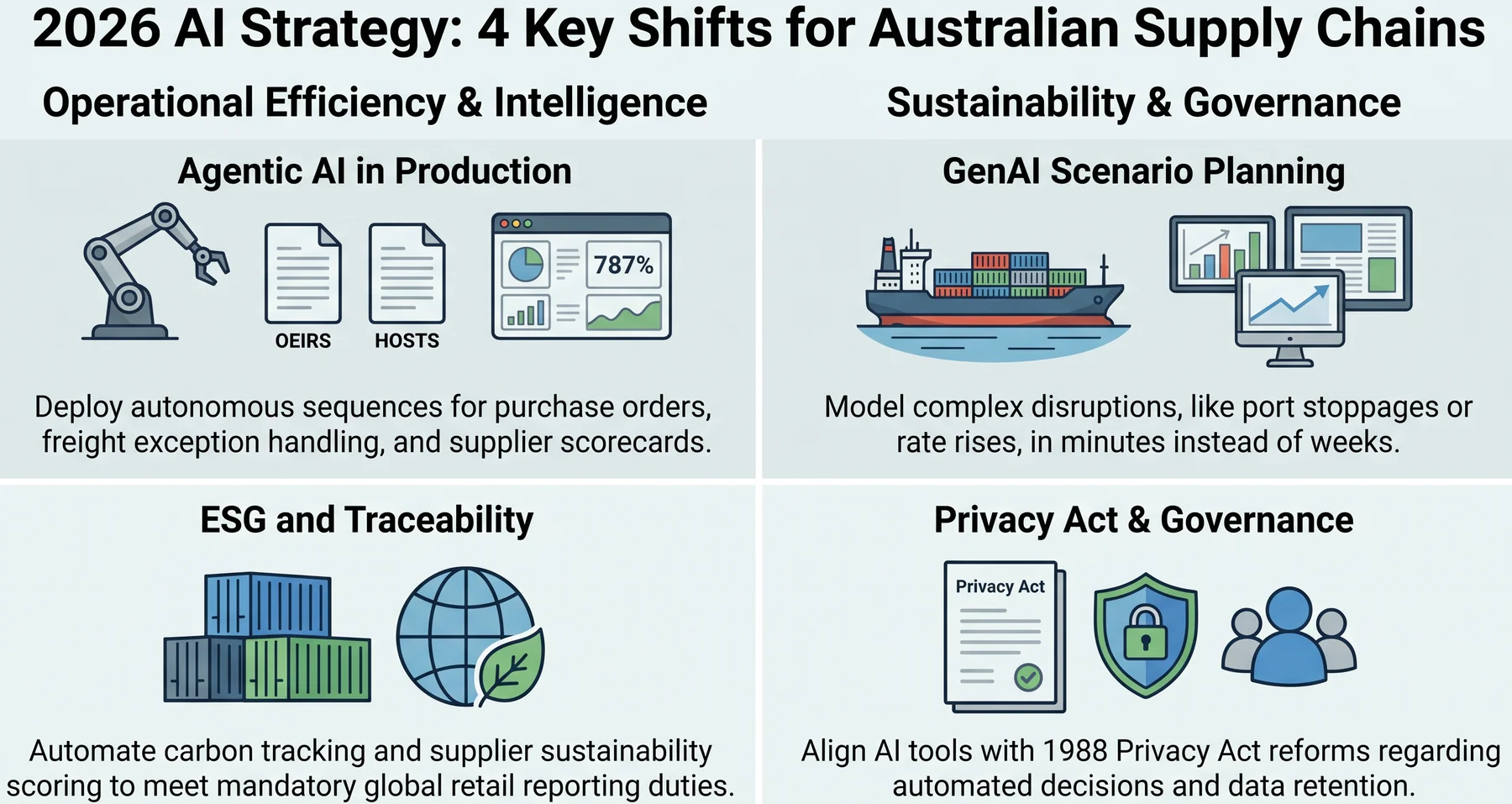
Supply chain AI is moving fast, and four shifts matter most for local decisions in 2026. With freight and logistics a heavy share of costs tracked by the ABS, the stakes for getting this right are real.
1. Agentic AI Is Entering Production
Agentic AI runs multi-step sequences rather than just answering questions. Early production cases include autonomous purchase orders, live freight exception handling, and auto-generated supplier scorecards.
2. Generative AI for Scenario Planning
Generative AI now models disruption scenarios that once needed analyst teams. Managers can ask what a twelve per cent carrier rate rise, or a four-week port stoppage, does to delivery commitments in minutes.
3. ESG, Traceability, and Supply Chain Transparency
Businesses feeding global retail and food chains face rising ESG reporting duties. AI now supports carbon and Scope 3 tracking, supplier sustainability scoring, and traceability that major retailers now require.
4. Privacy Act Reform and AI Governance
Reform of the Privacy Act 1988 is tightening rules on automated decisions that affect individuals. Confirm your AI tools carry clear retention policies, honour access requests, and apply security fit for the data.
How HashMicro Supports AI-Driven Supply Chain Management in Australia
HashMicro brings procurement, inventory, warehousing, logistics, and finance into one connected ERP built for Australian mid-market operators. That unified base is exactly what makes AI dependable.
Native AI drives demand forecasting, automated reorder points, and supplier performance scoring, while Hashy AI coworkers handle routine steps and surface the exceptions that need a human decision.
Your operation might be multi-warehouse distribution, a traceability-heavy food supply chain, or manufacturing with global suppliers. The platform pairs a clean data foundation with AI you can act on confidently.
That unified data is what turns AI from forecast to action. When procurement, inventory, and logistics share one system, Hashy AI reads across them and flags the stock and freight risks worth acting on today.






Conclusion
Artificial intelligence in the supply chain has moved from pilot curiosity to a practical toolkit for Australian mid-market operators. The value is real in forecasting, inventory, freight, risk, and warehousing.
The winners will not be those with the flashiest tool, but those with clean, unified data and steady adoption. Start with an ERP foundation, prove one use case, and let measured results shape the next step.
If you are interested in learning more about AI in supply chain management, you can book a free consultation with our experts today.
ㅤ
Frequently Asked Questions
AI is used across six core functions: demand forecasting, inventory optimisation, logistics routing, supplier risk, procurement automation, and warehouse operations. Each function uses one of these AI types.
The best tool is usually the AI built into your ERP, since it reads live operational data with no extra integration. Standalone apps suit narrower, specialised gaps.
No, but it will reshape the role. Routine reorder maths, PO processing, and tracking shift to automation, while managers focus on exceptions, supplier strategy, and judging when to override the AI.
Machine learning is one branch of AI that learns patterns from data to predict outcomes like demand or lead times. AI is the wider field, spanning machine learning, generative AI, and agentic systems.
With AI already built into a modern ERP, a focused pilot can show results in weeks, not months. A broader rollout across sites and functions usually spans a few months, paced by data quality and team adoption.