






 Limited to 100 registrants

An inventory management system is software that tracks stock levels, item values, and sales in real time. It can also support barcode or QR scanning, low-stock reorder alerts, warehouse and sales-channel syncing, and reports that help teams forecast demand, prevent stockouts, and reduce excess stock.
An inventory management system is not merely a tool for counting stock. It is the central system of a supply chain, ensuring that products flow efficiently from suppliers to warehouses and ultimately to the end customer.
Relying on outdated methods can lead to costly errors, stockouts, and bloated holding costs, especially in the dynamic markets like Australia. An inventory system allows real-time visibility into stock levels, automates processes, and generates data-driven insights that inform decisions.
This page will answer what an inventory system is and how you can implement it into your business to avoid all the possible risks and optimize your operation.
This page will answer what an inventory system is and how you can implement it into your business to avoid all the possible risks and optimize your operation.
his page will answer what an inventory system is and how you can implement it into your business to avoid all the possible risks and optimize your operation.
Key Takeaways
An inventory management system is a digital tool that tracks goods throughout the supply chain, optimizing stock levels and streamlining processes to support efficient business management.
The key benefits of an inventory system include lower costs, better stock accuracy and forecasting, improved supply chain visibility, and smoother scalability as your business grows.
An inventory system should cover GST BAS rules, support multi-location and multi-currency operations, connect smoothly with your workflows, and calculate landed costs accurately.

What is an Inventory System?

An inventory system helps businesses track goods throughout the entire supply chain, from purchasing to production to final sales. It uses software, hardwares like barcode scanners or RFID readers, and clear processes to keep inventory data accurate and up to date.
When managing large volumes of inventory, efficiency is key to maintaining profit margins. An effective inventory system helps businesses monitor and control stock movement, minimize wastage, and ensure timely restocking, improving both operational efficiency and cost-effectiveness.
To successfully manage stock and avoid overstocking or stockouts, businesses rely on robust inventory tracking systems. These stock management systems offer real-time visibility into inventory levels, supporting stock management and enabling companies to make informed decisions about procurement, production, and sales.
How Does an Inventory Management System Work?
An inventory management system tracks every stock movement in one central platform, helping businesses maintain accurate inventory records and improve visibility. From receiving goods to fulfilling customer orders, every transaction is recorded in real time so teams can make faster, more informed decisions.
Receive inventory: Goods are logged into the system and assigned to storage locations using barcodes or RFID tags.
Track stock movements: The system updates inventory automatically as items are picked, packed, transferred, or sold.
Monitor stock levels: Reorder points and safety stock levels trigger alerts or purchase orders before inventory runs low.
Generate reports: Real-time dashboards provide insights into stock levels, inventory turnover, supplier performance, and purchasing trends.
Inventory System Types That Fit Different Business Workflows
In practice, inventory systems usually fall into four working models: spreadsheets, cloud-based software, POS-connected systems, and ERP solutions. Businesses can then choose more advanced tracking methods such as barcode, RFID, 3PL, or ERP-integrated inventory depending on their operational complexity.
1. Perpetual inventory systems
A perpetual inventory system updates stock records in real time whenever items are received, moved, sold, or returned. This keeps inventory levels accurate, as long as daily processes are followed.
It often connects with POS, ecommerce, and warehouse scanning, so each sale instantly reduces available stock. With live data, you can set reorder points to prevent stockouts and reduce excess inventory.
2. Periodic inventory systems
With a periodic inventory system, stock numbers are refreshed only at scheduled points, such as month-end or quarter-end. The real inventory position is confirmed through a physical count, not live transactions.
Between stocktakes, gaps can build without warning, from shrinkage to recording mistakes. That limited visibility can slow forecasting and make stock control harder as the business grows.
3. 3PL inventory management system
A 3PL inventory management system is designed for businesses that outsource warehousing and fulfilment to third-party logistics providers. This inventory system provides real-time visibility into off-site stock and synchronizes data between your system and the 3PL warehouse.
This setup helps reduce manual coordination and delays in order processing. With shared dashboards and automated updates, businesses can monitor inbound shipments, outbound orders, and stock levels without constant back-and-forth communication.
4. Asset inventory management system
An asset inventory management system focuses on tracking company-owned equipment, tools, and fixed assets rather than products for sale. It records asset location, condition, depreciation, and maintenance history on a single centralized platform.
This is especially useful for construction, manufacturing, or field service operations where equipment movement must be controlled. Accurate asset tracking reduces loss, improves maintenance planning, and supports financial reporting.
5. Cloud-based inventory management system
A cloud-based inventory management system operates online, allowing access from any location with an internet connection. Data is stored securely in the cloud and updated in real time across devices and branches.
This model supports remote teams, multi-warehouse operations, and fast business expansion. It also reduces IT infrastructure costs because updates, backups, and system maintenance are managed by the provider.
6. Barcode inventory systems
Barcode inventory systems use scannable labels to record product data like SKU and description, so stock updates happen faster and with fewer mistakes. Instead of manual typing, teams scan items to log receiving, picking, and transfers.
You label products and storage locations, then scan each movement to confirm the right item goes to the right place. Barcodes are reliable and low-cost, and they work well with most inventory-tracking systems.
7. Radio frequency identification (RFID) systems
RFID uses radio signals to read tagged items without direct line of sight, so multiple products can be captured at once from a distance. This speeds up stock checks, especially in palletized warehouses and high-traffic areas.
Active tags have their own power for longer range tracking, while passive tags are cheaper for item-level use. It costs more to implement than barcodes do, but it delivers faster counts and greater visibility.
According to an Inside Retail report citing a 2024 retail survey, nearly 40% of retailers in Australia have reportedly cancelled at least one in ten orders due to inaccurate inventory data. In contrast, almost six in ten retailers admit their stock accuracy falls below 80%.
That is why an inventory management system is essential for keeping stock records accurate and preventing avoidable order cancellations.
Why Does an Inventory System Make Daily Work Easier?
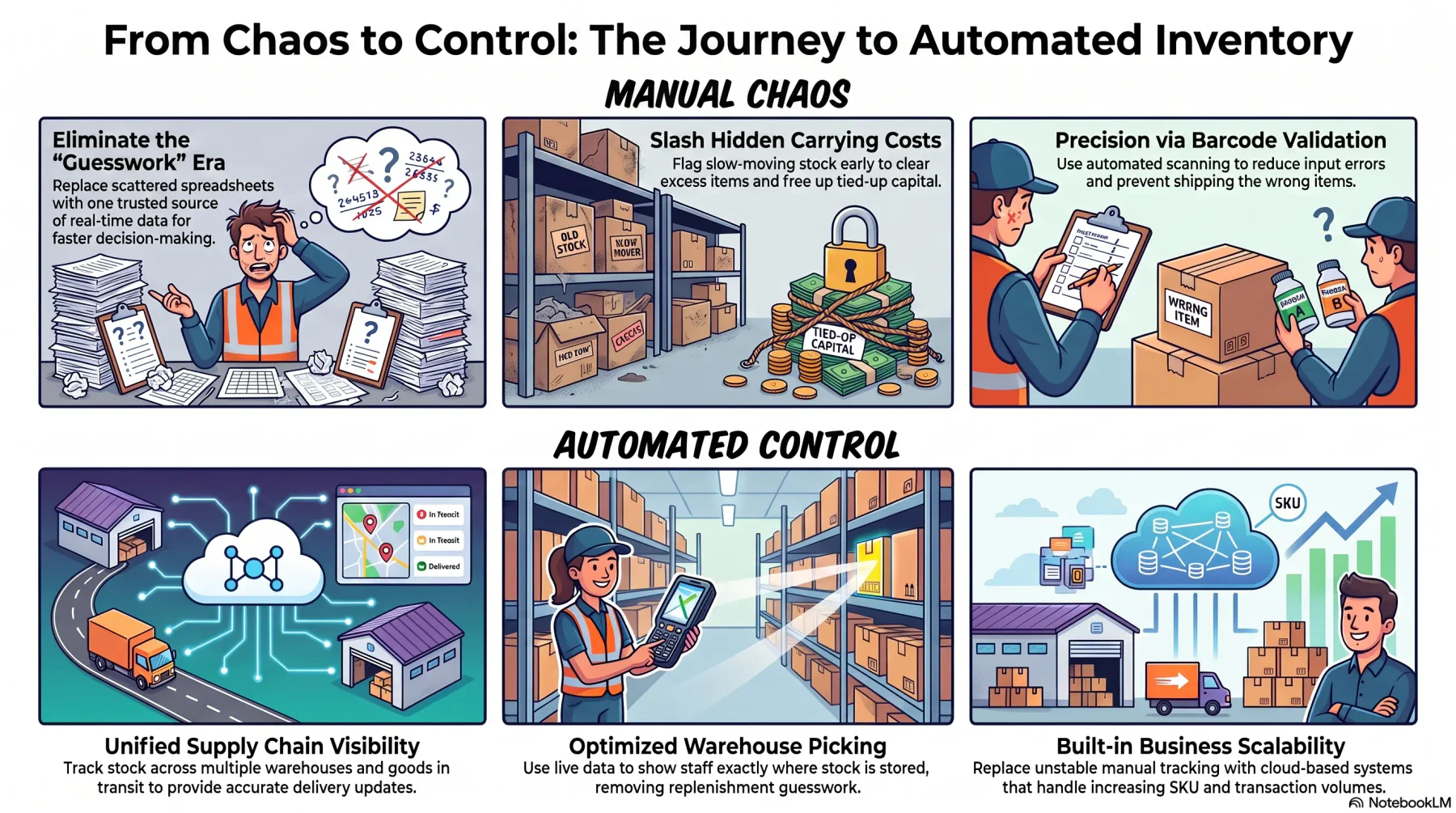
A strong inventory management system serves as a comprehensive stock management platform, helping you manage operations and cash flow with greater control. When you move from manual tracking to automation, inventory becomes easier to sell, replenish, and report.
The biggest shift is having one trusted source of data instead of scattered spreadsheets and guesswork. With clearer visibility, teams can make decisions faster and with fewer errors.
1. Significant cost reduction
An inventory tracking systems helps cut storage and carrying costs by flagging slow-moving stock early. This allows you to clear excess items and avoid tying up capital unnecessarily.
Automation also reduces manual work, like counting and data entry. With accurate reorder points, you avoid over-ordering and control purchasing spend.
2. Enhanced inventory accuracy and forecasting
Barcode validation reduces common input errors and prevents wrong items from being shipped. This improves stock accuracy and protects revenue.
Historical data also supports better demand forecasting strategies. You can prepare for seasonal spikes without overstocking in slower periods.
3. Improved supply chain visibility
A centralized system shows stock across warehouses, stores, and goods in transit. This makes it easier to manage lead times and give accurate delivery updates.
You can quickly reallocate stock between locations when needed. That flexibility helps prevent lost sales and improves service levels.
4. Scalability and business growth
Manual tracking becomes unstable as SKU and transaction volumes increase, which is why businesses need a scalable inventory app that can handle growth without slowing operations.
Cloud-based platforms also support expansion into new locations. This ensures your inventory process grows with the business.
5. Faster, more accurate warehouse operations
Inside the warehouse, an inventory system gives staff a live view of what stock is available, where it is stored, and when it needs replenishing. This removes the guesswork that comes with manual counts.
Picking, put-away, and restocking all run from the same live numbers instead of separate records. This reduces misplaced stock and keeps warehouse teams working from accurate, real-time data.
How Inventory and Procurement Work Together in One System
When inventory and procurement run in separate systems, the “stock on hand” figure your team sees is never fully current. Approved purchase orders that have not yet arrived are excluded from that number, so your team is making restocking decisions based on yesterday’s data.
The result is either preventable stockouts or excess safety stock sitting in the warehouse. When inventory management and procurement share one platform, projected stock levels include all goods on order and in-transit, not just what is physically in the warehouse.
A reorder point can automatically trigger a purchase order, and when a goods received note (GRN) is processed, stock levels update instantly without manual entry.
The table below shows exactly what changes when inventory and procurement run in the same system.
| Capability | Inventory System Only | Inventory + Procurement Integration |
|---|---|---|
| Stock visibility |
Shows current physical stock only | Shows physical stock plus all in-transit and on-order quantities |
| Purchase order creation |
Created manually in a separate procurement system | Raised automatically when stock hits the reorder point |
| Projected inventory view |
Not available. The system has no visibility into incoming stock. | Projected stock includes all confirmed POs and their expected delivery dates |
| Goods received update |
Requires manual data entry after physical receipt | Stock levels update automatically when a GRN is processed |
| Reorder automation |
Planners must check and initiate orders manually | System auto-triggers a purchase order when stock falls below the reorder point |
| Supplier lead time tracking |
Stored separately or not tracked in the system | Lead times are linked to each supplier and item, informing projected delivery dates |
| Approval workflow |
Managed via email or outside the system | PO approvals flow within the platform with a full audit trail |
| Reporting and audit trail |
Inventory and procurement data must be reconciled manually | Unified reports show the full order-to-receive history without manual reconciliation |
How a Purchase Order Becomes a Stock Update Automatically
The table above covers what’s possible, and the diagram below shows how it actually works, step by step, in a live system.
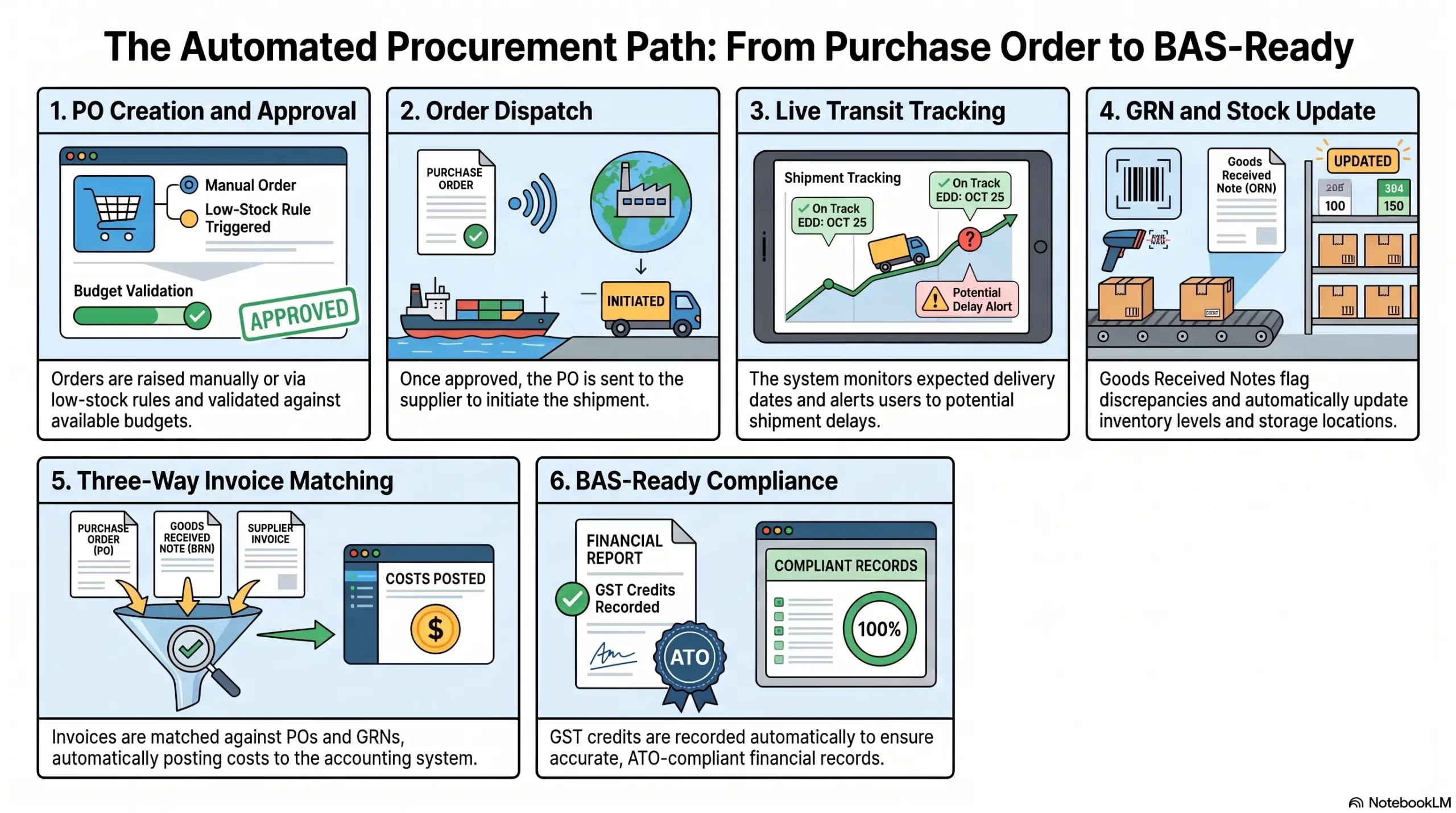
Here is how a single purchase order moves from approval to a live stock update, without manual entry at each step:
- PO created and approved → supplier, cost, and delivery terms locked into the system.
- PO sent to supplier automatically → order confirmation logged against expected delivery date.
- Goods received against the PO → received quantities matched to original order lines.
- Stock levels updated in real time → available stock reflects the new quantity across all locations.
- Landed cost allocated → freight, duties, and GST added to the stock value automatically.
- Accounts payable and general ledger updated → financial records stay aligned with physical stock, no manual entry.
- Reorder point checked → a new PO is triggered automatically if stock falls below threshold.
- Inventory and purchasing reports refreshed → updated stock position reflected instantly for decision-making.
This automation only works when procurement and inventory share one platform, as third-party tools introduce data gaps at each handoff point. Find out how a procurement management system works within a unified ERP.
Under the GST Act 1999, the ATO GST guide for businesses confirms businesses can claim input tax credits on purchases. An integrated system reduces the risk of under-claiming GST input credits at BAS lodgement time.
Must-Have Inventory Features for Australian Businesses
Australian businesses need inventory systems that account for local realities such as long delivery distances, GST compliance, and Australia-specific logistics workflows. Choosing an inventory system built for these needs reduces admin time, prevents compliance issues, and avoids workarounds.
Here are the critical features that should be on the checklist for any Australian enterprise.
1. GST and BAS compliance
The inventory tracking systems must calculate Goods and Services Tax (GST) correctly for purchases and sales. It should also automatically separate taxable and GST-free items.
Clear GST reporting simplifies Business Activity Statement (BAS) preparation and reduces compliance risk. For importers, it should include duties and import GST in landed costs.
2. Multi-location and multi-currency support
Australian businesses often operate across multiple warehouses. The stock management systems should show stock by location and manage transfers easily.
For international sourcing, it must handle foreign currencies and convert to AUD accurately. Exchange rate tracking ensures margins stay realistic.
3. Integration with local logistics and accounting ecosystems
The inventory system should connect to your accounting setup, such as Xero or HashMicro, so that stock movements update financial records automatically. This reduces manual reconciliation and keeps reporting consistent.
It should also integrate with local shipping workflows to generate labels and tracking faster. This improves dispatch accuracy and customer updates.
4. Landed cost calculation
Imported goods involve freight, duties, and other charges beyond the supplier price. Without landed cost tracking, margins can be miscalculated.
A strong stock management system allocates these costs across items in a shipment. This gives a clearer view of true product profitability.
5. Real-time inventory tracking
Live inventory tracking updates stock levels instantly whenever items are received, transferred, or sold. This gives your team real-time visibility across warehouses and sales channels.
With accurate live data, you can prevent stockouts, avoid overselling, and improve inventory restocking decisions.
6. Inventory reporting and analytics
Inventory reporting provides clear insights into stock movement, slow-moving items, and turnover rates. These reports help management identify which products drive profit and which tie up capital.
Analytics also supports better forecasting and replenishment planning. With data-driven insights, purchasing decisions become more precise and less reactive.
7. Purchasing management
Purchasing management streamlines the creation and approval of purchase orders. It tracks supplier performance, lead times, and order history in one system.
Automated reorder points reduce manual planning and prevent missed restocks. This ensures inventory is replenished based on real demand, not guesswork.
8. Order management
Order management centralises sales orders from multiple channels into one dashboard. It tracks order status from confirmation to delivery. For businesses selling across e-commerce or physical stores, real-time multi-channel syncing ensures stock levels stay accurate.
This improves coordination between sales, warehouse, and finance teams. Faster and more accurate processing leads to better customer satisfaction and fewer fulfilment errors.
9. Warehouse management systems (WMS)
A warehouse management system focuses on optimising operations inside the warehouse itself, including receiving, put-away, picking, packing, and dispatch. It directs staff through tasks using scanners and predefined workflows.
WMS platforms often work alongside inventory systems rather than replacing them. For high-volume operations, a WMS improves throughput and reduces picking errors at scale.
10. Accounting-integrated inventory systems
Accounting-integrated inventory systems connect stock tracking directly to your accounting software. Every purchase, sale, or transfer updates both inventory records and general ledger accounts at the same time.
This removes duplicate data entry and keeps financial records aligned with physical stock. It is especially useful for small to mid-sized businesses where finance and operations share overlapping workflows.
11. ERP-integrated inventory
This system sits inside a broader enterprise resource planning platform, linking stock with sales, purchasing, manufacturing, and finance modules. Data flows across departments without manual handover.
This integration gives leadership a unified view of operations and supports advanced planning, such as demand forecasting. For growing businesses, ERP-integrated inventory scales cleanly as complexity increases.
AI in Inventory Management: What It Means for Australian Businesses
Inventory software used to track what happened. AI-powered systems now anticipate what will happen, predicting demand shifts, flagging replenishment timing, and surfacing stock anomalies before they affect operations.
This shift means inventory teams can expect several concrete improvements, including:
- More accurate demand forecasting, using historical sales, seasonality, and supplier lead times to predict what stock will be needed and when.
- Earlier stockout and overstock warnings, flagging replenishment needs before they affect fulfilment.
- Automatic anomaly detection, surfacing unusual stock movements or discrepancies that would otherwise go unnoticed until a stocktake.
- Reduced manual reporting, letting managers query inventory data directly instead of building spreadsheets from multiple sources.
- Faster, more confident purchasing decisions, based on real-time patterns rather than static reorder points.
These improvements only help if managers can act on them directly, as part of their everyday workflow rather than a separate reporting step.
HashMicro's Hashy AI is embedded natively in the inventory module. Managers can query stock levels, movement summaries, and branch-level data in plain language without pulling separate reports.
HashMicro’s Hashy AI is embedded natively in the inventory module. Managers can query stock levels, movement summaries, and branch-level data in plain language without pulling separate reports.
For businesses managing stock across multiple locations, AI reduces the manual reconciliation cycle. One live dashboard replaces the pull-and-compare process that typically takes a team hours each week.
If these signs feel familiar, try our free demo and consultation to assess your current setup. See how AI-powered inventory software can automate processes and support better decisions.






How Much Should You Budget for an Inventory Management System?
The cost of an inventory management system (IMS) varies widely, ranging from free to thousands of dollars per month. On average, Australian businesses pay around AUD 175 per user license monthly, with cloud-based systems adding AUD 80 for customer support and one-time setup fees of around AUD 1,200.
For larger businesses seeking an advanced inventory-tracking ERP solution, implementation costs can range from AUD 15,000 to AUD 60,000. Despite the high upfront costs, these systems offer long-term benefits, improving stock management and operational efficiency.
Factors such as integration with other systems, the number of users, and additional features can affect the final cost. If you’re looking to explore cost-effective options, it’s essential to consider your specific business needs and explore available solutions that best fit your requirements.
When to Upgrade Your Inventory System
Knowing when to upgrade your inventory management system is just as important as choosing the right one. Most businesses delay the switch until operational pain points start hurting revenue and customer satisfaction.
1. Frequent stock discrepancies: If your physical stock consistently mismatches records, current tools cannot keep up with transaction volumes. This leads to oversells, missed deliveries, and costly manual recounts.
2. Heavy reliance on spreadsheets and manual entry: Excel works for small operations, but it breaks once SKU counts or locations grow. Inventory software improves traceability with features like serial number, batch, and expiration date tracking, which is essential for retail, manufacturing, and distribution businesses.
3. Scaling issues with growth: When adding new warehouses, channels, or products causes lag, it’s a clear sign the current setup lacks scalability. Cloud platforms handle multi-location growth without performance drops.
4. Poor integration with other tools: If your inventory system cannot connect cleanly to accounting, ecommerce, or shipping platforms, teams end up copying data between systems. This wastes time and creates reconciliation headaches.
5. Limited reporting and forecasting: Older systems often lack analytics depth. If you cannot pull clear insights on turnover, demand trends, or supplier performance, you are making decisions on outdated information.
Upgrading before these issues escalate helps protect stock accuracy, customer satisfaction, and future growth. The right system also gives teams clearer data while reducing manual work.
"A well-designed inventory management system gives businesses the visibility they need to reduce errors, optimise stock, and make confident decisions."
Practical Ways Australian Businesses Use Inventory Systems
Australian businesses across various sectors utilize these stock management systems to solve distinct challenges, from managing perishable goods in the food industry to tracking serial numbers in electronics. The following examples illustrate typical use cases in the Australian market:
1. The wholesale food distributor
Consider a Melbourne-based food distributor that struggled with spoilage and stockouts due to manual tracking. Expiry dates and batch rotation were difficult to control consistently.
With batch tracking and FIFO picking, older stock is prioritized automatically. Forecasting tools also help prepare for seasonal demand spikes and reduce waste.
2. The mining equipment supplier
A mining equipment supplier faced limited visibility across remote depots. High-value spare parts were often unavailable when urgently needed.
A cloud multi-location system now shows real-time stock by site. Transfers replace unnecessary new orders, reducing capital tied up in inventory.
3. The omnichannel fashion retailer
A fashion brand, selling both online and in-store, experienced frequent overselling. Manual updates could not keep stock aligned across channels.
A centralized system syncs inventory across all sales platforms instantly. This prevents overselling and supports faster fulfilment from any location.
A Buyer’s Checklist for Choosing the Right Inventory System
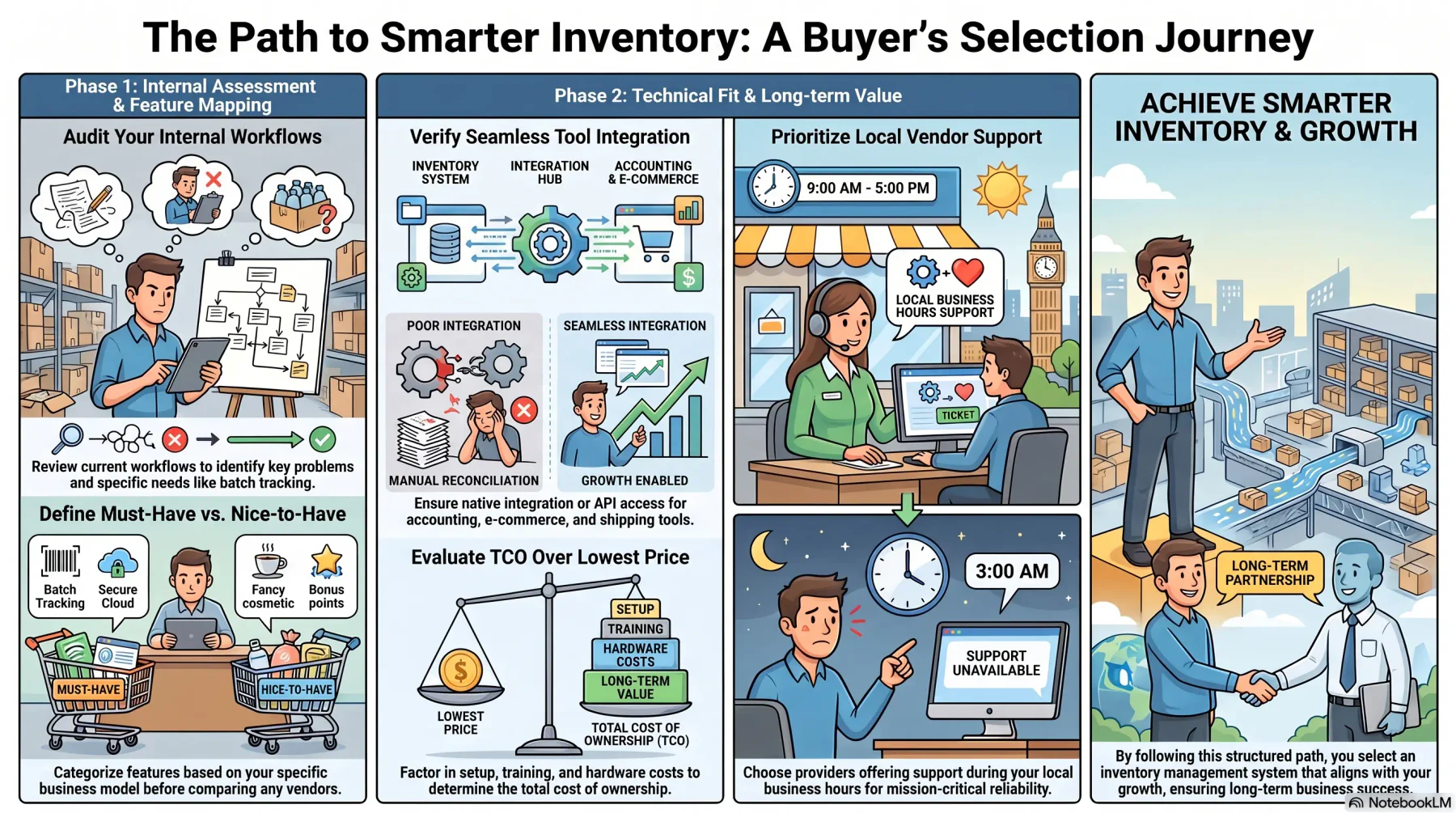
Choosing the right inventory system starts with identifying your business’s priorities and future needs. Online stores may need real-time channel syncing and order management, while warehouses may prioritise barcode or RFID workflows, reorder alerts, and WMS integration. For finance-focused businesses, accounting integration may be more important.
1. Assessing business complexity and needs
Start with an internal review of workflows and key problems you want to solve. Identify whether you need features like BOM, batch tracking, or multiple units of measure.
Different business models require different capabilities. Define clear must-have and nice-to-have features before comparing vendors.
2. Integration capabilities
An inventory system must integrate seamlessly with accounting, e-commerce, and shipping tools. Poor integration often leads to manual reconciliation and data gaps.
Check for native integrations and open API access. This ensures flexibility as your tech stack evolves.
3. Scalability and total cost of ownership (TCO)
Avoid choosing based only on the lowest price. The stock management systems should support growth through modular features or tiered plans.
Review the full cost, including setup, training, hardware, and integrations. A higher upfront cost can deliver better long-term value.
4. Vendor Support and Ecosystem
Strong vendor support is critical because inventory systems are mission-critical. Prioritize providers that offer support during local business hours.
Look for structured onboarding and local implementation partners. A reliable ecosystem ensures smoother adoption and long-term success.
Conclusion
An inventory management system is now essential for speed, accuracy, and smoother operations. For Australian businesses, the right platform connects logistics, compliance, and customer service into a single, clear workflow.
With the right system, you can handle GST requirements, manage multi-location stock, and achieve faster fulfilment with fewer errors. Choose based on fit, integrations, total cost, and support, so the investment keeps working as your business grows.
If you are still using spreadsheets, start by mapping your stock flow from receiving to dispatch and list the top three issues slowing your team down. Use that list as your checklist when shortlisting vendors, so the tool you pick solves real daily bottlenecks.
If you are evaluating which system best fits your operations, you can consult our expert team for tailored guidance.

Frequently Asked Questions About the Inventory Management System
An inventory system tracks stock levels, locations, and movements across the supply chain in real time. Inside the warehouse, it gives staff a live view of what stock is available, where it is stored, and when it needs replenishing, keeping picking, put-away, and restocking accurate without manual counts.
A perpetual inventory system updates stock levels in real time after every transaction, offering immediate visibility and accurate data. In contrast, a periodic system updates inventory only at specific intervals, usually after a physical stocktake, which can create data gaps between counts.
Inventory control is the process of managing stock to ensure availability at all times. It focuses on daily activities such as receiving, counting, storing, and replenishing items. Strong inventory control prevents stockouts, reduces excess stock, and keeps warehouse operations running smoothly.
It helps Australian businesses manage GST compliance, high logistics costs, and multi-location operations. An inventory management system supports accurate BAS reporting while optimising stock levels and freeing up working capital.
Costs vary based on system complexity and scale. Small business cloud solutions may cost a few hundred dollars per month, while enterprise-level ERP systems often involve higher implementation fees and ongoing costs.
Inventory systems analyse historical sales data, seasonal trends, and supplier lead times to forecast demand. This helps businesses order the right stock quantities and avoid overstocking or shortages.
If you manage over 50 SKUs, sell through multiple channels, or still track stock manually, an inventory system is worth trying. Even small Australian businesses can benefit from affordable cloud-based tools that improve stock accuracy and BAS reporting.
Common inventory management software options in Australia include Unleashed for stock tracking, Xero for accounting-linked inventory, Zoho Inventory, and NetSuite for ERP-scale needs. HashMicro can also be evaluated through a demo.
Free inventory tools can help with basic stock lists, but they usually become limited when a business needs multiple users, warehouse syncing, automated reordering, accounting integration, or role-based controls.
Excel can work for very small inventories, but it cannot reliably handle real-time stock sync, barcode scanning, low-stock alerts, multi-location updates, or audit-ready reporting as order volume grows.