







 Limited to 100 registrants

Double-entry bookkeeping is an accounting system that records every financial transaction in at least two accounts. Each transaction includes equal debits and credits, keeping the accounting equation balanced.
For example, when a business makes a sale, one account records the money received while another records the revenue earned. This gives a complete view of how each transaction affects the business.
This guide explains how double-entry bookkeeping works, provides common examples, compares it with single-entry bookkeeping, and explores its benefits for Australian businesses.
Key Takeaways
Double-entry bookkeeping records every transaction in at least two accounts to keep financial records accurate and balanced.
Understanding the differences between single-entry and double-entry bookkeeping helps businesses choose the right accounting method.
Double-entry bookkeeping supports accurate financial reporting and compliance for Australian businesses.

What is Double-Entry Bookkeeping?

Double-entry bookkeeping is an accounting system where every financial transaction is recorded in at least two accounts. One account is debited and another is credited, with both amounts always equal.
The system follows the accounting equation: Assets = Liabilities + Equity. Every transaction must keep this equation balanced.
By recording both sides of a transaction, double-entry bookkeeping provides more accurate financial records, makes reporting easier, and helps detect errors early.
How Does the Double-Entry Bookkeeping System Work?
The double-entry system records equal debit and credit amounts for every transaction. This structure keeps the books balanced and helps businesses see how each entry changes their financial position over time.
1. Every transaction affects at least two accounts
A single business transaction rarely affects just one account. Buying equipment with cash affects both the equipment account and the bank account. Selling on credit affects accounts receivable and sales revenue. This two-sided recording provides a more complete picture than a simple cash ledger. Each entry shows what increased, what decreased, and how the transaction affected the business's overall financial position.2. Debits and credits must balance
Every transaction must have equal total debits and credits. This does not mean each account carries the same balance. It means the transaction as a whole is recorded on both sides with matching amounts. For example, a $1,100 customer invoice including GST might debit accounts receivable for $1,100, credit sales revenue for $1,000, and credit GST payable for $100. Total debits equal total credits: $1,100.3. The accounting equation stays balanced
Every entry keeps the accounting equation in balance. If assets increase, another element must also change: a rise in revenue, an increase in liabilities, or a decrease in a different asset account. This structure supports reliable financial statements. A business can use the same records to prepare a balance sheet, profit and loss statement, and trial balance from consistently entered data."Every transaction tells two sides of the same financial story."
Double-entry Bookkeeping Examples
1. Customer invoice example
A business issues a customer invoice for $5,500, including $500 GST.2. Supplier bill example
A business receives a supplier bill for office supplies worth $330, including $30 GST.3. Equipment purchase example
A business buys equipment for $11,000, including $1,000 GST, paid from its bank account.4. Business loan example
A business receives a $50,000 loan from a bank.5. GST sale example
A business makes a cash sale of $2,200, including $200 GST.Single-Entry vs Double-Entry Bookkeeping
Single-entry and double-entry bookkeeping are two different approaches to recording business transactions. They differ in complexity, accuracy, and the depth of financial reporting each one can support.1. Recording method
Single-entry bookkeeping records each transaction once, typically as a single line in a cash journal. It tracks income and expenses but does not show how a transaction affects the broader accounts of the business. Double-entry bookkeeping records both sides of every transaction. The debit and credit structure creates a complete trail that captures the full effect of each entry on the financial position of the business.2. Accuracy
Single-entry bookkeeping is simpler to maintain but offers fewer safeguards. Errors or omissions can go undetected because there is no mechanism to verify that both sides of a transaction have been captured. Double-entry bookkeeping has a built-in check: total debits must equal total credits. If they do not balance, there is likely a recording error. This makes mistakes easier to identify before they affect reporting.3. Reporting depth
Single-entry bookkeeping can produce a basic income and expense summary but cannot generate a balance sheet or full financial statements. It lacks the account structure that formal reporting requires. Double-entry bookkeeping supports a general ledger, trial balance, balance sheet, and profit and loss statement. These reports give a complete view of financial position and performance over any period.4. Best use case
Single-entry bookkeeping may work for a very small business or sole trader with minimal transactions and no formal reporting obligations. It is straightforward but limited as business complexity grows. Double-entry bookkeeping suits businesses that manage invoices, accounts payable, inventory, loans, payroll, or assets. It scales with the business and supports the financial oversight that serious reporting demands. ㅤWhy Double-Entry Bookkeeping Is Important for Businesses
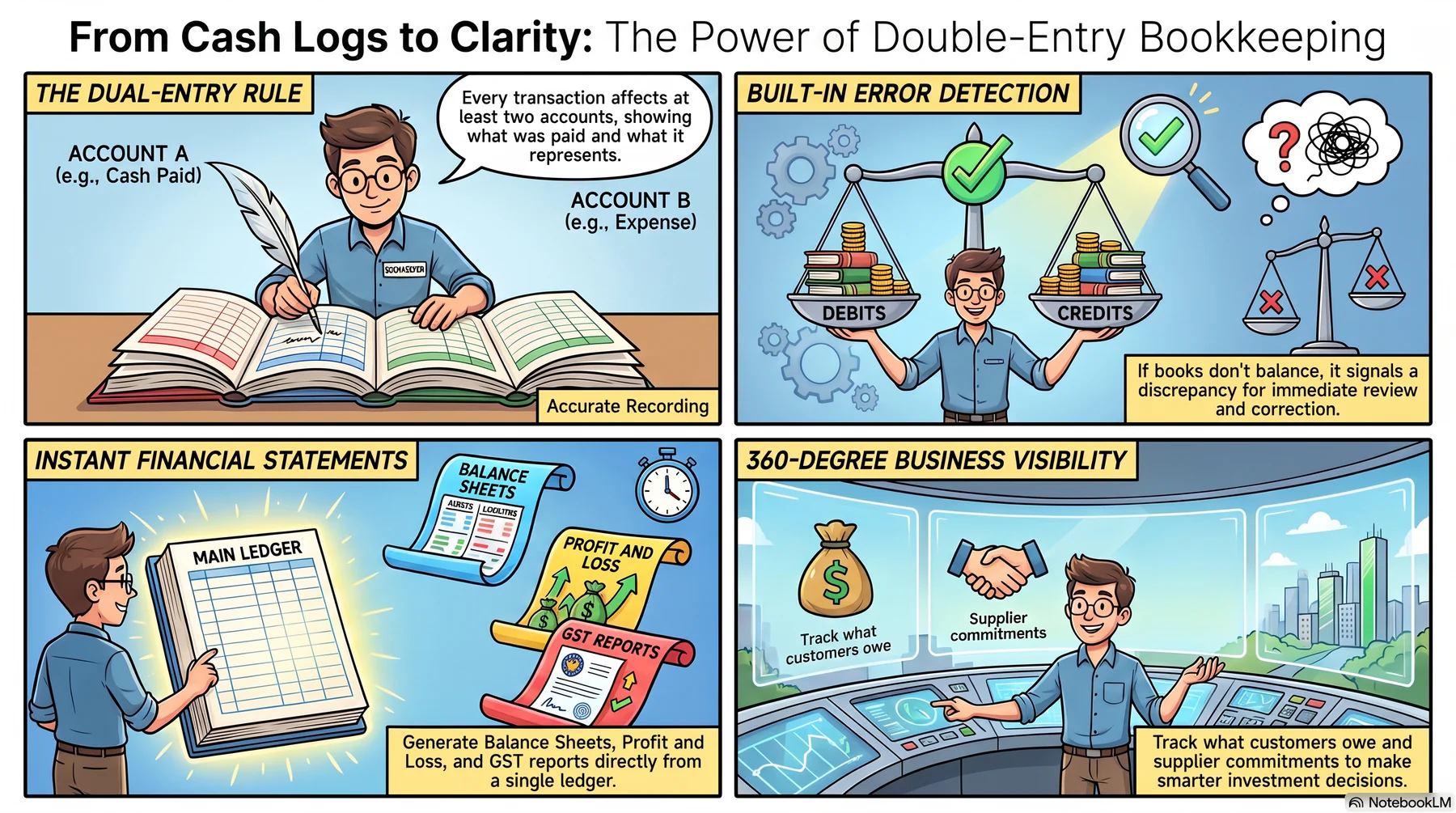
1. More accurate financial records
Double-entry bookkeeping builds a more detailed record than a simple cash log. Because every transaction affects at least two accounts, each entry shows what was paid, what it represents, and which accounts it changes. This level of detail makes it easier to review transactions, respond to auditor questions, and understand why account balances change at any point during the financial year.2. Better error detection
The balancing rule in double-entry bookkeeping acts as a built-in error check. If a transaction is posted incorrectly, the books will not balance, and the discrepancy signals that something needs to be reviewed. This does not catch every possible error, such as posting the correct amount to the wrong account. But it does reduce the risk of undetected omissions or transposition mistakes in day-to-day bookkeeping.3. Supports financial statements
Financial statements depend on accurate, consistently recorded account balances. Double-entry bookkeeping provides that structure by keeping every account updated each time a transaction is entered. A business can draw a balance sheet, profit and loss statement, and cash flow report directly from the same ledger. This consistency supports management reporting, investor review, and accountant sign-off.4. Helps with BAS and GST preparation
GST reporting requirements mean Australian businesses need clean, separated records before lodging BAS. Double-entry bookkeeping records GST collected and GST paid in separate accounts, making reconciliation more straightforward. This structure does not replace advice from a tax professional, but it ensures the records going into BAS preparation are accurate, traceable, and easy for an accountant or bookkeeper to review.5. Improves business visibility
Monitoring cash movements becomes clearer with double-entry bookkeeping, giving business owners a view of what customers owe, what is owed to suppliers, and what assets the business holds. This visibility supports stronger planning. A business that understands its debtor balance, supplier commitments, and current asset position is better placed to make decisions about cash flow, investment, and growth. ㅤDouble-Entry Bookkeeping for Australian Businesses
The Australian Bureau of Statistics counts more than 2.5 million actively trading businesses in Australia. Most are small businesses in sectors where accurate accounting directly affects compliance and reporting.Double-Entry Bookkeeping in Accounting Software
Financial transaction management software makes double-entry bookkeeping easier by handling debit and credit entries automatically. Most users never need to decide which account to debit or credit for a standard transaction.1. How software records both sides automatically
When a user creates an invoice, the software debits accounts receivable and credits sales revenue. When payment is received, it debits the bank account and clears the receivable. Both entries happen without manual input. This automation reduces the risk of missed entries, incorrect account codes, or unbalanced postings. The bookkeeper focuses on reviewing and reconciling rather than manually constructing every journal entry.2. How ERP connects bookkeeping with business operations
A digital finance infrastructure connects bookkeeping directly to purchasing, inventory, and sales. When a purchase order is confirmed, the system updates the relevant accounting records without requiring a separate journal entry. This means the general ledger reflects actual business activity in near real-time. Finance teams spend less time chasing paper trails and more time on analysis, reconciliation, and financial reporting.3. When to move beyond manual bookkeeping
Manual bookkeeping can work for a business with a small number of simple transactions each month. But as transaction volume grows, manual records become slower to maintain and harder to audit reliably. A business should consider accounting software when it regularly manages invoices, supplier bills, inventory, payroll, or multiple bank accounts. These are the points where automation adds the most value. ㅤHow HashMicro Helps Businesses Manage Double-Entry Bookkeeping
HashMicro's complete accounting platform records double-entry transactions automatically across invoices, bills, payments, and asset purchases. Each transaction posts to the correct accounts without manual journal entries.





Conclusion
Double-entry bookkeeping is a core accounting method that records every transaction with a matching debit and credit. It keeps the accounting equation balanced and gives businesses a complete view of financial activity.FAQ
Not always, but it is the standard method for most Australian businesses. It provides accurate financial records and supports reliable reporting and compliance.
No. The basic concept is straightforward, and most accounting software automates much of the process.
An unbalanced entry usually means there is an error. The transaction should be reviewed and corrected before the financial records are finalised.
Many small businesses benefit from double-entry bookkeeping because it improves accuracy and makes financial reporting easier as the business grows.
Yes. Most modern accounting software records debit and credit entries automatically, reducing manual work and helping maintain accurate financial records.