




A quotation template helps businesses create clear and consistent price estimates for goods or services. It ensures important details are included while saving time on repetitive formatting and calculations.
For Australian businesses, a well-structured quote also supports professionalism and reduces the risk of pricing disputes. It can improve communication with clients and help convert quotes into confirmed sales faster.
In this guide, you will learn what a quotation template is, what it should include, common types, and how to write a compliant and effective quote.
Key Takeaways
Quotation templates are pre-formatted documents outlining scope, pricing and terms before a sale, helping businesses create clear and consistent offers.
Australian quotation requirements include business and client details, an ABN, quote number, itemised pricing, GST, payment terms, validity and acceptance.
Ready-to-use quotation templates save time and maintain consistency, with formats for general businesses, letters, product sales, services and trades.
Moving from manual quotes to software helps growing businesses automate calculations, approvals, follow-ups, record storage and invoicing.

What Is a Quotation Template?

A quotation template is a pre-formatted document used to provide pricing details before a sale is confirmed. It outlines the scope of work, costs, and conditions so the client can review and approve the offer.
Businesses use quotation templates to standardise their quoting process and ensure all key information is included. This reduces errors and improves consistency across teams.
Quotation templates can be created in Word, Excel, PDF, or integrated into a platform for sales leads management and ERP systems.
What a Quotation Template Must Include in Australia
A complete quotation template should include key business, pricing, and legal details. Including the right information helps prevent misunderstandings and supports smoother transactions.
1. Business details
Include your business name, logo, address, contact details, and ABN. This helps identify your business clearly and builds trust with the client.
2. Quote number, date issued, and validity period
Assign a unique quote number and include the issue date. Adding a validity period helps avoid disputes if pricing changes over time.
3. Client and project or job site details
Include the client’s name, contact information, and job or project details. This ensures the quote is clearly linked to the correct scope of work.
4. Itemised pricing
Break down each product or service with quantities and unit prices. Businesses may also include applicable discounts or promotional pricing as a separate line item for clarity. This improves transparency and makes it easier for clients to understand the costs.
5. GST treatment
Clearly state whether GST is included or shown separately. This is important for compliance and helps avoid confusion about total pricing.
6. Payment terms and conditions
Include payment deadlines, methods, and any conditions such as deposits or milestone payments. Clear terms help set expectations early.
7. Acceptance block
Provide a section for the client to sign or confirm acceptance. This helps formalise the agreement and move the quote toward conversion.
"A clear and well-structured quotation helps businesses win trust, avoid disputes, and close deals faster."
Types of Quotation Templates
Different businesses use different types of quotation templates depending on their industry and services. Choosing the right type helps match the format to the job.
1. General business quotation
A general quotation template is suitable for most industries and includes standard pricing, terms, and client details. It is flexible, widely used, and fits into any sales funnel pipeline without complex setup.
2. Quotation letter
A quotation letter presents pricing in a more formal written format. It typically outlines the scope of work, timelines, and payment terms alongside the cost breakdown. It is often used for professional services or formal business communication where a structured, written record of the offer is required.
3. Service quote
A service quote focuses on labour, time, and service-based pricing. It may include hourly rates, project fees, or service packages.
4. Construction and trade quote
This type of quote is used by builders and trades. It often includes materials, labour, timelines, and site-specific details.
5. Product sales quote
A product quote lists physical goods, quantities, unit prices, and totals. It is commonly used in retail, wholesale, and distribution.
The Point Where Quoting Outgrows a Template
A template controls how a quote looks. It does not control what happens to that quote after it leaves your outbox, and that gap is where most quoting problems actually start.
Most Australian businesses cross that line gradually. Quote volume rises, a second person starts quoting, and the folder of files quietly stops being a reliable record.
The signs below are practical rather than technical. Each one describes a specific point where the quoting process needs a system behind it, not a better document.
1. The moment two versions of the same quote exist
A quote rarely goes out once. The client asks for a smaller scope, a different inclusion, or a revised deposit, so you edit the file and send it again.
Now two documents carry the same quote number and the same client name. Only one of them reflects what was actually agreed.
This matters because acceptance creates the contract. If a client signs or pays against an earlier version, you need to show which offer was live at that moment.
It matters more in regulated work. In New South Wales, residential building work above $5,000 requires a written contract, so the accepted scope has to be retrievable, not reconstructed.
A template cannot version itself. A quoting system keeps every revision against one record, with a timestamp showing what changed and who changed it.
2. Quote numbers that hold up when more than one person quotes
Sequential numbering works while one person issues every quote. The moment a second person opens the same folder, duplicates and gaps appear.
Duplicated numbers are awkward with clients. Gaps are worse, because you cannot tell whether a quote was cancelled, never sent, or simply saved somewhere else.
The Australian Taxation Office expects business records to be kept for five years and to explain each transaction. A numbering trail with holes in it makes that slower to satisfy.
Software assigns the next number centrally. No one has to remember what the last one was, and no two people can claim the same one.
3. GST that has to be correct on every line
Once your turnover reaches $75,000, registering for GST is compulsory, and every taxable sale you quote has to reflect it correctly.
A single ten per cent cell at the bottom of a template handles the simple case. It does not handle a quote that mixes taxable items with GST-free ones.
Exports, some food items, and certain medical supplies are treated differently. Applying one blanket rate across those lines produces a total that is quietly wrong.
Spreadsheet formulas also degrade. Someone copies a template, inserts a row outside the sum range, and the error ships to the client before anyone notices.
A system applies tax treatment per line item and recalculates every time. The rate becomes a property of the product, not a formula someone has to protect.
4. Prices that move faster than the file
A template holds a snapshot of your pricing on the day it was saved. Your actual costs do not stay still, particularly in trades, distribution, and freight-sensitive supply.
Steel, timber, and delivery rates can shift between quoting a job and starting it. If the template still carries last quarter's figures, you win the work at the wrong margin.
The problem is not the price change itself. It is that the current price list lives in one place and the quote is built somewhere else, so the two drift apart.
CPQ software pulls the live price at the moment the line is added. Discounts stay visible as a separate line, which also keeps the quote consistent with clear pricing expectations.
5. The follow-up that nobody owns
Most quotes include a validity period. Very few businesses have anything that actually tracks it.
The date sits on the page as text. Nothing tells you on Thursday that a $40,000 quote expires on Friday and has not been opened since it was sent.
Quotes do not usually die from rejection. They expire quietly while everyone assumes someone else is chasing them.
A system treats a quote as a record with a status, not a file. Expiry dates trigger reminders, and unactioned quotes stay visible instead of disappearing into a folder.
6. What happens after the client says yes
Acceptance is where the work multiplies. The quote has to become a job, a schedule, a tax invoice, and in construction often a progress claim.
Every one of those steps re-types information that already exists. Each retype is another chance for a quantity, a rate, or a scope line to change without anyone intending it.
Security of payment legislation operates in every state and territory, and progress claims are assessed against the agreed scope. A vague or missing quote weakens that position.
When quoting sits inside a connected system, acceptance converts the quote rather than restarting it. The invoice inherits the accepted figures instead of borrowing them.
7. How to tell your quoting has crossed the line
The clearest test is not volume. It is whether you can answer basic questions about your own quoting without opening individual files.
- What proportion of quotes issued last quarter were accepted?
- What is the average discount applied, and who approved it?
- How many quotes expired without a single follow-up?
- Which version did this client actually accept?
If answering those means opening a folder and counting, the process has already outgrown the document. Templates produce quotes. They do not produce the information you need to manage quoting.
That is the practical threshold. Once quoting involves versions, approvals, deadlines and reporting, it has become a process, and a process needs more than a document behind it.
Ready-to-Use Quotation Templates
Using ready-made templates can help businesses save time and maintain a consistent format. Different templates can be used based on business needs.
Templates provide a useful starting point, but teams must still enter customer details, pricing and terms manually. With sales data connected, Hashy AI can prepare the quotation for review.






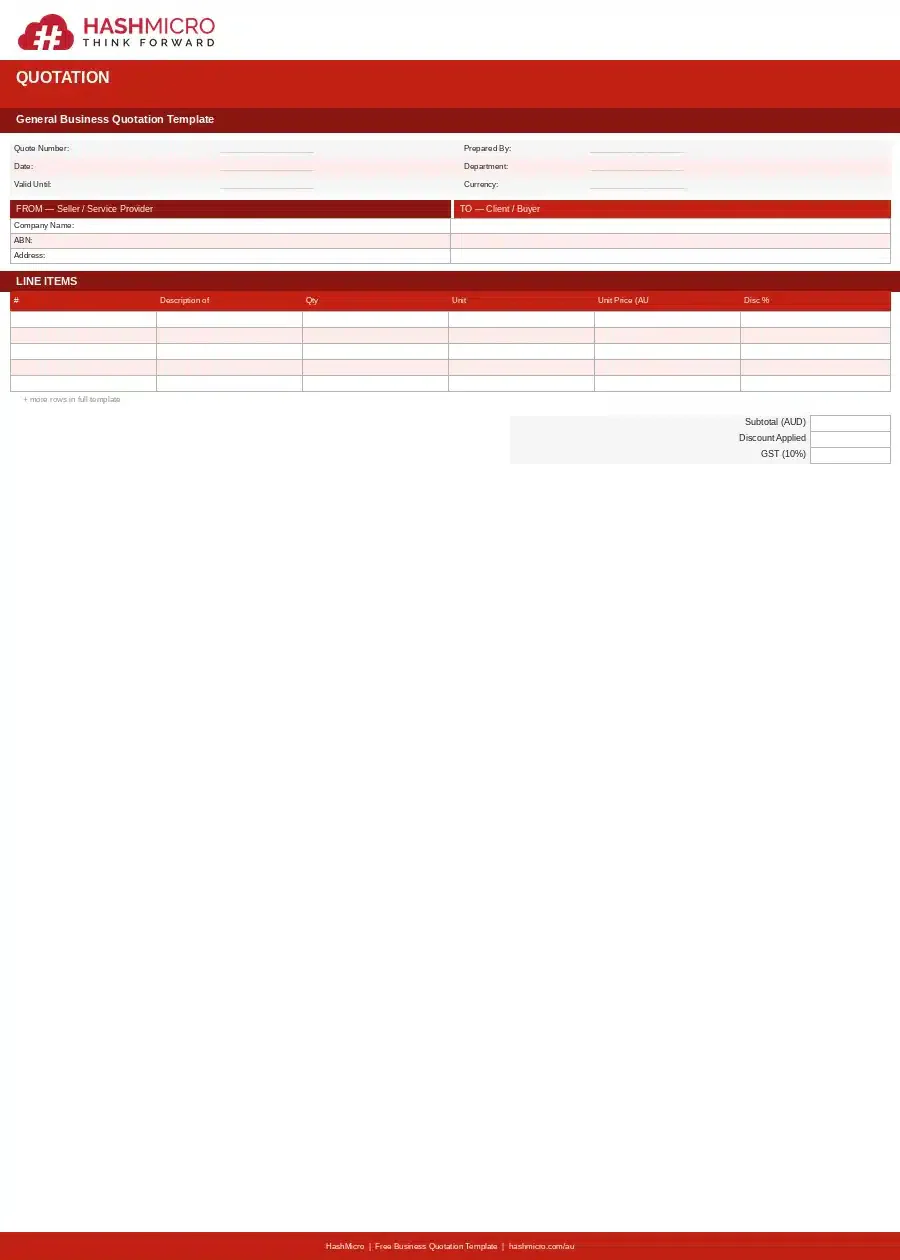
1. General business quotation template
This template includes standard fields such as business details, itemised pricing, GST, and payment terms. It is suitable for most general quoting needs.
General Business Quotation Template
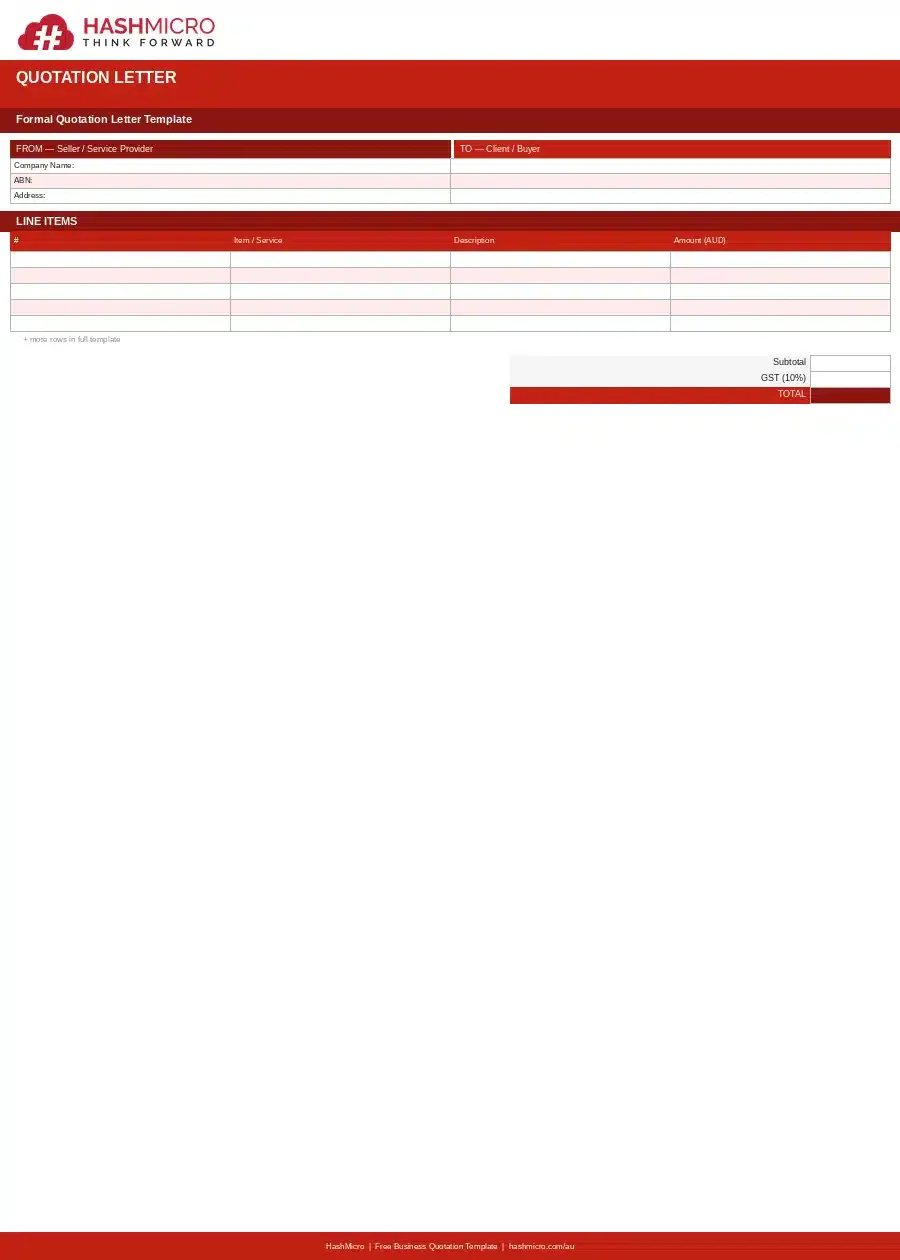
2. Quotation letter template
A quotation letter template is ideal for formal communication. It combines pricing details with a professional written message.
Quotation Letter Template
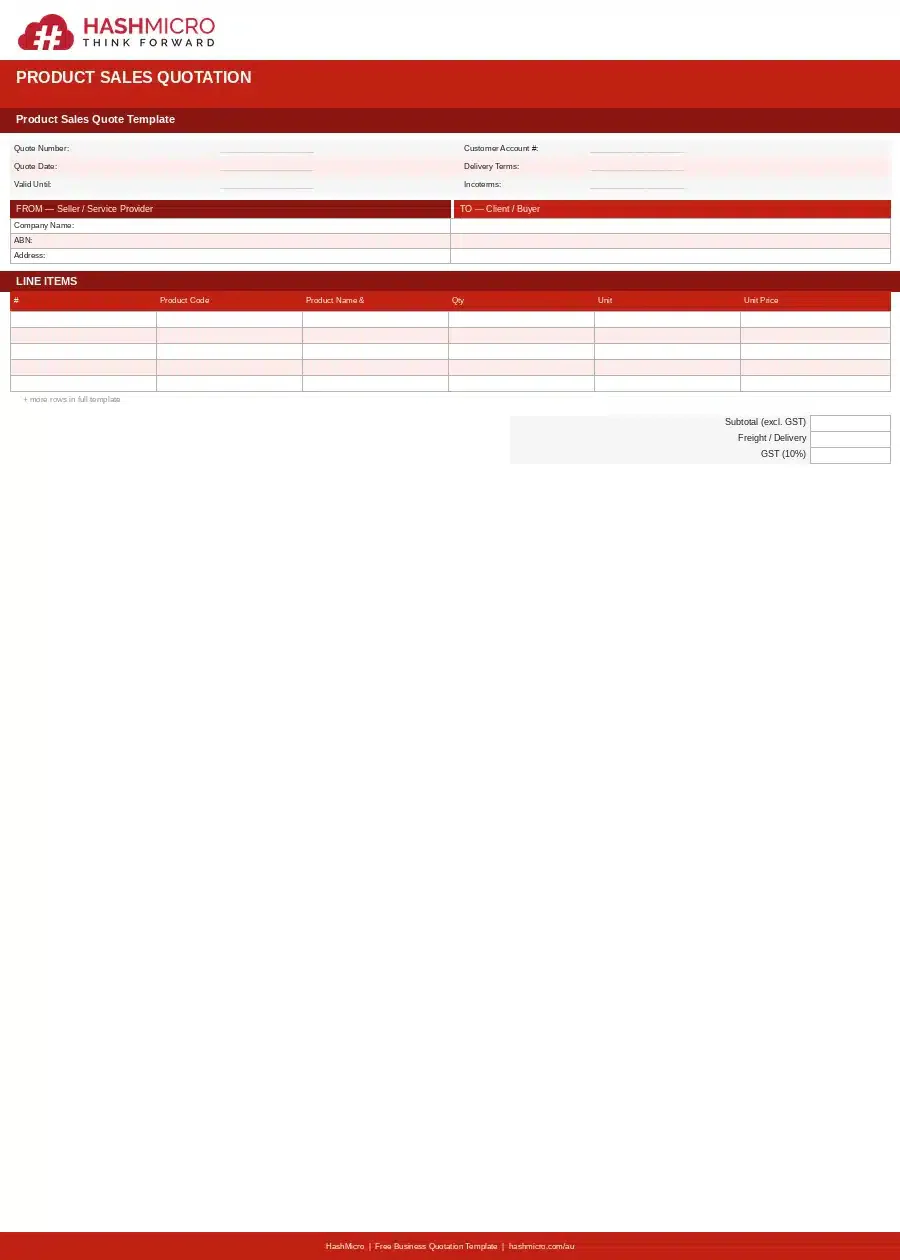
3. Product sales quote template
This template focuses on listing products, quantities, and pricing clearly. It is useful for businesses selling goods.
Product Sales Quote Template
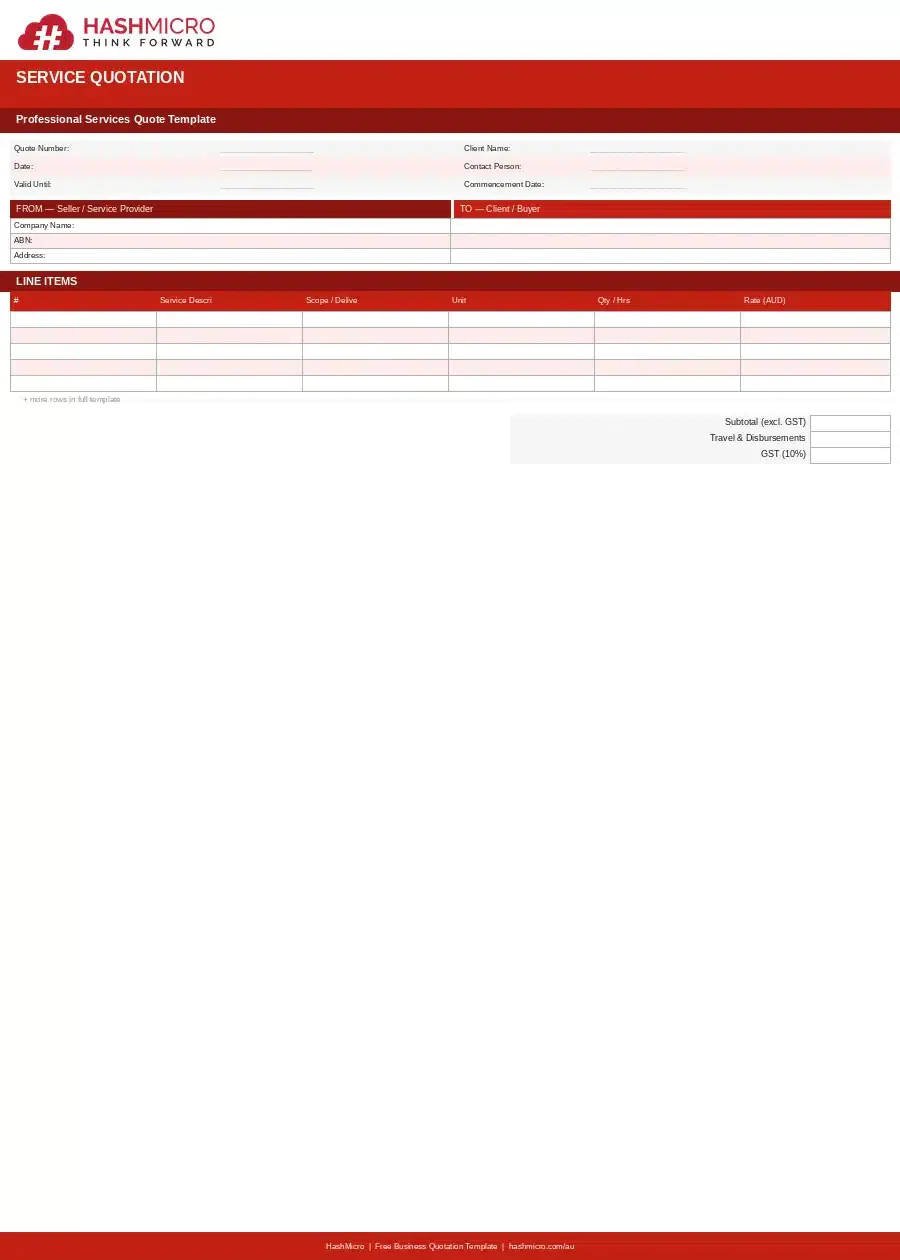
4. Service quote template
A service quote template is designed for labour-based pricing. It may include time estimates, service descriptions, and total costs.
Service Quote Template
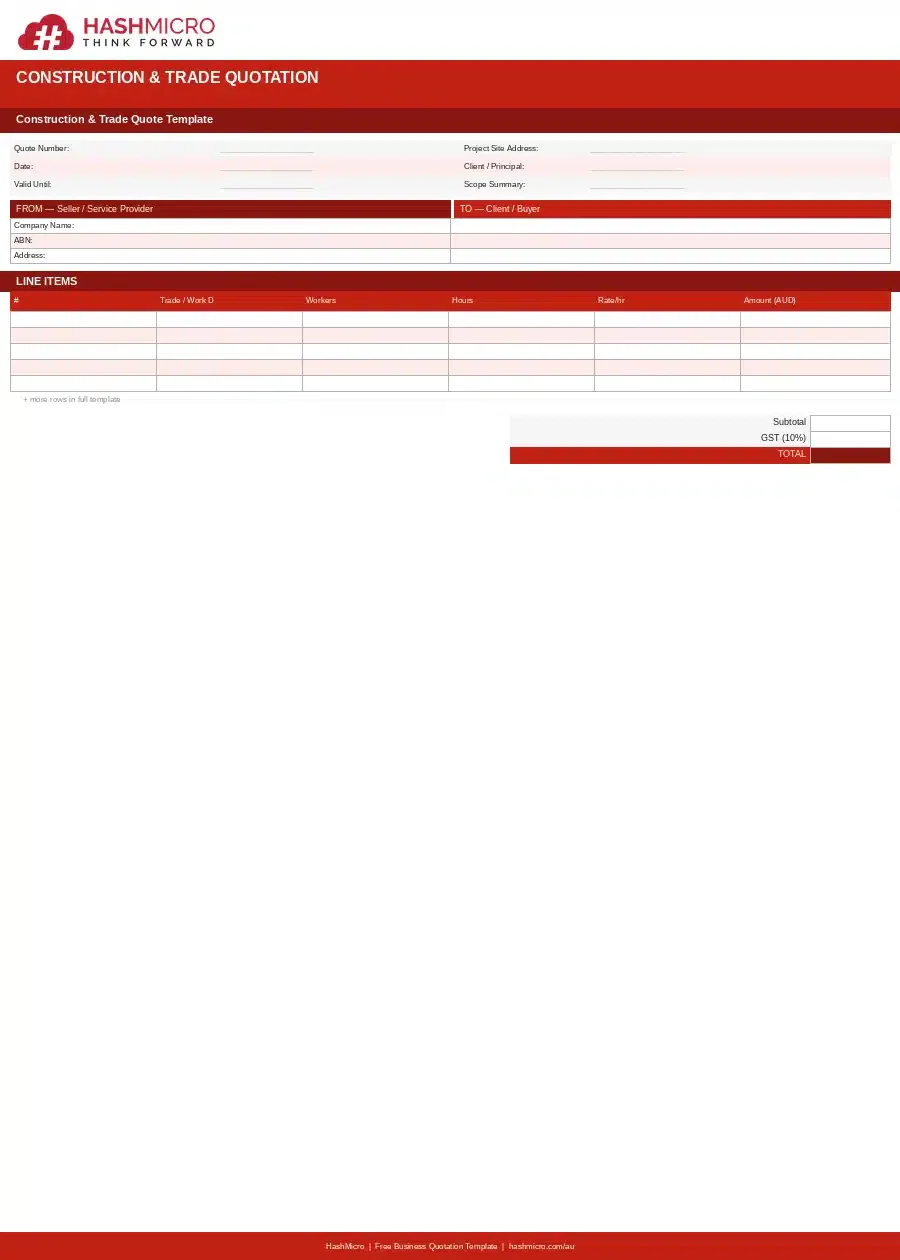
5. Construction and trade quote template
This template includes detailed breakdowns of materials, labour, and project scope. It is commonly used in building and trade industries.
Construction and Trade Quote Template
How to Write a Business Quotation
Writing a clear and accurate quotation helps improve client trust and increases the chances of winning work. Following a structured approach ensures nothing is missed.
1. Include your ABN, business name, and licence number (if a licensed trade)
Add your business details and ABN at the top of the quote. Licensed trades should also include relevant licence numbers where required.
2. Assign a quote number and state the validity period
Use a unique quote number for tracking and include how long the quote is valid. This helps manage pricing changes and follow-ups.
3. Describe each line item clearly with quantities and unit prices
Provide clear descriptions for each product or service. Including quantities and unit prices improves transparency and reduces confusion.
4. Apply GST correctly and show the total
Show whether GST is included or listed separately. Always include a clear total amount so the client understands the final cost.
5. State your payment terms and any special conditions
Include payment deadlines, deposit requirements, and any additional conditions. This helps avoid disputes later.
6. Send the quote, follow up before expiry, and convert to a tax invoice on acceptance
Send the quote promptly and follow up before it expires. Once accepted, convert the quote into a tax invoice for payment processing, and track sales performance against each converted quote in your records.
Are Quotations Legally Binding in Australia?
A quotation is not binding simply because it is issued. It becomes legally binding when the client accepts the offer and both parties agree to the stated scope, price, and terms.
The Australian Government’s quotation advice confirms that an accepted quote becomes a legally binding contract.
1. When does a quote become a contract?
Under the ACCC’s contract rules, acceptance can be written, verbal, or demonstrated through the client’s actions.
A client may accept by signing the quote, giving verbal approval, paying a deposit, clicking “I agree”, or acting in another way that clearly demonstrates consent.
A request to change the price, scope, timing, or terms is generally a counter-offer, not acceptance. A contract forms only when both parties agree to the revised offer.
2. Quote vs estimate: What is the legal difference?
A quote sets a specific price and scope. Once accepted, the supplier is generally expected to deliver on those terms unless the agreement allows a change or both parties approve a variation.
An estimate is an informed approximation that may change as more details become known. Label it clearly and explain its assumptions so it is not mistaken for a fixed quote.
3. How Australian Consumer Law applies to quoted prices
The ACCC’s price display requirements state that consumer prices must be clear, accurate, and not misleading.
The consumer-facing total must include applicable taxes, duties, and unavoidable or preselected fees. Mandatory charges should not be concealed behind a lower initial price.
Quotes shown only to other businesses do not have to include GST in the total price. Even so, state whether GST is included or excluded and show how it affects the amount payable.
4. How to record acceptance and price variations
Keep evidence of acceptance, such as a signed quote, confirmation email, deposit receipt, or digital audit trail. Record the date, accepted version, and authorised client contact.
Do not change an accepted price or scope without agreement. Australian Government contract variation advice recommends recording changes in writing.
State what changed, why it changed, the revised price, and any effect on timing. Both parties should approve the variation before the additional or amended work begins.
5 Quotation Mistakes Australian Businesses Make
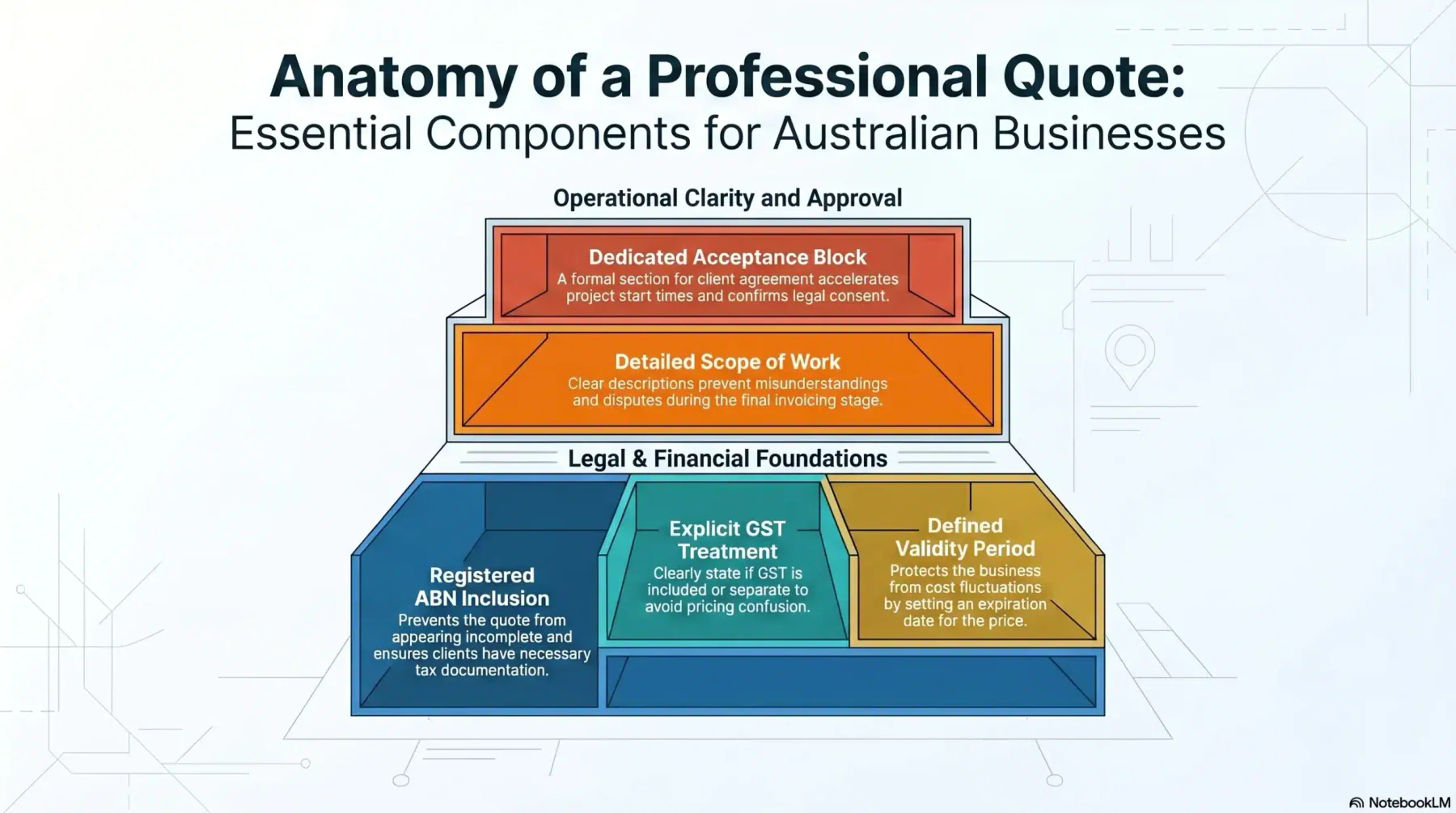
Avoiding common quoting mistakes can help improve professionalism and reduce disputes. Small errors can impact trust and delay sales.
1. Not including ABN
Missing your ABN can make the quote look incomplete or unprofessional. It may also cause issues for clients who need proper documentation.
2. Ambiguous GST treatment
Not clearly stating GST can lead to confusion about pricing. Always show whether GST is included or separate.
3. No validity period
Without a validity period, clients may assume the price remains open indefinitely. This can create problems if costs change.
4. Vague scope of work that leads to disputed invoices
Unclear descriptions can result in misunderstandings about what is included. This often leads to disputes during invoicing.
5. No acceptance block
Without an acceptance section, it may be harder to confirm agreement. This can delay approval and project start times.
When Should You Move from Manual Quotes to Sales or ERP Software?
Manual quotation templates work well for small businesses, but growing operations may need more advanced systems. Software can improve speed and accuracy.
1. Signs your manual quoting process is slowing down your sales cycle
Delays in creating, sending, or tracking quotes may indicate inefficiencies. Missed follow-ups and inconsistent pricing are also warning signs.
2. What quote automation software does that a Word template cannot
Quote software can automate sales processes including calculations, approval tracking, record storage, and invoicing integration. Within an ERP or CRM platform, a quotation can be created directly from a client record, with product pricing pulled automatically from the system. The completed quote can then be sent to the client and tracked through the sales pipeline, without switching between separate tools.
Conclusion
A quotation template is an essential tool for creating clear, professional, and accurate price estimates. It helps businesses standardise their quoting process and improve communication with clients.
For Australian businesses, including the right details such as ABN, GST treatment, and payment terms can reduce disputes and support smoother transactions. A well-prepared quote can also increase the chances of winning new business.
As your business grows, moving from manual templates to quoting software can improve efficiency and help manage your sales pipeline more effectively. Get a free consultation with our experts to find the right solution for your business.

Frequently Asked Question
A quotation template is a structured document used by businesses to provide pricing details for goods or services before a sale is confirmed. It helps standardise quotes and improve consistency.
In Australia, a quotation template should include business details, ABN, quote number, issue date, validity period, itemised pricing, GST treatment, payment terms, and an acceptance section.
A quotation is not usually legally binding until it is accepted by the client. Once accepted, it may form part of a contract depending on the terms and conditions.
A quotation is issued before a sale to outline pricing and scope, while an invoice is issued after goods or services are delivered to request payment.
A quotation is commonly valid for 7 to 30 days, depending on the business and industry. Including a validity period helps avoid pricing disputes.