




The average customer in Australia expects a response in minutes, not hours. Scaling headcount to meet that demand is not a sustainable strategy, and the gap between AI adopters and those still waiting is widening fast.
AI in customer service works by combining natural language processing, machine learning, and automation to handle enquiries, assist agents in real time, and personalise interactions at scale.
This article covers what AI in customer service is, ten proven applications, the evidence behind the results, and what Australian businesses need to know about Privacy Act compliance and CRM integration.
Key Takeaways
AI in customer service is the use of NLP, machine learning, and automation to handle enquiries, assist agents, and personalise interactions.
Risks and challenges to understand cover declining customer trust, Privacy Act obligations, hallucination risk, and over-automation.
Implementing AI in customer service follows a 5-step framework, from defining objectives to auditing data and tracking KPIs continuously.
CRM and ERP integration amplifies AI customer service by giving AI accurate, real-time access to order, billing, and customer history data.

What Is AI in Customer Service?
AI in customer service is the use of natural language processing, machine learning, and automation to handle enquiries, assist agents, and personalise service interactions across voice, chat, and email.
It enables businesses to resolve routine queries instantly, reduce response times, and deliver consistent, high-quality support at any scale, without proportional increases in headcount.
The structural difference from traditional support is significant. Traditional customer service is bound by headcount: you can only serve as many customers as you have agents available, during the hours they work.
AI removes that ceiling. The distinction matters because the starting point shapes the business case. A static chatbot deflects contacts. AI with NLP, ML, and CRM integration resolves them, and the results compound over time.
In 2026, AI in customer service is no longer just chatbots. Generative AI, sentiment detection, and agentic systems have fundamentally changed what is possible in a modern contact centre.
Salesforce's 2025 State of Service data projects that AI will handle 50% of all customer service cases by 2027, up from 30% today. The businesses building toward that capability now are the ones positioned to benefit.
"AI in customer service is the layer that lets routine enquiries resolve instantly while complex, emotionally sensitive cases reach the right human agent."
10 Examples of AI in Customer Service
The question most decision-makers ask is not whether AI works in customer service. The evidence is settled. The real question is which applications deliver value in a specific operation.
These ten use cases cover the full spectrum, from the quick wins most businesses start with to the more sophisticated capabilities that distinguish mature implementations.
1. AI chatbots & virtual assistants
AI chatbots handle routine enquiries around the clock: FAQs, order status checks, account queries, and appointment scheduling, every day of the week. A properly deployed chatbot deflects 30 to 40% of contacts in the first 90 days, with no additional headcount required.
The keyword is "properly." Without integration into your CRM, a chatbot can answer general questions but not customer-specific ones. That distinction determines whether it reduces load or creates frustration.
2. Intelligent ticket routing & triage
Machine learning classifies incoming tickets by type, complexity, and urgency the moment they arrive, then routes each one to the right agent or team automatically.
This removes one of the biggest contact centre bottlenecks: the manual triage step that slows every queue and results in contacts bouncing between agents before they reach the right person.
The outcome is faster resolution and fewer handoffs. The first agent who receives a ticket is almost always the right one, and both outcomes directly reduce the handling time that drives the most common customer complaint.
3. Sentiment analysis & emotion detection
AI reads the emotional tone of customer messages in real time, detecting frustration, distress, or confusion before it escalates to a formal complaint. Distressed customers are flagged for priority handling and routed to agents with the skills to de-escalate effectively.
Sentiment detection is one of the most underused capabilities in early AI deployments and one of the highest-value ones. Fewer complaints reach management, and fewer customers leave feeling unheard.
4. Agent assist & real-time suggestions
A co-pilot interface sits alongside agents in the helpdesk, surfacing relevant knowledge base articles, past ticket context, and suggested responses as the agent types. IBM's Institute for Business Value reported a 38% reduction in average call handling time for mature AI adopters in 2025.
Agent assist is the primary driver of that result. It does not replace agent judgment. It removes the time agents spend searching for information they know exists somewhere in the system.
5. 24/7 self-service portals
AI-powered help centres answer customer questions in natural language without human involvement, at any hour of the day. Unlike static FAQ pages, they update automatically from the knowledge base, learn from the questions customers actually ask, and improve accuracy over time.
They do not go offline at 6 pm. For Australian businesses serving customers across multiple time zones, this is a measurable operational advantage that does not require a roster change to activate.
6. Generative AI for response drafting
Generative AI drafts complete response messages for agents to review, edit, and send, ensuring consistent tone across the team and reducing typing time per interaction. Salesforce's 2025 State of Service data shows that service representatives using AI tools spent 20% less time on routine cases.
That is roughly four hours per week per agent, reinvested in complex, relationship-building interactions where human judgment adds the most value.
7. Predictive support
Machine learning analyses patterns across shipping delays, product anomalies, and billing irregularities to identify customers likely to contact support before they do. AI triggers proactive outreach: a message, a credit, or a heads-up.
The contact that would have become a complaint becomes a resolution before the customer notices the problem. McKinsey documents AI-enabled self-service reducing overall incident volume by 40 to 50% in mature deployments. Predictive support is the upstream capability that drives that reduction.
8. Automated follow-ups & case closure
Workflow automation sends follow-up messages, closes resolved tickets, and updates CRM records after interactions complete, without requiring agent involvement. It removes the administrative tail every case generates.
Agents previously completed this work manually after each interaction, consuming time that could go to customers waiting in the queue. At scale, the compounding effect is significant. Every minute removed from post-interaction admin is a minute available for the next customer.
9. Voice AI & smart IVR systems
Natural language voice AI replaces the button-menu IVR systems customers have tolerated for decades. Customers state their issue in plain language; AI understands, routes them correctly, or resolves the query outright.
The gap between a call that reaches the right person immediately and one that bounces through three departments shrinks to near zero.
For Australian businesses with high inbound call volumes, this is often the fastest route to measurable customer satisfaction improvement and one of the quickest wins to demonstrate ROI.
10. AI-powered knowledge management
AI surfaces the most relevant knowledge base articles for both customers in self-service and agents in the helpdesk, learning from ticket patterns to identify content gaps before they cause repeat contacts.
The result is a knowledge base that grows more useful the longer the system runs, rather than quietly becoming outdated as products and policies change.
This is one of the compounding advantages of AI in customer service: the system that was useful on day one is measurably more useful at month twelve, without manual curation effort proportional to that improvement.
Key Benefits of AI in Customer Service
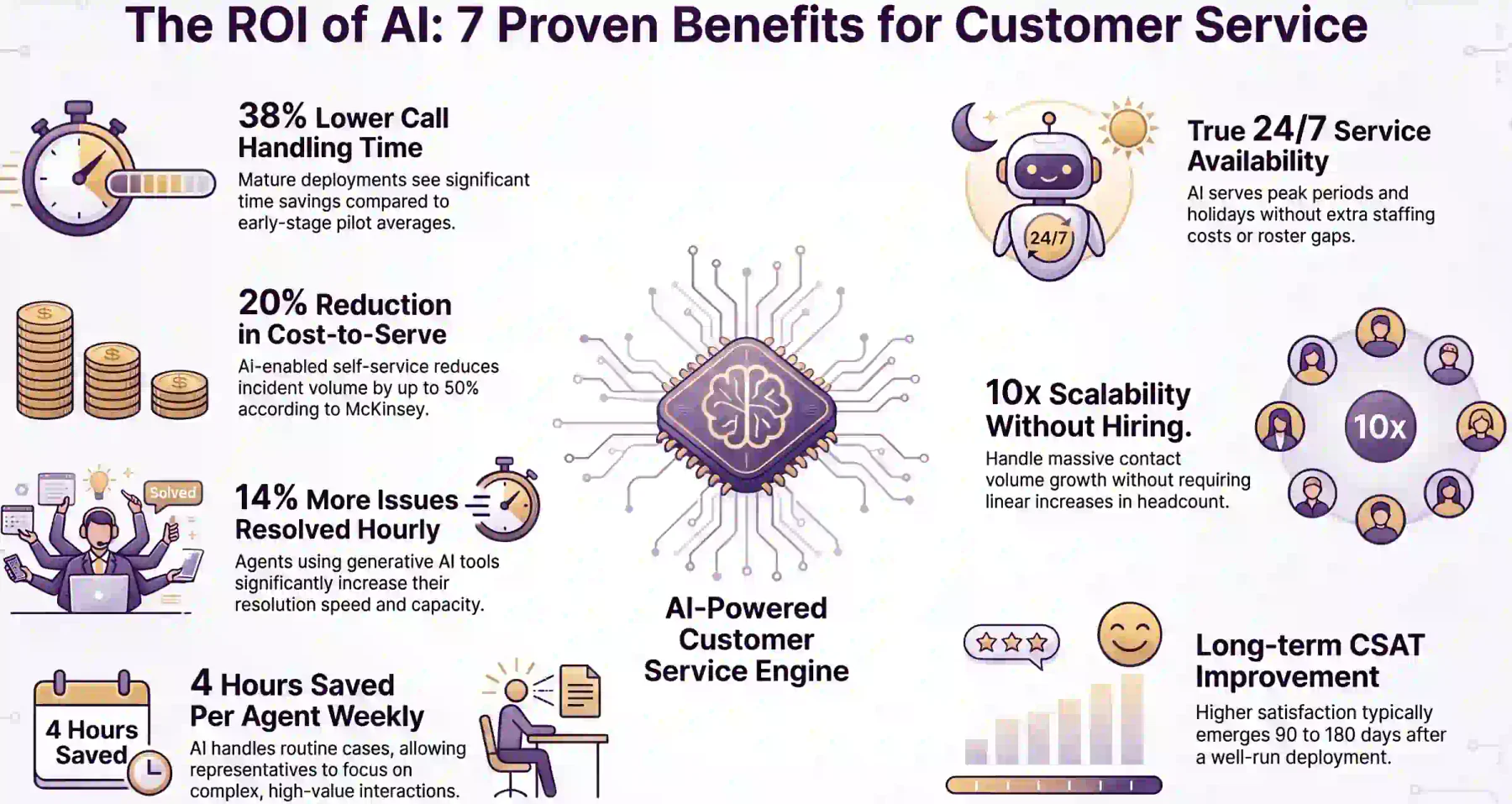
The business case for AI in customer service has moved from promising to proven. Results vary with implementation depth, but the evidence from mature deployments is consistent across industries and company sizes.
The seven outcomes below reflect what businesses with deep AI integration consistently report, each with a named source, because these numbers are only as useful as the study behind them.
- 38% lower average call handling time. IBM Institute for Business Value, 2025. This reflects mature deployments, not early pilot averages that tend to overstate the result.
- Faster first response times. AI channels respond in seconds. A 2023 NBER study found agents using AI tools resolved 14% more issues per hour ("Generative AI at Work," w31161).
- 24/7 availability, zero extra staffing. AI does not take shifts, call in sick, or go on holiday. Peak periods, public holidays, and after-hours contacts are served without overtime costs or roster gaps.
- Lower operational costs. McKinsey documents AI-enabled self-service reducing incident volume by 40 to 50%, with cost-to-serve falling more than 20% in businesses that implement it well. These savings compound as the system matures.
- Higher CSAT as deployments mature. CSAT is a lagging indicator. It typically arrives 90 to 180 days into a well-run deployment, not in the first weeks. Measuring it too early draws the wrong conclusion.
- Agent productivity gains. Salesforce's 2025 data shows representatives using AI spend 20% less time on routine cases, roughly four hours per week per agent, reinvested in the complex interactions where it matters most.
- Scalability without linear headcount growth. Handle ten times the contact volume without ten times the hiring. For Australian businesses in a growth phase, this is often the most commercially significant result on this list.
Risks & Challenges to Understand First
The businesses seeing the strongest results from AI in customer service are not the ones that deployed fastest. They are the ones who understood these failure modes before they went live.
1. Declining customer trust
Consumer trust in companies reached an 8-year low in 2024, with 63% of consumers saying AI advances have made trust more critical than ever (Salesforce, State of the Connected Customer 2024).
Three in four customers want to know when they are talking to an AI. Businesses that disclose AI use clearly and maintain a human escalation path are building a differentiator that their competitors are quietly neglecting.
2. Privacy Act 1988 obligations
Australian businesses handling customer data through AI are covered by the Privacy Act 1988 and the Australian Privacy Principles. The OAIC published specific guidance on commercially available AI in October 2024.
Existing generic privacy notices are insufficient. Customers must be explicitly informed that their personal information may be processed by AI systems during service interactions.
New APP obligations covering automated decision-making transparency are in development. Formal OAIC guidance is expected by September 2026.
Build disclosure capabilities into your architecture now. Retrofitting them after deployment costs significantly more.
3. Hallucination and accuracy risk
AI systems can produce confident, incorrect answers. Without human oversight on complex queries, a wrong answer damages the customer relationship you were trying to protect.
Rules-based escalation paths are not optional. They are the safety net that keeps AI in its lane and ensures complex, high-stakes interactions reach a human agent.
4. Over-automation of complex interactions
Routing all enquiries to AI without distinguishing high-stakes or emotionally charged interactions is the most common early mistake in customer service deployments.
Some contacts need a human. The AI's job is to identify which ones and create a clear, easy path for a person.
Customers who feel trapped in an AI loop leave, and they tell others. The businesses that get this right design their AI to make reaching a human faster, not harder.
How to Implement AI in Customer Service: A 5-Step Framework
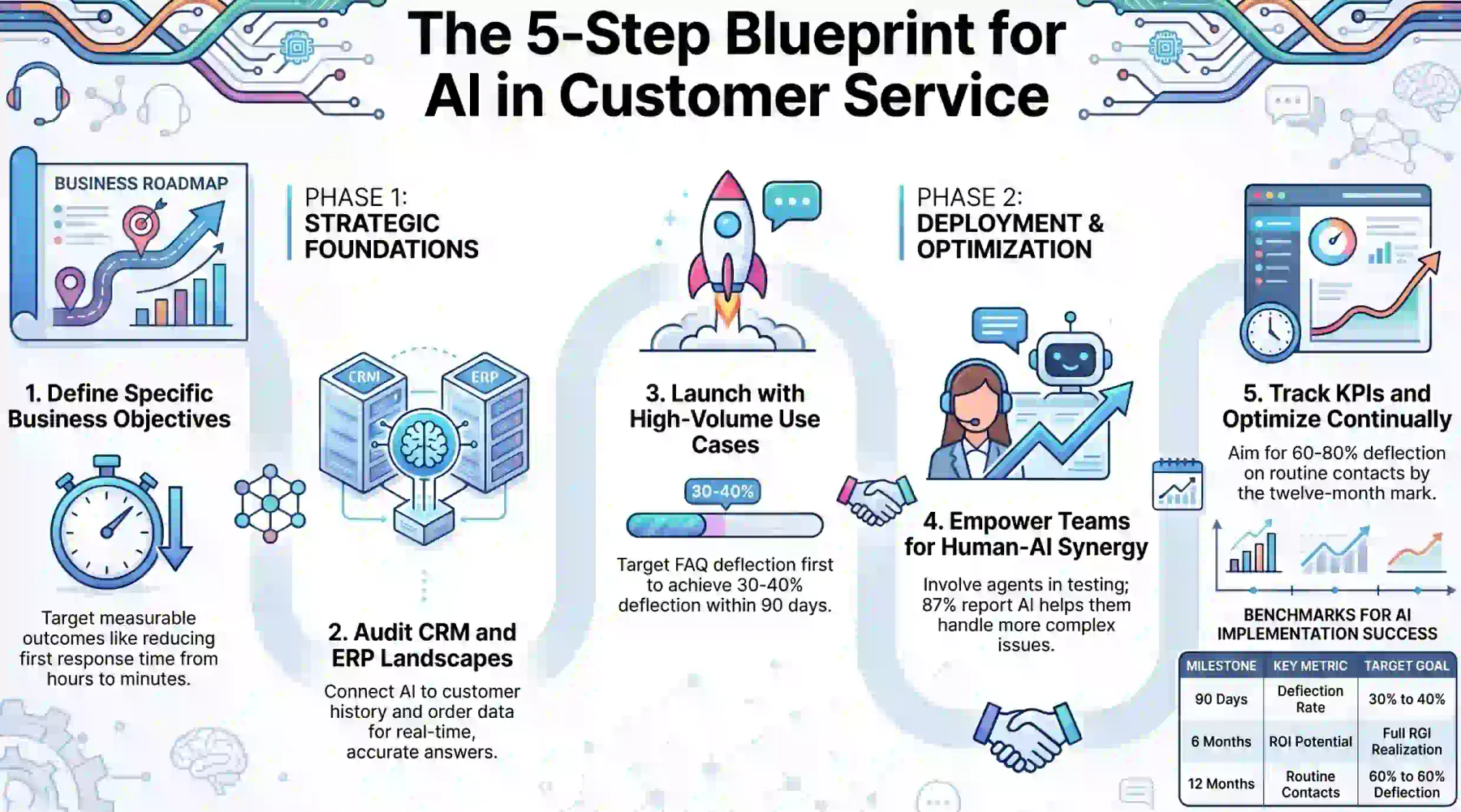
Most AI customer service implementations that underperform share a common starting point: they chose a platform before they understood their data. The five steps below are built around avoiding that mistake.
Each removes a specific failure mode that consistently derails early deployments before they reach their ROI potential.
1. Define clear business objectives
Start with outcomes, not technology. What specifically needs to change: first response time, deflection rate, average handle time, or CSAT? The clearer the target, the easier the platform selection and the more honest the 90-day review will be.
"We want to improve customer service" is not a business objective. "We want to reduce average first response time from four hours to under 30 minutes within six months" is.
2. Audit your customer data & integration landscape
AI performs at its ceiling when it has access to the data that makes a good answer possible. Before selecting a platform, identify what customer data you hold and where it lives. Your CRM holds customer history and preferences.
Your ERP holds order data, billing status, and inventory. AI connected to neither can only answer questions in generic terms. AI connected to both answers accurately, in real time, without a human agent. That is the difference between a deflection tool and an actual customer service operation.
3. Start with high-volume, low-complexity use cases
Do not try to automate everything at once. Start with the top ten query types that make up the majority of your contact volume. FAQ deflection and intelligent ticket routing are the highest-ROI starting points for most contact centres: high-frequency, well-defined, and relatively low-risk to automate.
Expect 30 to 40% deflection within 90 days of a properly deployed AI layer. Most businesses take more than six months to see full ROI. Set realistic expectations with stakeholders early (McKinsey, 2024).
4. Train your team to work alongside AI
AI adoption fails when the team feels threatened rather than supported. The framing matters: AI removes the tedious work so agents can focus on the interactions that actually matter.
In 2025, 87% of service professionals said AI enables them to handle more complex issues, and 86% reported developing new skills working alongside AI tools (Salesforce, State of Service 2025). Involve agents in testing before go-live.
Their feedback on edge cases and failure modes is some of the most valuable input you will get, and agents who helped build the system help improve it.
5. Track KPIs and optimise continuously
Set a 90-day review cycle as a minimum. Track deflection rate and first response time as leading indicators: they move quickly and tell you whether the system is working. Track CSAT and NPS as lagging indicators.
These reflect the cumulative customer experience and typically stabilise three to six months into a well-tuned deployment. By month twelve, target 60 to 80% deflection on routine contacts. If you reach month six and deflection is still below 30%, the issue is almost always integration depth, not the AI itself.
KPIs to Measure AI Customer Service Success
Not all KPIs move at the same rate. Deflection rate and first response time are leading indicators: they reflect system performance and move within the first 30 to 90 days. CSAT is a lagging indicator.
It reflects the cumulative customer experience and typically stabilises after three to six months of tuning. Measuring it before that window draws the wrong conclusion.
Watch the containment rate closely. A high deflection rate with a low containment rate means AI is starting conversations but not finishing them. That is almost always a sign the knowledge base or CRM integration needs work, not that the AI itself is failing.
AI in Customer Service in Australia: What You Need to Know
Australian businesses deploying AI in customer service are not operating in a regulatory vacuum. The Privacy Act 1988 and Australian Privacy Principles apply to any AI use that involves personal customer information.
In October 2024, the OAIC published specific guidance on commercially available AI products. For customer service contexts, the key obligations are straightforward but non-negotiable.
- Update your privacy notices. Existing generic privacy policies are insufficient. Customers must be informed that their personal information may be processed by AI systems during service interactions.
- Maintain a human escalation path. Customers who prefer to speak with a human must have a clear, easy route to do so. A chatbot that makes this difficult is a compliance risk, not just a UX problem.
- Conduct a Privacy Impact Assessment (PIA) before deploying AI that processes personal customer data. This is recommended best practice under OAIC guidance and is worth completing before platform selection, not after.
- Do not misrepresent AI as human. The ACCC's guidance on misleading representations applies. Claiming an AI agent is a person is a breach of Australian consumer law, not just an ethical concern.
One opportunity specific to the local market: Australia's culturally and linguistically diverse population creates multilingual support demand that traditional staffing models struggle to meet cost-effectively.
According to the ABS, more than 30% of Australians speak a language other than English at home (ABS, Cultural Diversity of Australia).
AI platforms capable of serving 50-plus languages address this at scale without proportional headcount increases, a meaningful advantage for businesses serving diverse communities that generic global deployments frequently overlook.
Australian contact centres handling high interaction volumes have seen substantial cost reductions after AI deployment, with most well-implemented platforms reaching positive ROI within 12 to 18 months.
The industries seeing the strongest results locally: financial services and insurance, telecommunications, retail and e-commerce, and healthcare. The competitive gap between AI adopters and non-adopters in Australia is widening.
The businesses building their AI customer service capability now, with the right data integrations in place, are the ones positioned to hold that advantage in 2027.
How CRM & ERP Integration Amplifies AI Customer Service
The most common frustration with AI customer service tools is surprisingly mundane. A customer asks, "Where is my order?" and the chatbot apologises that it cannot help. Not because AI cannot answer that question.
Because the AI is not connected to the system that holds the answer. This is the integration gap that separates a deflection tool from an actual customer service operation.
AI in isolation handles speed: it responds immediately. AI connected to your CRM and ERP handles accuracy: it responds correctly. The ROI difference is not marginal.
- AI + CRM: personalised enquiry handling. Customer history, past interactions, account preferences, and relationship context are available to the AI during every conversation. Data gives the AI context it can act on, not just acknowledge.
- AI + ERP: real-time operational resolution. Order status, billing data, stock levels, and account information are all available in real time. The most-asked question in most contact centres, "Where is my order?", can be answered accurately and immediately.
- AI + CRM + ERP: omnichannel consistency. The customer experience is the same across chat, voice, and email because the AI draws from the same unified data source and carries context across every channel.
Complete CRM Solutions like HashMicro's are built with this architecture in mind, giving Australian businesses the customer data foundation accurate AI responses need.
That same data foundation runs HashyOS, HashMicro's agentic AI platform, letting AI Coworkers act on customer information directly rather than just surface it back.
None of that proactive resolution happens unless the AI can reach live customer data. Hashy AI connects to your CRM and ERP, reads order, billing, and interaction history, and surfaces the enquiries that are escalating or still waiting on a human.






The Future of AI in Customer Service
By 2029, Gartner projects agentic AI will autonomously resolve 80% of common customer service issues, with an accompanying 30% reduction in operational costs (Gartner, March 2025).
- Agentic AI: The shift from AI that answers to AI that acts. An agentic system processes a return, updates a record, and confirms a refund within a single interaction, without human involvement for routine cases.
- Hyper-personalisation at scale: AI drawing on real-time CRM and ERP data gives each customer an answer relevant to their specific history, not a generic response. This capability is the downstream reward of the integration work described in the previous section. It does not appear without it.
- Proactive customer experience: Rather than waiting for customers to contact you, AI identifies the signals that predict support needs and reaches out first.
The contact that would have become a complaint becomes a resolution before the customer notices the problem.
Conclusion
AI in customer service in 2026 is not a pilot programme or a future investment. It is a live competitive factor, and the gap between early movers and those still evaluating is widening.
The results are consistent: 38% lower handling time, 40 to 50% incident reduction, and CSAT gains within six months. For Australian businesses, the strategy is integrating AI with your CRM and ERP now, not later. If you are interested in implementing your own customer service AI system, you can book a free consultation
with us today. Start anytime and learn practical business insights that take into account the current business landscape.
Frequently Asked Questions
Agentic AI takes action, processing a return, updating an account or confirming a refund in one interaction, without a human in the loop. Gartner projects 80% of common issues resolved this way by 2029.
Key risks are confidently incorrect AI answers, over-automating complex interactions, and eroding trust when AI use is undisclosed. Escalation paths, disclosure, and CRM and ERP integration mitigate all three.
Costs vary by scope and vendor. Entry-level chatbot platforms start from a few hundred dollars monthly. Enterprise deployments with CRM and ERP integration range from tens to hundreds of thousands annually.
Start with your data, not the platform. Audit what customer data you hold and whether it connects to AI. Then target your top ten query types for the fastest ROI in the first 90 days.