







Deducting wages to pay income tax should be an easy task; the intricacies of the BIR withholding tax system require a profound understanding, despite being one of the most critical components. Businesses in the Philippines have a duty to the Bureau of Internal Revenue (BIR) to be a withholding agent; failure to comprehend and execute these responsibilities accurately can lead to severe financial repercussions.
The withholding tax system helps the government secure steady revenue through tax deductions remitted to the BIR. For businesses, compliance gets complex because ATCs, rates, deadlines, and documents keep changing. The EOPT Act adds new rules, so companies need organized processes and close attention. Read more to see how your team can stay compliant with less confusion.
Key Takeaways
The BIR withholding tax system isn’t a new tax but a mechanism for collecting income tax in advance. Once withholding applies, agents must identify the correct ATC, calculate the tax, and issue BIR Form 2307 to the payee.
The BIR withholding tax system covers five categories, each requiring specific forms, correct rates, and timely filing to stay compliant.
Calculating BIR withholding tax correctly requires confirming the ATC, using the right tax base, and recording every transaction accurately.

Understanding the Fundamentals of BIR Withholding Tax
The BIR withholding tax system is a method of collecting income tax in advance from the payee of the income. It it not a new tax, rather it acts as a mechanism for advance collection of income tax, percentage tax, or VAT owed. The payor deducts the required amount, remits it to the BIR, and issues a certificate to the payee for use as a tax credit.
This system helps the government secure steady revenue, reduce tax evasion, and streamline collection. It also helps the BIR match reported expenses with declared income, which is why companies need accurate records, consistent workflows, and complete documentation to stay compliant.
How the Withholding Tax System Works in the Philippines

Applying the BIR withholding tax system starts with understanding the roles of the government, withholding agent, and payee. Under the Ease of Paying Taxes Act, withheld taxes are trust funds, requiring businesses to keep them in a separate account. The withholding agent must identify the correct ATC, calculate the tax, and issue the proper certificate, like BIR Form 2307, within the deadline.
Major Classifications of BIR Withholding Tax
The Philippine withholding tax system is not monolithic; it is divided into several distinct categories, each with its own set of rules, rates, and reporting requirements. Understanding these classifications is essential for accurate tax mapping and compliance.
Withholding Tax on Compensation (WTC)
WTC is the tax withheld from employees’ compensation income under an employer-employee relationship, affecting almost every formally employed individual. The tax deduction follows graduated income tax rates based on the Tax Reform for Acceleration and Inclusion (TRAIN) Law and the Corporate Recovery and Tax Incentives for Enterprises (CREATE) Act.
Employers calculate WTC by excluding non-taxable items such as statutory contributions, de minimis benefits, and the 13th-month pay up to PHP 90,000. The taxable income is then subjected to the withholding tax table. At year-end, employers perform an annualization process to ensure the correct tax amount is withheld, adjusting for any excess or deficit.
Expanded Withholding Tax (EWT) / Creditable Withholding Tax (CWT)
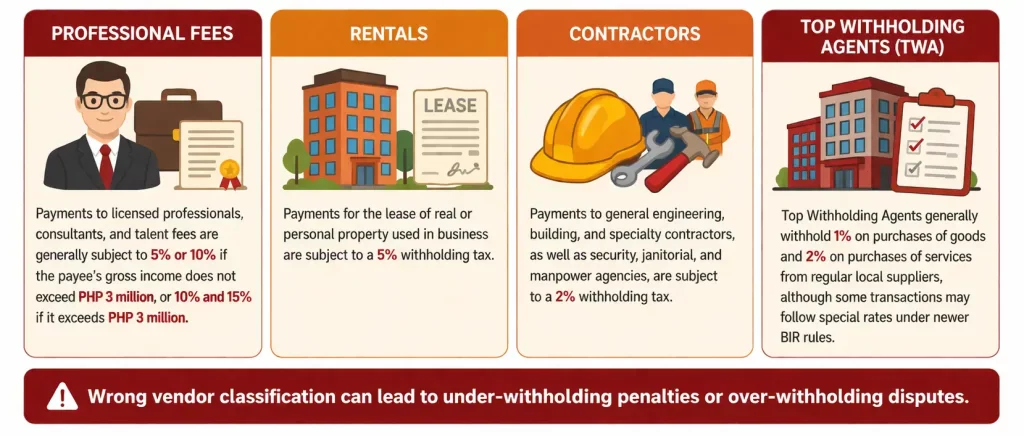
When EWT applies in actual transactions, it involves specific types of income payments made by a resident to another resident. The tax withheld is creditable, meaning the payee can use it to offset their quarterly and annual income tax liabilities. The complexity of EWT lies in the sheer volume of transactions it covers and the varying rates assigned to different Alphanumeric Tax Codes (ATCs). Common EWT rates include:
Final Withholding Tax (FWT)
The withholding agent deducts and remits FWT on specific types of passive income, including interest, royalties, prizes, winnings, some dividends, deposit substitutes, trust funds, and similar arrangements (typically subject to 20%). Once the withholding agent remits the tax, the taxpayer no longer reports that income annually. Because the tax is final, the withholding agent takes full responsibility for collecting and remitting the correct amount.
Fringe Benefits Tax (FBT)
Fringe Benefits Tax is a final withholding tax on benefits given to managerial or supervisory employees. It does not usually apply to rank-and-file employees under regular compensation tax. Employers compute FBT by grossing up the benefit’s value, applying the 35% rate, and paying the tax as a deductible business expense. If a company misclassifies, undervalues, or fails to remit FBT, it can face major BIR audit assessments.
Withholding of Value-Added Tax (WVAT) and Percentage Taxes
In certain cases, the government withholds business taxes (VAT or Percentage Tax) on top of income taxes. The most common instance of WVAT involves transactions with the government. Government agencies must withhold 5% Final VAT when purchasing from VAT-registered suppliers. Non-VAT entities under the 3% percentage tax face similar withholding rules. Proper invoicing and reconciliation are essential steps in maintaining your organization's tax-exempt standing. Taxpayers must account for withheld VAT in monthly and quarterly declarations to avoid double taxation.
Essential BIR Forms and Certificates Every Business Must Know

Compliance with the BIR withholding tax system is intrinsically tied to the accurate preparation and timely filing of numerous tax forms. The BIR relies heavily on these standardized documents to track remittances, cross-reference data, and execute tax audits. Understanding the purpose and workflow of each form is non-negotiable for any finance department.
Monthly and Quarterly Remittance Returns
Withheld taxes are remitted through returns, typically filed monthly or quarterly, depending on the tax type. Under the current rules, taxpayers generally file tax returns electronically, while payments may be made electronically or manually through authorized channels.
| BIR Form | Purpose | Remittance / Filing Rule | Deadline |
|---|---|---|---|
| 1601-C | Used by employers to remit taxes withheld from employees’ salaries. | Filed monthly. Taxpayers enrolled in eFPS must follow the applicable BIR filing and payment schedule. | For January to November, due on or before the 10th day of the following month. For December, due on or before January 15 of the following year. |
| 1601-EQ | Used to report and remit expanded withholding taxes deducted from suppliers of goods and services. | Filed quarterly. Taxpayers must still remit withholding tax for the first two months of each calendar quarter using BIR Form 0619-E. | Due not later than the last day of the month following the close of the quarter. |
| 1601-FQ | Used to report and remit final withholding taxes for the quarter. | Filed quarterly. Taxpayers remit withholding tax for the first two months of each calendar quarter using BIR Form 0619-F. | Due not later than the last day of the month following the close of the quarter. |
Annual Information Returns and the Alphalist
Withholding tax compliance also requires withholding agents to report detailed employee or payee information through the Annual Information Returns and alphalists. These include key data like TIN, name, income type, amount paid, and tax withheld, and must reconcile with remittance returns and supporting records.
| BIR Form | What It Covers | Deadline | Key Notes |
|---|---|---|---|
| 1604-C | Summarizes compensation paid and taxes withheld for the year. | On or before January 31 of the following year. | Should reconcile with monthly 1601-C remittances, employee records, and year-end alphalist data. |
| 1604-E | Consolidates annual EWT data and income payments exempt from withholding tax. | On or before March 1 of the following year. | Its annual alphalist supports BIR verification of payments and tax credits. The related alphalist is filed through eSubmission regardless of the number of payees. |
| 1604-F | Summarizes income payments subject to final withholding tax. | On or before January 31 of the following year. | Attachments include alphalists for payees subject to final withholding tax, fringe benefits, and income payments exempt from withholding tax but still subject to income tax. |
In practice, BIR filing mechanics still distinguish between platforms. Under RMC No. 18-2021, mandated eFPS users may still use 1604-CF in eFPS, while offline eBIRForms or manual filers use 1604-C and 1604-F. Late filing may trigger a penalty of ₱1,000 per failure, up to ₱25,000 per year, unless reasonable cause applies.
Certificates of Tax Withheld
Certificates of tax withheld are key documentary proof of a withholding tax transaction and are especially important for the income recipient. Depending on the transaction and current BIR rules, these certificates may be issued and transmitted in physical or digital form, subject to BIR validation requirements.
| BIR Form | Purpose | Issuance Timing | Key Notes |
|---|---|---|---|
| 2316 | Certificate of Compensation Payment/Tax Withheld for employees. | Issued on or before January 31 of the succeeding year, or on the day of the last compensation payment if employment ends earlier. | Shows total compensation and tax withheld. For qualified employees, it supports substituted filing, so they are not required to file BIR Form 1700. |
| 2307 | Certificate of Creditable Tax Withheld at Source for creditable withholding tax. | Furnished within 20 days from the close of the quarter. | Supports the payee’s tax credit claim, not a deduction claim. It may be transmitted digitally, and the BIR validates it against SAWT and the withholding agent’s alphalists. |
| 2306 | Certificate of Final Tax Withheld at Source for final withholding tax transactions. | Issued for transactions subject to final withholding tax. | This remains the proper certificate for final withholding tax transactions. However, for certain real estate cases involving BIR Form 1606, Form 1606 with proof of payment serves as the supporting proof instead of Form 2307. |
How the EOPT Act Changed Withholding Tax

The Ease of Paying Taxes (EOPT) Act updates the timing of withholding tax. The BIR now requires withholding once the income is payable, due, or enforceable by law. It also applies when income is accrued, recorded in the payor’s books, or supported by a sales invoice. Businesses should understand that withholding is not a cash-based rule.
The EOPT Act also categorized taxpayers based on the size of the businesses and provided a more responsive approach for micro and small taxpayers. The new law also provided that withheld taxes are trust funds and should not be commingled with other company funds. The new law also provided that filing and payment of taxes are made easier by providing different filing and payment options for taxpayers.
How Philippine Businesses Can Set Up Withholding Workflows

Step 1: Confirm the Nature of the Transaction and the Correct ATC
Before calculating withholding tax, identify the payment’s nature and check if it is subject to tax under BIR rules. For example, determine if it’s for rent, professional services, or janitorial services. Always verify the current ATC code and rate from the latest BIR schedule to ensure accuracy.
For certain rental payments, BIR uses WI100 for individuals and WC100 for corporations at a 5% rate. Since BIR may modify or create new ATCs, businesses must confirm the applicable code before processing payments.
Step 2: Confirm When the Withholding Obligation Arises
Under current EOPT rules, the withholding obligation arises when income becomes payable, demandable, or enforceable. Withholding may also occur when the payment is accrued, recorded as an expense or asset, or when the seller issues an invoice. Businesses should avoid describing the rule as purely a cash basis.
Step 3: Establish the Correct Tax Base
After confirming that withholding applies, determine the proper tax base. For many common VATable EWT transactions, the withholding tax is computed on the gross income payment exclusive of VAT. If the supplier issues a VAT-inclusive invoice, remove the VAT first before applying the withholding tax rate.
Example: If the invoice for professional services is ₱112,000 VAT-inclusive, divide the total by 1.12 to get the VAT-exclusive amount of ₱100,000. The VAT portion is ₱12,000. Businesses should still verify the specific rule for the transaction involved because not all withholding situations follow the same base.
| Step | Formula | Example | Result |
|---|---|---|---|
| 1. Remove VAT | VAT-inclusive invoice ÷ 1.12 | ₱112,000 ÷ 1.12 | ₱100,000 VAT-exclusive base |
| 2. Compute withholding tax | Tax base × withholding rate | ₱100,000 × 10% | ₱10,000 withheld tax |
| 3. Compute net payable | Total invoice − withheld tax | ₱112,000 − ₱10,000 | ₱102,000 paid to the supplier |
| 4. Record output | Base + VAT + tax payable + cash | Expense ₱100,000 / VAT ₱12,000 / EWT ₱10,000 / Cash ₱102,000 | Cleaner posting and easier audit trail |
Step 4: Apply the Withholding Tax Rate
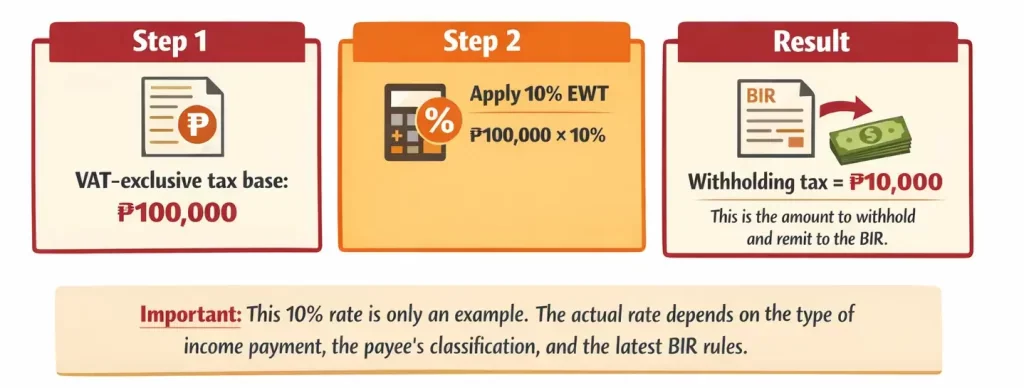
Once you establish the correct tax base, apply the corresponding ATC rate.
Illustration:
Step 5: Compute the Net Amount Payable to the Supplier
After calculating the withholding tax, subtract it from the total invoice amount to determine how much cash you will actually release to the supplier.
Example:
₱112,000 – ₱10,000 = ₱102,000
In this case, the business pays the supplier ₱102,000 and remits ₱10,000 to the BIR. The payor should also issue the proper withholding tax certificate, such as BIR Form 2307, in line with BIR timing rules. As a rule, the withholding tax statement is furnished within 20 days from the close of the quarter, or simultaneously with payment upon the payee’s request.
Step 6: Record the Journal Entry Properly
Proper accounting supports accurate reporting, reconciliation, and alphalist preparation. Using the same example, the journal entry would be:
Debit: Professional Fees Expense — ₱100,000
Debit: Input VAT — ₱12,000
Credit: Expanded Withholding Tax Payable — ₱10,000
Credit: Cash in Bank / Accounts Payable — ₱102,000
Recording the transaction this way helps the general ledger reconcile with the related invoice, withholding tax return, and supporting certificate.
Common Pitfalls and Compliance Risks to Avoid for Filipino Business Owners

Even with established processes, Philippine businesses frequently fall into traps that trigger BIR audits and penalties. Recognizing these pitfalls is the first line of defence against tax liabilities.
- Timing Differences in Withholding: Historically, businesses struggled with the “accrual vs. payment” rule. While the EOPT Act has clarified that the obligation to withhold arises at the time the income has become payable, many businesses still mistakenly wait until actual cash disbursement to record the withholding tax, leading to late remittance penalties.
- Failure to Issue BIR Form 2307 Promptly: Withholding agents often delay the issuance of Form 2307 until the end of the quarter. This creates immense friction with suppliers who need these certificates to claim tax credits on their own quarterly income tax returns. Failure to provide this form can result in vendor disputes and administrative complaints.
- Mismatched Alphalist Data: The BIR uses the Quarterly Alphalist of Payees (QAP) to cross-check the withholding taxes you remitted against the tax credits claimed by your suppliers. Typographical errors in Tax Identification Numbers (TINs) or discrepancies in the reported amounts will immediately flag your company in the BIR’s computerized matching system.
- Applying the Wrong Tax Base: A frequent error among junior accountants is computing the withholding tax based on the gross invoice amount, inclusive of VAT. It must always be calculated on the net-of-VAT amount.
How BIR Withholding Tax Works Across Philippine Industries
While the foundational rules of the BIR withholding tax system apply universally across all registered businesses, its practical application varies significantly depending on the industry. Different sectors encounter unique transaction types, requiring specialized knowledge of Alphanumeric Tax Codes (ATCs) and specific withholding tax rates.
| Industry | Common Transactions | Typical Withholding Tax Treatment | Key Compliance Challenge |
|---|---|---|---|
| Real Estate and Construction | Payments to prime contractors, subcontractors, and sales of real property by developers. | Local contractors are generally subject to 2% EWT. Progress billings require a deduction from the net amount, excluding VAT. Sales of real property may be subject to 1.5%, 3%, or 5% CWT depending on selling price and registration status. | Businesses need to handle progress billings, retention payables, and the correct CWT tier for property sales. |
| BPOs and Professional Services | Payments to consultants, IT specialists, freelancers, and other independent professionals. | Professional fees are typically subject to 5% or 10% for individuals and 10% or 15% for corporate consultants, depending on income thresholds. | Companies must track cumulative income to determine when a payee crosses the PHP 3 million threshold and becomes subject to the higher rate. |
| E-commerce and Retail Marketplaces | Gross remittances made by e-commerce platforms and digital financial service providers to online merchants. | Under RR No. 16-2023, platforms impose 1% creditable withholding tax on one-half of the gross remittances made to online merchants. | Platforms need payment systems that can automatically compute, deduct, and remit the tax before releasing funds to merchants. |

Conclusion
For BIR withholding tax compliance, there is a need to look beyond basic payroll or supplier deduction issues, as businesses must ensure they have the right ATC, proper tax bases, updated forms, and timely remittances to become compliant with BIR laws. By checking each transaction early on, businesses can minimize errors, disputes, and issues in managing their compliance with more confidence.
However, as rules, deadlines, and documentation needs are constantly changing, businesses face a challenge in staying accurate in their compliance efforts. That is why many businesses are now looking beyond basic tracking and are seeking the latest in software technology; businesses with an integrated accounting software workflow can reduce manual errors.
FAQ for BIR Withholding Tax
The Philippines does not apply one fixed withholding tax rate. The rate changes based on the type of income and transaction. For example, compensation withholding follows the current BIR withholding table, while some expanded withholding taxes apply rates such as 5% on certain rent, 2% on certain contractors, and 1% on one-half of certain e-marketplace remittances. >
The payor usually withholds and remits the tax to the BIR. The income recipient usually bears the tax because the payor deducts it from the payment. In practice, the buyer or payor acts as the withholding agent, while the seller or payee receives the net amount. >
Yes, taxpayers can recover excess >creditable withholding tax through a tax credit or refund if they properly report the income and prove the withholding. The law allows refunds when the withheld amount exceeds the tax due. Final withholding tax usually does not work the same way, unless an overpayment or an error has happened. >
The deadline depends on the form. Employers generally file >1601-C on or before the 10th day of the following month for January to November, and on or before January 15 for December. Taxpayers generally remit >0619-E and >0619-F on or before the 10th day of the following month, then file >1601-EQ or >1601-FQ by the last day of the month after the quarter closes. >