















Cash flow shows whether a business has enough available cash to pay its obligations, fund daily operations, and support future growth. A cash flow statement records where cash comes from and how it is used during a specific period.
For businesses in the Philippines, reviewing cash movements regularly helps owners and finance teams identify liquidity risks before they affect payroll, supplier payments, or expansion plans.
This guide will explains the purpose, components, preparation methods, examples, and interpretation of a cash flow statement. It also discusses common reporting issues and how accounting system can make the process more accurate and consistent.
Key Takeaways
A cash flow statement is a financial document that tracks the movement of cash into and out of business over a specific period.
Some of the main components of the cash flow statement include cash flows from operating activities, cash flows from investing activities, cash flows from financing activities, net changes in cash and ending balances.
HashMicro empowers businesses to optimize corporate financial operations and gain clearer financial insights.
What is a Cash Flow Statement?
A cash flow statement is a financial document that tracks the movement of cash into and out of business over a specific period. This statement helps business owners, managers, and investors understand how well the company generates cash to meet its financial obligations, fund operations, and support growth.
In the Philippines, where the economy is constantly evolving, having a clear picture of your cash flow is crucial for managing risks and planning for the future. Therefore, cash flow statement is essential for business assessing both short-term and long-term financial health, ensuring that your business stays on the path to success.
Cash Flow Statement Template Benefits

By utilizing a cashflow statement template example, businesses can streamline their financial reporting process and ensure consistency. Here are several key benefits of using this template:
- Simplifies financial analysis: Using a template for the cash flow statement makes it easier to categorize and track cash transactions over a specific period. This enables businesses to identify trends and make informed financial decisions.
- Improves accuracy and reduces errors: Predefined sections lower the risk of missing or misclassifying transactions. Finance teams can produce more reliable cash flow data with fewer manual corrections, which is essential for making strategic business decisions.
- Enhances cash flow management: Regular reporting helps businesses monitor their available cash and working capital. By having a good cashflow management, It also provides an early warning when upcoming expenses could create liquidity problems.
- Time-saving and efficient reporting: A ready-to-use format removes the need to build each report from scratch. Teams can enter the latest figures and complete their reports more efficiently.
- Supports regulatory compliance: A structured template helps businesses maintain the financial records required for audits and regulatory reporting. Consistent documentation also makes supporting information easier to verify.
When Do Companies Use a Cash Flow Statement?
A cash flow statement is part of financial statements that is used by a company to track and analyze the inflows and outflows of cash over a specific period. This document is crucial for assessing the company’s liquidity, operational efficiency, and financial health.
Unlike a sample profit and loss statement, which shows income and expenses to determine profitability, a cash flow statement provides a detailed view of actual cash movements.
Companies often use cash flow statements to make informed decisions regarding investments, budgeting, and financial planning. It also helps stakeholders understand how well the company manages its cash to sustain operations and fund growth.
Key Components of a Cash Flow Statement

Understanding the key components of a cash flow statement is essential for analyzing how a company manages its cash. Below are the main sections that make up a comprehensive cash flow statement:
- Cash flow from operating activities: This section highlights the cash generated or used by the company’s core business operations. It starts with net income and includes adjustments for non-cash items such as depreciation and changes in working capital. It provides insight into whether the company can generate sufficient cash from its everyday business activities.
- Cash flow from investing activities: This part details cash transactions related to the purchase or sale of long-term assets, such as property equipment and investments. Cash outflows for acquiring assets and inflows from the sale of assets are recorded here. This section indicates how much the company invests in future growth or receives from divesting its assets.
- Cash flow from financing activities: This section reflects cash movements related to funding the business, including issuing stocks, borrowing and repaying debt, or distributing dividends. It helps illustrate how the company finances its operations and long-term growth through various funding strategies.
- Net change in cash and ending balance: A company determines its net change in cash during the period by combining the cash flow from operating, investing, and financing activities. This change is added to the starting balance to arrive at the ending balance, giving a clear view of the company’s overall cash position.
These components together provide a comprehensive overview of how cash flow through a company, supporting better financial management and strategic decision-making.
How to Create a Cash Flow Statement

Creating a cash flow statement is essential for tracking a company’s financial health. Here is a step-by-step guide to help you create one effectively:
1. Determine the starting balance
The starting balance refers to the amount of cash available at the beginning of the reporting period. It is essential to accurately determine this figure as it forms the basis for calculating cash inflows and outflows throughout the period.
Typically, the starting balance is the ending balance from the previous period’s cash flow statement, which should be carried forward to ensure continuity and accuracy in financial reporting.
2. Calculate cash flow from operating activities
Cash flow from operating activities represents the cash generated or used by a company’s core business operations during a specific period. To calculate this, begin with the net income from the income statement and adjust for non-cash items, such as depreciation and changes in working capital.
These adjustments ensure that the cash flow reflects only the actual cash movements from day to day business activities, excluding any financing or investing activities.
This calculation provides insight into the company’s ability to generate cash from its primary business operations.
3. Calculate cash flow from investing activities
Cash flow from investing activities reflects the cash spent on or received from investments in long-term assets, such as property, equipment, or securities. To calculate this, include cash outflows for purchases of assets or investments, as well as cash inflows from the sale of such assets.
This section provides insight into how much cash the company is investing in its future growth or generating from the disposal of assets. It helps assess the company’s strategy regarding capital expenditures and investment decisions.
4. Calculate cash flow from financing activities
Cash flow from financing activities tracks the cash movements associated with raising or repaying capital. This section includes cash inflows from activities such as issuing stocks, obtaining loans, or other financial instruments that provide funding to the business.
It also accounts for cash outflows related to repaying loans, repurchasing company shares, and distributing dividends to shareholders. Accurately calculating this part of the cash flow statement is crucial for understanding how a company sustains its operations and growth through external funding.
It offers a clear view of the company’s financial strategies and obligations, highlighting its approach to leveraging debt and equity to support its business objectives.
5. Determine the ending balance
The ending balance represents the total cash available at the conclusion of the reporting period. To determine this figure, add the net cash flow from operating, investing, and financing activities to the starting balance.
This calculation provides a comprehensive picture of the company’s cash position at the end of the period and is essential for financial analysis and future planning.
The ending balance also serves as the starting balance for the next reporting period, ensuring continuity and consistency in financial reporting.
Example of a Cash Flow Statement
To better understand its format and significance, consider the following example.
A. Indirect cash flow statement
It begins with net income and adjusts it for non-cash expenses and changes in working capital. Items such as depreciation, inventory, trade receivables, and trade payables are adjusted to convert accrual-based profit into actual operating cash flow.
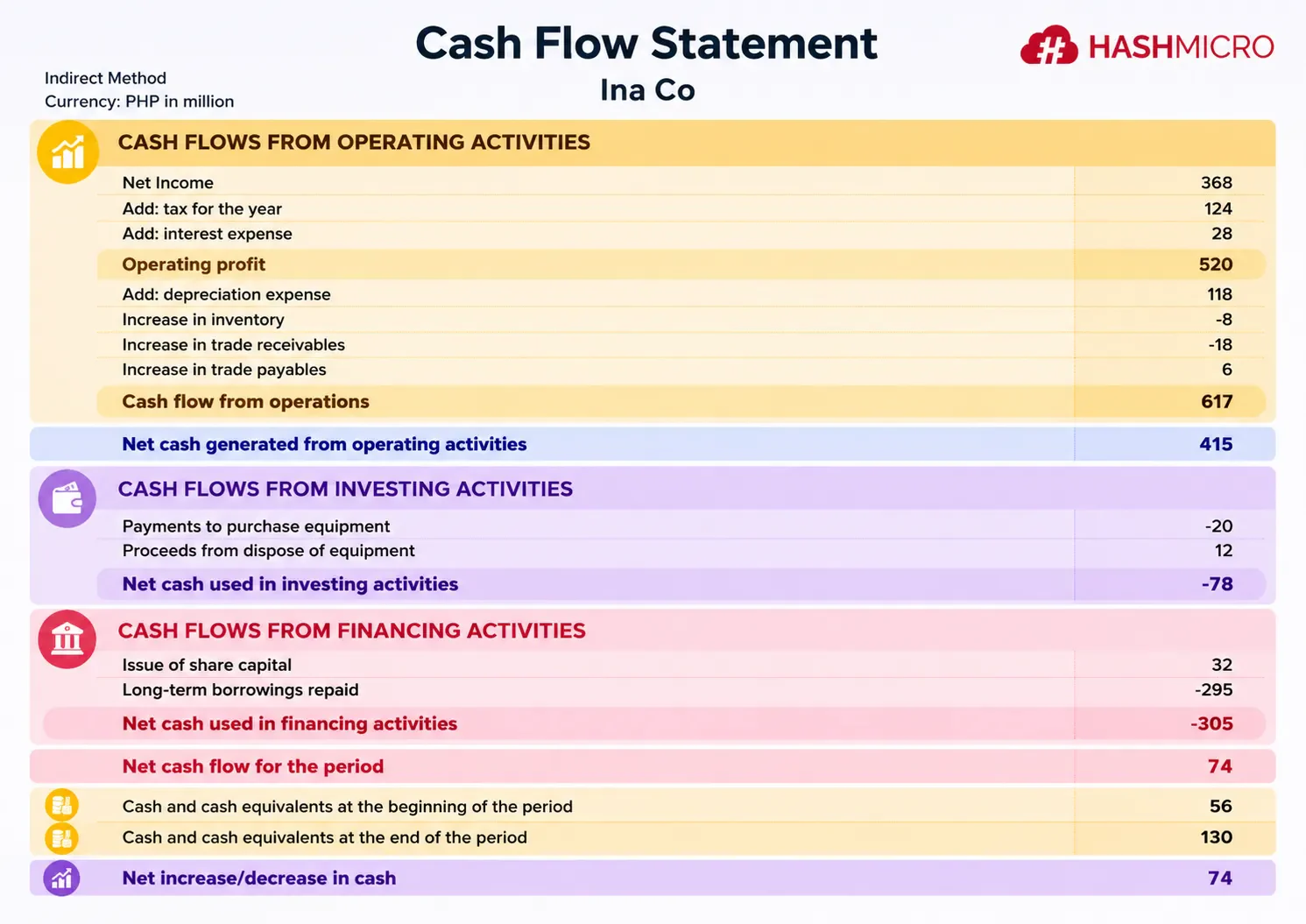
In this example, Ina Co. begins with PHP 368 million in net income. After adding tax, interest expense, depreciation, and working-capital adjustments, cash from operations reaches PHP 617 million, while dividend, interest, and tax payments reduce net operating cash flow to PHP 415 million.
Investing cash flow of negative PHP 78 million and financing cash flow of negative PHP 263 million produce a PHP 74 million net increase in cash. This raises the cash balance from PHP 56 million at the beginning of the period to PHP 130 million at the end.
B. Direct cash flow statement
This method calculates operating cash flow by listing actual cash received and cash paid during the reporting period. It shows customer receipts separately from payments to suppliers, employees, lenders, tax authorities, and shareholders.
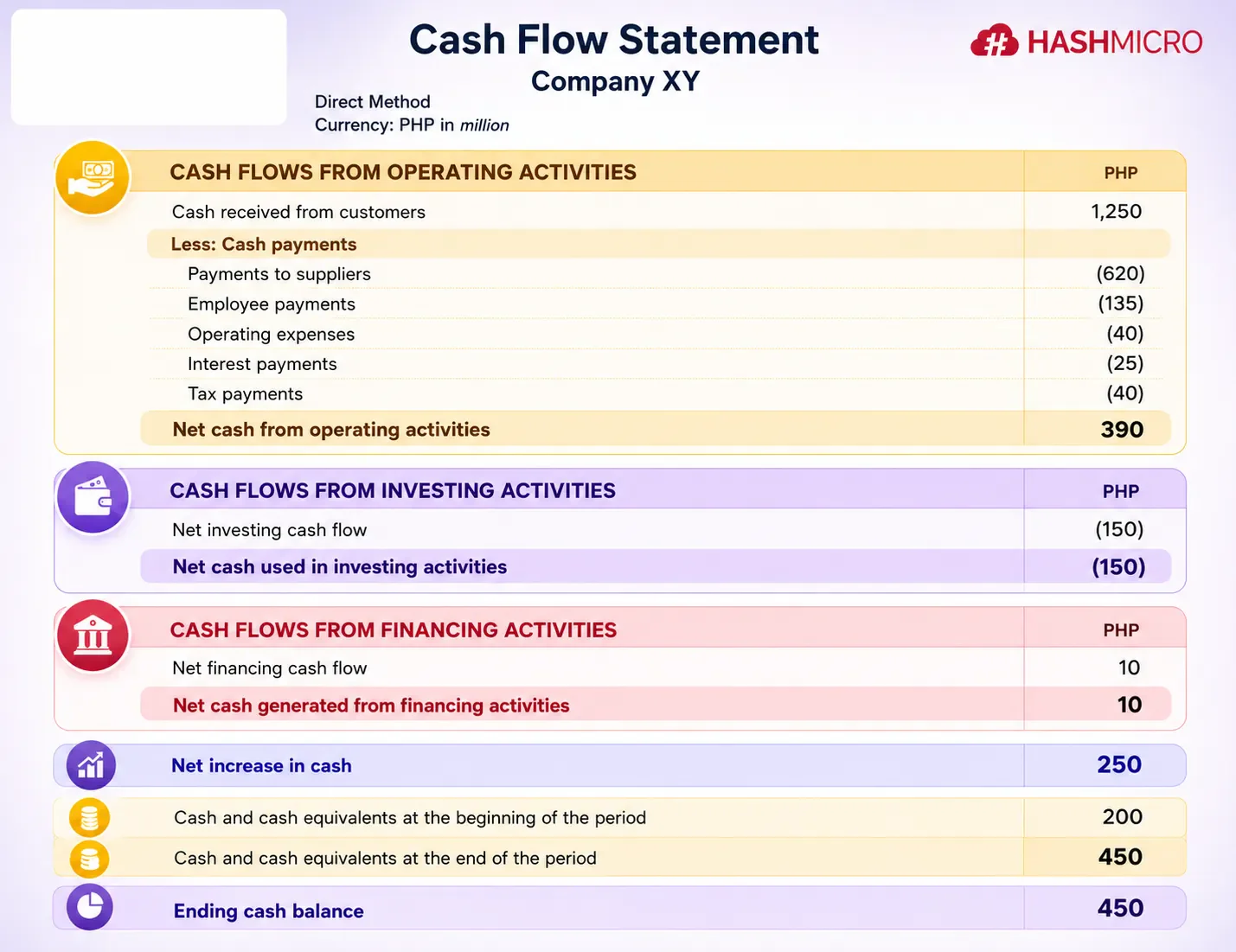
In this example, Company XY receives PHP 1,250 million from customers and pays PHP 860 million for suppliers, employees, operating expenses, interest, and taxes. This leaves PHP 390 million in operating cash flow.
After investing and financing activities, cash increases by PHP 250 million. The ending balance is therefore PHP 450 million.
Preparing cash flow statements consistently becomes more difficult when receipts, payments, journal entries, and bank records are stored in separate files. HashMicro Accounting Software connects transaction records with financial reporting in one system. Finance teams can prepare up-to-date cash flow statements, monitor cash movements, and reduce repetitive manual reconciliation.

How to Interpret Positive and Negative Cash Flow
| Aspect | Positive Cash Flow | Negative Cash Flow |
|---|---|---|
| Cash movement | Inflows exceed outflows | Outflows exceed inflows |
| Possible cause | Strong operations, asset sales, or new funding | Expansion, weak collections, or rising expenses |
| Interpretation | Usually supports liquidity and growth | Acceptable temporarily, but recurring deficits need attention |
| Recommended action | Review the source and plan the surplus | Improve collections, control costs, and monitor reserves |
Positive cash flow is one of the key indicators of effective cash flow management because it occurs when cash inflows exceed cash outflows during a reporting period. While Negative cash flow occurs when a company spends more cash than it receives.
Positive cash flow generally indicates that the business has sufficient liquidity to meet obligations, maintain operations, and fund growth. However, the source of the cash should still be reviewed because a positive balance caused mainly by new loans is different from cash generated through daily operations.
Negative cash flow is not always a sign of poor performance. It may occur temporarily when a company purchases equipment, expands its facilities, builds inventory, or makes other investments expected to support future growth. However, repeated negative operating cash flow requires closer attention.
Common Issues with Cash Flow Statement Formats
Creating an accurate and standardized cash flow statement can present several challenges. Here are some common issues companies may encounter with cash flow statement formats:
- Inconsistent classification of activities: One of the most common issues is the improper classification of cash flows. Cash flows from operating, investing, and financing activities must be clearly distinguished. However, sometimes companies incorrectly categorize transactions, which can distort the accuracy of the statement.
- Failure to adjust for non-cash items: Cash flow statements need to exclude non-cash transactions, such as depreciation or changes in the value of assets. Some companies fail to make these necessary adjustments, leading to misleading figures. This can result in an inaccurate representation of the company’s actual cash position, as these non-cash items affect net income but not the cash flow.
- Lack of transparency in financing activities: In some cases, companies may fail to provide enough detail in the financing activities section, such as distinguishing between long-term and short-term debt or properly identifying the sources of funds. Without clear transparency, stakeholders may find it difficult to understand the company’s capital structure and its approach to managing debt and equity.
- Overlooking changes in working capital: Changes in working capital, such as accounts receivable and payable, should be reflected in the operating activities section. Omitting these adjustments can mask liquidity issues and give a false impression of operational efficiency.
- Inaccurate representation of cash flow from investing activities: Failing to properly account for cash flows related to investments, such as asset purchases or sales, can lead to an incomplete or misleading view of the company’s investment strategy and cash position.
Simplify Your Company’s Cash Flow Statement with HashMicro’s Software

Managing and analyzing cash flow statements can be a complex task for many businesses. HashMicro’s advanced software solutions simplify this process by providing a comprehensive platform that automates and streamlines financial reporting. With features such as:
- Cash flow reports: This feature is directly related to the creation of cash flow statements, making it an ideal example. It enables companies to generate comprehensive and accurate cash flow reports, monitor cash inflows and outflows, and gain a complete overview of their financial position.
- Bank auto reconciliation: This feature ensures that recorded cash flow data is accurate and up-to-date. With auto reconciliation, companies can automatically match bank transactions with internal records, supporting the validity of cash flow statements. It demonstrates how efficient reconciliation processes keep cash flow records current.
- Profit & loss vs budget & forecast: This feature compares profit and loss statements with budgets and forecasts, which is useful for understanding how well financial planning aligns with actual cash flow. It supports cash flow statement examples by highlighting how budget accuracy impacts overall cash positioning.
- Forecast budget: This feature is relevant because it enables companies to create a cash flow projection of future cash needs, aiding strategic cash flow planning. It serves as an example of how businesses can anticipate cash inflows and outflows to maintain financial stability.
- Financial statement with budget comparison: This feature provides direct comparisons between actual financial statements and proposed budgets, offering insights into how well the company maintains its cash flow in line with financial plans. It demonstrates key elements of a cash flow statement in the context of budget realization.
Conclusion
Creating and managing accurate cash flow statements is essential for businesses in the Philippines to understand their financial health and ensure long-term sustainability.
A well-organized cash flow statement helps business owners and stakeholders track cash movements, manage liquidity, and make data-driven financial decisions.
By leveraging a powerful solution like HashMicro software, businesses can significantly simplify and improve their cash flow management processes. With its robust features, including automated reporting, real-time analytics, and seamless integrations, HashMicro empowers businesses to optimize their financial operations and gain clearer financial insights.
You can take a free consultation today to experience first-hand how HashMicro can simplify your financial management and improve your business strategy.

FAQ About Cash Flow Statement Example
A healthy cash flow statement generally shows consistent positive cash flow from operating activities, enough cash to cover short-term obligations, and an ending balance that supports upcoming expenses. The source and consistency of the cash are more important than a positive total from a single period.
Yes. A profitable business can have negative cash flow when revenue has been recorded but customers have not paid, inventory purchases are increasing, or the company is spending cash on equipment, debt repayments, or expansion.
No. Temporary negative cash flow may result from planned investments or seasonal business activity. It becomes more concerning when operating cash flow remains negative repeatedly without sufficient reserves or a realistic recovery plan.
The direct method is generally easier for monitoring daily receipts and payments, while the indirect method connects net income with operating cash flow. Small businesses should choose the method that matches their accounting records and reporting needs.
Most businesses should prepare a cash flow statement at least monthly. Businesses with limited reserves, seasonal sales, or rapidly changing expenses may need weekly cash flow monitoring, while quarterly and annual statements support formal reporting.