







 Limited to 100 registrants

When invoices, bank reconciliations, and financial reports begin taking too much time, the right accounting platform can make daily financial management easier. However, choosing one requires more than recognising a popular name.
Xero accounting is one of Australia’s most widely used cloud accounting platforms among small businesses, sole traders, accountants, and bookkeepers. It brings essential accounting tasks into one system, but its suitability depends on your business size, workflows, and plans for growth.
This review examines Xero’s features, pricing, advantages, and limitations to help you understand what to expect and when a broader business solution may be a better fit.
Key Takeaways
Xero is a cloud-based accounting software that helps small businesses manage invoices, reconciliation, and reporting from any device.
Xero covers the daily finance tasks most small businesses need, from invoicing and payroll to compliance and reporting.
Xero has built a strong reputation in the Australian market, delivering consistent value for small businesses and their accountants.
For many businesses, the need shifts from accounting software to something more connected when finance can no longer sit separately from operations.

What Is Xero Accounting Software?
Xero is a cloud-based accounting software that helps small businesses and sole traders manage invoices, bank reconciliation, expenses, and financial reporting from any device.
It is well suited to the Australian market, with built-in support for GST tracking, BAS lodgement, and Single Touch Payroll, which are three of the most common compliance obligations local businesses deal with regularly.
That said, Xero is accounting software first. It is not designed to manage warehouses, production workflows, or complex operational processes without additional tools or integrations.
Key Features of Xero Accounting
Xero covers the daily finance tasks most small businesses need, from invoicing and payroll to compliance and reporting. Here is a quick look at what each feature offers.
- Online invoicing and quotes: Create invoices, convert quotes, and track payment status in real time, though complex approval flows may need add-ons.
- Bank reconciliation and feeds: Connects to live bank feeds and auto-matches transactions, reducing manual data entry for small teams.
- GST, BAS, and STP compliance: Tracks GST automatically, generates BAS reports, and handles Single Touch Payroll reporting in one place.
- Payroll management: Covers pay runs, leave, and superannuation, with payroll capped at two employees on Grow, five on Comprehensive, and ten on Ultimate.
- Inventory tracking: Tracks stock levels from bills and purchase orders, suitable for simple product businesses but not for multi-warehouse or batch tracking needs.
- Project tracking and time billing: Logs time, expenses, and job profitability for small service teams, though resource scheduling and contract management are not included.
- Multi-currency support: Available on Comprehensive and Ultimate plans for foreign currency invoicing, but does not cover landed costs or overseas purchasing workflows.
- App integrations and ecosystem: Over 1,000 integrations available, though each additional app adds cost and upkeep to consider.
Pros of Xero Accounting Software
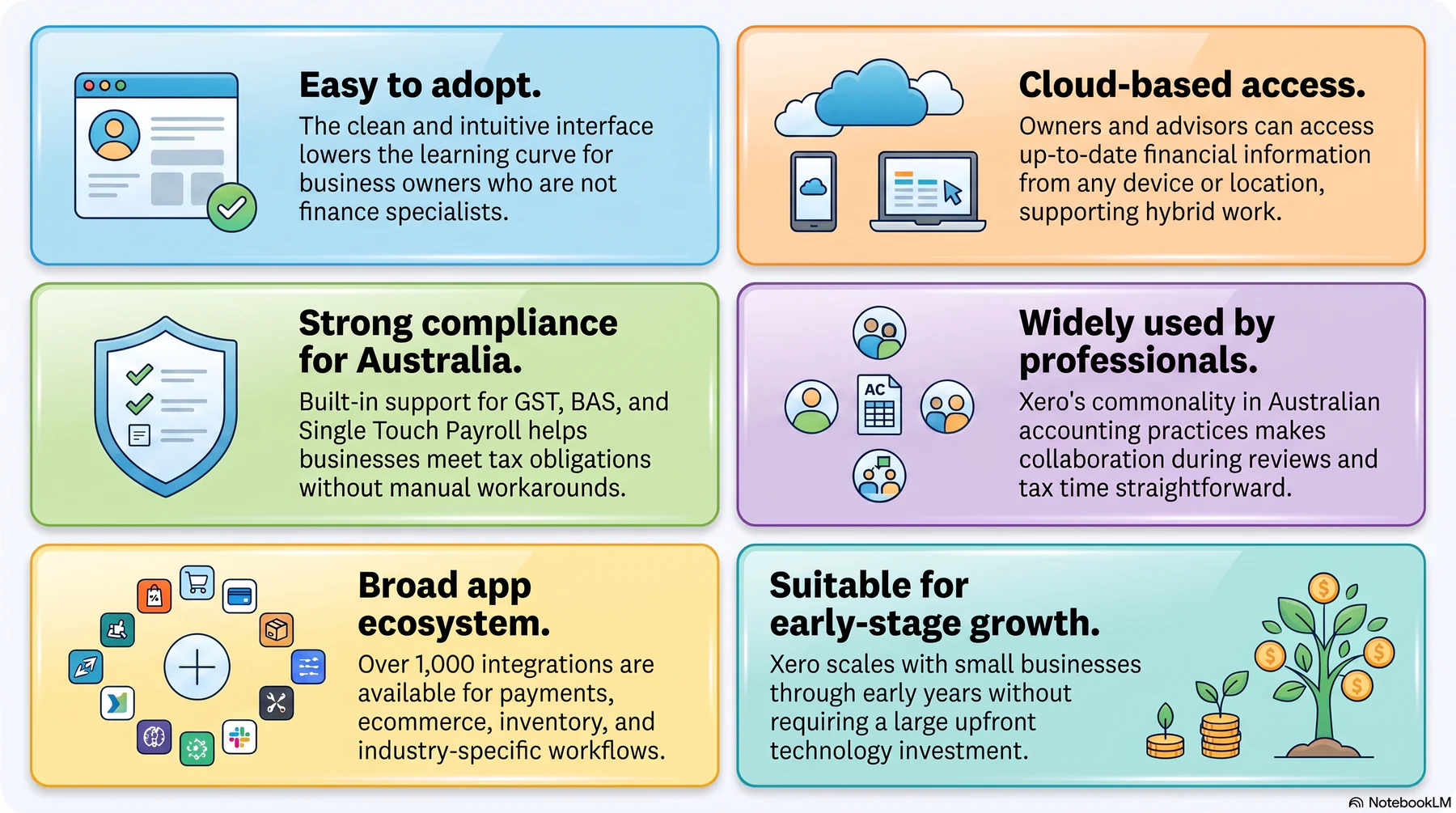
Xero has built a strong reputation in the Australian market for good reason. There are several areas where it consistently delivers value for small businesses and the accountants who support them.
- Easy to adopt. The interface is clean and intuitive, which lowers the learning curve for business owners who are not finance specialists. Most users can navigate core tasks without extensive training.
- Strong compliance coverage for Australia. Built-in support for GST, BAS, and Single Touch Payroll means Australian businesses can meet their tax obligations without relying on separate tools or manual workarounds.
- Widely used by accountants and bookkeepers. Because Xero is so common in Australian accounting practices, collaboration during setup, month-end reviews, and tax time is generally straightforward.
- Broad app ecosystem. With over 1,000 integrations available, businesses can extend Xero's functionality across payments, ecommerce, inventory, reporting, and industry-specific workflows.
- Cloud-based access. Business owners, finance staff, and external advisors can access up-to-date financial information from different devices and locations, which suits hybrid and remote working arrangements.
- Suitable for early-stage growth. Xero can scale with a small business through its early years without requiring a large technology investment upfront.
"Xero handles the accounting side well, but once finance starts depending on what is happening in your warehouse, your projects, or your supply chain, you need a system that connects all of that in one place."
Cons of Xero Accounting Software

Like any software, Xero involves trade-offs. Understanding these before committing to a plan helps businesses make a more informed decision about whether it fits their current and future needs.
- Payroll is limited by plan. The number of employees covered by payroll depends on the plan tier. Businesses with growing headcounts may find these limits restrictive and should factor in the cost of additional payroll capacity.
- Inventory tools are basic. The built-in inventory features work for simple stock management, but they are not designed for multi-location warehousing, serial or batch tracking, demand forecasting, or advanced procurement workflows.
- Project tracking covers finance only. Xero Projects is useful for profitability reporting, but it does not support resource planning, contract management, milestone approvals, or complex delivery workflows.
- Add-on dependency for operational needs. Businesses that need capabilities beyond core accounting often end up relying on multiple third-party apps, which adds cost and integration complexity over time.
- Pricing will increase from July 2026. Xero has announced a price increase for Australian plans effective 1 July 2026. Businesses currently on older pricing should verify updated costs before renewing or signing up.
- Not a full ERP system. Xero is designed as accounting software, which means it does not natively connect finance with inventory, procurement, manufacturing, HR, or CRM in the way a full ERP platform would.
Xero Accounting Pricing in Australia
Xero offers four plan tiers for Australian businesses, each suited to a different stage of growth. Prices are in AUD including GST, and a price increase is confirmed from 1 July 2026.
Figures above reflect Xero AU pricing as of June 2026. Visit Xero's official Australian pricing page to confirm current rates before subscribing.
Who Should Use Xero Accounting?
Xero fits a range of business types, though the right match depends on how complex your finance and operational needs are.
- Freelancers and sole traders: Good for managing invoices, expenses, GST, and BAS, especially when working alongside an accountant.
- Small retail and ecommerce businesses: Handles sales, reconciliation, GST, and basic stock, with integrations for Shopify and Stripe.
- Tradies and contractors: Covers quotes, invoices, expenses, and payroll for small crews on straightforward jobs.
- Consultants and professional services: Xero Projects suits small teams that need time tracking and job profitability reporting.
- Businesses that may need more than Xero: Manufacturers, distributors, and multi-branch businesses may find accounting software alone leaves gaps when operational data needs to connect with finance.
HashMicro as an Alternative When Xero Is No Longer Enough
For many businesses, the point where Xero starts to feel stretched is not about the accounting features themselves. It is when finance can no longer sit separately from the rest of the business.
Once inventory accuracy affects cost reporting, or procurement delays show up in project margins, the need shifts from accounting software to something more connected.
HashMicro is an ERP platform built for businesses at that stage. It connects finance with inventory, procurement, sales, manufacturing, HR, CRM, and project management in one system.
For businesses where operational and financial data need to move together, that kind of integration reduces the gaps that tend to appear when separate tools are stitched together.
If your business has outgrown standalone accounting, explore what a connected ERP system can offer at HashMicro Accounting Software.
Conclusion
Xero remains a solid choice for small Australian businesses that need cloud-based accounting without the complexity of a full ERP system. It covers invoicing, reconciliation, GST, BAS, payroll, and reporting well enough for most small teams to get started and stay organised.
That said, as your business grows and finance starts connecting with inventory, procurement, or project operations, it may be worth looking at what else is available. If you are at that stage, book a free consultation to see how HashMicro can support your next step.
FAQ
Yes. Xero is a strong option for small Australian businesses that need cloud invoicing, bank reconciliation, GST tracking, BAS support, payroll, and app integrations. It is less suitable for businesses that need deep inventory control, manufacturing workflows, or full ERP functionality.
The main trade-offs include plan-based payroll limits, basic inventory tools, project tracking that covers finance only, and a growing reliance on third-party add-ons for operational needs. It is also not designed to replace a full ERP system.
As of June 2026, Xero Australia offers four plans: Ignite at AUD $35/month, Grow at AUD $75/month, Comprehensive at AUD $100/month, and Ultimate from AUD $130/month. All prices include GST. A price increase is confirmed from 1 July 2026, so check Xero's official pricing page before subscribing.
Yes. Xero supports Australian payroll including pay runs, leave management, superannuation, and Single Touch Payroll reporting. Payroll is included within plan limits, so businesses with larger teams should check the employee caps on each plan before subscribing.
No. Xero is accounting software, not a full ERP system. It handles finance administration well but does not natively connect with inventory, procurement, manufacturing, HR, or CRM in the way a full ERP platform would.