




Procurement teams are under more pressure than ever. Rising supplier costs, tighter compliance requirements, and growing volumes of spend data have made manual processes genuinely unsustainable.
AI in procurement offers a practical way to handle that complexity. It moves teams away from reactive purchasing and towards a more strategic role in the business.
This guide covers what AI in procurement involves, the benefits it delivers, where it is being applied right now, and how teams can implement it without disrupting existing operations.
Key Takeaways
AI in procurement uses machine learning, natural language processing, and predictive analytics to automate purchasing processes and surface insights that manual methods cannot match.
AI delivers measurable gains across automation, spend optimisation, data-driven decision making, and continuous compliance monitoring across the full procurement function.
The highest-impact applications include spend analysis, supplier evaluation, contract management, and procure-to-pay automation, all of which reduce manual workload and improve accuracy.
Successful implementation starts with identifying high-impact use cases, ensuring data readiness, and running a structured pilot before scaling across the source-to-pay process.

What Is AI in Procurement?
AI in procurement refers to the use of artificial intelligence technologies, including machine learning, natural language processing, and predictive analytics, to automate and improve procurement processes. An AI-powered purchasing system goes beyond rule-based automation by learning from data and improving its recommendations over time.
It covers everything from spend analysis and supplier evaluation to contract review and purchase order automation.
The key distinction from traditional software is that AI systems learn from data over time. Rather than following fixed rules, they identify patterns, surface insights, and make recommendations based on what the data shows. For procurement teams, that means less time on manual analysis and more time on decisions that require human judgement.
Why AI Is Transforming Procurement
"AI does not replace procurement professionals. It removes the data burden that stops them from doing their best work."
Procurement has always been data-heavy. What has changed is the volume, speed, and complexity of that data, which makes traditional methods increasingly difficult to manage at scale.
AI addresses that gap by processing large datasets quickly and translating them into actionable insights. Several factors are driving adoption across businesses of all sizes.
Growing data complexity
Most procurement teams deal with data from multiple systems, including ERP platforms, supplier portals, contract databases, and purchasing tools. Consolidating all that data manually takes significant time and still produces incomplete results.
AI tools connect those data sources, identify patterns across thousands of transactions, and flag anomalies that would otherwise go unnoticed. The result is a more accurate view of spend, supplier performance, and risk exposure.
Need for cost control and efficiency
Procurement is one of the largest areas of controllable spend for most businesses. Therefore, even small improvements in purchasing efficiency translate into meaningful savings at scale.
AI reduces the manual workload involved in tasks like purchase order processing, invoice matching, and supplier onboarding. Software for procurement efficiency frees procurement staff to focus on negotiation, strategy, and supplier relationships where human input genuinely adds value.
Shift to strategic procurement
Businesses increasingly expect their procurement functions to contribute to broader goals, such as sustainability targets, supply chain resilience, and risk mitigation. That requires more than transactional efficiency.
AI supports that shift by taking over the repetitive, data-intensive tasks that previously consumed most of a procurement team’s time. With those tasks automated, procurement professionals can focus on work that directly affects business outcomes.
Key Benefits of AI in Procurement
Businesses that have implemented AI tools consistently report improvements across efficiency, cost control, decision quality, and compliance. The following areas are where the impact is most consistently felt.
Automation and efficiency gains
AI automates the repetitive tasks that consume the most time in procurement operations. Purchase order creation, invoice matching, three-way matching, and supplier communication can all be handled automatically once the system is configured.
For example, AI-powered tools match invoices to purchase orders and goods receipts without human intervention, flagging only the exceptions that require review. That alone can significantly reduce processing time and cut error rates across accounts payable.
Cost reduction and spend optimisation
Spend analysis tools powered by machine learning categorise transactions automatically, identify maverick spend, and surface consolidation opportunities across supplier relationships.
Beyond analysis, AI supports negotiation by benchmarking supplier pricing against market data and flagging contracts due for renegotiation. Over time, that drives more disciplined purchasing behaviour across the business.
Data-driven decision making
Predictive analytics tools can forecast demand, anticipate price movements, and model the impact of supply chain disruptions before they occur.
That gives procurement teams more lead time to respond and better information to work with when they do. AI adds a third layer to decision-making that goes beyond what any team could review manually.
Risk management and compliance
AI tools monitor supplier financial health, news coverage, regulatory status, and delivery performance continuously, rather than only at scheduled review points.
On the compliance side, AI flags purchase transactions that fall outside policy, identifies approval workflow gaps, and ensures contract terms are being followed. That level of continuous monitoring is effectively impossible to achieve manually at scale.
Core Use Cases of AI in Procurement
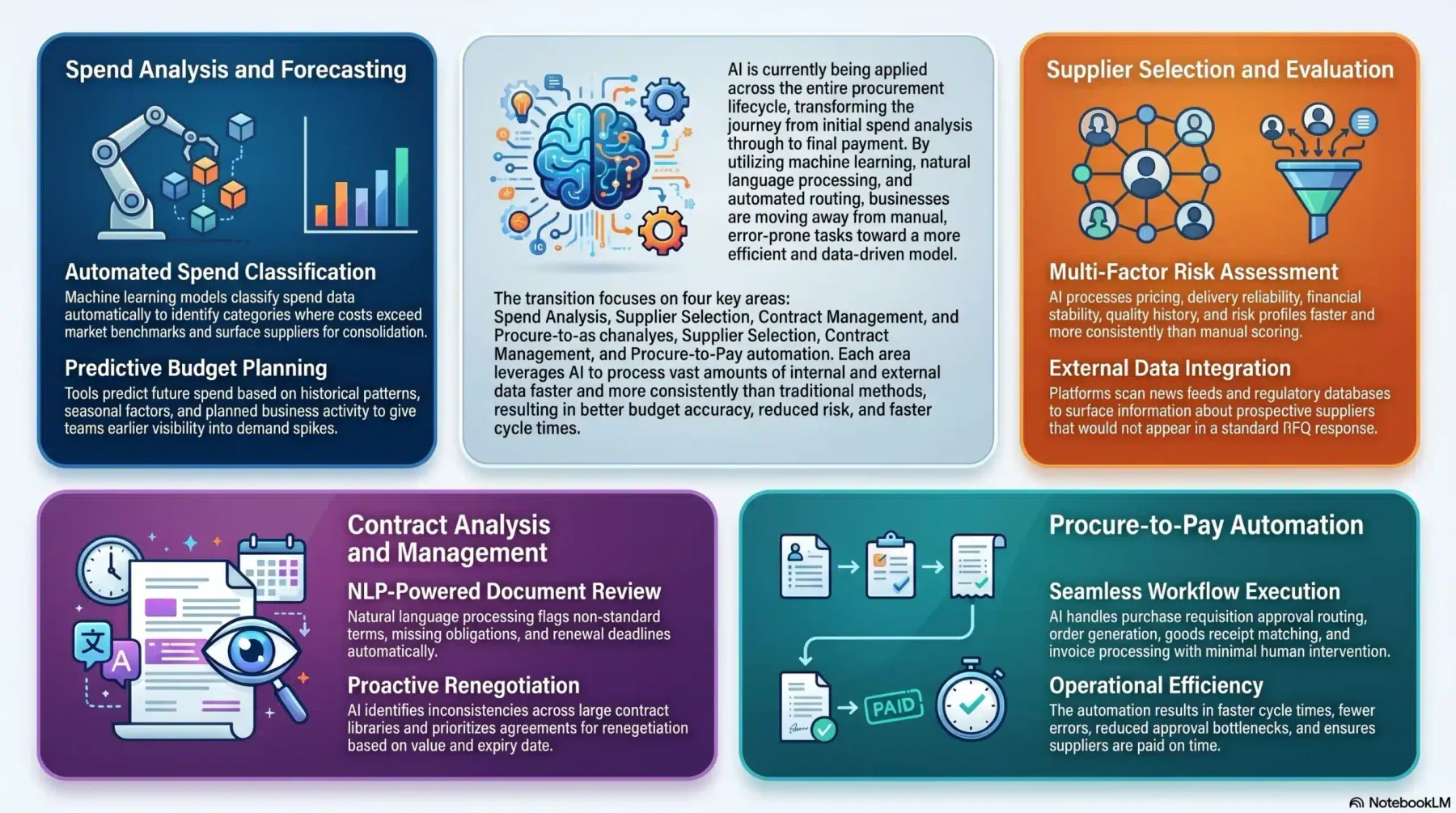
AI is being applied across the full procurement lifecycle, from spend analysis through to payment. The following use cases represent the areas where businesses are seeing the most consistent results.
1. Spend analysis and forecasting
Machine learning models classify spend data automatically, identify categories where costs exceed market benchmarks, and surface suppliers where consolidation would reduce unit costs.
Forecasting tools extend that by predicting future spend based on historical patterns, seasonal factors, and planned business activity. That makes budget planning more accurate and gives procurement teams earlier visibility into demand spikes.
2. Supplier selection and evaluation
Selecting the right supplier involves weighing up pricing, delivery reliability, financial stability, quality history, and risk profile. AI processes that information faster and more consistently than manual scoring methods.
Some platforms also scan external data sources, such as news feeds and regulatory databases, to surface information about prospective suppliers that would not appear in a standard RFQ response.
3. Contract analysis and management
AI-powered contract analysis tools use natural language processing to read contract documents, flagging non-standard terms, missing obligations, and renewal deadlines automatically.
For businesses managing large contract libraries, AI can also identify inconsistencies across agreements and prioritise contracts for renegotiation based on value and expiry date. That turns contract management from a reactive task into a proactive one.
4. Procure-to-pay automation
AI can handle purchase requisition approval routing, purchase order generation, goods receipt matching, and invoice processing with minimal human intervention. Automating order approval workflows is one of the fastest ways to reduce cycle times and cut errors across the full procure-to-pay process.
The practical benefit is faster cycle times and fewer errors across the entire process. Suppliers get paid on time, approval bottlenecks are reduced, and procurement staff spend less time chasing paperwork.
AI in Supplier Management
The volume of data involved in monitoring supplier performance, assessing risk, and detecting irregularities makes manual approaches difficult to sustain at scale. AI addresses all three areas consistently.
Supplier risk monitoring
Traditional supplier risk reviews happen at set intervals, which means issues can develop and go undetected between cycles. AI changes that by monitoring supplier risk continuously across multiple data sources.
Risk monitoring tools track supplier financial performance, credit ratings, regulatory compliance status, and news coverage in real time. Centralised supplier oversight through AI ensures that when a risk signal appears, the system alerts the relevant team members immediately rather than waiting for the next scheduled review.
Performance evaluation
AI automates performance evaluation by pulling data directly from ERP systems, logistics platforms, and quality management tools, rather than requiring manual data collection.
Performance dashboards give procurement teams an up-to-date view of delivery reliability, quality rates, and responsiveness for every supplier. That makes supplier review conversations more informed and objective.
Fraud detection
Machine learning models detect fraud by identifying patterns across thousands of transactions that would be invisible to a human reviewer. That includes duplicate invoice submissions, unusual payment patterns, and vendor relationships outside normal procurement activity.
The result is a targeted list of transactions for internal audit teams to investigate, rather than a full manual review of everything.
Challenges of AI in Procurement
Businesses that go in without addressing the following challenges often find that their AI tools underperform or create new problems alongside the ones they were meant to solve.
Data quality and integration
Procurement data is frequently spread across multiple systems in inconsistent formats, with gaps, duplicates, and classification errors that undermine the accuracy of AI-generated insights.
Before deploying any AI tool, procurement teams need to assess data quality and address the most significant issues. That typically involves standardising supplier master data, cleaning historical transaction records, and establishing consistent coding practices across the business.
Change management
Introducing AI into procurement workflows changes how people work. Some tasks are automated, new tools require learning, and the role of procurement staff shifts towards oversight and exception handling.
Without clear communication, targeted training, and leadership that reinforces the value of the change, adoption tends to be slow and inconsistent. Change management is as important as the technical implementation itself.
Governance and compliance risks
AI tools make recommendations and, in some cases, take actions autonomously. That creates a governance question about accountability and how procurement leaders can ensure AI-driven decisions comply with policy and regulatory requirements.
Businesses need to define which decisions require human approval, set up audit trails for AI-generated actions, and review AI outputs regularly to ensure alignment with compliance obligations.
Best Practices for AI Adoption

Successful AI adoption in procurement is less about selecting the right technology and more about preparing the business to use it effectively. The following practices consistently separate implementations that deliver results from those that stall early.
Start with high-impact use cases
Identify the two or three areas where AI will deliver the clearest and fastest return, such as invoice processing, spend analysis, or supplier risk monitoring, and focus the initial implementation there.
Starting with high-impact use cases builds confidence in the technology, generates measurable results, and gives the team practical experience before moving to more complex applications.
Ensure data readiness
Data readiness is a prerequisite, not a nice-to-have. Procurement teams that skip this step consistently find that their AI tools produce unreliable outputs, which erodes trust and slows adoption.
Assess data quality early, prioritise the data sets the initial use cases depend on, and put governance processes in place to keep data clean as the system scales.
Align teams and processes
AI tools connect with existing systems, depend on accurate data inputs, and produce outputs that procurement staff need to act on. Optimising purchasing procedures requires the people and processes around the technology to be aligned with how the AI tools function, not just the technology itself.
That means involving procurement staff in the design of AI workflows, updating process documentation, and establishing clear escalation paths for exceptions the AI cannot handle.
How to Implement AI in Procurement
The path from proof of concept to full deployment is longer and more complex than most teams anticipate. The following approach reflects how successful implementations are typically structured.
1. Identify opportunities across source-to-pay
Start by mapping your current source-to-pay process and identifying where the greatest inefficiencies, risks, and costs sit. That assessment gives you a prioritised list of AI opportunities grounded in real operational data.
Common findings include slow invoice processing, inconsistent supplier performance data, manual contract tracking, and reactive spend reporting. Each represents a concrete AI opportunity with a measurable baseline.
2. Integrate with existing systems
AI tools in procurement need to connect with your existing ERP, finance, and supplier management systems to function effectively. Evaluate integration requirements early and involve your IT team in vendor selection.
Platforms with pre-built connectors to your existing systems will typically deliver faster time to value than those requiring custom development. Confirm that the AI tool can read and write data in the formats your current systems use.
3. Pilot and scale gradually
Run a structured pilot before committing to full deployment. Select a specific use case, define success metrics upfront, and set a clear timeline for evaluating results.
Once the pilot delivers expected results, scale deliberately. Add use cases in order of priority, allow the team to build confidence at each stage, and review AI outputs regularly as the system handles more volume.
Future of AI in Procurement
The role of AI in procurement will continue to expand as the technology matures and businesses build the data infrastructure needed to support more sophisticated applications.
Predictive and autonomous procurement
Over the coming years, AI will move further towards autonomous decision-making, where routine purchasing decisions are executed automatically based on pre-approved parameters.
That means purchase orders generated without human input, supplier selections based on real-time performance data, and contract renewals triggered automatically when conditions are met. The procurement professional’s role shifts towards setting parameters and reviewing exceptions.
AI as a strategic business partner
As AI takes over more of the transactional workload, procurement teams will have the capacity to focus on supplier development, supply chain resilience planning, sustainability sourcing, and commercial negotiation.
AI will support that work by providing better market intelligence, more accurate risk assessment, and faster scenario modelling. The businesses that build AI capability in procurement now will be better positioned to use it as a genuine strategic asset.
Conclusion
AI in procurement removes the guesswork from purchasing, giving teams the data, automation, and visibility they need to control costs and manage supplier risk at scale. The businesses that implement it now are building a structural advantage that manual processes simply cannot match.
The question is not whether AI belongs in procurement, but where to start. Schedule a free consultation with our team and find out which use cases will deliver the fastest return for your operation.
Frequently Asked Question
AI in procurement refers to the use of machine learning, natural language processing, and predictive analytics to automate and improve procurement processes. It covers spend analysis, supplier evaluation, contract review, and purchase order automation, helping teams make faster and more accurate decisions.
AI reduces procurement costs by identifying maverick spend, flagging overpriced supplier contracts, and surfacing consolidation opportunities across vendor relationships. Spend analysis tools categorise transactions automatically and benchmark pricing against market data, giving teams clear visibility into where savings are available.
AI can automate purchase order creation, invoice matching, three-way matching, supplier onboarding, and contract renewal alerts. It also handles approval routing, goods receipt matching, and fraud detection, reducing the manual workload across the full procure-to-pay process.
The three most common challenges are data quality, change management, and governance. AI systems rely on clean and consistent data to produce reliable outputs. Without clear governance frameworks and proper team training, even well-configured AI tools can underperform or create new compliance risks.
Implementation timelines vary depending on the complexity of your systems and the use cases you prioritise. A focused pilot on a single use case such as invoice automation or spend analysis can typically be up and running within a few months. Broader deployments across the full source-to-pay process depend heavily on data readiness and system integration.