




Businesses often treat assets as static items on a balance sheet instead of resources that change over time. This creates “ghost assets”, where equipment still appears in records even though it is missing, damaged, or no longer usable.
A recent study by Kroll found that around 10%-30% of assets listed are ghost assets. Asset Lifecycle Management (ALM) helps businesses reduce these inefficiencies through better visibility and control.
This guide explains how ALM works, including its stages, management approaches, and the impact it has on operational performance.
Key Takeaways
ALM is a strategic process that optimizes the profit generated by assets throughout their entire life, from planning to disposal.
The 5 Key Stages of Asset Lifecycle Management involve planning, deployment, operation, maintenance, and eventual renewal to ensure maximum efficiency.
Benefits of Asset Lifecycle Management include significant cost reductions, improved regulatory compliance, and enhanced operational reliability.
Asset Lifecycle Management Best Practices focus on data-driven decision-making, automation, and cross-departmental collaboration.

What Is Asset Lifecycle Management?

ALM is the process of maximising asset value throughout the entire lifecycle. Instead of focusing only on tracking, ALM helps businesses plan, monitor, maintain, and optimise assets more effectively.
Many businesses now treat ALM as a long-term operational strategy rather than a maintenance function alone. As our Senior Product Manager, Kaia Lockwood, explained,
"Every company in this modern age is extracting every bit of value they could from their assets to win in today's competitive market."
While tracking answers where an asset is located, ALM focuses on how the asset performs, when maintenance is needed, and when replacement becomes more cost-effective. The goal is to maximise value while controlling operational risk and cost.
At its core, ALM balances performance, cost, and risk using continuous operational data instead of assumptions. It combines policies, workflows, and technology to support better asset-related decisions across the business.
ALM also creates a continuous feedback loop. Data collected during operations helps businesses improve future purchasing and planning decisions. If certain equipment repeatedly underperforms, that information influences future procurement choices.
Using the top software for managing asset, many companies improve operational visibility and identify weaknesses earlier. This allows businesses to strengthen efficiency and make better long-term decisions.
Types of Assets Covered by ALM
The scope of Asset Lifecycle Management is broad because businesses manage many different asset categories. Each type requires different strategies, depreciation methods, and condition-based maintenance approaches.
- IT Assets (Hardware and Software)
IT assets are among the fastest-changing asset categories. They include hardware such as servers, laptops, networking devices, and mobile equipment, along with software licences, cloud subscriptions, and digital intellectual property.
Managing IT assets requires close attention to cybersecurity, software compliance, and rapid obsolescence. Unlike buildings or machinery, many IT assets become outdated within only a few years, requiring faster lifecycle planning.
- Fixed or Physical Assets
These are tangible assets used in day-to-day operations, including machinery, equipment, office furniture, land, and buildings. Management priorities often focus on preventive maintenance, location tracking, and depreciation reporting.
These assets usually have longer operational lifespans. In industries such as manufacturing or mining, asset reliability directly affects production performance and workplace safety.
- Infrastructure and Public Assets
Governments and utility providers manage assets such as roads, bridges, pipelines, and power networks. In these environments, ALM plays a major role in maintaining public safety and service continuity.
These assets often remain operational for decades, making maintenance and renewal highly resource-intensive. Long-term planning is critical to avoid major failures and compliance risks.
The 5 Key Stages of Asset Lifecycle Management
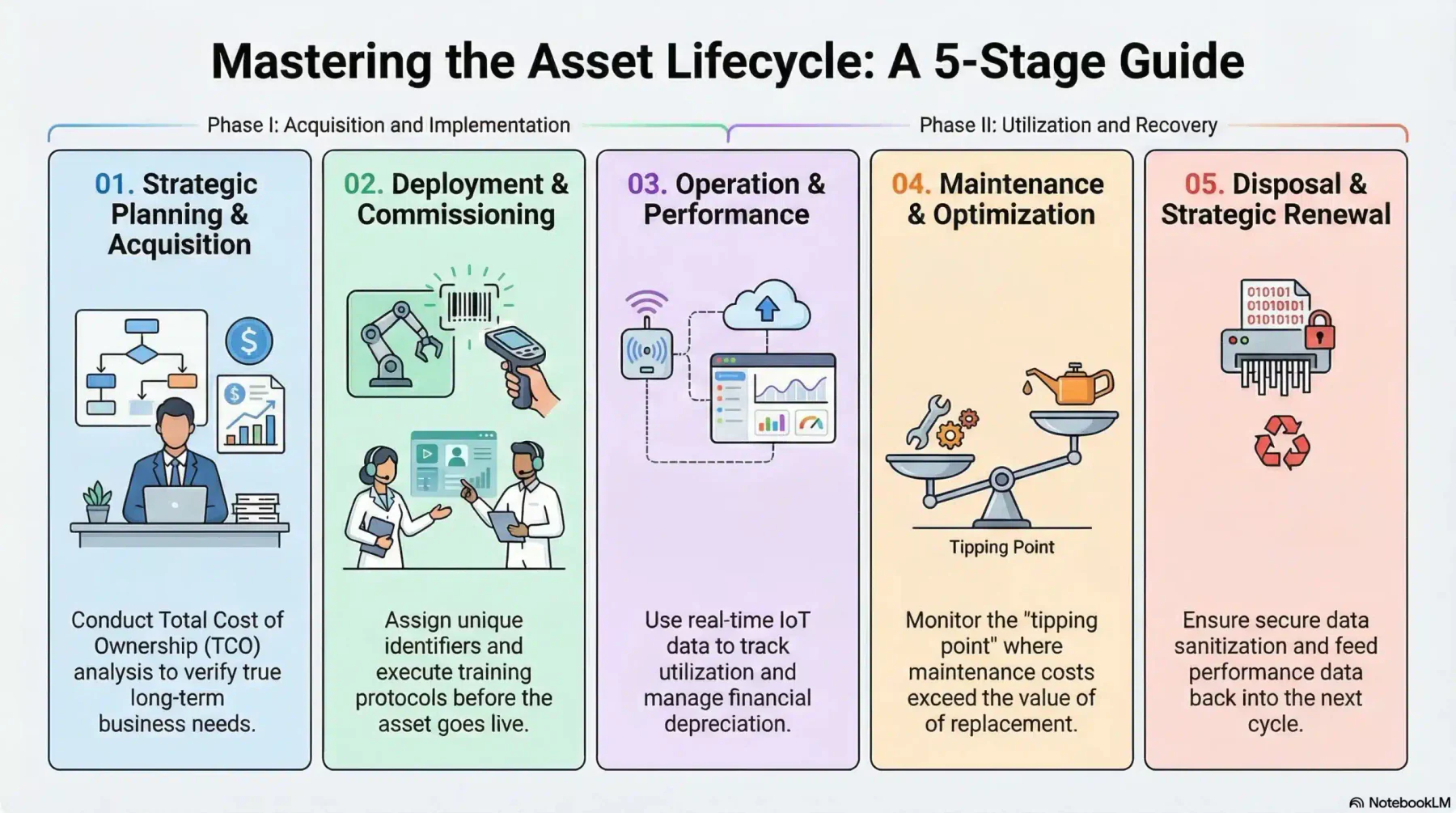
To manage assets effectively, businesses usually divide the lifecycle into several manageable stages. While the exact approach may differ between industries, most ALM frameworks follow five core phases that help reduce risk and improve long-term value.
1. Planning and Acquisition
The planning stage is often the most important because early mistakes can create long-term operational costs. Businesses first identify whether a new asset is truly needed or if existing assets can still be utilised more effectively.
Planning also includes reviewing specifications, operational requirements, installation costs, maintenance needs, and long-term ownership expenses. This helps businesses avoid assets that appear cheap initially but become expensive over time.
After planning, the acquisition phase covers procurement activities such as vendor evaluation, contract negotiation, financing, and SLA reviews. The goal is to secure assets that align with operational requirements, not just the lowest purchase price.
2. Deployment and Commissioning
Once acquired, the asset enters the deployment phase. This stage covers delivery, installation, configuration, and integration into existing operations.
Simple assets may be deployed immediately, while larger equipment or enterprise systems often require weeks of setup and testing. Proper training before go-live is also important to reduce operational mistakes and improve adoption.
Commissioning verifies that the asset performs according to operational and safety standards. During this stage, the asset is also formally recorded in the asset register using barcodes, QR codes, or RFID tags.
3. Operation and Utilization
This is typically the longest stage of the lifecycle, where assets are actively used to support operations. The main objective is to maximise utilisation while maintaining operational efficiency.
Effective company equipment management depends on utilisation tracking that shows how equipment performs and whether resources are being fully used. IoT sensors and operational monitoring tools also provide visibility into speed, output quality, and usage trends.
During this phase, businesses also monitor depreciation, compliance, and safety requirements. Overused assets may fail earlier than expected, while underused assets often indicate poor planning or inefficient allocation.
4. Maintenance and Optimization
Although no asset lasts forever, proper maintenance can significantly extend operational lifespan. This stage focuses heavily on controlling downtime and reducing maintenance-related costs.
Preventive maintenance uses scheduled servicing based on time or usage intervals. Predictive maintenance goes further by analysing operational data to identify potential failures before breakdowns occur.
Businesses also optimise assets by updating software, improving workflows, or reducing energy consumption. Over time, ALM helps identify the point where maintaining an ageing asset becomes less cost-effective than replacing it.
5. Disposal and Renewal
The final stage begins when an asset reaches the end of its useful life due to wear, outdated technology, or changing operational needs. Disposal involves more than simply discarding the asset.
For IT assets, data destruction and cybersecurity are critical. Industrial equipment may also require environmentally compliant disposal procedures for batteries, fluids, or electronic components.
Businesses may still recover value through resale, auctions, or spare-part recovery. Operational data collected throughout the lifecycle is then reused during future planning, helping businesses make smarter acquisition decisions in the next cycle.
The 5 P’s of Asset Management

While the lifecycle explains timing, the 5 P’s define the core elements needed to manage assets effectively.
1. Policy
Policy sets the direction for how assets should be managed across the business. It establishes objectives, governance standards, and decision-making guidelines for asset-related activities.
Clear policies help ensure decisions remain consistent across departments instead of depending on individual judgement alone.
2. Process
Processes are the documented workflows that guide activities throughout the asset lifecycle. This includes procurement procedures, maintenance requests, and disposal approvals.
Without structured processes, different departments may manage assets inconsistently, creating operational inefficiencies and poor visibility.
3. People
This principle focuses on defining accountability and responsibilities. Businesses need clear ownership over asset performance, maintenance, and operational monitoring.
It also includes workforce training and change management. Even strong ALM systems fail when teams ignore maintenance procedures or inaccurate data entry practices.
4. Product
This refers to the systems and tools used to manage asset data. In most businesses, this includes EAM platforms, ERP modules, or specialised asset management software.
These systems centralise data across finance, operations, and maintenance teams. They also improve visibility, automate workflows, and support faster decision-making.
5. Performance
Performance focuses on KPIs and continuous improvement. Metrics such as Mean Time Between Failures (MTBF), Overall Equipment Effectiveness (OEE), and TCO help businesses measure operational efficiency.
Performance analysis closes the loop by showing whether asset strategies deliver the expected business outcomes. It also helps businesses distinguish revenue-generating assets from resources that create costs without sufficient operational value.
Benefits of Asset Lifecycle Management
Adopting a structured ALM strategy requires investment in technology, processes, and organisational change. Businesses that move from reactive asset handling to proactive lifecycle management often use a maintenance management system to improve maintenance visibility, control, and efficiency.
- Significant Cost Reduction
Optimised maintenance schedules help businesses avoid expensive emergency repairs and unexpected equipment failures. Better planning also reduces over-purchasing and lowers spare parts inventory costs.
TCO analysis helps companies prioritise assets that deliver stronger long-term value instead of focusing only on upfront purchase prices.
- Improved Regulatory Compliance
Industries such as healthcare, aviation, and manufacturing operate under strict maintenance and safety regulations. ALM creates a clear digital audit trail across asset activities.
Documented maintenance and operational records simplify audits, reduce compliance risks, and support more consistent safety practices.
- Enhanced Operational Reliability
ALM encourages preventive and predictive maintenance instead of reactive repairs. This helps businesses keep equipment available and operational when needed.
Reliable assets improve production consistency, reduce downtime, and strengthen customer service performance across the supply chain.ompany.
Asset Lifecycle Management Best Practices
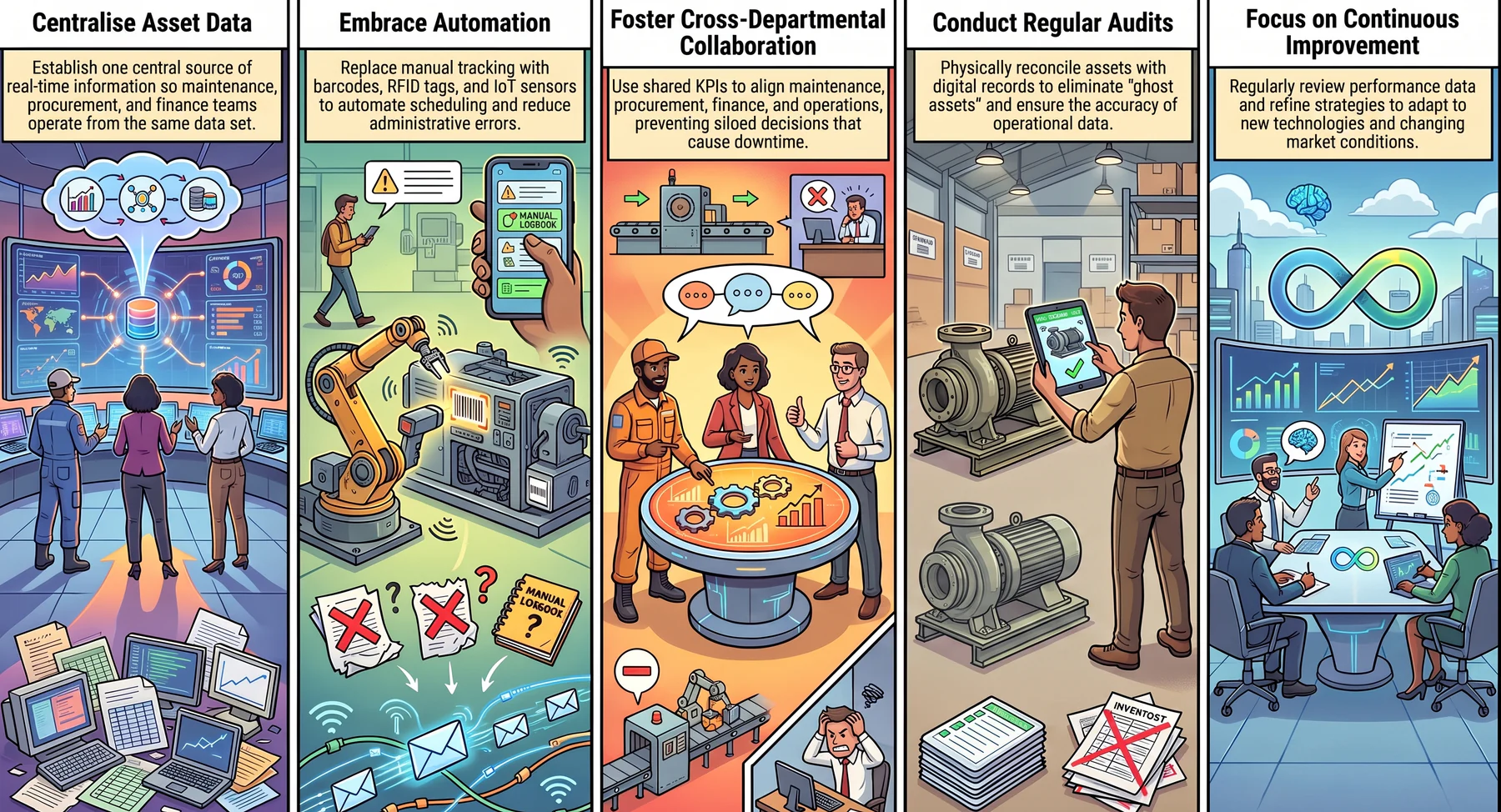
To implement ALM effectively, businesses should follow proven operational practices that improve visibility, control, and long-term asset performance. Many companies support these processes using intelligent asset software to centralise and automate asset management activities.
1. Centralise Asset Data
A strong ALM strategy relies on having one central source of asset information. This allows maintenance, procurement, and finance teams to work with the same real-time data across the business.
When maintenance teams report issues, procurement can immediately plan spare parts purchases while finance teams can monitor cost impacts more accurately.
2. Embrace Automation
Manual asset tracking is slow and highly prone to errors. Modern ALM systems use automation technologies to improve speed, visibility, and operational accuracy.
Barcodes, QR codes, RFID tags, and IoT sensors help automate tracking, maintenance scheduling, and work order creation. This reduces administrative work and allows teams to focus on operational improvement.
3. Foster Cross-Departmental Collaboration
ALM works best when departments collaborate using shared KPIs and aligned operational goals. Maintenance, procurement, finance, and operations teams all influence asset performance throughout the lifecycle.
Better communication helps businesses avoid siloed decisions that create unnecessary downtime, delays, or operational inefficiencies.
4. Conduct Regular Audits
Even with digital systems, physical asset conditions can change without proper updates. Assets may be relocated, damaged, or lost while records remain unchanged.
Regular audits help businesses reconcile physical assets with digital records. This reduces ghost assets and improves the accuracy of operational data used for decision-making.
5. Focus on Continuous Improvement
ALM is not a one-time implementation process. Businesses should continuously review performance data and refine strategies as technologies, operations, and market conditions change.
Ongoing improvement helps businesses strengthen efficiency, optimise maintenance activities, and improve long-term asset performance.
Asset data is most useful when early warnings trigger timely action. Hashy, HashMicro’s AI assistant, reads condition and usage patterns, flags failure risks, and prepares maintenance work before disruption, as shown below.






How Asset Platforms Support ALM in One of Australia’s Most Recognized Industries
Australia’s mining sector relies heavily on high-value equipment and large-scale operations across remote locations. According to the Australian Government, 432 major resource and energy projects were under development as of 31 October 2025. Asset platforms help mining businesses improve visibility and control across the asset lifecycle.
1. End-to-End Asset Visibility
Asset management platforms provide real-time visibility into equipment performance across remote mining operations. This helps teams identify inefficiencies earlier and improve asset utilisation throughout daily operations.
2. Predictive Maintenance Capabilities
By analysing operational data, asset platforms can detect early signs of equipment failure before breakdowns occur. This allows maintenance teams to schedule repairs more efficiently and reduce costly downtime.
3. Compliance and Cost Optimisation
Automated reporting supports regulatory compliance while operational insights help businesses make better repair, replacement, and investment decisions. This improves cost control without compromising safety or operational standards.
Conclusion
Asset Lifecycle Management is more than a set of procedures; it’s a strategic philosophy that recognizes the value of a company’s assets. By thoroughly managing assets through the stages, businesses can transform their resources into a competitive advantage.
As we look toward the future, the role of ALM will only grow in importance. The integration of AI and Machine Learning will push predictive maintenance to new levels of accuracy, while sustainability mandates will make the disposal and renewal phase a centerpiece of corporate responsibility.
Businesses that master ALM today are building the resilient and efficient foundations for tomorrow. Try out our free consultation curated for various industries and all business processes, fit for your company. We wish you good luck on your asset management journey!

Frequently Asked Question
Asset Management is a broad term often referring to the daily tracking of assets. Asset Lifecycle Management (ALM) is a strategic subset that focuses specifically on optimizing the asset's value and performance across its entire lifespan, from planning to disposal.
The planning stage determines the asset's specifications and TCO. Mistakes such as underestimating maintenance costs or choosing the wrong equipment will compound over time, making it the most influential phase for long-term value.
ALM promotes sustainability by extending the useful life of assets through better maintenance, reducing the need for frequent replacements. It also mandates responsible disposal practices, ensuring compliance with environmental regulations regarding recycling and waste management.
Yes, ALM applies to intangible assets like software licenses, patents, and intellectual property. Managing the lifecycle of these assets involves tracking expiration dates, compliance, version updates, and renewal negotiations to maximize their commercial value.
Technology is the backbone of modern ALM. Solutions like ERP and EAM systems centralize data, while technologies like IoT, RFID, and AI automation enable real-time tracking, predictive maintenance, and accurate data analysis for decision-making.