






Modern businesses rely heavily on data to guide decisions, improve customer experiences, and optimize operations. However, the value of information ultimately depends on how easily it can move across systems, departments, and business processes.
These isolated repositories, commonly known as data silos, prevent departments from accessing shared information. As businesses adopt more business oversight tools, disconnected systems can gradually form across marketing, finance, operations, and other teams.
This guide explains what data silos are, why they occur, and how they affect organizational performance. It also explores practical strategies to break down silos and build a more integrated, data-driven environment.
Key Takeaways
A data silo is information stored within one system, department, or application that stays inaccessible to the rest of the business, fragmenting information.
Data silos form through departmental barriers, legacy systems, poor data interoperability, mergers and acquisitions, and a culture where teams hoard information rather than share it.
Four steps to eliminate silos: audit existing data sources, build an integration architecture, set governance policies, and drive company-wide adoption of the connected platforms.
Advanced architectures such as data fabric, data mesh, and AI-driven integration help larger businesses manage complex data environments and stop new silos forming as they scale.

Centralise your data and unify operations across every department
What Is a Data Silo?
A data silo refers to a collection of information that is stored within a specific system, department, or application but remains inaccessible to other parts of the Business. Instead of flowing across teams and platforms, the data stays isolated within its original environment.
The term comes from agricultural silos used to store different types of grain separately. While this separation is useful in farming, it becomes problematic in modern enterprises where departments need shared access to reliable information.
Data silos can appear in many forms, from legacy systems that cannot integrate with modern platforms to standalone spreadsheets used by individual teams. The key characteristic is that the information remains difficult for other systems or departments to access.
When information is fragmented across disconnected systems, businesses struggle to maintain a single source of truth. Departments may rely on conflicting datasets, making enterprise reporting slower, less accurate, and more difficult to trust.
Real-World Examples of Data Silos
Data silos often appear quietly within everyday business operations. When systems or departments do not share information effectively, small inefficiencies accumulate and eventually disrupt workflows, reporting accuracy, and customer experiences.
Below are common scenarios that illustrate how disconnected systems create operational friction across companies.
1. Sales and customer support disconnect
In many businesses, the sales team manages customer relationships through a CRM platform while customer support uses a separate helpdesk system. When these systems are not integrated, support agents cannot see the expectations set during the sales process.
As a result, customers may need to repeat their information when requesting assistance. At the same time, sales representatives might attempt upsells without knowing the customer is experiencing unresolved issues, creating a frustrating experience.
2. Marketing and finance data gaps
Marketing teams often evaluate campaigns using metrics such as traffic, conversions, and promotional revenue. Meanwhile, finance departments track profitability, refunds, and operational costs through accounting systems.
Without integration between these platforms, marketing may perceive a campaign as successful while finance identifies low margins or excessive returns. This disconnect leads to misaligned strategies and inefficient budget allocation.
3. Procurement and manufacturing misalignment
In manufacturing environments, procurement teams typically manage supplier orders through supply chain software, while production teams schedule manufacturing activities using separate planning systems.
If these systems are not connected, procurement may not receive real-time updates about increased production demand. This delay can lead to raw material shortages, emergency purchasing costs, or production interruptions.
4. Human resources and departmental shadow IT
Human resources departments usually maintain employee records through centralized HR systems. However, department managers often track team performance, skills, or certifications using their own spreadsheets or unofficial tools.
This fragmented approach makes it difficult to obtain a complete view of workforce capabilities. When companies attempt to plan promotions, training programs, or succession strategies, critical employee data may be scattered across different systems.
Common Causes of Data Silos
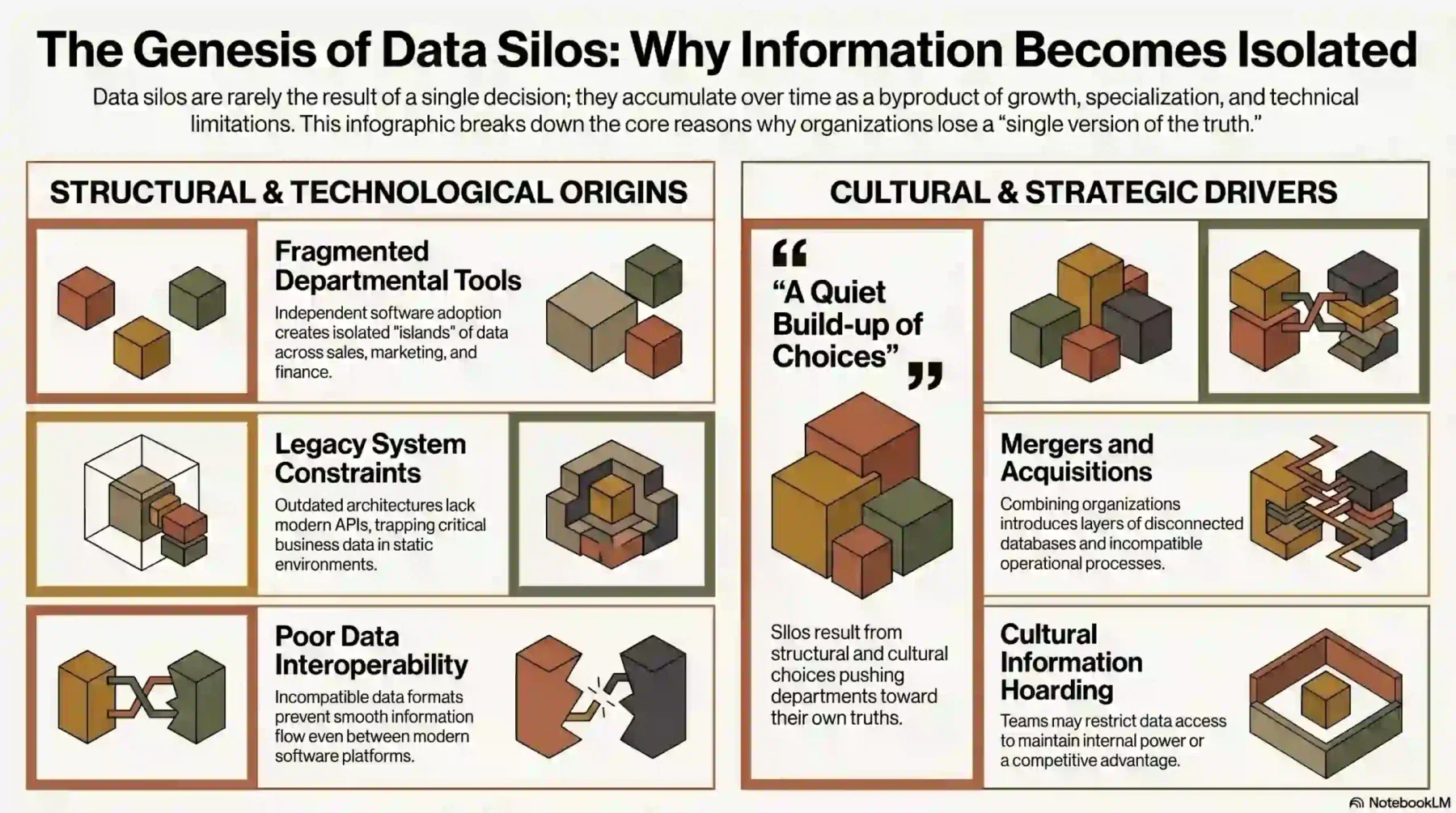
Data silos rarely appear suddenly. In most businesses, they develop gradually as businesses adopt new technologies, expand departments, or implement specialized software to solve specific operational problems.
Without a coordinated strategy for managing information across systems, these tools can unintentionally isolate data within individual departments. Over time, the company accumulates multiple disconnected data sources that no longer communicate effectively.
Several structural, technological, and cultural factors commonly contribute to the formation of data silos.
"Data silos are rarely the result of a single decision; they build up quietly as structural, technological, and cultural choices push each department toward its own version of the truth"
1. Organizational structure and departmental barriers
Traditional organizational structures divide companies into departments such as sales, marketing, finance, and operations. While this structure improves specialization, it can also create barriers to information sharing.
Departments often adopt their own tools and processes to solve immediate challenges. When these systems are implemented independently without centralized governance, they rarely integrate with other business platforms.
2. Legacy systems and vendor lock-in
Many established companies still rely on legacy software built long before modern cloud integrations and APIs became common. These systems were designed primarily to store data rather than share it with other platforms.
Because of vendor lock-in or outdated architecture, extracting or synchronizing information from legacy systems can be difficult and expensive. As a result, critical business data remains trapped within isolated applications.
To deal with this issue, you can review some of Australia’s ERP recommendations to leverage the most advanced business systems in the market.
3. Poor data interoperability
Even when companies adopt modern software, data silos can still form if systems do not share compatible data structures or communication standards.
Different applications may store customer records, product information, or transaction data using entirely different formats. Without proper integration tools or APIs to translate these formats, information cannot flow smoothly across systems.
4. Mergers and acquisitions
Corporate mergers and acquisitions often introduce new layers of complexity to enterprise data environments. When two companies combine, they typically bring different software platforms, databases, and operational processes.
Integrating these systems requires significant time and investment. Until full integration occurs, the newly merged business may operate with multiple disconnected information environments.
5. Organizational culture and information hoarding
Technology is not the only factor behind data silos. Organizational culture can also encourage departments to control or restrict access to information.
In some environments, teams view data as a source of power or competitive advantage within the enterprise. Without leadership promoting transparency and collaboration, this behavior reinforces siloed information practices.
Why Are Data Silos a Serious Business Problem?
Data silos are more than a technical inconvenience. When information becomes isolated across departments or systems, businesses lose visibility into operations and struggle to coordinate. The impact shows up in four main ways:
1. Operational inefficiency
When systems cannot communicate, employees rely on manual data transfers and spreadsheets to move information between platforms. This wastes time and creates errors that flow into reports, billing, and operational planning.
2. Slower and less reliable decision-making
Different departments often rely on separate datasets, which produces conflicting reports and uncertainty over which version of the information is actually correct.
3. Inconsistent customer experience
Without a unified view of customer interactions, businesses may deliver inconsistent support, send duplicate communications, or push irrelevant offers across channels.
4. Security and compliance risks
When sensitive information is scattered across multiple systems, it becomes harder to manage access, maintain data integrity, and meet Australian regulatory requirements.
How to Break Down Data Silos
Breaking down data silos requires both technological improvements and organizational alignment. Companies must ensure that systems can share information while also encouraging teams to collaborate across departments.
Without a coordinated strategy, new tools may simply create additional isolated systems. Businesses, therefore, need a structured approach to manage data across platforms, teams, and processes.
Several core strategies can help reduce fragmentation and build a more integrated data environment.
1. Implement strong data governance
A strong data governance framework defines how information is collected, stored, and shared across the company. It also establishes clear responsibilities for maintaining data accuracy.
By defining data ownership and access policies, companies can prevent departments from maintaining separate versions of the same information.
2. Standardized data management practices
Standardizing data formats and definitions ensures that different systems interpret information consistently. For example, departments should use the same definitions for customer records, product data, or sales metrics.
Enterprises often create a centralized data dictionary to document how information is structured and used across systems.
3. Invest in data integration and ERP systems
Integration tools help connect different systems so information can move between platforms automatically. Technologies such as APIs, ETL pipelines, and integration platforms enable real-time data exchange.
Many businesses also leverage ERP advantages to unify multiple business functions within a single platform.
4. Implement master data management (MDM)
Master Data Management ensures that critical business entities, such as customers, suppliers, and products, have a single authoritative record.
By maintaining a consistent master dataset, businesses can reduce duplicate records and ensure that all systems reference the same information.
5. Build a collaborative data culture
Technology alone cannot eliminate data silos. Companies must also encourage transparency and cross-department collaboration.
Leadership should promote data sharing, provide training on integrated systems, and align incentives so teams prioritize enterprise-wide visibility rather than departmental control.
Industry Impact of Data Silos
Data silos affect companies in every sector, but the operational consequences often differ depending on the industry. In sectors that rely heavily on real-time information, fragmented data can quickly disrupt workflows, decision-making, and customer experiences.
The following examples illustrate how disconnected systems create industry-specific challenges.
1. Healthcare
In healthcare environments, data silos can directly impact patient care. When electronic health records, pharmacy databases, and billing systems operate independently, medical staff may lack a complete view of patient information.
This fragmentation can lead to repeated tests, delayed treatments, or incomplete medical histories. Integrated healthcare systems help ensure that patient data is accessible across departments, improving both efficiency and patient safety.
2. Retail and E-commerce
Retailers rely on accurate information across sales channels, inventory systems, and customer platforms. When point of sale systems, e-commerce platforms, and warehouse databases are not synchronized, stock visibility becomes unreliable.
This disconnect can result in overselling products, delayed order fulfillment, or inconsistent customer experiences across online and physical stores.
3. Manufacturing
Manufacturing operations depend on close coordination between procurement, production planning, and supply chain management systems. When these systems operate in isolation, production teams may lack visibility into material availability or supplier updates.
This can lead to unexpected production delays, inefficient resource planning, and higher operational costs.
Strategy to Eliminate Data Silos
Eliminating data silos requires a structured approach that aligns technology with organizational processes. Companies should follow a clear integration strategy so information can move consistently across departments.
The steps below outline a practical framework businesses can use to identify, integrate, and manage enterprise data more effectively.
1. Conduct a data audit
The first step is to understand where data currently exists within the enterprise. Many companies operate dozens of applications, spreadsheets, and legacy systems that store business information.
Action Items:
- Identify all systems that store operational or customer data
- Map where critical information originates and where it is stored
- Document which departments manage each dataset
2. Establish an integration architecture
After identifying data sources, companies must determine how systems will communicate with each other. This often involves selecting an integration framework or centralized data platform.
Action Items
- Evaluate integration options such as APIs, ETL pipelines, or data warehouses
- Connect critical systems that frequently exchange information
- Ensure real-time or scheduled synchronization between platforms
3. Implement data governance policies
Integration alone does not guarantee reliable data. Businesses must establish governance policies that define how information is structured, maintained, and accessed.
Action Items
- Define standardized naming conventions and data formats
- Assign clear ownership for critical datasets
- Implement access controls and data quality monitoring processes
4. Encourage organizational adoption
Technology changes must be supported by organizational alignment. Employees need to understand how integrated systems improve collaboration and decision-making.
Action Items
- Provide training on new data platforms and workflows
- Encourage cross-department collaboration around shared data
- Align leadership incentives with enterprise-wide transparency
Common Pitfalls When Eliminating Data Silos
Although eliminating data silos can significantly improve operational visibility, many Businesses encounter challenges during the integration process. Without proper planning, new systems may introduce additional complexity rather than solving the problem. Understanding common pitfalls helps Businesses implement integration strategies more effectively.
1. Migrating poor-quality data
One of the most common mistakes is transferring inaccurate or duplicated data into a new system. If Businesses migrate inconsistent records from multiple silos, the centralized database will inherit the same problems.
To prevent this, companies should perform data cleansing, validation, and deduplication before large-scale migration projects.
2. Ignoring security and compliance requirements
When data from multiple systems is consolidated, Businesses must carefully manage access permissions. Without proper controls, sensitive information may become accessible to employees who should not view it.
Implementing role-based access control and compliance monitoring ensures that integration does not compromise data security.
3. Lack of executive support
Breaking down data silos often requires cross-department cooperation and significant system changes. Without support from executive leadership, these initiatives may lose momentum.
Strong leadership involvement helps ensure sufficient resources, clear priorities, and Business-wide adoption of integrated systems.
Advanced Data Architecture Strategies
As Businesses grow and manage larger volumes of information, traditional integration methods may become insufficient. Many enterprises now adopt advanced data architectures to maintain scalability, flexibility, and real-time connectivity across systems.
These emerging approaches help Businesses manage complex data environments while preventing new silos from forming.
1. Data fabric
Data fabric architecture connects information across environments such as cloud platforms, on-premise systems, and edge devices. This unified layer allows systems to discover and access data without fully centralizing it.
This approach improves data accessibility while maintaining governance and security controls across the entire enterprise ecosystem.
2. Data mesh
Data mesh takes a decentralized approach to data management. Instead of relying on a single centralized team, ownership of datasets is distributed to the teams that generate and use the data.
Each domain manages its own data as a product while still following shared governance and interoperability standards. This structure allows Businesses to scale data operations without creating new bottlenecks.
3. AI-driven data integration
Artificial intelligence is increasingly used to automate complex data integration tasks. AI tools can detect hidden data relationships, identify inconsistencies across systems, and recommend integration improvements.
By analyzing large volumes of information, these tools help Businesses identify emerging silos and maintain data consistency across multiple platforms.
How ERP Software Helps Eliminate Data Silos in Your Company
Disconnected systems remain one of the costliest hidden inefficiencies in Australian businesses.
The Productivity Commission of Australia notes that a mature data-sharing regime could unlock as much as $10 billion in additional annual economic output.
An ERP system tackles this directly by replacing scattered tools with one shared database that every department reads from and writes to. The result is a single, current source of truth for the whole business.
Below are four ways an ERP removes silos and keeps data flowing across teams.
1. One central database for every department
Sales, finance, inventory, HR, and operations all work from the same records, so customer, product, and transaction data is created once and used everywhere without manual re-entry.
2. Real-time visibility across the business
Updates flow instantly between modules, which means a sale in the storefront immediately reflects in stock levels, accounts receivable, and management dashboards without waiting for batch updates.
3. Standardised data formats and definitions
An ERP enforces consistent fields, codes, and naming rules across every module, so departments stop arguing over which spreadsheet has the ‘real’ customer or product record.
4. Built-in role-based access and audit trails
Sensitive information stays accessible to the people who need it, while access controls and audit logs help meet Australian Privacy Principles and other compliance requirements.
By unifying data, processes, and reporting into one platform, an ERP turns fragmented information into a coordinated asset that supports faster decisions and stronger collaboration across the company.
Conclusion
Data silos reduce the value of information by isolating it within departments or disconnected systems. When Businesses cannot access shared data easily, operational efficiency declines, and decision-making becomes slower and less reliable.
Breaking down data silos requires a combination of technology, governance, and collaboration. By integrating systems, standardizing data practices, and encouraging cross-department transparency, Businesses can build a unified data environment that supports better insights and business performance.
For Businesses evaluating their next steps, a structured approach can help identify the most effective integration strategy. If you want help shortlisting solutions, request a free consultation with our team.

Frequently Asked Questions About Data Silos
Data silos are generally considered bad for most businesses because they fragment information, slow decisions, and limit collaboration. In rare cases, intentional separation can be useful for sensitive or regulated data, but unintended silos almost always hurt operational efficiency and reporting accuracy.
A data warehouse is a centralised repository designed to consolidate information from multiple systems for reporting and analysis. A data silo, on the other hand, is an isolated dataset that other systems cannot easily access, which is the exact problem a data warehouse is built to solve.
The opposite of a data silo is an integrated or connected data environment, often described as a single source of truth. In this setup, information flows freely across systems and departments through tools such as ERP platforms, APIs, and unified data architectures.
You can identify data silos by looking for duplicated records across systems, departments using their own spreadsheets, conflicting reports between teams, and frequent manual data transfers. A data audit that maps where information is stored and who owns it usually reveals the most common silos.
Data integration enables different software systems to exchange information automatically. By connecting platforms through APIs, integration tools, or unified data architectures, businesses can ensure that critical business data remains accessible and consistent across departments.