







Order fulfillment is the process of receiving, processing, packing, and shipping customer orders from purchase to final delivery. It helps businesses manage inventory, improve delivery accuracy, and ensure customers receive products on time.
In today’s hyper-connected and fast-moving commerce landscape, the journey from warehouse shelf to customer doorstep plays a major role in business success. Whether you run a growing e-commerce brand in Melbourne or manage a national B2B distribution network, how you process and ship orders directly affects your reputation.
This journey is known as order fulfillment. It covers every step required to turn a confirmed sale into a delivered product. When done well, it keeps customers happy and operations running smoothly.
For Australian businesses, fulfillment comes with unique challenges. Large distances, uneven population spread, and rising delivery expectations force companies to plan logistics carefully. Mastering fulfillment is no longer optional. It is essential for customer retention and long-term growth.
Key Takeaways
Order fulfillment is the complete process of receiving, packing, shipping, and delivering customer orders while managing returns efficiently.
Order fulfillment directly affects customer satisfaction, operational costs, and a business’s ability to scale sustainably.
Businesses can choose from in-house, 3PL, dropshipping, or hybrid models depending on scale, budget, and growth goals.
Australian businesses must consider geography, courier coverage, warehouse locations, and technology integration when building a fulfillment strategy.
What Is Order Fulfillment?
Order fulfillment is the complete process of receiving, processing, packing, and shipping a customer’s order. It spans from the initial point of sale to final delivery, encompassing inventory management as well as returns and exchange handling.
Although the concept sounds simple, execution is complex. Fulfillment combines warehouse operations, transport networks, automation, and real-time data. A single mistake at any stage can delay delivery or increase costs.
No matter the industry or order size, the goal stays the same. Deliver the right product to the right customer, on time, in perfect condition, and at the lowest possible cost to the business.
Why Is Order Fulfillment Important for Businesses?
"Order fulfillment is where customer promises are either kept or broken. Businesses that invest in this process see stronger loyalty and healthier margins."
Order fulfillment represents your brand promise in physical form. Even the best products and marketing efforts fail if delivery falls short. A strong fulfillment strategy protects revenue, reputation, and customer trust.
Order delivery management covers the end-to-end process of scheduling, dispatching, and tracking customer orders from the warehouse to the final delivery point.
Businesses use it to assign drivers to routes, send automated delivery notifications, confirm proof of delivery, and monitor real-time order status across all active shipments.
Impact on customer experience
Fulfillment is the most visible interaction customers have with your business after purchase. Fast delivery, accurate orders, and neat packaging build trust and encourage repeat sales.
Australian customers also expect transparency. They want tracking updates, clear delivery windows, and quick communication when delays occur. A smooth fulfillment experience directly improves reviews and brand perception.
Operational costs and efficiency
Fulfillment makes up a large share of operating costs. Labour, warehousing, packaging, and freight quickly add up when processes run inefficiently.
Optimised fulfillment reduces waste and errors. Better picking methods, correct box sizing, and smart warehouse layouts help businesses cut costs and protect margins.
Business scalability
A setup that works for 50 orders a day will struggle at 5,000. Sales spikes during events like Black Friday or Christmas expose weak delivery management software.
Scalable fulfillment allows a business to grow without breaking operations. It ensures consistent service even during peak demand or rapid expansion.
How the Order Fulfillment Process Works
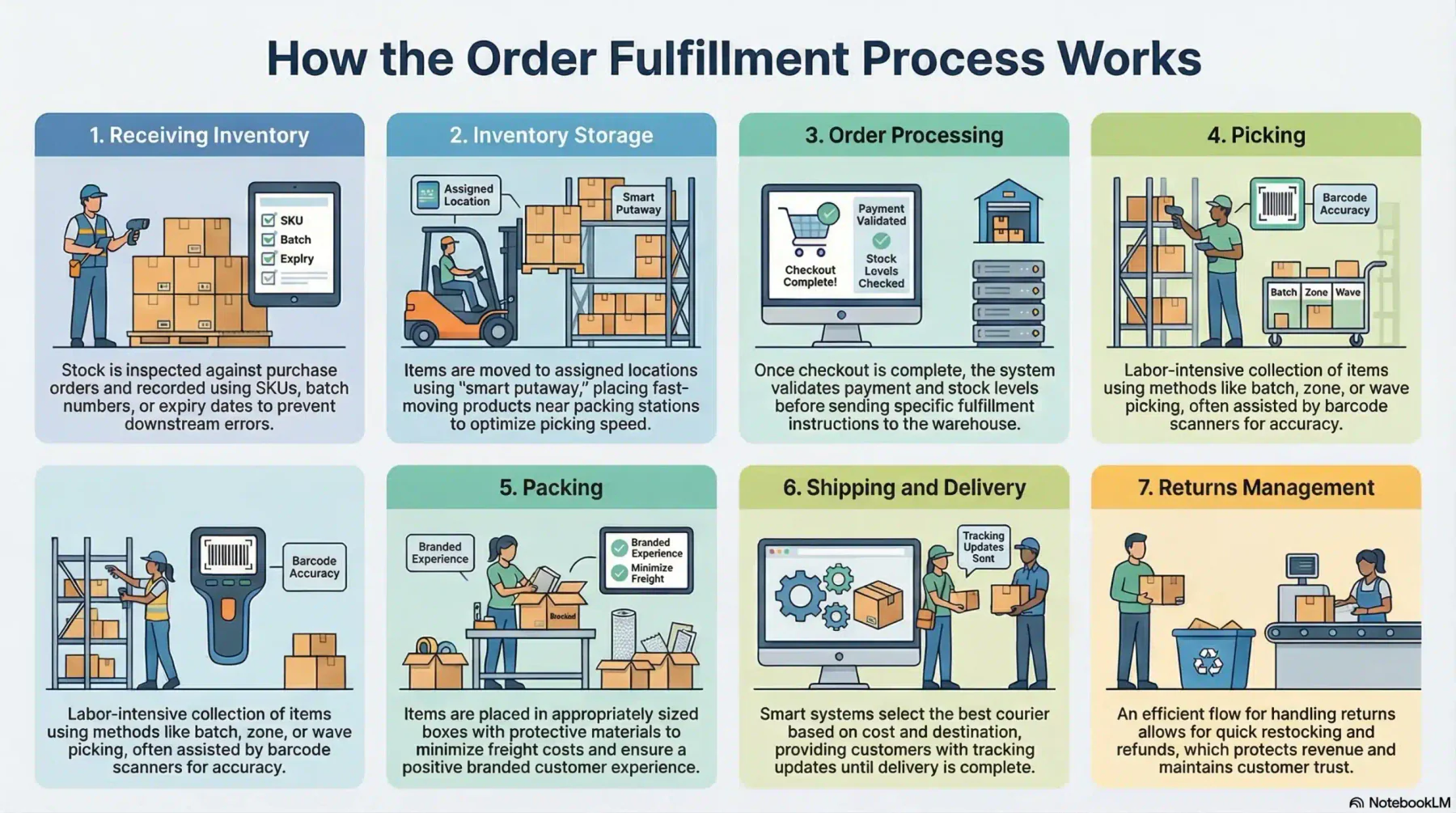
Order fulfillment follows a clear sequence of stages. Each step plays a role in speed, accuracy, and cost control. Improving one stage often improves the entire operation.
1. Receiving inventory
Receiving starts when stock arrives from suppliers. Warehouse staff check quantities, inspect goods, and confirm items match purchase orders.
Once verified, the system records each item using SKUs, batch numbers, or expiry dates. Accurate receiving prevents downstream errors and stock discrepancies.
2. Inventory storage
After receiving, inventory moves into assigned storage locations. Smart putaway improves space usage and picking speed.
Fast-moving products sit close to packing stations, while slower items stay further back. Proper rotation methods protect stock quality and reduce losses.
3. Order processing
Order processing begins once a customer completes checkout. The system confirms payment, checks stock levels, and validates delivery details.
The system then allocates inventory and sends instructions to the warehouse floor. This step connects sales channels directly to fulfillment teams. For businesses running an ERP system, this entire sequence is automated.
4. Picking
Picking involves collecting items for each order. It takes the most labour and directly affects accuracy.
Businesses use methods like batch, zone, or wave picking to reduce walking time. Barcode scanners and guided systems help prevent mistakes.
5. Packing
At the packing station, staff prepare items for shipping. They choose the right box size and protective materials to avoid damage and excess freight costs.
Packing also supports branding. Custom packaging and inserts turn delivery into a positive customer experience.
6. Shipping and delivery
Once packed, orders pass to courier partners for delivery. Australian businesses often work with multiple national and regional carriers.
Smart shipping systems select the best courier based on cost, speed, and destination. Tracking updates keep customers informed until delivery is complete.
7. Returns management
Fulfillment does not end at delivery. Returns handling plays a major role in customer satisfaction.
Efficient returns processing allows quick refunds and restocking. A clear returns flow protects revenue and maintains customer trust.
Order Fulfillment vs Order Management vs Dropshipping
These terms often get mixed up, but they serve different purposes in the supply chain.
Order fulfillment
Order fulfillment covers the physical handling of inventory. It includes receiving stock, picking items, packing boxes, and shipping orders to customers.
Order management
Order management controls the data and decisions behind each sale. It tracks orders, payments, inventory levels, and customer communication across channels.
Dropshipping
Dropshipping is a model where the seller never holds stock. The supplier ships products directly to customers, while the seller manages sales and support.
Types of Order Fulfillment Models

Businesses can choose different fulfillment models based on budget, scale, and product type. Many companies combine models as they grow.
1. In-house fulfillment
In-house fulfillment means managing everything internally. The business owns the warehouse, staff, and processes.
This model offers full control but requires high investment and limits rapid scaling.
2. Third-party logistics (3PL)
A 3PL provider handles storage, picking, packing, and shipping on behalf of a business. Orders flow automatically from sales channels to the 3PL.
These outsourced logistics services often have flexibility, scalability, and lower upfront costs, but reduces direct control.
3. Dropshipping
Dropshipping removes inventory holding entirely. The supplier fulfills orders directly to customers.
It lowers entry barriers but offers thin margins and little control over delivery quality.
4. Hybrid fulfillment
Hybrid models combine multiple approaches. Businesses may ship fast-moving items in-house while outsourcing bulky or interstate orders.
This approach balances cost, speed, and operational control.
Order Fulfillment Strategy: Key Considerations for Australian Businesses
- Business size and order volume
Match your fulfillment setup with daily order volume and growth plans. High-volume businesses need automation and scalable capacity. - Sales channels and technology
Ensure all sales channels connect to a central system. Strong integrations prevent overselling and fulfilment delays. - Warehouse location and distribution
Consider multiple warehouse locations to reduce transit times across Australia. East and west coast coverage improves delivery speed. - Customization and flexibility
Factor in special handling needs like temperature control, kitting, or regulated goods. Your strategy must support compliance and product care.
Industry-Specific Order Fulfillment Use Cases
While the fundamentals of fulfilment stay consistent, execution varies by industry. Product type, compliance needs, and customer expectations shape how each business designs its fulfilment strategy.
1. E-commerce and Direct-to-Consumer (DTC)
This sector focuses on fast dispatch, accurate picking, and strong presentation. Businesses manage high order volumes and must scale quickly during sales events and seasonal peaks.
2. Healthcare and pharmaceuticals
Fulfilment in this space demands strict regulatory compliance and full traceability. Temperature control, batch tracking, and precise handling protect product safety and patient outcomes.
3. Food and beverage
Speed is critical due to limited shelf life. Businesses rely on FIFO inventory control and local fulfilment hubs to maintain freshness and minimise spoilage.
4. Manufacturing and B2B wholesale
Large orders, palletised goods, and scheduled deliveries define this sector. Fulfilment supports just-in-time production and requires end-to-end shipment visibility to meet strict routing and delivery requirements.
Step-by-Step Implementation: Optimizing Your Fulfillment Strategy
Improving fulfilment does not require a full overhaul overnight. A clear, structured approach helps businesses reduce risk, control costs, and scale operations with confidence.
Step 1: Audit your current operations
Review each stage of your fulfilment flow, from receiving to delivery. Identify delays, error rates, and cost leaks to establish a clear performance baseline.
Step 2: Connect your systems
Adopt technology that links orders, inventory, and warehouse activity in real time such as ERP. This prevents overselling, improves visibility, and speeds up decision-making.
Step 3: Optimise warehouse layout
Reposition fast-moving items closer to packing areas and group commonly ordered products together. Shorter travel paths directly improve picking speed and accuracy.
Step 4: Diversify courier partnerships
Work with multiple carriers to balance cost, coverage, and reliability. This reduces dependency on a single provider and protects service levels during disruptions.
Step 5: Measure and refine continuously
Track KPIs such as order accuracy, dispatch time, and return rates. Use these insights to refine processes and train staff regularly.
Common Order Fulfillment Challenges
Inventory inaccuracy causes missed sales and cancelled orders. Poor stock visibility damages customer trust and creates operational chaos.
Supply chain disruptions also hit Australian businesses hard. Weather events and transport delays quickly impact delivery timelines.
Labour shortages increase picking errors and slow dispatch times. Without automation, costs rise as volume grows.
High last-mile delivery costs reduce margins, especially for regional and remote areas. Poor courier performance adds further risk.
Advanced Practices Shaping the Future of Fulfillment
Automation and robotics reduce labour strain and speed up warehouse movement. Robots now assist with transport, storage, and packing.
Micro-fulfillment centres place stock closer to customers. This approach supports faster delivery within metro areas.
Predictive analytics helps businesses position inventory before demand spikes. Data-driven planning reduces stockouts and delays.
Sustainable fulfillment focuses on right-sized packaging and cleaner delivery routes. Many Australian customers now expect eco-friendly practices.
Utilizing a logistics optimization solution is considered a standard practice in the market. Acquiring this system is a must for your business to compete with other businesses.
Conclusion
Order fulfillment sits at the heart of customer satisfaction and operational efficiency. When businesses streamline how they receive, store, pack, and ship orders, they protect margins while delivering reliable experiences customers trust.
For Australian companies facing long distances and rising delivery expectations, a strong fulfillment strategy is no longer optional. If you want to improve speed, accuracy, and scalability, consult our experts for free to assess your current fulfillment setup.
Frequently Asked Question
Order fulfillment is the process of receiving, picking, packing, shipping, and delivering customer orders, including returns.
Australian businesses face long distances and high delivery expectations, making efficient fulfillment essential for customer satisfaction and cost control.
Order fulfillment handles physical goods, while order management focuses on order data, inventory visibility, and customer communication.
A 3PL is ideal for businesses seeking scalability, lower upfront costs, and access to logistics expertise.
You can improve fulfillment by optimising warehouse layout, integrating systems, using multiple couriers, and tracking performance metrics.
Pick, pack, and ship are the main steps in the fulfillment process. Picking means collecting items from the warehouse, packing prepares them for safe delivery, and shipping sends them to the customer through a carrier. These steps directly affect order speed and accuracy.