

 Limited to 100 registrants

Cold chain logistics helps businesses protect goods that depend on stable temperatures. It covers how products are packed, stored, moved, monitored, and delivered.
For Australian companies, this process affects food safety, product quality, customer trust, and compliance. A weak step can cause waste, rejected orders, or costly claims.
Effective cold chain management connects warehouse, transport, inventory, and delivery records. With the right system, teams can track risks earlier and act before products fail.
Key Takeaways
Cold chain logistics is the controlled storage, handling, transport, monitoring, and delivery of temperature-sensitive goods.
Cold chain logistics challenges include temperature excursions, poor visibility, delayed routes, manual records, packaging failure, and rejected deliveries.
Improving cold chain logistics starts with clear temperature rules, validated packaging, controlled storage, route planning, monitoring, and digital records.
HashMicro helps manage cold chain logistics by connecting inventory, warehouse, fleet, sales orders, delivery records, and reporting in one ERP system.
What Is Cold Chain Logistics?

Cold chain logistics is the controlled handling of temperature-sensitive goods from storage to final delivery. It keeps products within a required temperature range.
This process applies to chilled, frozen, and controlled ambient products. It helps prevent spoilage, safety issues, quality loss, and compliance failures.
A cold supply chain can include cold rooms, freezers, insulated packaging, refrigerated transport, sensors, proof of delivery, and audit records. Each part must work together.
In Australia, cold chain logistics is critical because routes can be long and climates can vary sharply. Goods may pass through depots, carriers, branches, and customers.
"Cold chain logistics is not only about refrigerated vehicles. Businesses also need connected inventory, warehouse, transport, and delivery records to prove that sensitive goods were handled correctly."
Cold Chain Logistics vs Cold Chain Transport vs Cold Chain Shipping
Cold chain logistics is the full temperature-controlled supply chain. It includes storage, picking, packing, dispatch, transport, monitoring, delivery, and documentation.
Cold chain transport focuses on the physical movement of goods. Refrigerated trucks, chilled vans, and temperature-controlled containers are common examples.
Cold chain shipping refers to the shipment process itself. It often includes packaging, carrier handover, tracking, delivery status, and shipment condition records.
The difference matters for business planning. A company may have refrigerated vehicles but still fail if storage, packaging, monitoring, or delivery records are weak.
How Cold Chain Logistics Works
Cold chain logistics works by controlling conditions at every stage of movement. Teams need clear rules, suitable equipment, reliable records, and quick exception handling.
The process starts before goods leave storage and continues until the recipient accepts delivery. Each handover should protect temperature, timing, and product condition.
1. Product temperature requirements are defined
Each product needs a defined temperature range before storage or delivery begins. Frozen food, chilled dairy, vaccines, cosmetics, and fresh produce may need different rules.
These requirements should be visible to warehouse, dispatch, and driver teams. Clear instructions reduce picking errors, wrong storage, and unsuitable vehicle allocation.
2. Goods are packed using suitable cold chain packaging
Cold chain packaging protects products during storage, loading, transport, and delivery. It may include insulated boxes, gel packs, dry ice, thermal liners, or validated cartons.
The right packaging depends on product sensitivity, route length, outside temperature, and delivery duration. Packaging that works for one route may fail on another.
3. Inventory is stored in temperature-controlled facilities
Before dispatch, goods must stay in suitable cold rooms, freezers, or controlled zones. Inventory records should show location, quantity, batch, and storage status.
Accurate stock visibility helps teams avoid delays and wrong movements. It also supports rotation rules, expiry control, and faster issue tracing when a problem occurs.
4. Shipments are assigned to refrigerated transport
Orders should be matched with the right vehicle, carrier, or container. Dispatch teams must consider temperature range, delivery window, route length, and vehicle capacity.
Loading sequence also matters because frequent door openings can affect product stability. Sensitive goods should move through dispatch with minimal exposure time.
5. Temperature is monitored during storage and transit
Cold chain monitoring supports monitoring goods in transit and checks whether products remain within the required temperature range. Businesses may use sensors, data loggers, vehicle records, alerts, and exception reports.
When a temperature excursion occurs, teams need fast visibility. They can investigate the cause, quarantine stock, reroute delivery, replace goods, or update the customer.
6. Delivery and handover records are documented
The final stage confirms delivery time, recipient details, product condition, and any delivery issue. These records help resolve disputes and support audit readiness.
Proof of delivery becomes stronger when linked with temperature logs. Businesses can show not only that goods arrived, but also how they were handled in transit.
Why Cold Chain Logistics Matters for Australian Businesses
Cold chain logistics matters because preserving temperature-sensitive goods requires consistent control across storage, transport, and delivery. A short delay, incorrect packing method, or missed alert can create major waste.
Australian operations often involve interstate freight, regional routes, warm weather, and multiple carriers. These conditions increase the need for clear control at every stage.
The Australian Bureau of Statistics tracks industries where freight, food, health, and distribution activity affect business performance. Cold chain control supports these sectors by reducing loss and improving reliability.
Strong cold chain management also protects customer trust. Retailers, clinics, restaurants, wholesalers, and end customers expect goods to arrive in the right condition.
Compliance is another major reason to improve cold chain operations. Businesses need records that show how products were stored, moved, delivered, and managed during exceptions.
Common Cold Chain Logistics Challenges
Cold chain logistics can fail when teams rely on manual records, disconnected tools, or limited delivery visibility. Problems often appear after the product has already been affected.
Most challenges are preventable when businesses use software for supply chain managers to connect warehouse, transport, temperature, and delivery data.The goal is to find risks before they become rejected orders.
1. Temperature excursions
A temperature excursion happens when goods move outside their approved range. It can occur during storage, loading, transport, delivery delays, or final handover.
Even a short excursion can affect sensitive goods. The impact depends on product type, exposure time, temperature level, and whether the item can still be released.
2. Limited shipment visibility
Many businesses cannot see where shipments are or whether conditions remain stable. This makes it hard to respond before a customer reports an issue.
Limited visibility also affects service teams and managers. They may struggle to explain delays, confirm shipment status, or identify recurring carrier problems.
3. Delays across long-distance routes
Australian cold chain routes can involve long distances between warehouses, depots, stores, and customers. Traffic, weather, driver delays, and regional windows increase risk.
Longer routes create more exposure points. Teams need accurate planning, so products spend less time outside controlled storage and more time in stable conditions.
4. Inconsistent handling during handovers
Cold chain goods often pass between pickers, packers, drivers, carriers, branches, and customers. Each handover creates risk if teams follow different procedures.
Clear handling standards reduce confusion during transfers. Digital records also help confirm who handled the goods, when they moved, and whether any issue occurred.
5. Manual temperature records
Paper logs and spreadsheets are difficult to maintain across fast-moving operations. They can be incomplete, late, duplicated, or hard to verify during audits.
Manual records also make trend analysis slower. Managers may miss repeated issues on a route, vehicle, warehouse zone, product type, or delivery partner.
6. Packaging failure
Packaging can fail when it does not match the product, route, weather, or delivery duration. Poor packaging may cause heat exposure, thawing, condensation, or damage.
Businesses should test and review packaging performance regularly. A packaging method that works in short metro deliveries may not suit regional or interstate freight.
7. Compliance and audit pressure
Cold chain businesses often need to prove how goods were stored, moved, and delivered. Scattered emails, paper logs, and carrier portals slow this process.
Audit pressure grows when records are incomplete or inconsistent. Connected digital records make it easier to trace stock, review exceptions, and support claims.
8. Product spoilage and rejected deliveries
When goods arrive outside expected condition, customers may reject the delivery. This creates replacement costs, waste, claims, urgent reshipping, and relationship damage.
Spoilage also affects planning and cash flow. Businesses may need extra safety stock, more manual checks, or higher transport costs to recover from repeated failures.
Industries That Rely on Cold Chain Logistics
Cold chain logistics supports many Australian industries that handle sensitive goods. Each sector has different temperature needs, delivery risks, and recordkeeping requirements.
The common goal is the same across these industries. Businesses need to protect product quality from storage through to customer handover.
| Industry | Products handled | Cold chain priority | Main business risk |
| Food and beverage | Chilled food, frozen goods, prepared meals, drinks, ingredients, and fresh produce. | Maintain safe storage and delivery conditions from suppliers to warehouses, retailers, restaurants, and customers. | Spoilage, customer complaints, unsafe products, and rejected deliveries. |
| Seafood, meat, and dairy | Seafood, meat, dairy products, and other highly perishable goods. | Control temperature strictly from processing and storage through to refrigerated transport and final delivery. | Quality loss, safety concerns, financial loss, and product rejection. |
| Pharmaceuticals and healthcare | Vaccines, medicines, samples, diagnostic materials, and medical products. | Keep products within approved conditions and maintain accurate monitoring records. | Compliance failure, product instability, patient safety risks, and audit issues. |
| Cosmetics and sensitive consumer goods | Skincare products, cosmetics, chemicals, and heat-sensitive consumer goods. | Protect products from heat, humidity, and prolonged exposure during storage and shipping. | Changed texture, colour issues, damaged stock, returns, and inconsistent customer experience. |
1. Food and beverage
Food and beverage businesses use cold chain logistics to protect chilled, frozen, and perishable products. This includes prepared meals, drinks, ingredients, and fresh produce.
Temperature control helps reduce spoilage and customer complaints. It also supports safer delivery from suppliers to warehouses, retailers, restaurants, and end customers.
2. Seafood, meat, and dairy
Seafood, meat, and dairy products are highly sensitive to temperature changes. These goods can lose quality quickly if storage or transport conditions are unstable.
Businesses in this sector need strict control from processing to final delivery. Spoilage can create financial loss, safety concerns, and rejected orders.
3. Pharmaceuticals and healthcare
Pharmaceutical and healthcare supply chains often involve vaccines, medicines, samples, and medical products. Many of these items need controlled storage and transport.
Accurate monitoring is critical because product stability can affect patient safety and compliance. Records must show that goods stayed within approved conditions.
4. Cosmetics and sensitive consumer goods
Some cosmetics, skincare products, chemicals, and consumer goods can be affected by heat or humidity. Prolonged exposure may change texture, colour, or product quality.
Cold chain logistics helps protect these goods during storage and shipping. It also reduces returns, damaged stock, and inconsistent customer experience.
How to Improve Cold Chain Logistics
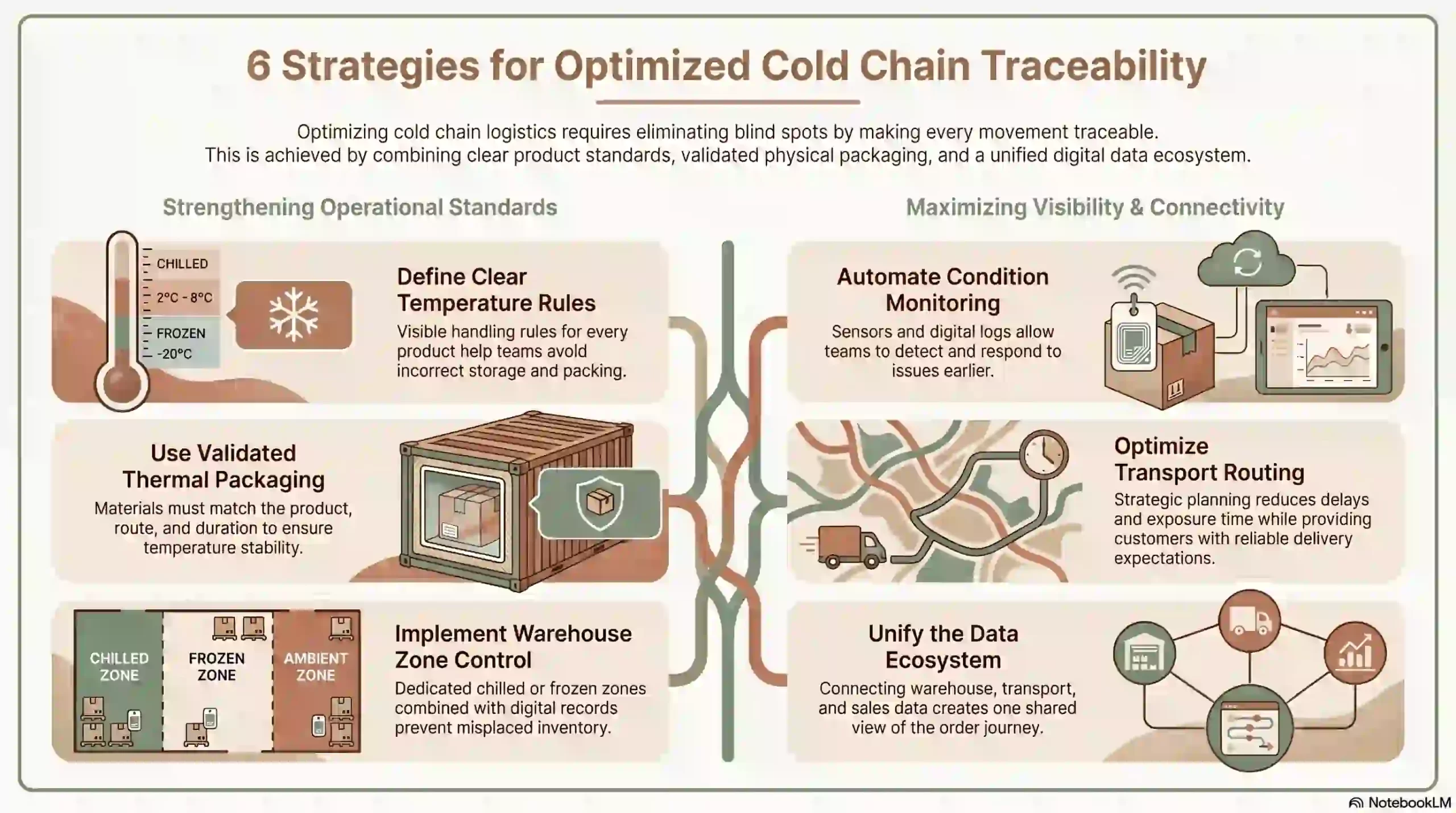
Improving cold chain logistics starts with reducing blind spots through a logistics control system that connects operational data. Businesses need clear product rules, stronger warehouse control, better routes, and connected records.
The priority is to make every movement traceable. Teams should know what was shipped, where it moved, who handled it, and whether conditions stayed stable.
1. Set clear temperature ranges for each product
Each product should have a defined temperature range and handling rule. These details should be visible before warehouse, dispatch, or delivery work begins.
Clear rules help teams avoid incorrect storage, poor packing, and unsuitable vehicle selection. They also support faster decisions when exceptions occur.
2. Use validated cold chain packaging
Packaging should match the product, route, and expected delivery duration. Businesses may use insulated cartons, refrigerants, thermal liners, or other validated materials.
Validation helps confirm that packaging can hold the required temperature. It is especially useful for long routes, warm conditions, and sensitive products.
3. Improve warehouse temperature control
Warehouse teams need clear zones for chilled, frozen, and controlled goods. Inventory should move quickly from storage to picking, packing, and dispatch.
Digital stock records help prevent misplaced items and delayed orders. They also make it easier to manage batches, expiry dates, and stock rotation.
4. Optimise refrigerated transport routes
Route planning can reduce delays, unnecessary stops, and exposure time. Teams should consider vehicle capacity, delivery priority, customer availability, and route distance.
Better routing also helps protect service quality. It gives drivers clearer schedules and gives customers more reliable delivery expectations.
5. Automate cold chain monitoring
Automated monitoring reduces reliance on paper checks and delayed updates. Sensors, alerts, and digital logs help teams detect temperature issues earlier.
When teams receive alerts quickly, they can respond before products are compromised. This may include rerouting, quarantining stock, or replacing affected goods.
6. Keep digital proof of delivery and condition records
Digital proof of delivery confirms delivery time, recipient details, and shipment condition. It helps businesses manage claims, disputes, and customer follow-up.
When delivery records connect with temperature logs, evidence becomes stronger. Teams can review the full delivery history instead of relying on manual notes.
7. Connect cold chain data with inventory, warehouse, and sales orders
Cold chain performance improves when temperature-controlled logistics software connects operational data across inventory, warehouse, transport, and sales activities. Inventory, warehouse, sales, transport, and delivery records should support one shared view.
This connection helps teams trace issues faster and understand the full order journey. It also supports reporting on delays, rejected deliveries, and recurring risks.
How HashMicro Helps Manage Cold Chain Logistics
HashMicro helps Australian businesses manage cold chain operations through integrated management software. It’s connected to inventory, warehouse, fleet, sales, and reporting processes.
Instead of managing records across spreadsheets and separate tools, teams can centralise operational data. This improves visibility from stock storage to final delivery.
Businesses can monitor stock movement, manage warehouse activity, plan deliveries, and track fleet operations. They can also record proof of delivery and review reports.
For food, healthcare, pharmaceutical, cosmetics, and other sensitive goods businesses, this connection supports better coordination. Teams can reduce manual work and respond faster.
HashMicro also helps managers identify delays, rejected deliveries, stock issues, and process bottlenecks. This gives businesses better control across temperature-sensitive supply chains.
Conclusion
Cold chain logistics management is essential for businesses that handle temperature-sensitive goods. It protects quality, reduces spoilage, supports compliance, and improves customer trust.
Strong control requires more than refrigerated transport. Businesses also need clear temperature rules, suitable packaging, controlled storage, monitoring, and digital delivery records.
To learn further about cold chain logistics, book a free consultation with us today and improve your operations.
Frequently Asked Questions
The required range depends on the product being handled. Frozen goods, chilled food, pharmaceuticals, and cosmetics may each need different storage and transport conditions. Businesses should define rules based on product requirements, supplier guidance, and relevant Australian standards. These rules should be clear to warehouse, dispatch, and delivery teams.
Any business handling temperature-sensitive goods may need cold chain logistics. This includes food suppliers, seafood companies, meat and dairy producers, and beverage distributors. It also applies to pharmaceutical, healthcare, cosmetics, chemical, and retail businesses. The need depends on product sensitivity, storage conditions, and delivery risk.
Cold chain monitoring records storage and transit conditions. These records help businesses show that products stayed within approved temperature ranges. Monitoring also supports audits, claims, and internal quality checks. When issues occur, teams can review alerts, logs, and delivery records faster.
Cold chain delivery failures can come from poor packaging, delayed routes, vehicle issues, and incorrect handling. Temperature excursions are also a common cause. Manual records and limited visibility can make these problems worse. Teams may only discover the issue after customers reject the delivery.
Yes, cold chain logistics software can help reduce spoilage. It improves stock visibility, route planning, monitoring, delivery records, and issue response. When teams can track movement and conditions more accurately, they can act earlier. This helps protect products before quality or safety is compromised.