









 Limited to 100 registrants

Managing tax obligations is an important part of running a business in Australia. One of the key requirements is lodging a BAS Business Activity Statement accurately and on time.
A BAS is used to report GST, PAYG withholding, and other tax obligations to the ATO. Understanding how it works helps businesses follow tax compliance in Australia and manage cash flow more effectively.
In this guide, we explain what BAS is, who needs to lodge it, due dates, and how to prepare and submit it correctly.
Key Takeaways
Understand the core concept of the Business Activity Statement.
Explore the technical definition and purpose of the BAS.
Determine if your enterprise is required to submit a BAS.
Break down the specific taxes and components included.

What Is a Business Activity Statement?

BAS stands for Business Activity Statement, a tax reporting form issued by the Australian Taxation Office (ATO). It is used by businesses to report and pay certain tax obligations in one form, making tax reporting simpler and more organised.
The BAS helps businesses report amounts such as GST, PAYG withholding, PAYG instalments, and other applicable taxes. Depending on the business, BAS may need to be lodged monthly, quarterly, or annually.
In simple terms, a BAS shows how much tax a business owes to the ATO or whether it is entitled to a refund. Keeping accurate financial records is important to ensure BAS figures are correct and lodged on time.
Who Needs to Lodge a BAS?
You need to lodge a BAS if your business is registered for GST. In Australia, GST registration is usually required if your turnover is $75,000 or more ($150,000 for non-profits).
Some businesses must register from the start, such as taxi and ride-sourcing services. Others may register voluntarily to claim GST credits on business purchases and improve cash flow.
You also need to lodge a BAS if you have employees and withhold tax under PAYG withholding. This means you must report and pay the tax you collect from wages to the ATO through your BAS regularly.
For your business to comply, follow a BAS compliance guide is recommended to simplify the process and ensure risks are avoided entirely.
"Strong financial reporting and accurate data are essential for maintaining compliance and making informed business decisions, especially when managing obligations like BAS."
What Do You Report on a BAS?
A BAS Business Activity Statement covers different types of taxes depending on your business setup. Most businesses mainly report GST and, if applicable, payroll-related taxes.
You may need to report:
- GST (Goods and Services Tax): GST collected from sales and GST paid on business purchases
- PAYG withholding: Tax withheld from employee wages and paid to the ATO
- PAYG instalments: Regular payments towards your expected income tax
- Other taxes (if applicable): Such as FBT, LCT, or WET depending on your industry and registrations
Common GST mistakes that cause BAS errors (and how to fix them)
Even with accurate records, certain GST errors appear consistently across Australian businesses. Knowing what to watch for can prevent costly corrections and ATO penalties.
- Claiming GST on non-GST items: Residential rent, basic food, and private health insurance are GST-free under Australian tax law, but businesses sometimes claim input tax credits on these by mistake. Check the ATO’s list of GST-free supplies before claiming.
- Miscalculating the GST amount: A common error is calculating GST as 10% of the GST-inclusive price instead of dividing by 11. If a sale is $110 including GST, the GST component is $10, not $11. Always use the 1/11th method when working back from a GST-inclusive figure.
- Missing input tax credits (ITCs): Businesses sometimes miss eligible ITCs because invoices are missing or transactions are miscategorised. Ensure valid tax invoices are on file for all business purchases over $82.50 including GST.
- Including private expenses in BAS: Personal expenses mixed into business records can inflate GST claims incorrectly. Only business-related purchases with a valid tax invoice qualify for GST credits. Keep personal and business accounts clearly separated.
- Incorrect BAS period: Under cash accounting, GST is reported when payment is received or made. Under accrual, it is reported when the invoice is issued. Confirm your accounting method with the ATO and apply it consistently.
When Is Your BAS Due?
Your BAS due date depends on your business size and reporting cycle. Most businesses lodge either quarterly or monthly, and missing deadlines can lead to penalties and interest charges from the ATO.
| Lodgment Frequency | Who It Applies To | Due Date (Typical) | Late Penalty Risk |
|---|---|---|---|
| Quarterly | Most small-medium businesses (GST registered) | 28 days after quarter end | Yes — FTL penalty |
| Monthly | Businesses with GST turnover > AUD $20M, or voluntary | 21 days after month end | Yes — FTL penalty |
| Annual | Businesses using GST annual apportionment | Same as income tax return | Yes |
⚠️ ATO Late Lodgment Penalty (FTL)
If you miss your BAS due date, the ATO charges a Failure to Lodge (FTL) penalty:
💸 AUD $313 per 28-day period (for small entities)
Quarterly BAS (most small businesses):
- Q1 (Jul–Sep): due 28 Oct
- Q2 (Oct–Dec): due 28 Feb
- Q3 (Jan–Mar): due 28 Apr
- Q4 (Apr–Jun): due 28 Jul
Monthly BAS (larger businesses over $20M turnover):
- Due on the 21st of the following month
Annual BAS (rare cases):
- Due with your annual tax return (mainly small businesses voluntarily registered for GST)
How to prepare your BAS
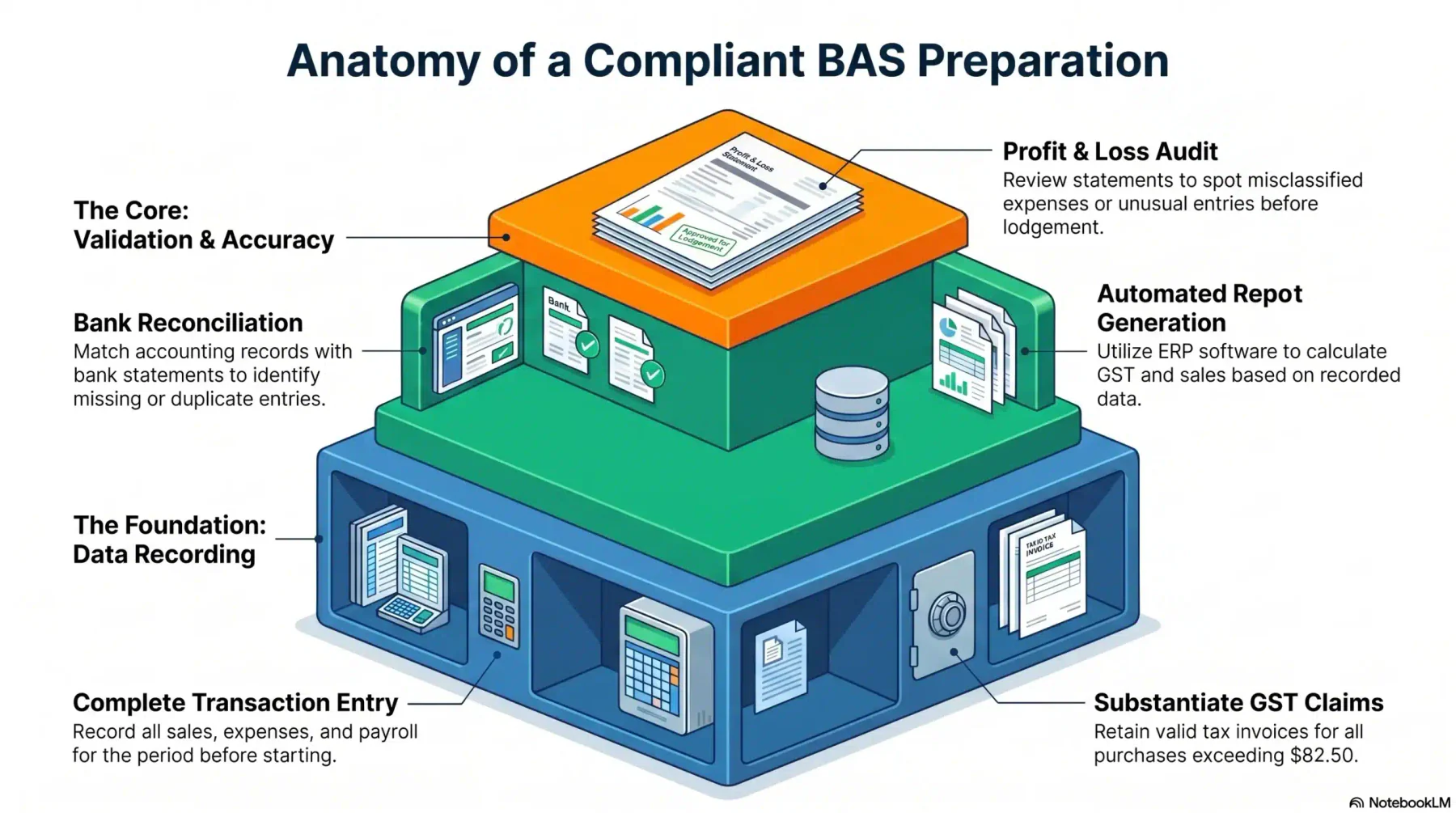
Preparing a BAS Business Activity Statement requires accurate records, careful checks, and a clear understanding of your financial data. Taking a structured approach helps reduce errors and ensures your lodgement is correct and compliant.
1. Get your records up to date
Make sure all transactions for the period are recorded before preparing your BAS, including sales, expenses, and payroll. Also keep valid tax invoices for purchases over $82.50 (including GST) to support any GST claims, as required by the ATO.
2. Run your BAS report from your accounting software
Most businesses use an accounting platform that complies with BAS to generate reports automatically. These tools calculate GST, sales, and purchases based on your records, but you still need to ensure your settings and data entry are correct before relying on the results.
3. Cross-check against your bank balance
Reconcile your accounting records with your bank statements to make sure every transaction is accurate. This helps identify missing payments, duplicates, or errors so your BAS reflects the true financial position of your business.
4. Review your profit and loss statement
Check your profit and loss report to spot any unusual entries or misclassified expenses that could affect your BAS. This step helps ensure GST has been applied correctly and all figures align with your actual business activity.
5. Common mistakes to avoid
Common BAS errors include missing transactions, incorrect GST coding, poor record keeping, and failing to reconcile bank accounts. Avoiding these mistakes helps prevent ATO penalties and ensures smoother, more accurate lodgements.
6. How accounting software automates your BAS preparation
| Manual BAS Process | With Accounting Software |
|---|---|
| Manually tally all GST collected from sales | Auto-categorises taxable vs GST-free transactions |
| Manually calculate input tax credits | Auto-identifies eligible ITC from purchases |
| Check bank statements one by one | Bank feed integration syncs transactions in real time |
| Risk of human error on GST amounts | Auto-validates 10% GST calculation |
| Remember lodgment due dates yourself | Automated deadline reminders & pre-fill to ATO portal |
| Peppol eInvoicing requires separate system | Integrated Peppol-ready e-invoicing module |
Modern accounting software integrates directly with ATO systems, handling GST categorisation, bank reconciliation, and BAS lodgment automatically. With STP Phase 2 mandatory since 2022, the right platform manages both STP reporting and BAS in one ecosystem.
If you are still preparing BAS manually, an integrated accounting solution could reduce that workload significantly. Explore your options at HashMicro Accounting Software.
Lodge Your BAS: Step-by-Step Options
Lodging your BAS Business Activity Statement is the final step in meeting your tax obligations with the ATO. Depending on your business setup, there are several ways to submit and pay your BAS, from doing it yourself online to using a BAS-ready financial system.
1. Lodge online (ATO Online Services / myGov)
You can lodge your BAS directly through the ATO’s Online Services via myGov. This option is commonly used by sole traders and small businesses to submit and manage their tax obligations digitally.
2. Lodge through accounting software
Many businesses lodge BAS using accounting or ERP software that connects directly to the ATO. This helps automate calculations, reduce errors, and streamline the lodgement process.
3. Lodge through a BAS agent or tax agent
A registered BAS or tax agent can prepare and lodge your BAS on your behalf. This is a good option for businesses that want expert support or have more complex tax requirements.
4. Pay your BAS
Once lodged, any amount owed must be paid to the ATO by the due date. Payments can be made online through the ATO portal, bank transfer, or other approved payment methods.
ATO eInvoicing and Peppol: What Australian Businesses Need to Know
eInvoicing is changing how Australian businesses send, receive, and report invoices. Understanding how Peppol works and what it means for your BAS can help you stay ahead of compliance requirements.
1. What is Peppol eInvoicing?
Peppol is an international network for automatic invoice exchange between accounting systems. Australia adopted it as the national eInvoicing standard, with the ATO serving as the local Peppol Authority.
The ATO has been actively encouraging adoption through the ATO Digital Business Plan, positioning eInvoicing as a way to reduce processing costs, speed up payments, and improve data accuracy across the business community.
From 1 July 2022, all Commonwealth agencies are mandated to receive Peppol eInvoices, meaning any business supplying federal government agencies needs to be Peppol-ready. Refer to the ATO’s official eInvoicing resources for guidance on Peppol adoption in Australia.
2. How does eInvoicing relate to your BAS?
- eInvoices sent and received through the Peppol network are automatically recorded in your accounting system, meaning the data is already available and structured when it comes time to prepare your BAS lodgment.
- Automated invoice capture reduces manual data entry, which directly lowers the risk of GST calculation errors that commonly cause BAS inaccuracies.
- The ATO can perform real-time data matching between invoices reported by your business and those received by your counterparty, creating a more accurate and verifiable picture of your tax position.
- Consistent, system-generated invoice data reduces discrepancies between your records and the ATO’s, lowering the risk of audit triggers from mismatched figures.
3. Peppol B2G mandate: timeline for Australian businesses
- 2019: ATO announced Peppol as Australia’s national eInvoicing standard, signalling a long-term shift away from PDF and email-based invoicing.
- July 2022: Mandate took effect. All Commonwealth entities are required to receive Peppol eInvoices, and businesses supplying federal government agencies must be Peppol-ready from this date.
- 2023 to 2024: Expansion continued into state government procurement, with NSW, VIC, and QLD progressing their own eInvoicing programs. B2B adoption was also encouraged across industries.
- 2025 onwards: ATO is actively promoting voluntary adoption among small and medium businesses through compatible accounting software integrations.
- Future: Mandatory B2B eInvoicing remains a likely trajectory as Australia follows global trends seen in the EU, Singapore, and New Zealand.
4. Does your business need to adopt Peppol eInvoicing?
- ✅ You supply Commonwealth or federal government agencies: Peppol readiness is mandatory. Your accounting system must be able to send eInvoices through the Peppol network.
- ✅ You supply state government entities in NSW, VIC, QLD, or other states: Check each state’s current mandate status, as requirements vary and are expanding.
- ✅ You process more than 100 invoices per month: Adopting eInvoicing now reduces processing time, errors, and reconciliation work regardless of mandate status.
- ℹ️ You operate a pure B2C business serving consumers only: eInvoicing is not yet mandatory, but adopting it through compatible accounting software is still good practice for accuracy and future readiness.
Using accounting software that supports Peppol eInvoicing is one of the simplest ways to meet current requirements and prepare for broader adoption without changing your existing workflows.
What Changed with ATO BAS Reporting?
In Australia, BAS reporting has shifted mostly to digital lodgement through the ATO or an Australian financial software instead of paper forms. This has made reporting faster and more convenient for businesses.
The ATO now uses more automation and data matching, so errors and inconsistencies are picked up more easily. This means businesses need to keep more accurate records.
BAS reporting is also more integrated with payroll and accounting systems, helping Australian businesses reduce manual work and stay compliant more easily.
BAS Example: A Step-by-Step Walkthrough
Understanding BAS is easier when you see how the numbers work in a real situation. The example below shows how a simple business calculates and reports GST through its BAS.
1. Example scenario
A business earns $11,000 (including GST) in sales and spends $5,500 (including GST) on business expenses during a quarter. This is a simple setup commonly used to show how BAS works in practice.
2. Calculate GST
From these figures, GST collected from sales is $1,000 and GST paid on business expenses is $500. These amounts are separated from total sales and costs to work out the tax position.
3. Final BAS result
The business subtracts GST paid from GST collected, meaning it owes $500 to the ATO. This amount is then reported and paid when lodging the BAS.
4. What this means
If GST paid was higher than GST collected, the business would instead receive a refund. This is why accurate record-keeping is important for correct BAS reporting.
Conclusion
The BAS Business Activity Statement is a key requirement for Australian businesses to report and manage their tax obligations with the ATO. It brings together GST, PAYG, and other taxes into one regular report.
By understanding what to report, when it’s due, and how to prepare it, businesses can avoid penalties and stay compliant. Using accurate records and the right tools also makes the process much smoother.
With proper preparation and timely lodgement, BAS becomes a manageable part of running a business rather than a stressful task.
Get free consultation with us for free to get clarity on BAS lodgement, avoid costly mistakes, and stay compliant with the ATO.

Frequently Asked Question
Yes, you can lodge your own BAS using ATO Online Services or accounting software, and some businesses also use a BAS agent for help.
BAS is used to report and pay business taxes like GST and PAYG to the ATO.
A BAS is lodged regularly to report business taxes, while a tax return is lodged yearly to report total income and final tax.
You may get penalties or interest charges from the ATO if you lodge your BAS late.
A BAS return is another name for the Business Activity Statement you lodge with the ATO.