















Many companies face challenges like isolated data, inefficiencies, and scalability issues, often worsened by on-premises ERP systems. These systems require dedicated servers, leading to high maintenance costs, complex disaster recovery, and limited access.
To solve these problems between cloud-based ERP and on-premises ERP, Cloud ERP systems have become a solution. They remove the need for special hardware, cutting costs and risks. This type of ERP also provides real-time data processing and easy integration, helping streamline operations and make data more accessible.
This article explains what cloud ERP is, how it works, and why it might be the right solution for your business needs.
Key Takeaways
Cloud ERP (Enterprise Resource Planning) is a system hosted and managed by cloud-based data center vendors.
When considering the adoption of Cloud ERP, businesses can expect a range of significant benefits that directly address common operational challenges.
Cloud ERP is composed of several integrated components that are crucial for streamlining various business operations.
Three main types of ERP systems have different technological structures and implementation methods.
HashMicro Cloud ERP stands out as a comprehensive solution, offering customizable and integrated features that meet diverse business needs.
What is Cloud ERP Software and How Does It Work?
Cloud ERP software, short for Cloud-based Enterprise Resource Planning, is a system hosted and managed by cloud-based data center vendors, who handle applications, databases, servers, security, and disaster recovery. It ranks among the best ERP software choices for companies needing full ERP access via the internet, without on-premises hardware. The key steps in how it works include:
- Hosting and accessibility: The Enterprise Resource Planning is hosted on cloud infrastructure, making it accessible from anywhere with internet connectivity. This eliminates the need for local installations and maintenance.
- Integration and centralization: Cloud-based ERP integrates various business functions into a single system, centralizing data from departments such as finance, sales, and human resources. This integration facilitates seamless data flow and real-time updates across the company.
- Scalability and management: The system offers scalable resources, allowing businesses to adjust their usage based on current needs without significant capital investment. The cloud provider handles all maintenance, including software updates and security patches, reducing the IT workload for businesses.
This model leverages modern ERP cloud computing technologies to deliver a flexible, efficient, and secure ERP solution that meets the dynamic needs of contemporary enterprises, including inventory, accounting, human resources, and so on.
Why Philippine Businesses Are Moving to Cloud ERP Now

Philippine businesses are moving to Cloud ERP now because energy volatility is making office based systems less practical. In March 2026, the government moved to contain power price spikes, with officials warning electricity prices could jump and later suspending spot power sales during the energy emergency. That is pushing companies to adopt systems that are easier to access, maintain, and scale without heavy reliance on onsite infrastructure.
Cloud ERP is also becoming more relevant as work arrangements grow more flexible. On March 17, 2026, DOLE said private employers may adopt flexible schemes, including a compressed 4-day workweek, which makes real-time access more important for approvals, reporting, and coordination across teams.
To explore the best solutions for your business, check out HashMicro’s ERP software. Discover our pricing schemes below and find the right package for your needs.

Benefits and Limitations of Cloud ERP Software
When considering the adoption of Cloud ERP systems, businesses can expect a range of significant benefits that directly address common operational challenges. Here, we explore how Cloud ERP systems turn potential drawbacks into advantages.
1. Enhanced data security
While data security is often a concern with digital systems, Cloud ERP systems provide advanced security measures including data encryption, regular security audits, and strict compliance with international data protection regulations. This capability ensures data is securely managed and protected against breaches and losses. This makes it especially valuable for high-volume retail businesses such as supermarkets that process thousands of daily transactions across inventory, supplier, and financial records.
2. Reliable access with intelligent connectivity solutions
Cloud ERP systems rely on internet connectivity but excel at delivering consistent, reliable access. Providers design these systems to minimize latency and often include offline functionalities that allow users to keep working even when the internet is down, syncing data once connectivity is restored.
3. Seamless system integration
These systems offer APIs and other tools to facilitate seamless communication between diverse systems and applications. This integration capability enhances business efficiency by allowing different systems, such as an accounting system, to interact effectively, thereby streamlining processes and reducing operational silos.
4. Cost-effective implementation and maintenance
Cloud ERP systems are inherently more cost-effective over time. The cloud provider manages all updates and server maintenance, significantly reducing IT overhead and ongoing operational costs. Additionally, Cloud ERP is supported by extensive training resources, which help reduce the time and expense of training employees.
5. Flexible and customizable solutions
Cloud-based office management software means providing customizable and modular solutions tailored to meet specific business needs. Despite some concerns about customization limits, Cloud ERP solutions offer flexibility that allows businesses to enhance their operations with configurations that support unique processes and goals.
6. Remote Access and Collaboration for Hybrid Teams
Cloud ERP enables businesses to support work-from-home and distributed team setups by providing secure remote access to all business systems through the internet without relying on office-based infrastructure. With real-time data synchronization and multi-user collaboration, every team member works from the same up-to-date information simultaneously, reducing delays and keeping operations connected and productive regardless of location.
Components of Cloud ERP

Cloud ERP software is composed of several integrated components that are crucial for streamlining various business operations. Each component plays a critical role in ensuring that different areas of business operations are integrated smoothly to enhance efficiency.
- Financial Management: This module is essential for handling all financial aspects, including accounting, financial reporting, and compliance. It ensures that financial operations are transparent and auditable and provides real-time insights.
- Project Management: This functionality enables organizations to plan, execute, and monitor project status. It helps in resource allocation, budget management, and team collaboration, ensuring projects are delivered on time and within budget.
- Supply Chain Management (SCM): SCM optimizes the flow of goods and services from manufacture to market. It integrates procurement, inventory management, and logistics to ensure the right products are delivered at the right time.
- Customer Relationship Management (CRM): CRM systems within a cloud-based ERP help businesses manage customer interactions, track sales leads, conduct marketing campaigns, and improve customer service by offering a comprehensive view of customer activities.
- Human Capital Management (HCM): HCM solutions manage all aspects of employee administration from hiring and onboarding to payroll, benefits administration, and performance management, ensuring the workforce is engaged and efficiently managed.
Together, these components form a cohesive system that supports seamless data flow and connectivity between different business functions, enhancing overall operational efficiency and decision-making capabilities.
The Differences Between Cloud ERP, On-Premises ERP, and Hybrid ERP
The three main types of ERP systems, Cloud, On-Premise, and Hybrid, have different technological structures and implementation methods. Here is a detailed explanation of each system to help you choose what best suits your business objectives.
| Category | Cloud ERP | On-Premises ERP | Hybrid ERP |
|---|---|---|---|
| Definition | Web-based ERP hosted online with remote access; maintenance is provider-managed. | Installed on the company’s hardware, maintained by internal IT. | It combines cloud and local hosting and offers flexible management. |
| Strengths | It enables users to access the system from any location via the internet, delivers regular vendor-managed updates, integrates all modules seamlessly in real time, and automatically backs up data to the cloud to prevent loss. | It gives businesses full control over the ERP system and its infrastructure, enforces robust in-house data security, and operates independently of internet connectivity since all processing runs on local servers. | It features a fallback mechanism that switches to a local server during internet disruptions and syncs data to the cloud when connectivity is restored. |
| Weaknesses | Requires a stable internet connection, business data is stored on third-party vendor servers, and licensing fees can accumulate over several years. | High costs for servers and hardware, risk of data loss, and requires IT team for installation, troubleshooting, and updates. | Cannot continuously perform real-time synchronization, can only implement specific modules, and potential data conflicts between online and offline modes. |
| Suitable for | Companies with stable internet connections, lacking IT teams, and seeking ease regarding accessibility and flexibility. | Companies with less stable internet connections, adequate IT teams, and want complete control over their ERP system. | Companies located in areas with internet limitations, have adequate IT teams, but want to use cloud systems. |
HashMicro as the Best Cloud ERP Software for Enterprise
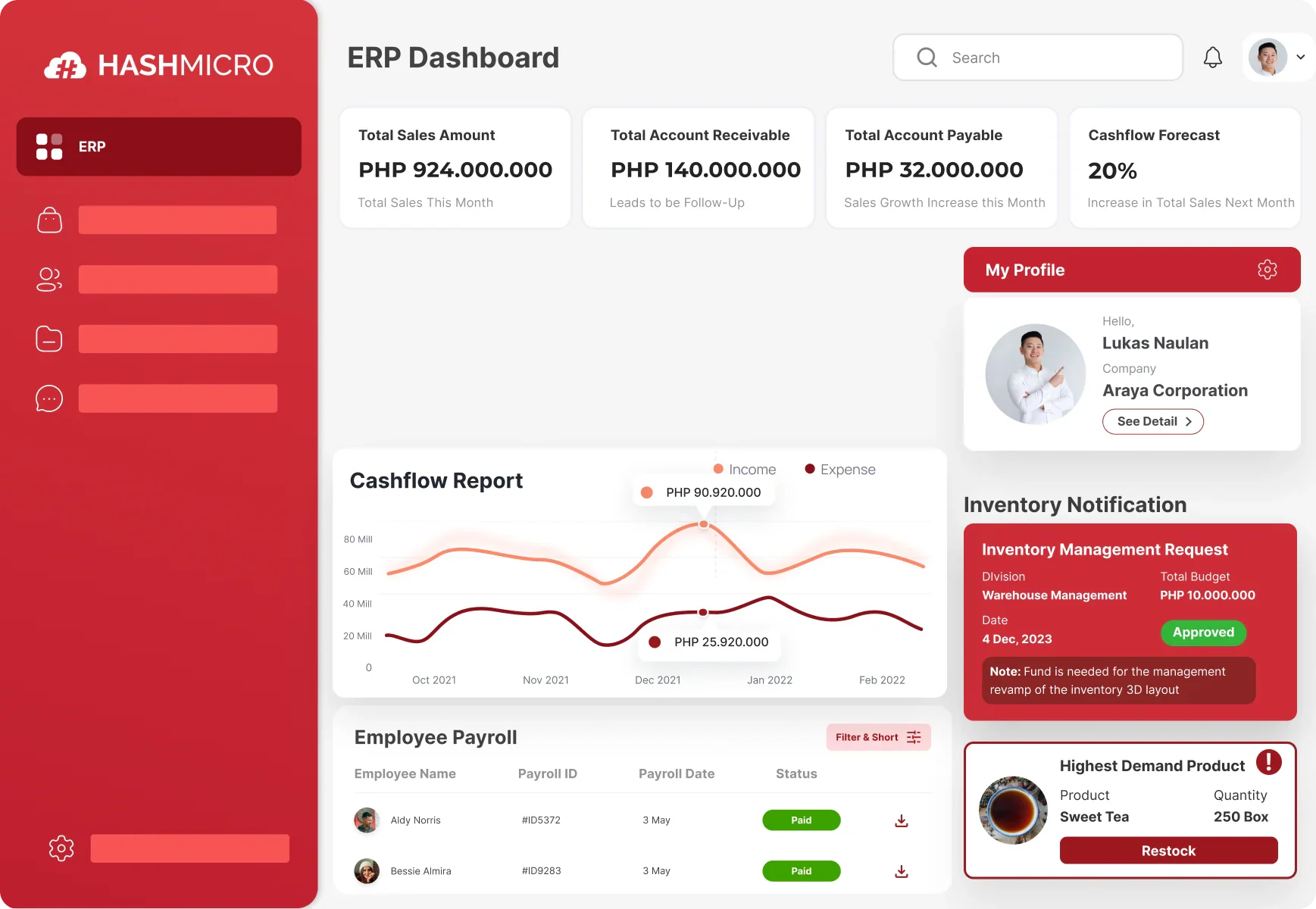
HashMicro cloud ERP software is a trusted cloud-based ERP system built for enterprises. It ensures regulatory compliance and supports hybrid online-and-local operation so businesses can tailor the system to their own security and reliability needs.
It enables single-click access to all business data from any laptop or mobile device. Book a free consultation with HashMicro's expert team to experience the full cloud ERP system firsthand.
Let’s take a closer look at how HashMicro Cloud ERP can streamline your business operations:
- Built-in BI (Business Intelligence): The integrated BI feature enables comprehensive data analysis, aiding in better decision-making. With this tool, businesses can access data visualizations and real-time reports.
- Dashboard Ninja: HashMicro provides customisable dashboards to monitor KPIs and other essential metrics efficiently. Users can easily organize and visualize critical data for daily operations.
- Sheet Management: This feature simplifies document tracking and management by seamlessly integrating essential documents into the ERP system for better access and management.
- Mobile Apps: HashMicro ERP mobile apps allow remote access to the ERP system, ensuring you stay connected and productive even while traveling.
- Multi-Language Support: Multi-language support in HashMicro ERP ensures the system can be effectively accessed and used by a global team, helping to reduce language barriers in multinational businesses.
- AI-Generated Report & Explainer: AI-generated reports and explanations provide in-depth analysis, helping to understand complex trends and automatically generating reports.
HashMicro’s end-to-end solution encompasses all essential ERP functionalities, from financial management to supply chain operations, providing a comprehensive toolset that enhances operational efficiency and decision-making.
Conclusion
Once businesses understand what cloud ERP is and its core capabilities, implementing a system becomes a clear strategic move for enterprises seeking to enhance their operational efficiency and data accessibility. It provides a scalable, flexible, cost-effective solution that streamlines business operations, improves accessibility, and facilitates real-time decision-making.
HashMicro Cloud ERP stands out as a comprehensive solution, offering customizable and integrated features that meet diverse business needs. Its end-to-end capabilities, from financial management to supply chain operations, ensure comprehensive support for your business growth.
Discover how HashMicro can transform your business operations and experience the powerful features firsthand. Try the system now!
FAQ for Cloud ERP
Cloud ERP is a broad term for any ERP system hosted on remote servers and accessed via the internet, while SaaS ERP is a specific delivery model where the cloud ERP software is subscription-based and fully managed by the vendor. Most modern cloud-based ERP solutions serving Philippine enterprises today are SaaS by default.
Cloud ERP software cost depends on the vendor, number of users, and modules selected. In the Philippines, monthly subscription fees typically range from ₱1,500 to ₱15,000+ per user. Additional costs may include implementation, data migration, and training. Unlike on-premise ERP, the cloud ERP system eliminates large upfront hardware investments.
Cloud ERP implementation typically takes 1 to 6 months. Small Philippine businesses with straightforward workflows can go live in 4–8 weeks, while larger enterprises integrating multiple departments may need 3–6 months. The number of cloud ERP modules deployed, data readiness, and vendor support are the key factors affecting timeline.
Existing data is migrated to a cloud ERP system through a structured process: extraction from legacy software, data cleansing and reformatting, field mapping to the new ERP structure, and post-import validation. Most cloud-based ERP vendors provide dedicated migration tools and onboarding support to ensure accuracy and minimize operational disruption during the transition.
When choosing cloud ERP software, businesses should evaluate module coverage, scalability, local compliance support (BIR, SSS, PhilHealth for Philippine companies), integration capability, total cost of ownership, and post-implementation support quality. A free consultation or product demo helps verify whether the cloud ERP system fits the company's specific industry workflow before committing.