




Property management software for Australian businesses is a platform for managing properties, leases, rent collection, arrears, maintenance, inspections, tenant and owner communication, trust accounting, and portfolio reporting in one workflow.
This guide compares property management software for residential agencies, commercial portfolios, landlords, and multi-property teams in Australia, with emphasis on choosing a system that fits portfolio size and operational complexity.
Key Takeaways
Learn how property management software helps businesses centralise leasing, maintenance, reporting, and tenant management within one connected platform.
Property management software helps Australian businesses automate rent collection, maintenance, inspections, and tenant communication.
The best property management software improves operational efficiency by centralising property, tenant, and financial data in one platform.
Different property management platforms are designed for different operational priorities, from trust accounting and lease tracking to maintenance workflows and tenant communication. The shortlist below highlights several widely used property management software solutions for Australian real estate and property businesses.

Best Because
Residential property management and trust accounting platform.

Best Because
Scalable property management and reporting platform.
Best Because
Commercial lease and portfolio management software.



Best Because
Property accounting and maintenance management software.
What is Property Management Software?
Property management software Australia businesses use helps manage leases, rent collection, maintenance requests, and tenant communication within one platform. It centralises daily property operations, improves visibility, and streamlines reporting processes.
Many systems also support trust accounting, inspections, compliance tracking, and property portfolio management. Some real estate software platforms additionally integrate with accounting, CRM, and maintenance workflows to create a more connected property management process.
For businesses managing multiple commercial properties, enterprise property management software centralises lease management, rent reviews, outgoings reconciliation, and financial reporting across all locations.
Why Australian Property Businesses Need Property Management Software
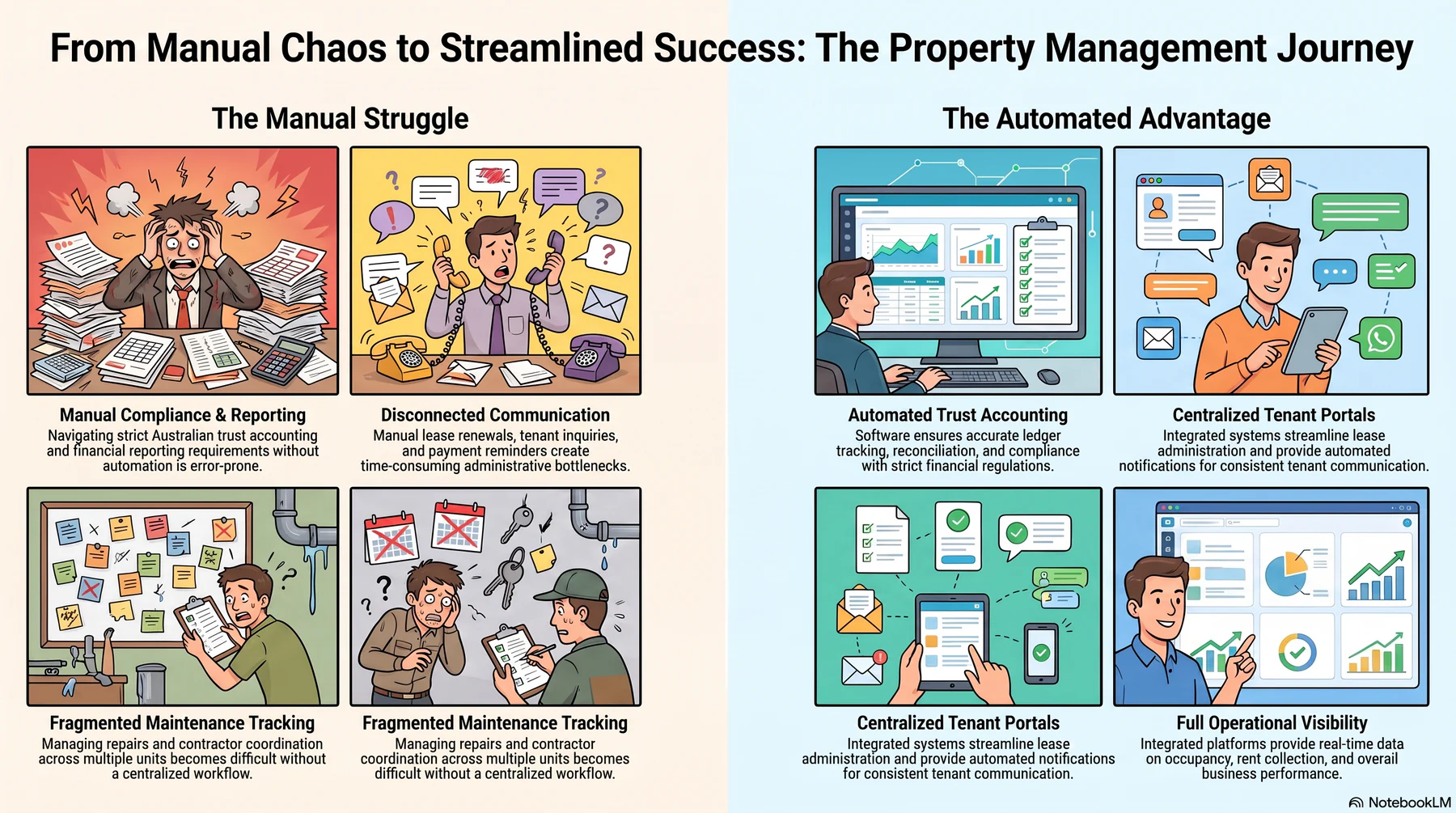
Property businesses manage lease administration, maintenance coordination, tenant communication, and financial reporting across multiple properties. As operations grow, manual processes can reduce operational visibility and reporting efficiency.
1. Trust accounting and compliance
Australian property businesses must comply with strict trust accounting and financial reporting requirements. Property management software helps automate reporting, ledger tracking, and reconciliation processes more accurately.
However, Australian compliance requirements vary by state, entity and workflow. Confirm current obligations with the relevant official authority before relying on software guidance.
2. Lease and tenant management
Managing lease renewals, rent schedules, tenant records, and occupancy updates manually can become time-consuming. Software helps centralise lease administration and tenant communication within one system.
3. Maintenance tracking
Manage repairs, contractor coordination, and work order progress more efficiently. Businesses running a heavy repair volume may also want dedicated property maintenance software, which handles tradie assignment and job tracking in more depth than a general platform.
4. Tenant communication
Responding to tenant enquiries, maintenance updates, and payment reminders manually can slow operations. Tenant portals and automated notifications help improve communication consistency.
5. Operational visibility and reporting
Disconnected systems can make property reporting slower and less accurate. Integrated platforms help management teams monitor occupancy, maintenance activity, rent collection, and operational performance more efficiently.
"Property operations become easier to scale when leasing, maintenance, tenant communication, and financial reporting work within one connected system instead of disconnected tools. "
What We Looked for in the Best Property Management Software
We compare these platforms by workflow coverage, portfolio fit, accounting and reporting depth, maintenance and inspection handling, Australian relevance, usability, pricing transparency, and documented limitations. "Best" means best fit for the stated use case, not a universal ranking.
- Property and portfolio management: How effectively the platform manages properties, units, leases, tenants, and occupancy across a growing portfolio.
- Trust accounting and financial management: Support for trust accounting, rent collection, owner statements, financial reporting, and compliance requirements.
Rent collection, arrears, and reconciliation: How the platform handles rent schedules, payment processing, arrears tracking, receipting, and reconciliation against the ledger.
- Maintenance and work order management: The ability to track maintenance requests, assign tasks, monitor progress, and control repair costs.
Tenant and owner communication or portals: Whether tenants and owners can access statements, request maintenance, and view property information through a portal or app rather than contacting the office.
- Automation and operational efficiency: Features that reduce manual administration, including automated reminders, invoicing, lease management, and rent processing.
- Reporting and business visibility: Access to real-time dashboards, portfolio performance metrics, vacancy tracking, and financial insights.
- Integrations and scalability: Compatibility with accounting systems, CRM platforms, payment gateways, and the ability to support portfolio growth.
- Ease of use and user experience: How easy the software is to implement, learn, and use for property managers, tenants, landlords, and maintenance teams.
- Commercial Lease Complexity and Outgoings Management: Commercial leases are more complex than residential ones. We prioritised software that supports lease management, outgoings reconciliation, CAM tracking, and multi-site financial reporting.
How to Choose Property Management Software in Australia
The right property management software depends on the type of portfolio you manage, how your team operates, and the workflows that need the most control. Use the guide below to narrow your shortlist before comparing individual platforms. Confirm each capability, integration, price and compliance requirement with the vendor for your Australian operating context.
| Business model | Best-fit workflow | Must-have capabilities | Verify before purchase |
|---|---|---|---|
| Residential agency | Manage rental properties, leases, rent collection, tenants, and maintenance for owners. | Lease and tenant records; rent and arrears tracking; trust accounting; maintenance; inspections; tenant and owner communication. | State-specific trust accounting; owner statements; payment handling; portal and mobile access; migration; pricing. |
| Commercial / mixed portfolio | Manage leases, rent reviews, outgoings, renewals, maintenance, and reporting. | Lease terms and dates; rent reviews; outgoings reconciliation; work orders; portfolio reporting; role-based access. | Commercial lease features; multi-entity reporting; approvals; audit trail; integrations; implementation scope. |
| Independent landlord / small portfolio | Track properties with simple lease, rent, document, and maintenance workflows. | Property and tenant records; rent tracking; reminders; maintenance logs; basic reporting; support. | Total cost; user and property limits; data export; accounting workflow; support availability. |
| Enterprise / multi-location | Standardise property operations, reporting, and controls across teams, entities, or locations. | Multi-property and multi-entity support; permissions; automation; consolidated reporting; audit history; implementation and training. | Scalability; security and privacy; service levels; data hosting; migration plan; verified integrations. |
Quick Comparison of the Best Property Management Software in Australia
| # | Software | Best fit | Portfolio fit | Rent & arrears | Trust accounting | Maintenance | Portal & communication | Pricing |
|---|---|---|---|---|---|---|---|---|
| 1 | PropertyMe | AU residential agencies | Residential; mixed scope to verify | Collection, arrears & reconciliation | Trust accounting & reporting | Maintenance & inspections | Owner/tenant portal | From around AUD $175/month |
| 2 | MRI Property Tree | AU residential & mixed operations | Residential & mixed; commercial scope to verify | Rent, arrears & ledger | Trust accounting & reporting | Maintenance & inspections | Owner/tenant communication | Custom quote based on portfolio size and users |
| 3 | Re-Leased | Commercial property teams | Commercial & mixed-use | Rent schedules & arrears | Commercial reporting & accounting | Work orders & inspections | Tenant communication & portal | Custom quote based on portfolio size and modules |
| 4 | Console Cloud | AU residential agencies | Residential; mixed scope to verify | Collection, arrears & trust workflow | Trust accounting & reporting | Maintenance & inspections | Owner/tenant portal | Custom pricing based on portfolio size |
| 5 | HashMicro | ERP-linked property operations | Residential/commercial fit to verify | Rent, arrears & reconciliation | Accounting, reporting & audit | Maintenance & inspections | Tenant/owner access | Custom quote based on modules, users and implementation scope |
| 6 | Managed App | AU property managers | Residential; commercial scope to verify | Payments, collection & arrears | Reporting & accounting | Maintenance requests | Tenant/owner app or portal | Custom quote based on operational requirements |
| 7 | Ailo | Residential property businesses | Residential; commercial scope to verify | Payments, collection & arrears | Reporting & trust requirements | Maintenance workflow | Renter/owner/manager app | Custom pricing based on portfolio size |
| 8 | RentingSmart | Landlords & small portfolios | Residential/small portfolio | Rent tracking & arrears | Basic reporting & accounting | Maintenance & inspections | Tenant communication/portal | From around AUD $19/month |
| 9 | Buildium | Residential & commercial businesses | Residential & commercial; AU availability to verify | Online payments & arrears | Property accounting & reporting | Maintenance & inspections | Resident/owner portal | From around AUD $89/month |
| 10 | TenantCloud | Landlords & small-mid managers | Residential; commercial scope to verify | Online rent & arrears | Accounting/reporting depth | Maintenance & inspections | Tenant/owner portal | Free plan; paid from around AUD $18/month |
For Australian property managers, disconnected systems and manual processes can lead to inefficiencies, delays, and limited visibility across the portfolio
Managing properties is easier with the right tools. HashMicro's property management software centralises your operations, while Hashy helps you quickly access property, tenant, and financial information. Book a free demo to see how they can simplify your daily property management.


Managing properties is easier with the right tools. HashMicro's property management software centralises your operations, while Hashy helps you quickly access property, tenant, and financial information. Book a free demo to see how they can simplify your daily property management.
Managing properties is easier with the right tools. HashMicro's property management software centralises your operations, while Hashy helps you quickly access property, tenant, and financial information. Book a free demo to see how they can simplify your daily property management.
Managing properties is easier with the right tools. HashMicro's property management software centralises your operations, while Hashy helps you quickly access property, tenant, and financial information. Book a free demo to see how they can simplify your daily property management.






10 Best Property Management Software Australia 2026
The best property management software depends on portfolio size, operational complexity, and business requirements. Some platforms focus on residential leasing, while others support enterprise operations or commercial portfolio management.
1. PropertyMe
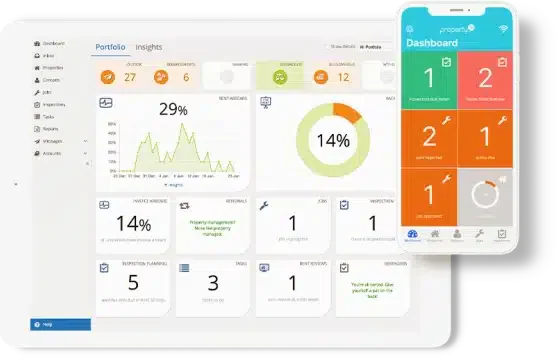
PropertyMe is one of Australia’s most widely used cloud-based property management platforms designed for residential property managers and real estate agencies. The platform helps businesses manage trust accounting, inspections, maintenance workflows, tenant communication, and operational reporting within one system.
Its automation tools and cloud-based infrastructure make it particularly useful for agencies looking to reduce manual administration and improve operational efficiency across growing property portfolios. PropertyMe also offers mobile apps and tenant portals that help streamline communication between tenants, owners, and property managers.
Key Features:
- Trust Accounting: Automate reconciliation and financial workflows.
- Maintenance Tracking: Manage repairs and contractor workflows.
- Inspection Tools: Conduct mobile inspections and reporting.
- Tenant Portals: Centralise tenant communication and payment tracking.
| Pros | Cons |
| ✓ Strong trust accounting and workflow automation. | ×Advanced pricing tiers can become expensive. |
| ✓ Very popular among Australian residential agencies. | ×Less suitable for enterprise-level mixed portfolios. |
| ✓ Easy-to-use interface and mobile accessibility. | ×Some advanced features require higher plans. |
Pricing: Plans start from around AUD $175/month for smaller portfolios, with higher tiers available for larger agencies and advanced features.
Best for: Residential property agencies needing trust accounting and workflow automation.
2. MRI Property Tree
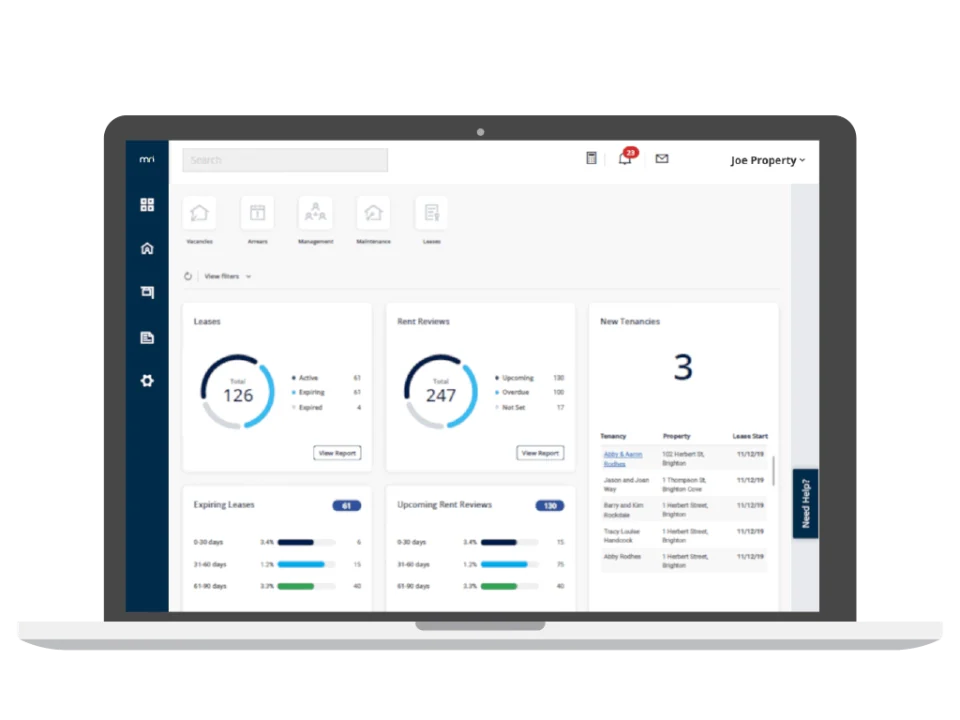
MRI Property Tree is a cloud-based property management platform designed for medium to large property businesses managing residential or mixed property portfolios. The platform combines trust accounting, workflow automation, inspections, maintenance management, and operational reporting within one system.
The software is particularly strong in scalability, reporting visibility, and integration capabilities, making it suitable for agencies handling larger rent rolls and operational complexity. MRI Property Tree also supports owner and tenant portals, API integrations, and operational dashboards for portfolio monitoring.
Key Features:
- Trust Accounting: Support compliant reconciliation and reporting workflows.
- Workflow Automation: Automate inspections, communication, and transactions.
- Tenant Portals: Provide self-service access for tenants and owners.
- Operational Reporting: Monitor arrears, vacancies, and portfolio performance.
| Pros | Cons |
| ✓ Strong reporting and operational visibility tools. | ×Pricing requires direct consultation. |
| ✓ Suitable for scaling property businesses. | ×Some automation features require add-ons. |
| ✓ Good integration and portfolio management capabilities. | ×Can feel complex for smaller agencies. |
Pricing: Custom quote-based pricing depending on portfolio size, users, and operational requirements.
Best for: Medium to large property businesses requiring automation, reporting, and operational scalability.
3. Re-Leased
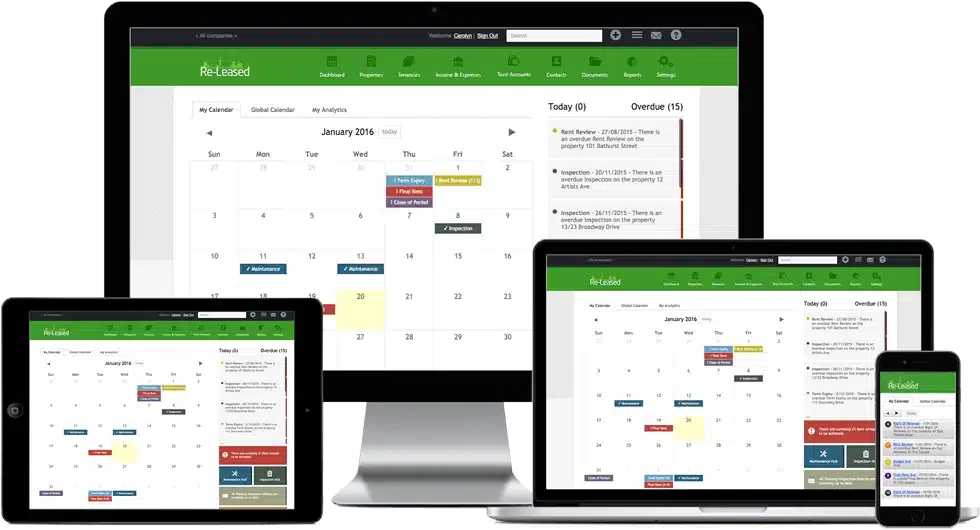
Re-Leased is a cloud-based property management platform designed primarily for commercial and mixed-use property portfolios.
The software helps property businesses manage lease administration, maintenance workflows, tenant communication, and financial reporting through a centralised platform with a focus on long-term asset valuation.
Its strong integration with platforms such as Xero and QuickBooks makes it particularly useful for businesses requiring operational visibility and accounting connectivity across commercial property operations. Re-Leased also offers workflow automation and portfolio dashboards that help reduce administrative workload.
Key Features:
- Lease Management: Track lease terms, renewals, and rent reviews.
- Maintenance Workflows: Manage repairs and contractor coordination.
- Accounting Integration: Connect with Xero and QuickBooks.
- Operational Dashboards: Monitor portfolio activity and reporting.
| Pros | Cons |
| ✓ Strong commercial property management capabilities. | ×Pricing is not publicly transparent. |
| ✓ Excellent accounting integrations. | ×Less suitable for small residential portfolios. |
| ✓ User-friendly dashboards and automation tools. | ×Some users report occasional system lag. |
Pricing: Custom quote-based pricing depending on portfolio size and modules.
Best for: Commercial property managers and mixed-use portfolio businesses.
4. Console Cloud
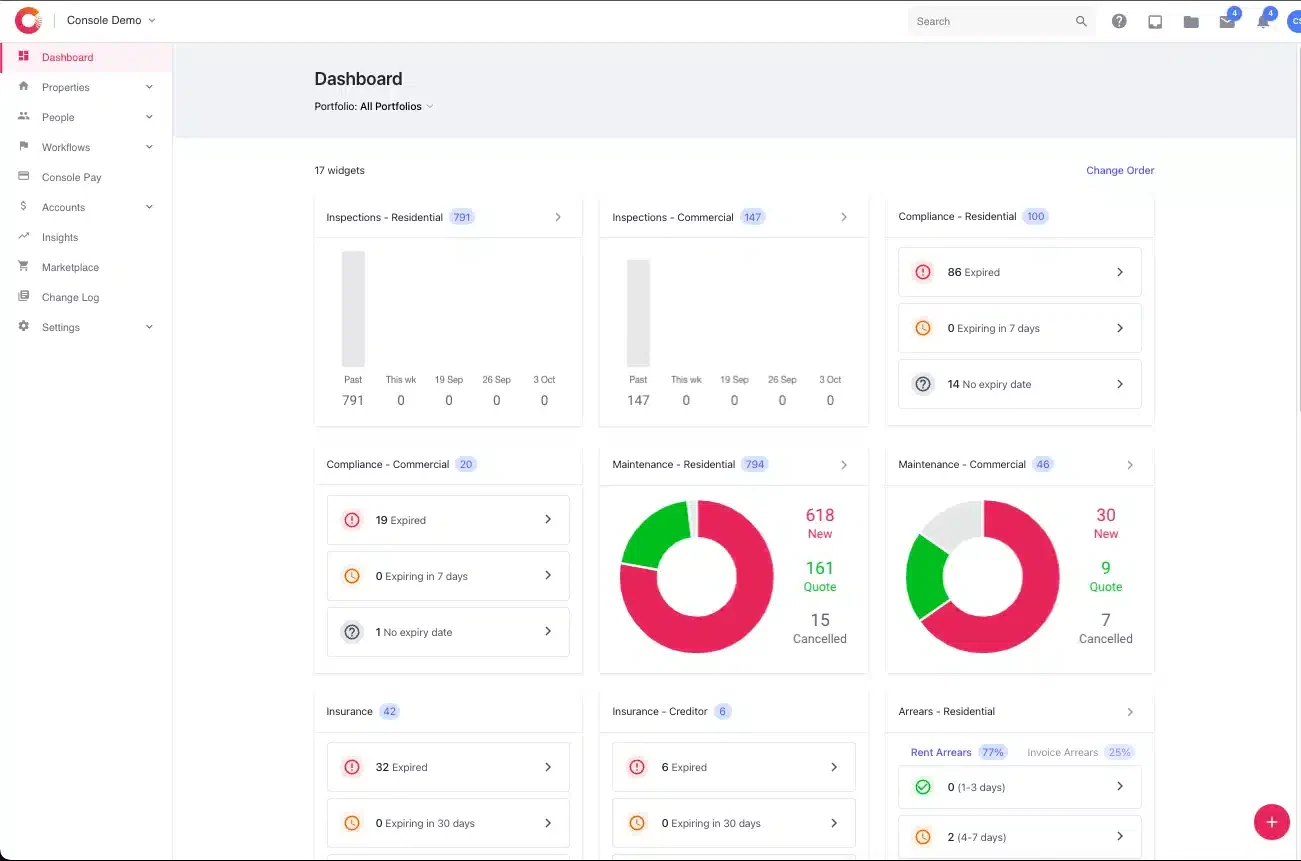
Console Cloud is a cloud-native property management platform designed for residential real estate agencies and property managers. The software focuses heavily on workflow automation, trust accounting, maintenance management, and tenant communication to help agencies streamline daily operations.
Its automation-driven workflows make it particularly useful for agencies looking to reduce repetitive administration and improve operational efficiency across growing rent rolls. Console Cloud also supports mobile inspections, maintenance tracking, and integrated financial workflows.
Key Features:
- Workflow Automation: Automate inspections, communication, and recurring tasks.
- Trust Accounting: Manage reconciliation and financial reporting workflows.
- Maintenance Management: Track repairs, contractor activity, and work orders.
- Mobile Inspections: Conduct inspections through mobile-enabled tools.
| Pros | Cons |
| ✓ Strong workflow automation capabilities. | ×Pricing is not publicly available. |
| ✓ Good operational visibility across portfolios. | ×Can require onboarding time for new users. |
| ✓ Suitable for scaling residential agencies. | ×Advanced features may increase implementation complexity. |
Pricing: Custom pricing depending on portfolio size and operational requirements.
Best for: Residential property agencies focused on workflow automation and operational efficiency.
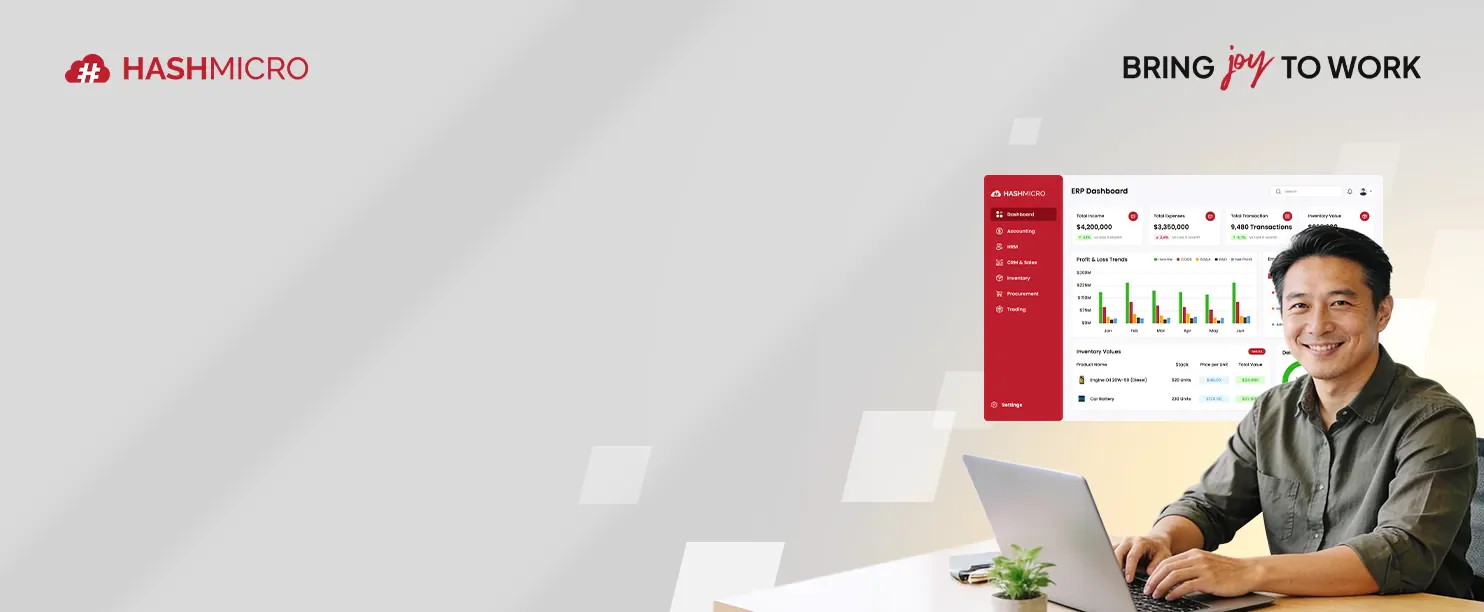
5. HashMicro
HashMicro is a cloud-based ERP platform that helps property businesses manage leasing, maintenance, accounting, procurement, CRM, and operational reporting within one system. Its modular structure makes it suitable for property companies requiring integrated operational visibility across departments.
The platform is particularly useful for medium to large property businesses managing multiple properties, maintenance workflows, procurement processes, and financial operations simultaneously. HashMicro also supports workflow automation and customisable reporting for property portfolio management.
Key Features:
- Property Management: Manage leases, tenant records, and property operations.
- Maintenance Tracking: Monitor repairs, work orders, and contractor activity.
- ERP Integration: Connect accounting, procurement, CRM, and finance workflows.
- Operational Reporting: Access centralised dashboards and portfolio reporting.
- AI Vacancy Risk Detection: Hashy AI monitors lease timelines and tenant behaviour to flag renewal risks early, giving property managers time to act before occupancy drops.
- Smart Work Order Prioritisation: Hashy AI ranks maintenance requests by urgency and asset criticality, so teams can resolve high-impact issues without manually sorting backlogs.
| Pros | Cons |
| ✓ Integrated ERP and property management workflows. | ×Pricing is not publicly available. |
| ✓ Strong operational and financial visibility tools. | ×Implementation scope may vary based on customisation. |
| ✓ Supports scalable property portfolio management. | ×Advanced modules may require onboarding support. |
Pricing: Custom quote-based pricing depending on modules, users, and implementation scope.
Best for: Medium to large property businesses needing integrated ERP and operational management.
If you’re considering implementing HashMicro for your business, you can click the banner below to discover the pricing plan.
6. Managed App
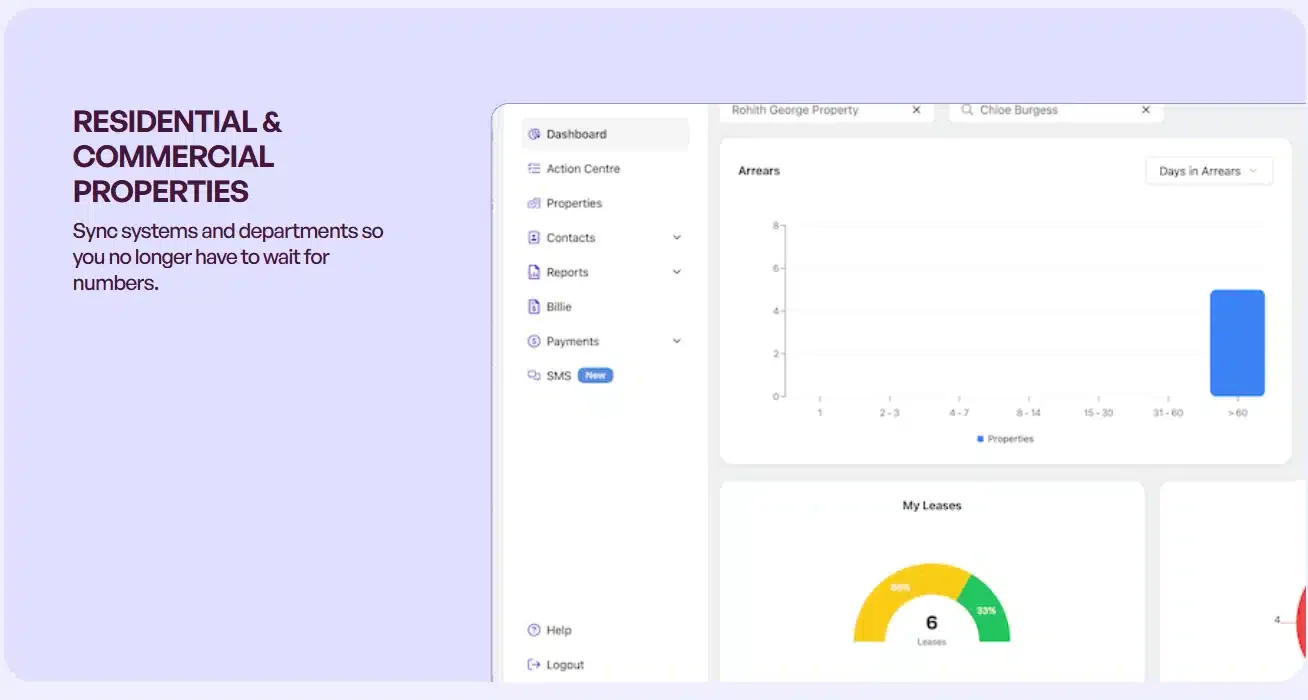
Managed App is an Australian property management platform focused on automating rent payments, maintenance workflows, and tenant communication. The platform is designed to simplify operational processes for property managers while improving payment visibility for owners and tenants.
One of its most distinctive features is its real-time payment distribution model, which helps reduce trust accounting administration and improve payment processing efficiency. Managed App also supports maintenance coordination, inspections, and operational communication through a mobile-friendly platform.
Key Features:
- Rent Automation: Automate rent collection and payment workflows.
- Maintenance Tracking: Manage repairs and contractor coordination.
- Tenant Communication: Centralise messaging and operational updates.
- Operational Visibility: Monitor payments and property activity in real time.
| Pros | Cons |
| ✓ Strong payment automation capabilities. | ×Pricing is not publicly transparent. |
| ✓ Good tenant and owner communication tools. | ×Less suitable for highly complex enterprise operations. |
| ✓ Modern mobile-friendly interface. | ×Some advanced workflows may require onboarding. |
Pricing: Custom quote-based pricing depending on operational requirements.
Best for: Property businesses focused on payment automation and tenant communication.
7. Ailo
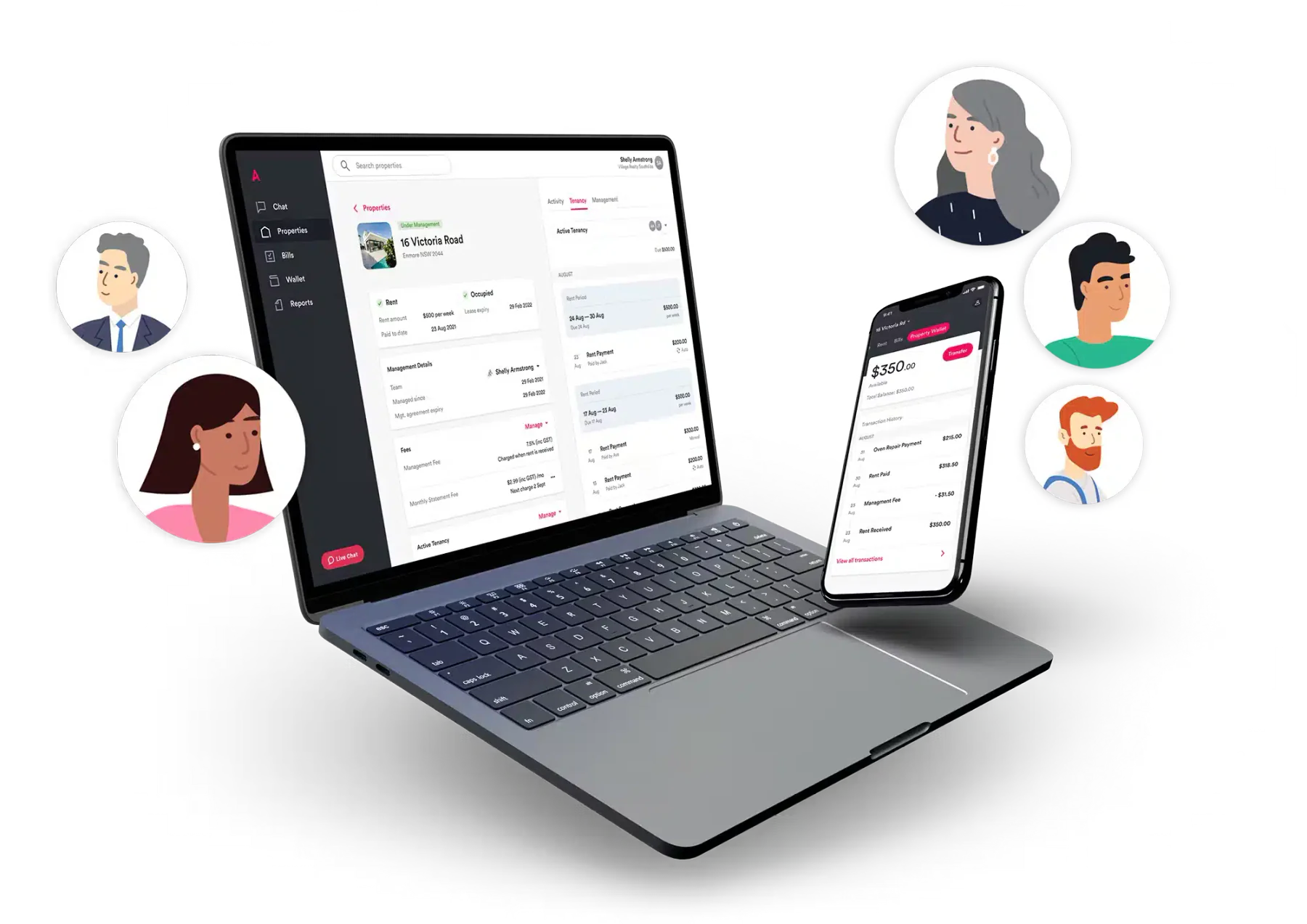
Ailo is a cloud-based property management platform designed to improve payment processing, tenant communication, and operational workflows for residential property businesses. The platform focuses heavily on automation, mobile accessibility, and owner or tenant experience.
Its real-time payment infrastructure and collaborative communication features make it particularly useful for agencies looking to improve operational efficiency and client experience across the complete property lifecycle.
Ailo also supports maintenance workflows, inspections, and financial visibility tools.
Key Features:
- Payment Processing: Support faster rent disbursement workflows.
- Tenant Communication: Centralise communication between tenants and owners.
- Maintenance Tracking: Manage repairs and operational requests.
- Mobile Accessibility: Access workflows and reporting through mobile apps.
| Pros | Cons |
| ✓ Strong payment and communication workflows. | ×Pricing requires consultation. |
| ✓ Modern interface with mobile-first functionality. | ×Primarily focused on residential operations. |
| ✓ Useful automation for property managers. | ×Advanced integrations may vary by plan. |
Pricing: Custom pricing depending on portfolio size and operational requirements.
Best for: Residential property agencies focused on tenant experience and payment automation.
8. RentingSmart
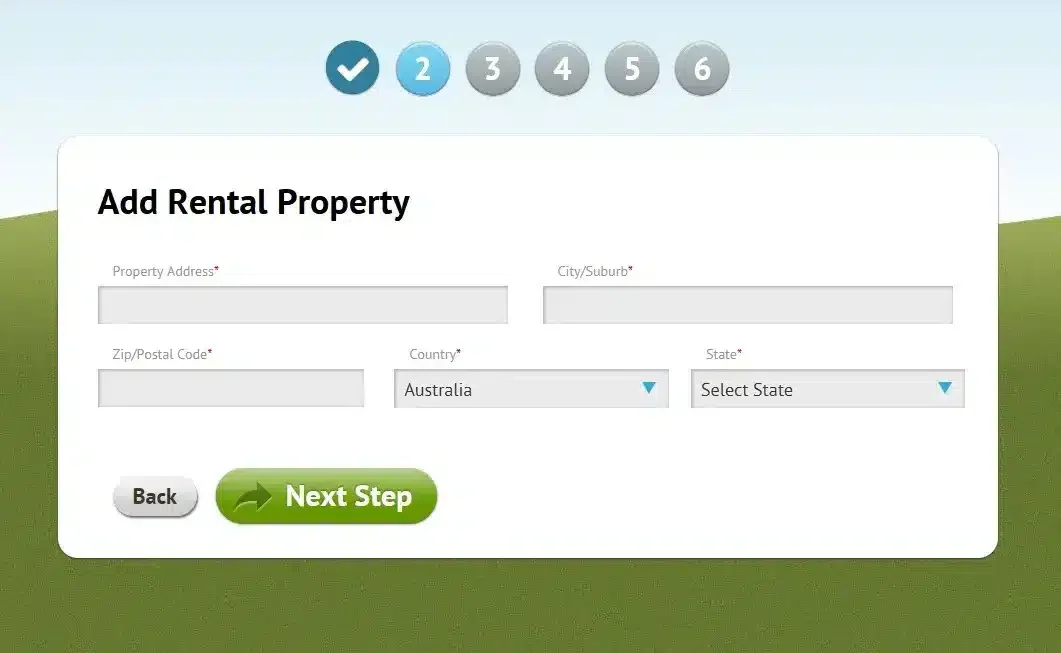
RentingSmart is a property management platform designed primarily for independent landlords and smaller property portfolios. The software helps users manage rent tracking, lease administration, maintenance requests, and property-related documentation within a simplified platform.
Its lightweight and easy-to-use structure makes it suitable for landlords who want to manage rental properties without relying on more complex enterprise systems. RentingSmart also supports reminders, document storage, and tenant management workflows.
Key Features:
- Rent Tracking: Monitor rent payments and outstanding balances.
- Lease Management: Store lease agreements and renewal information.
- Maintenance Requests: Track repairs and maintenance activity.
- Document Storage: Centralise tenancy and property records.
| Pros | Cons |
| ✓ Simple and beginner-friendly platform. | ×Limited enterprise and automation capabilities. |
| ✓ Suitable for independent landlords. | ×Less suitable for large property portfolios. |
| ✓ Affordable entry-level solution. | ×Advanced integrations are limited. |
Pricing: Plans start from around AUD $19/month depending on portfolio size and features.
Best for: Independent landlords and small residential property portfolios.
9. Buildium
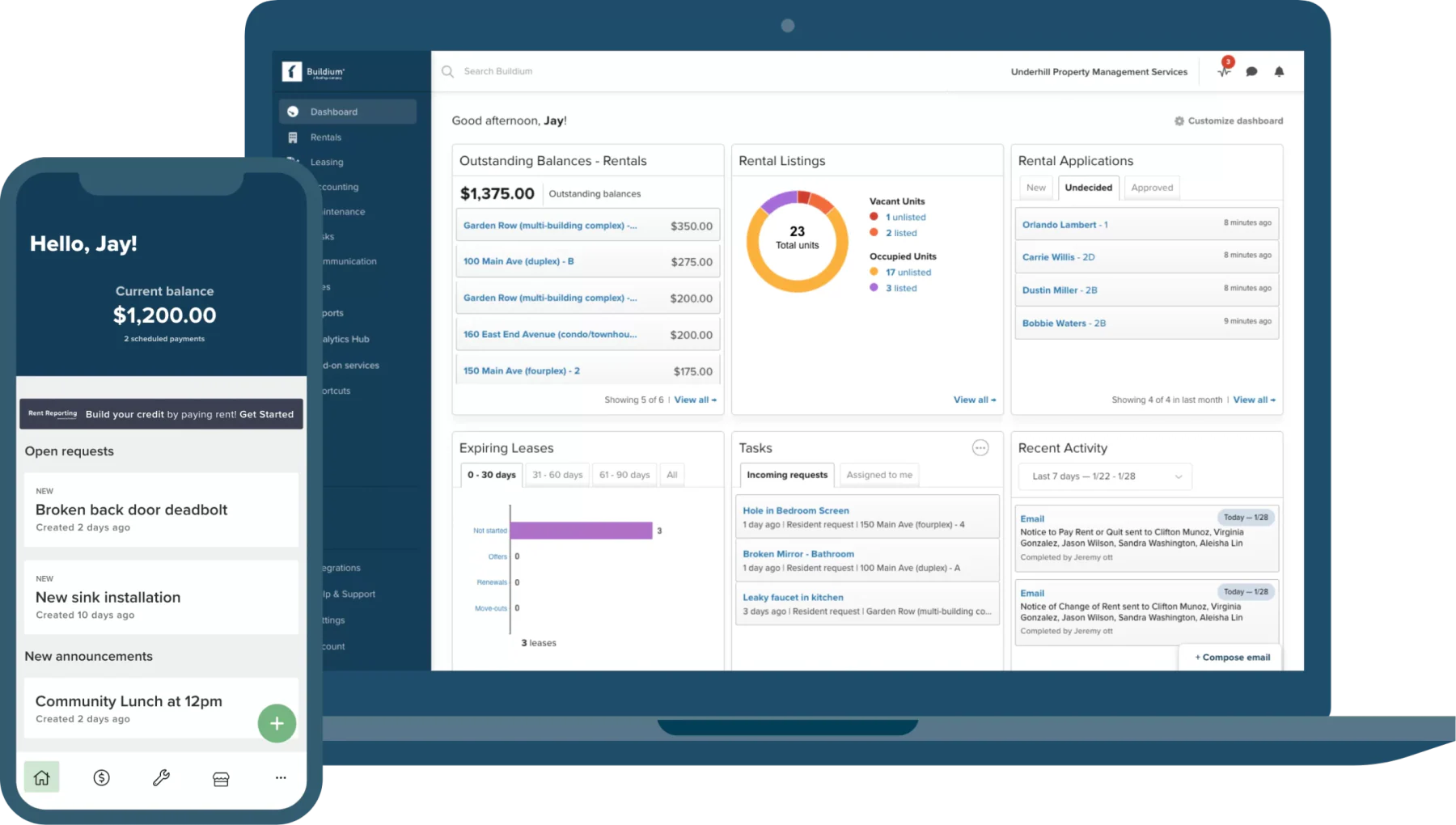
Buildium is a cloud-based property management platform widely used for residential, commercial, and mixed-use property portfolios. The software combines lease management, accounting, maintenance tracking, communication workflows, and operational reporting into one platform.
Its accounting and reporting capabilities make it particularly useful for property businesses managing larger portfolios and more complex operational workflows. Buildium also supports online payments, maintenance coordination, tenant portals, and vacancy management.
Key Features:
- Lease Management: Track lease terms, renewals, and occupancy.
- Accounting Tools: Manage payments, reporting, and operational finances.
- Maintenance Tracking: Coordinate repairs and work order workflows.
- Tenant Portals: Support tenant communication and online payments.
| Pros | Cons |
| ✓ Strong accounting and reporting functionality. | ×Advanced plans can become expensive. |
| ✓ Supports multiple property portfolio types. | ×Some features require higher pricing tiers. |
| ✓ Good operational and maintenance visibility. | ×Less tailored specifically for Australian compliance. |
Pricing: Plans start from around AUD $89/month, with higher-tier plans available for larger portfolios and advanced features.
Best for: Property businesses needing accounting, maintenance, and portfolio management within one platform.
10. TenantCloud
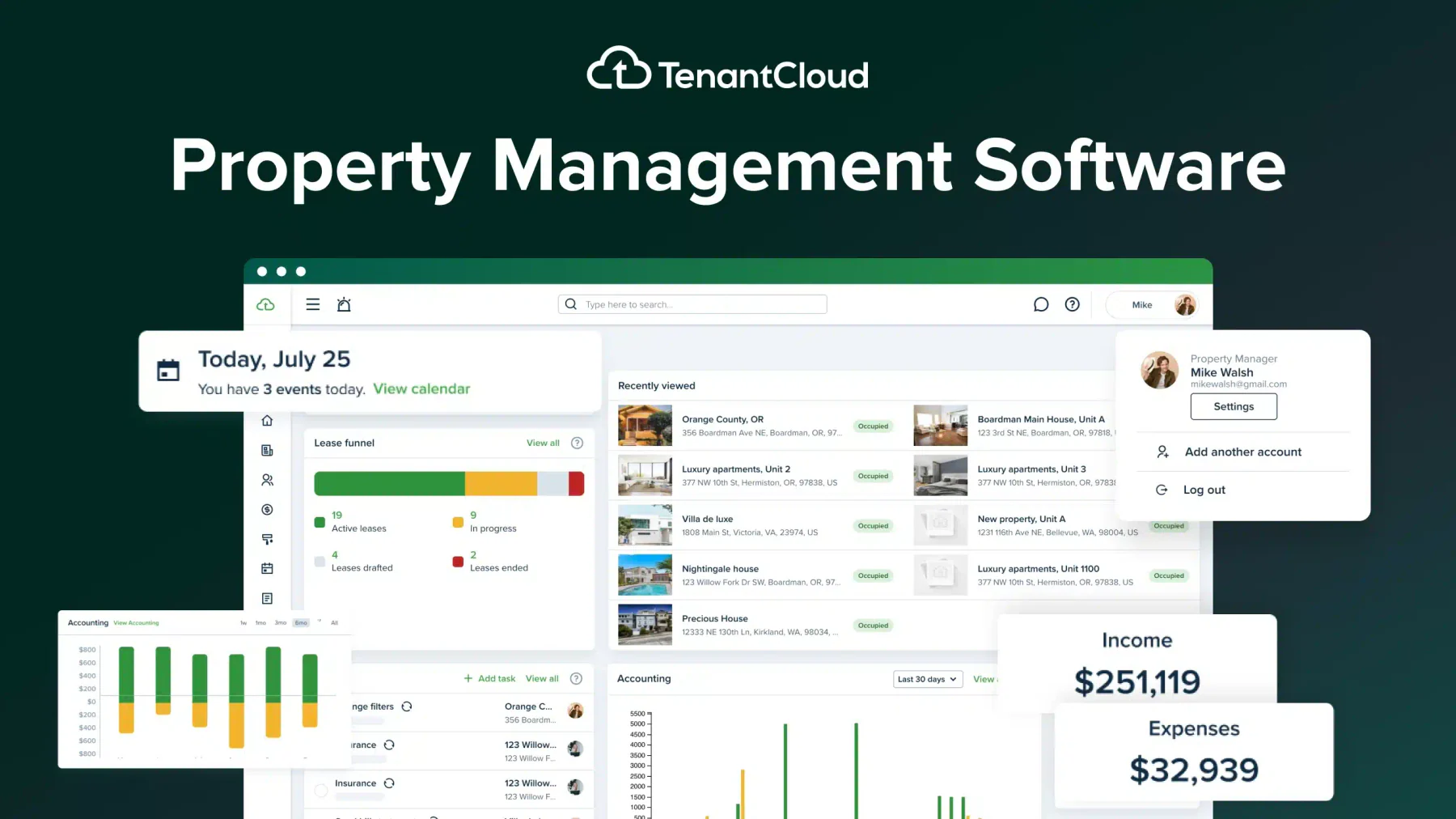
TenantCloud is a cloud-based property management platform designed for independent landlords, small property businesses, and residential property managers. The platform supports rent collection, lease tracking, maintenance requests, tenant communication, and operational reporting through a user-friendly interface.
Its affordable pricing and simplified workflows make it suitable for smaller portfolios looking to improve operational visibility without implementing a more complex enterprise system. TenantCloud also provides mobile apps and online payment functionality.
Key Features:
- Online Payments: Manage rent collection and payment tracking.
- Lease Tracking: Store lease agreements and renewal schedules.
- Maintenance Requests: Coordinate maintenance and tenant issues.
- Tenant Communication: Centralise messaging and notifications.
| Pros | Cons |
| ✓ Affordable and beginner-friendly platform. | ×Limited enterprise-level functionality. |
| ✓ Good online payment and tenant communication tools. | ×Advanced reporting features are limited. |
| ✓ Suitable for small residential portfolios. | ×Less focused on Australian trust accounting requirements. |
Pricing: Free plan available; paid plans start from around AUD $18/month depending on features and property count.
Best for: Independent landlords and smaller residential property portfolios.
How Much Does Property Management Software Cost in Australia?
Property management software Australia pricing varies depending on portfolio size, features, and operational complexity. Smaller platforms may start from around AUD $20–$100 per month, while larger enterprise solutions often use custom quote-based pricing.
Additional costs can include onboarding, data migration, integrations, trust accounting modules, and workflow customisation. Businesses managing larger property portfolios typically require more scalable systems, which may involve higher implementation and subscription costs.
Conclusion
Property management software helps businesses improve lease management, maintenance coordination, tenant communication, and operational reporting. Integrated systems also help reduce manual administration and improve operational visibility.
The right platform depends on portfolio complexity, reporting requirements, and operational priorities. You can also consult with experts to find the most suitable property management software for your business.
Frequently Asked Question
Property management software focuses on lease administration, rent collection, maintenance tracking, tenant communication, and property operations, while real estate software is generally designed for sales, CRM, marketing, and lead management activities.
Yes, most property management platforms support rent collection, lease tracking, maintenance workflows, tenant records, and operational reporting within one system.
Yes, many property management systems support GST-ready financial reporting, trust accounting workflows, and integrations with accounting platforms commonly used by Australian businesses.
Platforms such as HashMicro, MRI Property Tree, and Re-Leased are suitable for medium to large property businesses requiring operational visibility, reporting, automation, and scalable portfolio management.
Property management software pricing in Australia varies depending on portfolio size, features, and operational complexity. Smaller platforms may start from around AUD $20–$100 per month, while larger enterprise systems often use custom quote-based pricing.
Property management software is used to manage properties, leases, rent collection, arrears, maintenance requests, inspections, tenant and owner communication, trust accounting, and portfolio reporting within one system. It replaces spreadsheets and separate tools by keeping property records, financial transactions, and operational tasks connected.
Commercial portfolios generally need software that handles lease terms and critical dates, rent reviews, outgoings reconciliation, work orders, multi-entity reporting, and role-based access. Confirm commercial lease functionality, approval workflows, audit trail, and integration scope with the vendor, since many residential-focused platforms handle these differently.