









 Limited to 100 registrants

Tax compliance in the Philippines starts with issuing the right receipt. Small slips in invoice details or POS setup can result in penalties. The Ease of Paying Taxes (EOPT) Act changed those paperwork rules. A 2026 DWIJMH study of 86 eatery owners in Laoag City found slight EOPT awareness and low compliance.
The BIR keeps tightening the rules. Revenue Memorandum Circular No. 099-2026 reiterates the compliance requirement under Section 5(H) of RR No. 7-2024. It extends the period to display the BIR Registration Seal Badge until October 31, 2026. Covered online sellers must post proof of registration on their storefront pages.
This guide explains what the changes mean at the counter. You will learn the current role of the sales invoice and the fields a receipt must carry. It covers POS setup steps that protect your audit trail, plus the mistakes that invite penalties.
Key Takeaways
A BIR official receipt proves that a customer paid, and the BIR uses it to verify declared income.
The EOPT Act made the sales invoice the primary proof of sale, leaving the official receipt as supporting evidence.
Missing NIRI signage, outdated POS templates, and faded receipts invite compromise penalties that start at ₱1,000 and reach ₱50,000.
What Is a BIR Official Receipt and Why Does It Matter?

A BIR official receipt is a formal document that proves a customer paid for a service or transaction. It records the payment amount and carries the seller's registered tax information. Philippine businesses issue it so every peso they collect leaves a traceable paper trail.
The Bureau of Internal Revenue (BIR) collects national taxes and monitors how businesses document each sale. Official receipts give the agency that visibility, because they show what a company actually earned. Buyers also keep them to support expense claims during audits.
That role narrowed in 2024. The Ease of Paying Taxes (EOPT) Act, or Republic Act No. 11976, took effect that year. It made the sales invoice the primary proof of sale for goods and services. The official receipt now supports payment or collection only, and wrong documents invite penalties.
The Historical Distinction Between Goods and Services
This distinction explains the original purpose of the official receipt BIR assigned to service transactions. The tax code required different documents for different sales. Businesses selling physical goods, such as supermarkets and hardware stores, issued a sales invoice as proof of sale.
Service providers and lessors issued an official receipt once the customer paid. The receipt confirmed collection and served as the main tax document for that income. Businesses selling both goods and services managed two document types and separate system settings.
The Role of Supplementary Documents
Supplementary documents support the official receipt, but they never replace its tax function. The BIR recognizes delivery receipts, order slips, billing statements, statements of account, and collection receipts. These papers add detail to a transaction, yet buyers cannot use them to claim input VAT.
Service businesses relied on the official receipt as their key tax document. A billing statement alone did not satisfy the BIR. Companies issued an official receipt once payment arrived and tracked both documents inside their accounting system.
The Drive Toward Digitalization and Standardization
Digital receipting protects the integrity of every official receipt the BIR accepts. As transaction volumes grew, manual paper receipting became impractical. It also opened the door to fake receipts, tax evasion, and heavy administrative work for businesses and the government.
The BIR responded by regulating cash register machines, POS systems, and computerized accounting systems more strictly. Any system that generates tax documents must first earn registration and approval. This requirement keeps sales data secure, traceable, and ready for audit.
BIR Official Receipts Key Rules
An official receipt BIR rules govern is a legal tax document, not a courtesy slip. The BIR sets the required information, the layout, and the way businesses compute each figure. A document that misses any mandatory element becomes invalid, so issuers face penalties and buyers lose the tax credit.
These rules apply to both documents, but they are not identical. EOPT Act receipt rules changed which form proves a sale, and BIR sales invoice requirements now cover most transactions. The official receipt vs sales invoice question decides what your system prints.
1. Mandatory Information on the Header and Footer
The header identifies the business issuing the document. A compliant system prints these details automatically, and an official receipt BIR examiners accept must show every one of them. Missing entries invalidate the document.
- Registered business name, plus the trade or franchise name if it differs
- TIN with branch code and the VAT or Non-VAT status
- Complete branch address
- Correct document title, such as Sales Invoice or Official Receipt
- Serial number running in unbroken sequence
Sequential numbering is not optional. Review the invoice numbering requirements for BIR compliance before you configure a series. Gaps invite immediate audit attention. The footer then carries the verification details that prove a machine-generated document came from a registered system.
- Machine Identification Number (MIN)
- Permit to Use (PTU) number with its issue date
- Software vendor name, address, TIN, and accreditation number
Non-VAT businesses and supplementary documents carry one more requirement. The document must state: "THIS DOCUMENT IS NOT VALID FOR CLAIM OF INPUT TAX." Buyers who receive it cannot use the amount as input tax credit.
2. The Mathematical Breakdown of Sales and Taxes
The tax breakdown is the most technical part of the document. VAT-registered businesses must show how they reached the total, because BIR sales invoice requirements treat the VAT figure as auditable. A summary that hides the computation fails review.
- Vatable sales
- 12% VAT
- VAT-exempt sales
- Zero-rated sales
- Total amount due
Each line must reconcile with the total. Auditors compare these figures against your books, so a rounding shortcut creates a discrepancy the BIR will question. Fix the setup before the next filing period.
3. Handling Senior Citizen and PWD Discounts
Senior Citizen and PWD transactions follow a strict order of computation. The system removes the 12% VAT first, then applies the 20% discount to the VAT-exclusive amount. Reversing that order overstates the discount and understates your output VAT.
- The document must display each adjustment on its own line.
- "Less: VAT Exemption"
- "Less: 20% SC/PWD Discount"
- SC/PWD ID number
- Customer signature
Correct math alone does not clear you. Confirm the POS accreditation requirements with the BIR before you trust a terminal with these computations. This is where official receipt BIR Philippines compliance most often breaks down during an audit.
BIR Sales Invoice vs Official Receipt
These two documents cover different points in the same sales cycle. The official receipt BIR framework treats as proof of payment, while the sales invoice records the sale itself. EOPT Act receipt rules made the invoice primary, so the order of events decides which page your customer receives.
Start with the comparison table below to see how the three documents differ on purpose, timing, and tax value. The sections that follow explain each document in detail, then show worked examples you can match against your own forms.
Comparison at a Glance
BIR sales invoice requirements and official receipt rules overlap on content yet differ on legal weight. The official receipt vs sales invoice question usually decides what your system prints first. Use this table to route each transaction to the correct document.
| Point of difference | Sales Invoice | Official Receipt | Collection Receipt |
|---|---|---|---|
| Purpose | Records what you sold and the amount owed | Proves the customer paid | Acknowledges a payment you received |
| When to issue | At delivery or billing | On receipt of payment | On partial payment or deposit |
| BIR requirement | Yes, for sales of ₱500 or more | No longer the primary sales record | Yes, when you collect payment |
| Input tax value | Yes | Limited | Limited |
| Key contents | Items, prices, taxes, terms | Payment amount and date | Amount received and purpose |
| Typical issuer | Every registered business | Narrow use under EOPT | Service providers |
| Status under RR 7-2024 | Required | Secondary document | Valid and transitional |
The short rule: issue a sales invoice for every sale, then issue a receipt or collection record each time money arrives.
BIR Sales Invoice
BIR sales invoice requirements make this document the primary record of a sale for both goods and services. A compliant invoice lists the items delivered, the amount owed, the applicable taxes, and the payment terms. It also carries the seller's registered TIN and the serial number of the approved series.
Issue the invoice when you deliver the goods or bill the service. That timing matters because the invoice creates the buyer's obligation to pay. Send it early so the customer sees an exact balance and pays sooner.
Sales invoice example
A hardware store sells goods, and the buyer pays later. The invoice below shows the layout a VAT-registered seller uses. It also includes the tax breakdown line that BIR sales invoice requirements demand on every transaction.
Free BIR Sales Invoice Template:
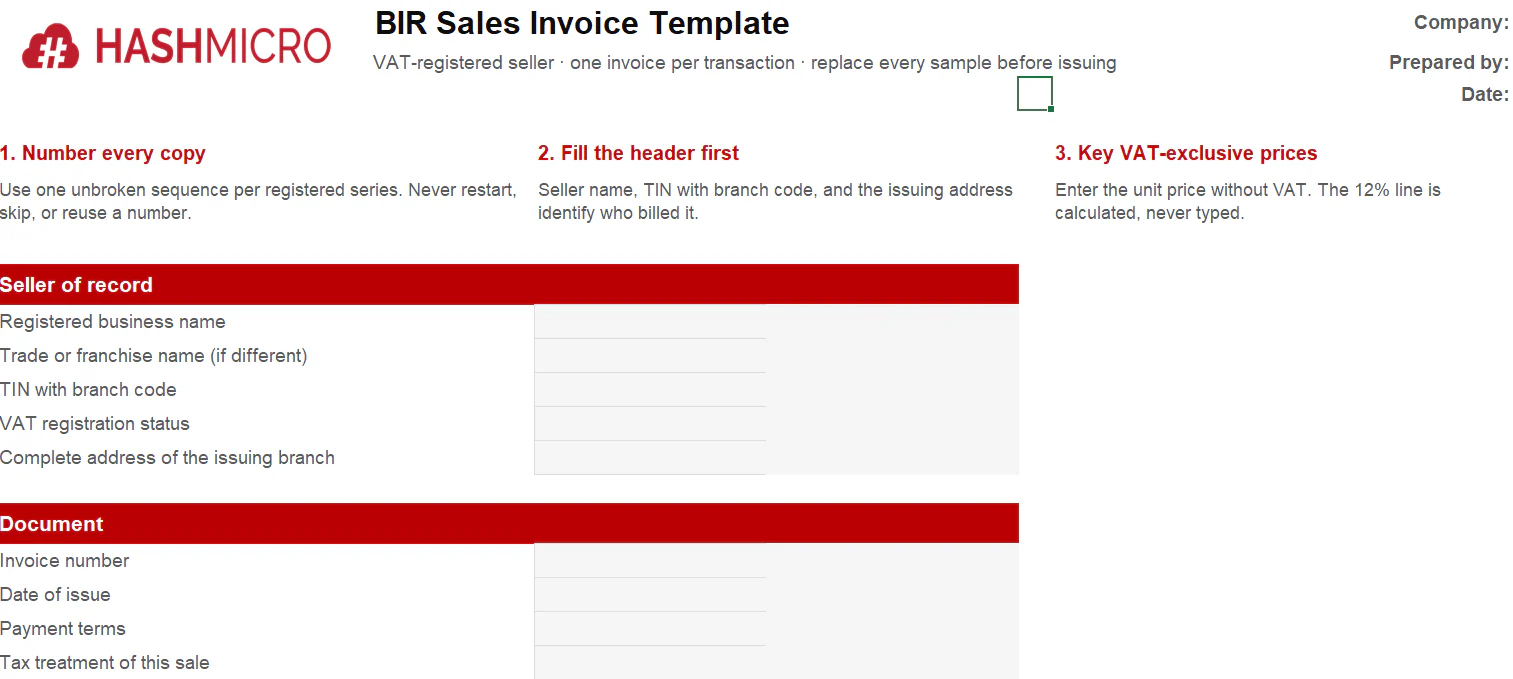
This free template carries the mandatory header fields and the VAT breakdown lines. It also includes the sequential numbering slot described in the key rules above. Replace the sample entries with your registered business details before use.
Official Receipt
An official receipt confirms that you collected money for goods or services. Revenue Regulations No. 7-2024 moved the document to secondary status. It no longer stands as the primary record of a sale. Keep issuing it because buyers still need the proof.
The receipt supports buyer expense claims, warranty requests, and returns. Use it alongside the invoice instead of in place of it. That pairing gives you one record for the sale and one record for the collection.
A collection receipt works the same way with a narrower scope. Businesses issue it for partial payments, deposits, and advance collections. It remains valid while companies finish migrating to EOPT-compliant invoicing.
Collection receipt example
A consultancy bills a client and collects a partial fee days later. The receipt below shows how a service provider acknowledges that payment without replacing the sales invoice. Keep both documents filed together against the same client account.
Free BIR Official Receipt and Collection Receipt Template:
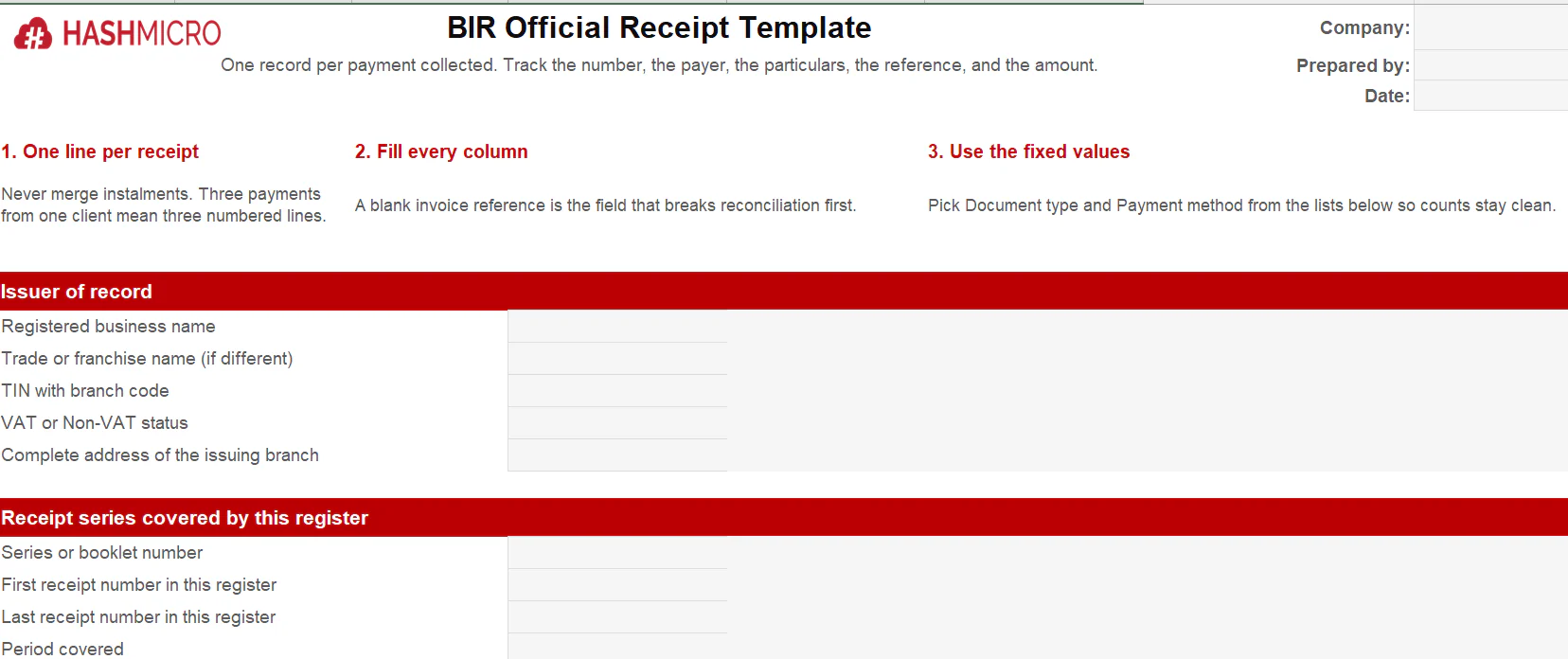
This template pack includes an official receipt BIR examiners can verify and a matching collection receipt layout. Both files carry the header fields, the payment lines, and the serial number slot from the rules above.
How to Apply Official Receipt BIR Rules in Your POS System
A POS system does more than print a tidy receipt. It has to enforce the documentation rules that the BIR sets for every sale. Use this how-to checklist to configure your terminals, records, and staff habits around the current official receipt BIR requirements.
One caution before you start. No POS vendor is automatically BIR approved. Accreditation and the Permit to Use remain your obligations as the merchant. Compliant software gives you the right controls. You still file the registrations and reports yourself.
1. Make the sales invoice your default document
Under the Ease of Paying Taxes Act, the invoice is now the primary proof of sale for goods and services. Set your POS so a completed sale produces an invoice by default. Reserve the official receipt BIR layout for acknowledgements of payment.
Then deal with your unused stock. Report the remaining booklets and follow the BIR instructions for cancellation or conversion. Do not leave old serials open, because gaps in your POS data look like unreported sales during an audit.
2. Load the mandatory invoice fields into your POS template
BIR sales invoice requirements are specific, and your POS template must carry them. Print the registered taxpayer name, trade name, address, and TIN. Show the VAT-registered status, the serial number, and the date of issue on every copy.
Buyer details matter once the customer asks for credit. Capture the buyer name, TIN, and address so the invoice can support input tax. Finish the body with quantity, unit price, discounts, VAT, and the total amount due.
3. Keep one unbroken serial sequence across every terminal
Assign invoice numbers from a single register, not from each cash drawer. The sequence must run in ascending order with no skipped or reused numbers. A gap invites the examiner to assume you hid a sale.
When you add a branch, extend the same series with a branch code rather than restarting at one. Log every voided number too. A voided receipt stays in the book as evidence, and the audit trail becomes easier to defend.
4. Calculate VAT and statutory discounts in the correct order
Set the tax engine before the layout. VAT-registered sellers charge 12% on the gross selling price and must invoice every sale, whatever the amount. The ₱500 minimum applies only to non-VAT sellers, so do not copy that rule across regimes.
Discounts need the same care. A senior citizen or PWD sale is exempt from VAT and also gets 20% off. Most practitioners strip the VAT first, then discount the VAT-exclusive amount. Confirm the order before you hard-code it.
5. Preserve transaction records for five years
Older guidance told businesses to keep books for ten years. Revenue Regulations No. 7-2024 shortened that to five. Count from the day following the filing deadline for the taxable year. The clock stops later if a protest or refund claim is pending.
The rule covers every POS transaction your terminal records, from the sale to voids, refunds, discounts, and the daily report. Computerized records may be preserved as electronic copies. The BIR can examine the books once per taxable year, with exceptions, so keep them ready.
6. Block edits to posted sales and protect the grand total
Never let a cashier overwrite a completed transaction. Configure the POS so posted sales are locked, and route corrections through a void, a refund, or a credit memo. The system must keep the original line and the reason for the change.
The grand total counter deserves the strictest control. It reports cumulative sales, and the BIR reads it as a revenue cross-check. Restrict it to read-only users, separate supervisor rights, and treat any reset as an authorized, logged exception.
7. Train the counter team on the document rules
Rules that live only in the back office break at the register. Teach staff the difference between an invoice and a receipt, and when each is issued. A cashier who hands over the wrong document creates a repairable but annoying mismatch.
Write the rules into a one-page checklist and review it at shift handover. Cover reprint requests, missing customer TINs, and who may approve a void. Then test the workflow with a live order so the training sticks under queue pressure.
8. Prepare for electronic invoicing
The BIR now moves invoice reporting online. Revenue Regulations No. 26-2025 pushed the deadline for covered taxpayers to 31 December 2026. More sectors join in phases, so check whether your registration type is already on the covered list.
Pick a POS that already produces the invoice formats and the daily summaries the new system expects. This comparison of the best POS systems in the Philippines shows which vendors handle BIR reporting out of the box. Keep the Z reading as daily sales evidence for audit and eSales reporting.
Common Pitfalls to Avoid Under the EOPT Act Receipt Rules
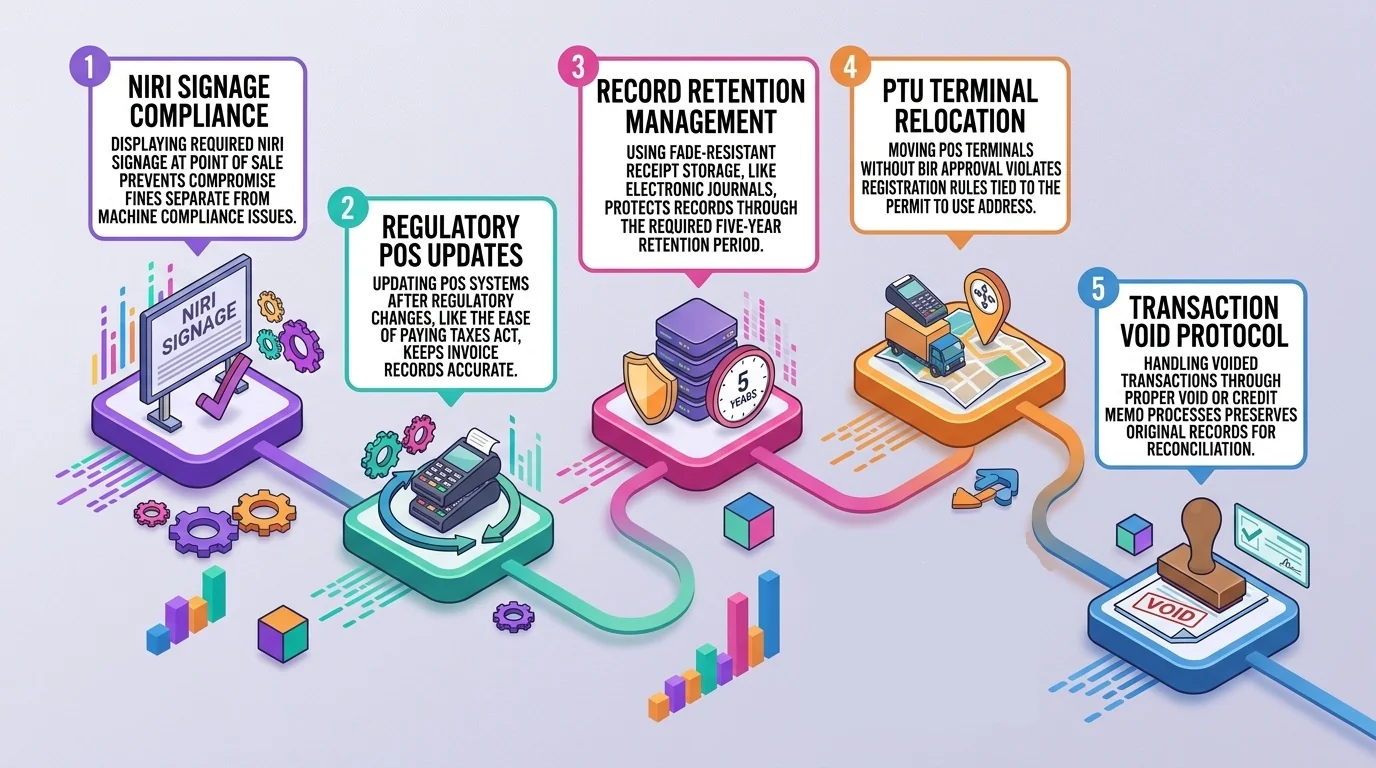
Even careful businesses fall into compliance traps when they stop watching the receipting process. The items below cover the errors that surface most often during a POS audit, from invoice setup through record retention. Each one names the rule and the control that closes the gap.
1. Failing to display the NIRI signage
The BIR requires the Notice to Issue Receipt or Invoice at every point of sale. RMO No. 43-2022 introduced that poster and retired the older Ask for Receipt notice. A compliant machine does not excuse a missing sign, and the display lapse carries its own compromise fine.
2. Not updating the system after regulatory changes
Many businesses install a POS once and never revisit the settings. The Ease of Paying Taxes Act changed invoice rules in 2024. A template that still prints Official Receipt as the main sales document sends the wrong record. Ask your vendor to confirm the current field set.
3. Using receipt paper that fades
Retailers now keep records for five years, not the ten in older guidance. Thermal prints fade inside that window, which quietly destroys your own evidence. The rule expects records of a quality that survives the assessment period. Move each day's data into an electronic journal or a Z reading export.
4. Moving a POS terminal without BIR approval
A registered machine is tied to the address on its Permit to Use. Using registered receipts away from that location is its own violation, with a compromise fine of nearly ₱1,000. An unregistered machine carries a far larger amount per unit. The MIN on each printed receipt exposes the mismatch.
5. Improper handling of voided transactions
Cashiers must never delete or overwrite a posted sale. Corrections belong in a void or a credit memo, so the original line and the reason both survive. A blank duplicate copy with a detached original counts as its own violation. Reconcile the sequence at every shift close.
6. Penalties for non-compliance
Section 264 of the Tax Code sets the criminal range at a fine of ₱1,000 to ₱50,000 plus possible imprisonment. The BIR schedule of compromise penalties lists the settlement amounts below. Later violations of the same kind stop qualifying for compromise.
| Violation | First offense | Second offense |
|---|---|---|
| Failure to issue an invoice or receipt | ₱10,000 | ₱20,000 |
| Refusal to issue an invoice or receipt | ₱25,000 | ₱50,000 |
| Invoice that omits the correct transaction amount | ₱20,000 | ₱50,000 |
| Receipt that does not truly reflect the sale | ₱5,000 | ₱10,000 |
| Blank duplicate copy with a detached, unaccounted original | ₱20,000 | ₱50,000 |
| Use of unregistered receipts or invoices | ₱20,000 | ₱50,000 |
| Unregistered POS machine used in place of an invoice | ₱25,000 per unit | ₱50,000 per unit |
| Receipts printed without BIR authority | ₱25,000 | ₱50,000 |
| Receipts printed with the wrong serial range, TIN, or printer details | ₱20,000 | ₱50,000 |
| Understated amount on your copy versus the buyer's copy | Not qualified for compromise | Not qualified for compromise |
| Possession or use of double or multiple sets of receipts | Not qualified for compromise | Not qualified for compromise |
| Missing NIRI poster or Certificate of Registration display | ₱1,000 | ₱1,000 |
| Missing the authorized POS sticker or decal | ₱1,000 | ₱1,000 |
| Registered receipts used away from the registered location | ₱1,000 | ₱1,000 |
| Failure to keep or preserve required records | ₱1,000 or up to six months imprisonment | ₱1,000 or up to six months imprisonment |
| Unregistered branch, line of business, or facility | ₱20,000 in cities, ₱10,000 in first-class municipalities, ₱2,000 in third-class municipalities | Same schedule by locality |
These amounts come from the BIR schedule of compromise penalties for registration, invoicing, bookkeeping, and compliance requirements. That schedule covers settlement with the Bureau, not a court sentence, so treat each figure as the cheaper outcome of two bad days.
Conclusion
BIR compliance goes well beyond printing a receipt. The revised guidance turns it into a checklist you can run inside your POS. For official receipt BIR Philippines rules, default to a sales invoice with one unbroken number series. Keep the VAT order right and preserve records for five years.
Small gaps carry real costs. A missing invoice draws a ₱10,000 fine on a first offense and ₱20,000 on a second. Later violations lose that option entirely. Two deadlines also deserve attention. The registration seal display runs to October 31, 2026, and e-invoicing follows at year-end.
You do not have to police all of this by hand. Spreadsheet packs and accounting software can hold the required fields, and they can run the VAT math automatically. Print each document in a layout that matches BIR rules, and your records stay audit-ready. The accreditation obligation still stays with you.

FAQ About Official Receipt BIR
The Sales Invoice is now the primary proof of sale for both goods and services. Official Receipts are no longer used as the main document and are treated only as supporting documents for payments.
A valid receipt must include the business name, TIN with branch code, address, document title, serial number, MIN, PTU details, and vendor information. Missing any of these can make the receipt non-compliant.
The BIR requires clear computation of VAT. Receipts must show vatable sales, VAT amount, VAT-exempt sales, zero-rated sales, and the total due to ensure transparency and accurate tax reporting.
The system must first remove the 12% VAT, then apply the 20% discount on the VAT-exclusive amount. The receipt must show both deductions separately along with the ID number and signature.
Common issues include missing NIRI signage, outdated POS settings, using fading receipt paper, relocating terminals without approval, and deleting transactions instead of processing voids.