





In the Philippines’ year-round tropical heat, cold storage help reaches product to consumers in perfect condition. From fresh produce in Mindanao to pharmaceutical supplies in Metro Manila, the integrity of temperature-sensitive goods depends entirely on how well the warehouse behind them is designed, operated, and managed.
This article covers the full picture of efficient cold storage warehouse solutions for Philippine businesses: the technologies driving modern facilities, the operational and design principles that keep costs down, the challenges most operators face, and the sustainability practices that are increasingly separating competitive warehouses from outdated ones including how the country’s shift to a compressed workweek is reshaping how cold storage operations need to be staffed and managed.

Key Takeaways
Cold storage is critical in the Philippines’ tropical climate agriculture, food processing, pharma, and logistics all depend on it to keep products safe and market-ready
IoT sensors, automated retrieval systems, and real-time monitoring are transforming cold storage efficiency through data-driven temperature control and reduced human intervention
The Philippines’ four-day compressed workweek is widening the gap between automated cold storage facilities and those still relying on manual monitoring and human-triggered responses
Cross-trained staff, rotating on-call rosters, and IoT-based automated alerts are the core adjustments cold storage operators need to stay resilient under a compressed schedule.
Managing Cold Storage Facilities Under the 4-Day Workweek
The Philippines’ shift to a compressed four-day workweek has direct operational implications for cold storage facilities and most operators have not fully adjusted yet
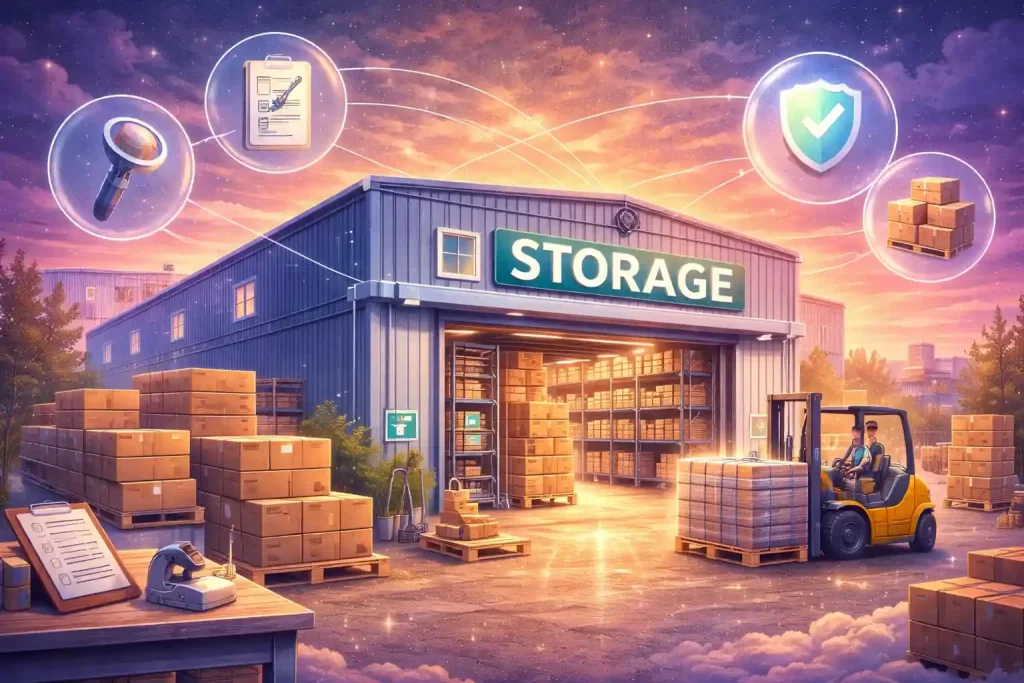
1. The Operational Gap: The transition to a 4-day workweek in the Philippines creates a monitoring risk for 24/7 cold storage. Perishables and refrigeration systems cannot “pause” during a 3-day weekend, leaving facilities that rely on manual checks vulnerable to undetected failures.
2. The Automation Solution: To bridge this gap, operators must accelerate tech investment. IoT monitoring provides 24/7 alerts for temperature deviations, while Automated Storage and Retrieval Systems (ASRS) and a Cloud-based WMS allow skeleton crews to maintain full visibility and handle routine tasks without a full team present.
3. Resilient Workforce Planning: Adapting requires cross-training staff and building rotating on-call rosters for long weekends. Successful businesses are using the compressed schedule as a “forcing function” to modernize SOPs and digitalize operations, turning a scheduling constraint into a competitive advantage.
Quick Overview of Cold Storage Warehousing in the Philippines
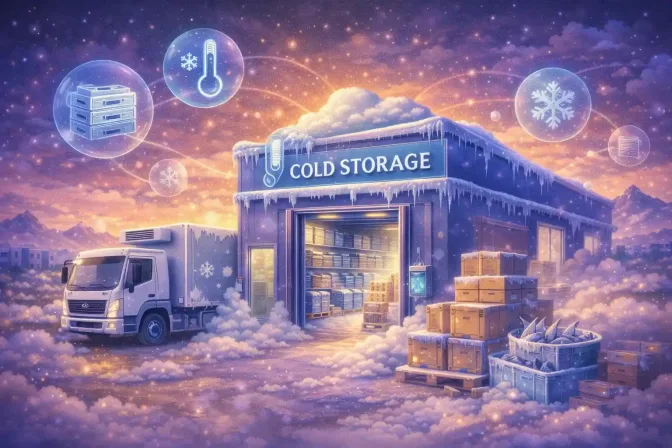
The Philippines’ tropical climate that consistently high temperatures and humidity throughout the year makes cold storage infrastructure essential across multiple industries. Agriculture, food processing, pharmaceuticals, logistics, and chemical distribution all depend on temperature-controlled facilities to maintain product quality, ensure regulatory compliance, and prevent spoilage during storage and transit.
What makes cold storage particularly critical in the Philippine context is the archipelagic supply chain. Goods often travel across islands before reaching their final destination, making the reliability of each cold storage point along the route directly tied to whether products arrive market-ready. A gap in the cold chain even briefly can render entire batches unsellable, making facility efficiency not just a cost issue but a revenue one.
What are the Innovative Technologies in Cold Storage?
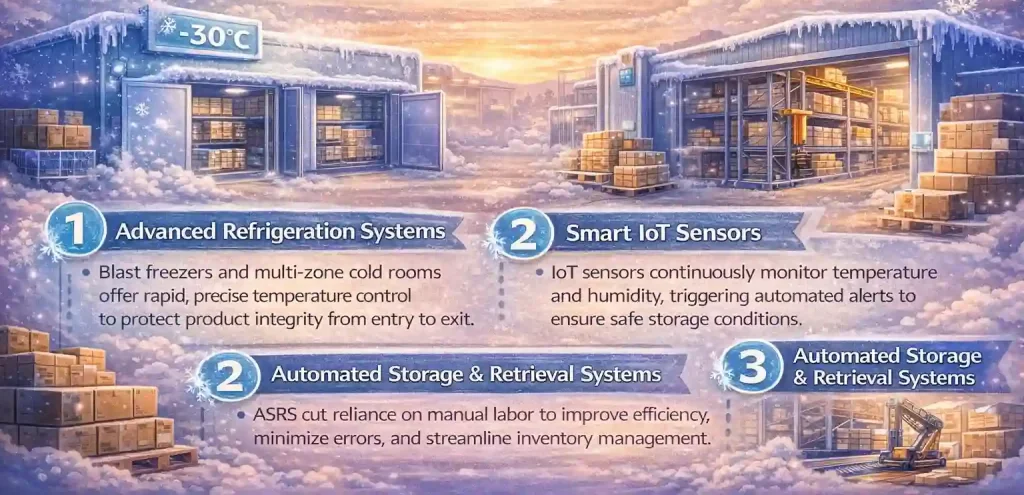
Advanced refrigeration systems including blast freezers and multi-zone cold rooms are now the baseline expectation for competitive cold storage facilities in the Philippines. These systems deliver precise, rapid temperature control that protects product integrity from the moment goods enter the warehouse to the moment they leave.
IoT sensors are transforming how temperature and humidity are monitored across large facilities. Rather than relying on manual checks, real-time data is continuously gathered from multiple points in the warehouse, triggering automated alerts when conditions deviate from acceptable ranges. This reduces the window between a temperature event and a corrective response which in a cold chain context can mean the difference between a manageable adjustment and a spoilage incident.
Automated storage and retrieval systems (ASRS) reduce reliance on manual labor for picking and putaway, cutting both error rates and the labor hours required per pallet movement. Combined with IoT monitoring, this automation layer enables a level of operational visibility and control that is increasingly important as Philippine cold storage operators look to do more with leaner teams, a need made more pressing by the country’s move toward a four-day compressed workweek.

Optimizing Operations in a Cold Storage Warehouse
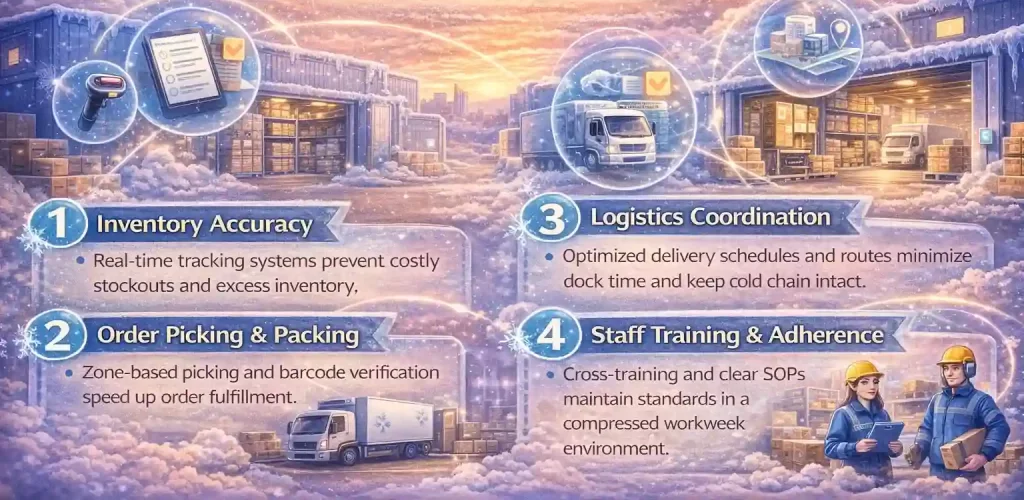
Efficient daily operations are what separate a cold storage facility that stays profitable from one that bleeds cost through avoidable waste and rework. Four areas deserve the most attention:
- Inventory accuracy: Real-time tracking systems prevent both stockouts and overstock situations, two of the most common sources of hidden cost in cold storage, where holding excess inventory means paying for refrigeration on product that is not generating revenue.
- Order picking and packing: Streamlined pick paths, zone-based picking, and barcode verification reduce errors and speed up fulfillment, critical when order lead times are tight and temperature exposure during picking needs to be minimized.
- Logistics coordination: Optimizing outbound delivery schedules and routes reduces idle dock time, keeps trucks moving efficiently, and ensures cold chain handoff happens on time.
- Staff training and protocol adherence: In a compressed workweek environment where three-day weekends are becoming standard, well-documented SOPs and cross-trained staff are essential to maintain consistent quality and safety standards without relying on the same personnel every shift.
Implementing a Warehouse Management System (WMS) ties all of these together automating workflows, improving inventory accuracy, and giving operations managers real-time visibility into what is happening across the facility. HashMicro’s WMS is purpose-built for this kind of integrated oversight, reducing manual errors and surfacing bottlenecks before they compound into larger problems.
Design and Construction of Efficient Cold Storage Facilities
Getting the physical design right from the start is far more cost-effective than retrofitting a poorly insulated or inefficiently laid out facility later. Insulation is the foundation: high-performance walls, roofs, floors, and door seals prevent heat ingress from the Philippines’ ambient temperatures, which regularly exceed 30°C. Every degree of uncontrolled heat gain translates directly into compressor load, energy consumption, and wear on refrigeration equipment.
Energy efficiency should be designed in, not bolted on. Inverter-type refrigeration compressors, LED lighting with motion sensors, and properly sized cold rooms. All contribute to a lower monthly energy bill and a more predictable operating cost structure. In a market where Philippine electricity rates are among the highest in Southeast Asia, energy efficiency in cold storage is a direct margin improvement.
Space optimization determines how much revenue a facility can generate per square meter of footprint. Vertical racking, mezzanine platforms, and high-density mobile shelving allow businesses to store significantly more product in the same building envelope. Smart aisle and dock placement also reduces the travel time and temperature exposure that occurs every time a pallet is moved.
Conclusion
Efficient cold storage in the Philippines is a complex challenge involving technology, design, and workforce management. With the compressed workweek accelerating the need for automation, the gap between top-tier and poorly managed facilities is widening. Beyond physical infrastructure, the key to scaling and reducing waste lies in the software layer. Operators looking to modernize can explore this guide to the best warehouse management systems for 2026, covering the features and pricing models most relevant to local cold chain operations.
Frequently Asked Questions around Cold Storages
Cold storage costs in the Philippines vary based on storage capacity, temperature range, location, and whether the facility is for rent or full purchase. Businesses usually need to compare supplier quotations directly because pricing often depends on project requirements and installation scope
Renting cold storage is usually more practical for businesses that need flexibility, lower upfront costs, or short-term capacity. Buying a facility may suit companies with stable long-term demand and enough volume to justify a larger capital investment.
Cold storage logistics helps businesses preserve product quality during storage and distribution, especially for food, pharma, and temperature-sensitive goods. In the Philippines, this is especially important because climate conditions and transport distances can quickly affect product integrity.
Businesses should review the supplier’s storage capacity, temperature control system, installation support, maintenance service, and track record in local operations. It is also important to check whether the supplier can support compliance, energy efficiency, and long-term scalability.