







Warehouse operations in the Philippines carry a structural disadvantage from the start. According to BusinessWorld, logistics costs consume 27.5% of the country’s GDP, the highest among ASEAN, and an OECD competition review identified warehousing and infrastructure as key areas still needing significant improvement.
Without a clear process flow, inventory mishandling, fulfillment errors, and delivery delays can become routine issues that weaken customer trust and reduce stock visibility as demand grows.
This article breaks down each stage of the warehouse process flow, covers both inbound and outbound processes, and outlines practical strategies for optimizing warehouse operations.
Key Takeaways
Warehouse process flow is a structured sequence that manages the movement of goods from receiving to shipping, ensuring consistent and accurate operations.
Main warehouse processes such as receiving, putaway, storage, picking, packing, and shipping can be optimized through automation, efficient layout planning, and robust inventory control.
Optimizing warehouse operations leads to faster delivery, better cost control, and improved data visibility, helping businesses make more informed decisions.
What is Warehouse Management System Process Flow?
A warehouse management system process flow is a visual representation that outlines the key operations within a warehouse. As a crucial part of warehouse organization, it maps out how goods are received, handled, stored, and eventually shipped, including every step in between.
You can create this process flow using various tools such as graphic design platforms, WMS generated data, or common programs like Microsoft Excel or Word. Integrating a warehouse storage system into this flow enhances visibility and structure.
Investing time in developing an effective process flow can lead to substantial cost savings and increased efficiency by streamlining tasks and reducing errors across your operations.
Main Warehouse Processes and How to Optimize Them
Every key process in the warehouse must be systematically optimized. Here are the key processes and how to improve them:
1. Receiving
Receiving goods begins with verifying incoming orders and matching them with purchase documents. This process should include updating the inventory system in real time. The use of barcodes or RFID technology helps speed up the inspection and recording process.
2. Put away
Once goods are received, they must be immediately moved to the appropriate storage location. An efficient warehouse layout design helps minimize staff travel time. Equipment such as pallet jacks or forklifts speeds up movement depending on the scale of the warehouse.
3. Storage
Stored items must be organized for easy access and to prevent overstocking or understocking. Vertical storage systems and methods, such as FIFO or LIFO, help with efficiency. Regular stock audits ensure accuracy and orderliness of storage.
4. Order picking and packing
Items are picked based on customer orders using strategies such as batch picking or zone picking. After that, products must be packed safely and efficiently. Staff training and double-checking systems help reduce errors and packaging waste.
5. Shipping
The shipping stage includes automatic label printing and real-time tracking. Integration with logistics systems ensures packages are delivered on time. Notifying customers also enhances their experience and satisfaction.
6. Warehouse management system (WMS)
WMS enables full control over all of the above processes through real-time data. This system reduces manual errors and helps identify operational bottlenecks. With the right KPIs, management can make more strategic decisions.
Warehouse Outbound Process Flow
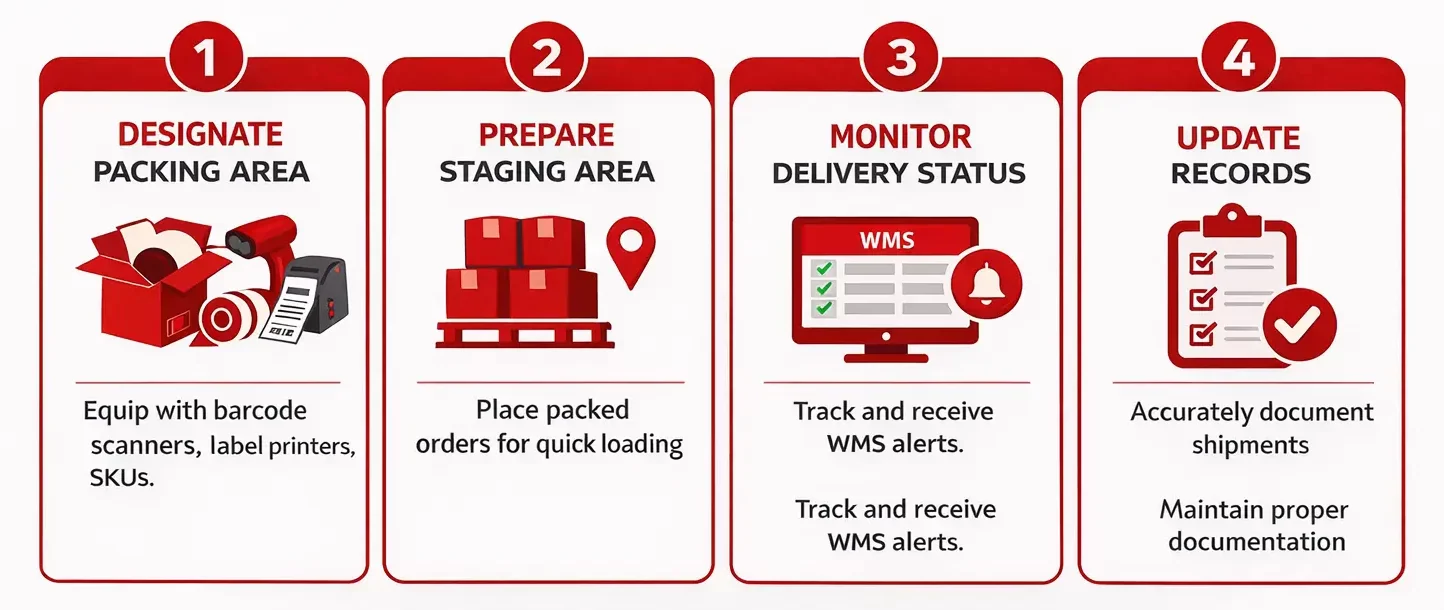
Understanding your outbound warehouse flow is key to delivering orders accurately and maintaining strong customer relationships. Each step in this process must run smoothly. Here are the four key steps:
1. Designate a specific area for packing
Provide an efficient packing space equipped with barcode scanners, label printers, SKUs, and packaging materials. This area must always be ready to support packing activities without interruption. This is important to maintain the speed of the outbound process and reduce shipping errors.
2. Prepare a staging area for shipping
Place finished packages in the staging area before transporting them to the delivery truck. A well-designed warehouse layout allows drivers to load goods immediately upon arrival. This reduces idle time and improves delivery productivity.
3. Monitor delivery notifications and delivery status
Use a warehouse management system (WMS) to view delivery status in real-time. Some systems also provide notifications when customers receive goods. This minimizes unnecessary follow-up communication and supports quick responses to delivery issues.
4. Update records and documentation
Always accurately document items leaving the warehouse along with their destinations. Whether done manually or through warehouse automation, written proof is necessary for audits and tracking. This provides full transparency over the outbound process and helps prevent stock loss while improving operational efficiency.
Warehouse Inbound Process Flow
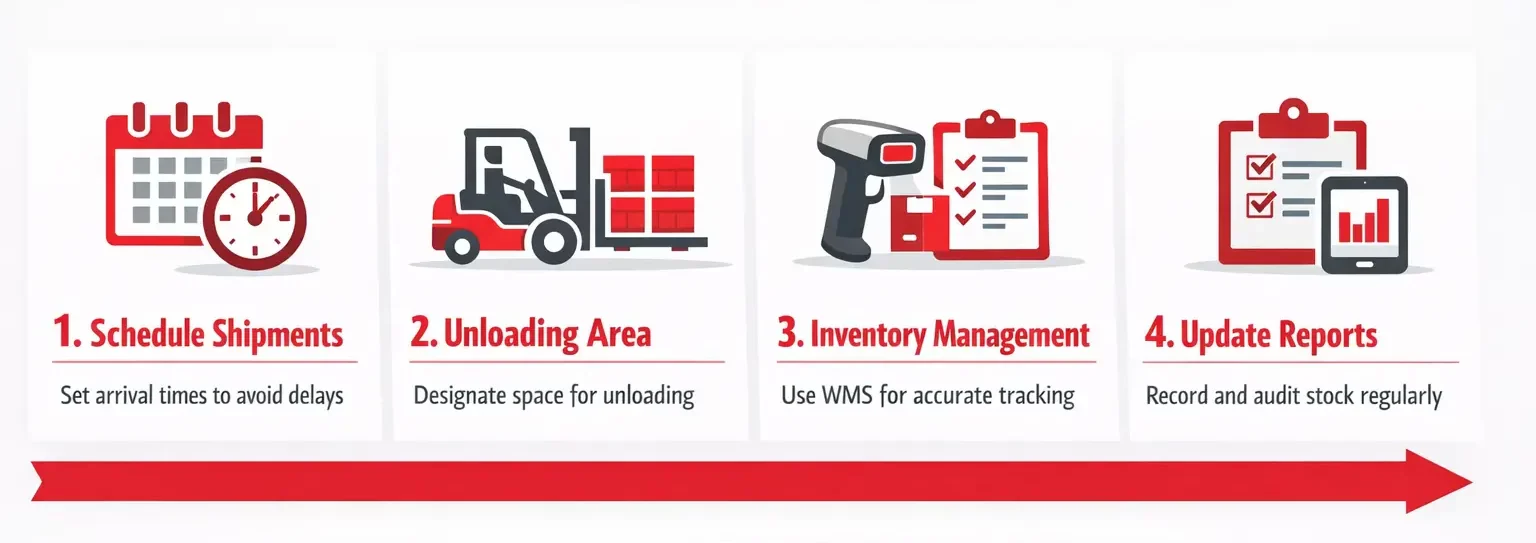
An effective inbound process is the cornerstone of warehouse productivity and inventory data accuracy. You can do these four steps to ensure good inbound processes:.
1. Schedule all incoming shipments
Unscheduled shipments can pile up in the unloading area and cause delays. Set up an automated scheduling system or manually set arrival times. This ensures that the receiving process runs smoothly and without queues.
2. Designate a specific area for unloading
Provide a specific area for unloading pallets and separating products before storage. This area supports efficiency in transporting goods to storage locations. Ensure that it is not mixed with other operational areas.
3. Integrate inventory management into the process
Store goods accurately and quickly in accordance with established storage optimization procedures. Products requiring special handling must be managed according to their respective storage standards. Use labels and a WMS system for real-time stock updates.
4. Update reports and data regularly
Every product that comes in should be recorded so that the data in the system matches the physical stock. Unrecorded or damaged goods will affect the order fulfillment process. Conduct regular inventory audits to maintain data consistency.
How to Optimize Warehouse Process Flow
Optimizing your warehouse process flow involves improving operational efficiency at every stage of product movement. Whether you’re a small distributor or a large manufacturing warehouse, streamlining these flows results in faster delivery, lower costs, and better use of space and labor.
Begin by conducting a full audit of your current workflows. Identify bottlenecks, redundancies, and opportunities for automation. A warehouse storage system can help segment products by demand level, making fast-moving items more accessible.
To drive better performance, consider the following optimization strategies:
- Implement real time tracking: Use scanning technology to track stock movements and reduce misplacements.
- Adopt slotting optimization: Arrange inventory based on picking frequency to minimize travel time.
- Standardize workflows: Use SOPs to train teams and maintain consistent performance.
- Integrate WMS with ERP: Allow seamless data exchange for more accurate inventory and order management.
For smoother Warehouse Process Flow, use a trusted WMS to automate inbound, storage, and outbound processes. It helps reduce errors, improve efficiency, and accelerate delivery. Explore our pricing scheme to find the right WMS solution for your business.

5 Benefits of 3PL Warehouse Management

Outsourcing warehouse operations to a third-party logistics (3PL) provider helps growing businesses manage complexity, reduce costs, and increase operational efficiency. Here are five major benefits of partnering with a 3PL:
1. Logistical optimizations
3PL providers serve diverse clients and use vast data to improve warehouse processes. They optimize routes, inventory planning, and shipping costs. This results in faster delivery times and improved customer satisfaction.
2. Expanded warehouse network
Instead of shipping from a single location, 3PLs let you distribute inventory across multiple warehouses. This shortens delivery distances and speeds up nationwide or regional shipping. Customers benefit from quicker, more affordable service.
3. Significant time savings
3PLs handle tedious logistics tasks like packing, tracking, and returns. With these duties off your plate, your team can focus on sales or product growth. Their system also helps monitor fulfillment performance in real time.
4. Flexible warehouse space usage
3PLs charge based on actual space used by bin, shelf, or pallet. This prevents overpaying for unused space or running out during demand spikes. Businesses can also repurpose or release their own warehouse facilities.
5. Real-time operational insights
With 3PL tech tools, you can monitor your inventory and order status anytime. From order tracking to fulfilment accuracy, you get transparent performance data. This insight supports smarter business decisions and growth planning.
Optimize Warehouse Process Flow with HashMicro Warehouse Management System
As warehouse operations scale, managing process flow manually becomes increasingly difficult to sustain. Using a dedicated warehouse management system helps automate inbound, storage, and outbound processes, reducing errors and improving efficiency across all stages.
Key capabilities that support optimized warehouse flow include:
- Product Dimension Tracking: Automatically logs the height, width, and weight of each item during receiving for accurate categorization.
- Putaway Strategy Settings: Assigns items to optimal storage locations based on type, volume, or movement frequency.
- Putaway Capacity Checking: Verifies available capacity in each zone or bin before storage to prevent overloading.
- Location Dimension Management: Matches product size with shelf or rack dimensions to maximize warehouse space.
- Pallet Racking Configuration: Defines racking types and assigns rack numbers to reduce staff travel time during picking.
- In-Depth Performance Reporting: Provides multi format reports to monitor order speed, storage efficiency, and movement trends.
Together, these tools give warehouse teams the visibility and control needed to manage operations with precision as volume grows.
Conclusion
An efficient warehouse process flow helps businesses move goods more accurately, respond faster to orders, and maintain better inventory control. When receiving, storage, picking, packing, and shipping run in a clear sequence, warehouse teams can reduce delays, prevent stock errors, and support more consistent fulfilment performance.
However, these gains are harder to sustain when workflows remain manual or disconnected. For that reason, businesses often review broader operational approaches, including inventory management software in the Philippines, to compare systems, visibility features, and process controls that better support warehouse efficiency over time.
Question About Warehouse Process Flow
To run a warehouse operation effectively, use a clear layout that supports smooth goods movement and apply SOPs for receiving, picking, and shipping. A WMS also helps track inventory, reduce errors, optimize space, and improve overall visibility and control.
A flow-through process (or cross-docking) is a warehouse strategy where incoming goods are directly transferred to outbound shipments with minimal or no storage time. This method is often used to increase speed and reduce handling or storage costs.
The cycle process in a warehouse refers to the recurring set of warehouse activities—receiving, storing, picking, packing, and shipping—that repeat with each inventory turnover. Effective cycle processes ensure continuous product movement and operational efficiency.
Switch to Code mode or refresh to load the visual preview.