






In today’s competitive market, securing top talent is no longer just an administrative task. It is a critical business imperative. Companies face talent shortages, shifting candidate expectations, and rapid technological change that traditional hiring methods struggle to address.
Recruitment Process Outsourcing is a partnership that optimizes the talent acquisition lifecycle. By integrating external expertise, technology, and streamlined processes into a HR framework, RPO delivers a comprehensive solution to modern hiring challenges.
This blog covers the definition, types, implementation, best practices, and benefits of recruitment process outsourcing and how you can optimize your own workforce.
Key Takeaways
RPO is a partnership in which an external provider takes full or partial ownership of a company's recruitment function, integrating people, processes, and technology to improve hiring outcomes.
The benefits of RPO include faster time-to-hire, lower recruitment costs, improved candidate quality, access to specialist expertise, and the ability to scale hiring up or down.
Implementation success depends on clear SLAs, strong internal buy-in, seamless technology integration, and treating the RPO provider as a genuine strategic partner.
Advanced RPO practices such as predictive analytics, AI-driven sourcing, Total Talent Management, embedded DEI, and ERP integration are redefining what is possible in modern RPO.
What Is Recruitment Process Outsourcing (RPO)?

Recruitment Process Outsourcing (RPO) is a specialized form of business process outsourcing and an outsourced HR service where an employer transfers all or part of its permanent recruitment processes to an external provider.
Unlike staffing agencies that fill immediate vacancies, RPO providers take ownership of the design, management, and execution of recruitment. This approach aligns talent acquisition with the strategic objectives of the business, rather than treating hiring as a series of isolated transactions.
RPO is built on the deep integration of people, processes, and technology. Providers typically operate under the client’s brand, ensuring a consistent and authentic employer identity in the talent market.
This means candidates interact with recruiters, believing they are communicating directly with the hiring company. This approach protects and enhances the employer’s brand while delivering a superior candidate experience.
RPO covers workforce planning, employer branding, candidate sourcing, rigorous screening, and data analytics to support smarter hiring decisions. They use advanced technologies, such as AI-driven systems & predictive analytics, that may be too costly for a single company to implement.
Ultimately, RPO shifts the focus from filling empty seats to strategically acquiring the right talent to drive long-term business success.
"Most companies underestimate how much time and money they lose to inefficient hiring. RPO brings structure, speed, and accountability to a process that is too often left to chance."
How Recruitment Process Outsourcing Works
Implementing an RPO solution is a structured process that requires a deep understanding of the client’s business, culture, and long-term goals. Every partnership is tailored to the specific needs of the company.
A comprehensive, end-to-end RPO engagement typically follows a well-defined lifecycle. Below is a detailed look at the eight stages that make up the RPO operational framework.
1. Workforce Needs Assessment
The foundation of any successful RPO engagement begins with a thorough Workforce Needs Assessment. The RPO provider conducts a deep dive into the client’s current structure, historical hiring data, and future business objectives.
This involves extensive consultations with key stakeholders, including HR leaders, department heads, and executive management, to understand the skills, competencies, and cultural attributes required for success.
The assessment also includes a full audit of existing recruitment processes to identify bottlenecks and inefficiencies. The RPO team analyzes time-to-hire, cost-per-hire, turnover rates, and candidate feedback.
By mapping the current state of talent acquisition, the provider can forecast future workforce requirements, anticipate talent gaps, and build a proactive strategy. This predictive approach prevents the business from being caught off guard by sudden shortages.
2. RPO Strategy and Solution Design
Following the needs assessment, the RPO provider moves to Strategy and Solution Design. This phase creates a customized recruitment blueprint aligned with the client’s specific requirements.
The strategy covers employer branding, sourcing channels, compliance protocols, and diversity, equity, and inclusion (DEI) objectives. The goal is a robust, scalable framework that adapts to the dynamic needs of the business.
Technology integration is a critical component of this phase. The RPO provider evaluates the client’s existing HR technology stack and determines how best to integrate advanced recruitment tools.
Integrating the recruitment workflow with a broader enterprise system enables seamless data flow from initial application through to payroll and performance management, ensuring all hiring activities are tracked and optimized in real time.
3. Candidate Sourcing and Screening
Unlike traditional recruitment, RPO employs a proactive, multi-channel sourcing methodology rather than waiting for candidates to apply.
Expert sourcers use advanced techniques such as boolean searches, programmatic advertising, and social media recruiting to reach passive talent, qualified professionals open to the right opportunity but not actively job hunting.
Providers combine technology and human expertise, using AI-driven resume parsing, behavioral assessments, and cognitive testing. The objective is to evaluate both technical skills and cultural fit. This process ensures only the most qualified and suitable candidates are presented to hiring managers.
4. Interview Coordination
Interview coordination can be one of the most time-consuming aspects of talent acquisition for internal HR teams. In an RPO model, this is handled entirely by the dedicated recruitment team.
This involves communication between candidates, hiring managers, and stakeholders to schedule interviews, manage calendar invites, and distribute all necessary documentation and interview guides.
RPO providers also assist in structuring the interview process itself. They collaborate with hiring managers to develop standardized, competency-based questions and evaluation rubrics to reduce unconscious bias.
This structured approach ensures a consistent candidate experience and a clear, objective framework for comparing applicants. The RPO team also prepares candidates by sharing insights into company culture and expectations.
5. Offer Management and Hiring
When a hiring manager selects the ideal candidate, the RPO provider leads Offer Management and Hiring. This phase requires tact, negotiation skills, and a solid understanding of current market compensation trends.
The RPO team works with the client to formulate a competitive offer aligned with internal equity and market conditions. They manage all candidate communications, including presenting the offer and addressing questions about the total rewards package.
The provider also handles background checks, employment history verification, credential checks, and any required drug screenings. Once the offer is accepted, they generate the employment contract and complete all compliance documentation.
This seamless transition from candidate to hired employee is critical for maintaining momentum and ensuring the new hire remains engaged throughout the process.
6. Onboarding Support
RPO providers offer comprehensive Onboarding Support to bridge the gap between acceptance and the new hire’s first day, often referred to as pre-boarding.
During this period, the RPO team stays in regular contact with the new hire, providing welcome materials, company information, and any paperwork to complete in advance of the start date.
Effective onboarding support reduces candidate drop-off and the risk of a signed hire changing their mind before starting. A smooth, engaging pre-boarding experience ensures the new employee feels valued and prepared from day one.
This process is often integrated with the client’s internal HR systems to automatically trigger IT provisioning, workspace setup, and orientation scheduling, accelerating the new hire’s time-to-productivity.
7. Recruitment Reporting and Analytics
One of the most significant advantages of RPO is access to sophisticated Recruitment Reporting and Analytics. Throughout the engagement, the RPO team continuously collects and analyzes data across the entire hiring process.
Clients receive real-time dashboards with visibility into sourcing channel effectiveness, pipeline health, diversity metrics, and bottleneck identification, supporting more informed decisions at every stage.
These insights aid business leaders in making strategic decisions based on data rather than intuition. The RPO provider conducts regular business reviews to present findings and recommend areas for continuous improvement.
By treating recruitment as a measurable, iterative process, the RPO model ensures the talent acquisition strategy continuously evolves to deliver maximum return on investment.
8. Strategic Talent Alignment
The final step in the RPO lifecycle is Strategic Talent Alignment. This elevates the RPO relationship from a transactional service to a transformative business partnership.
The RPO provider works with executive leadership to ensure the talent acquisition strategy remains aligned with overarching business goals, whether scaling for a new product launch, diversifying the workforce, or planning for succession.
Strategic talent alignment involves long-term workforce planning, market mapping, and building comprehensive talent pools for future needs. The RPO team acts as a trusted advisor on talent availability and competitor compensation strategies.
By maintaining this forward-looking perspective, the RPO provider ensures the business is not just reacting to immediate vacancies but proactively building a resilient, high-performing workforce for sustained growth.
Why Companies Choose Recruitment Process Outsourcing






Transitioning from in-house recruitment to a fully managed outsourced model is a significant strategic move. Companies of all sizes and across various sectors are increasingly making this shift.
The driving force is the need to overcome complex hiring challenges and gain a competitive edge in the market. The key reasons companies choose RPO can be grouped into several distinct benefits.
Faster Hiring and Reduced Time-to-Hire
In today’s business environment, speed is critical. A prolonged vacancy leads to lost productivity, lower team morale, and missed revenue opportunities. RPO drastically reduces time-to-hire by deploying dedicated recruitment teams focused solely on filling open positions.
Unlike internal HR generalists who balance employee relations, payroll, and benefits administration alongside hiring, RPO recruiters dedicate 100% of their time to sourcing and engaging talent.
RPO providers also build and nurture extensive talent pipelines and proprietary candidate databases. When a new role opens, they tap into a pre-vetted pool rather than starting from scratch.
Combined with streamlined processes and the elimination of administrative bottlenecks, this proactive approach ensures top candidates are identified, interviewed, and hired far faster than a traditional in-house team could manage.
Access to Recruitment Expertise and Technology
The talent acquisition landscape is constantly evolving, with new sourcing methodologies, compliance regulations, and technologies emerging regularly. Staying ahead requires significant investment and continuous learning.
By partnering with an RPO provider, companies gain immediate access to deep recruitment expertise. RPO professionals are industry specialists with intimate knowledge of market dynamics, candidate behavior, and best-in-class hiring practices.
Access to cutting-edge technology is equally important. Enterprise-grade ATS platforms, candidate relationship management tools, AI-driven sourcing software, and software for outsourced hiring are often too costly for individual companies to purchase and maintain.
RPO providers embed these advanced technologies into their service offerings, giving clients access to state-of-the-art tools without heavy capital expenditure. This enables more precise targeting, automated workflows, and a better candidate experience.
Improved Candidate Quality
Filling a role quickly means little if the new hire is not equipped to succeed or does not align with the company culture. A poor hire wastes training resources, disrupts team dynamics, and restarts the hiring process at high cost.
RPO improves candidate quality through rigorous, multi-layered screening and a strong focus on cultural alignment. Providers use behavioral interviewing, cognitive and personality testing, and scenario-based evaluations to assess each candidate thoroughly.
Because RPO teams are not incentivized simply to place a candidate, they take time to deeply understand the unique makeup of the client company. Only candidates with the right technical skills and the emotional intelligence to thrive are presented to hiring managers.
This approach increases long-term retention rates, reducing the recurring costs and disruption associated with repeat hiring for the same roles.
Lower Recruitment Costs
While engaging an external partner involves a financial commitment, the overall cost of talent acquisition is almost always lower under an RPO model. Traditional recruitment costs are often fragmented and hidden across departments.
These costs include job board subscriptions, agency fees ranging from 15% to 30% of a hire’s first-year salary, advertising spend, and the often uncalculated cost of internal staff time spent on recruitment administration.
RPO consolidates these expenses into a predictable, transparent pricing structure. By leveraging economies of scale, providers negotiate better rates for job boards and advertising.
By reducing reliance on expensive contingency agencies and minimizing the financial impact of prolonged vacancies and bad hires, RPO delivers a strong return on investment. It shifts hiring from a high fixed-cost model to a flexible, variable-cost structure.
Scalable Hiring for Business Growth
Business needs are rarely static. They fluctuate based on market conditions, seasonality, product launches, and strategic expansion. An internal HR team sized for steady-state hiring will quickly become overwhelmed during rapid growth.
Conversely, maintaining a large internal recruitment team during a hiring freeze creates unnecessary overhead. Scalability is one of the most powerful attributes of the RPO model.
RPO operates like an accordion, expanding and contracting in direct response to hiring volume. If a company suddenly needs to hire hundreds of employees for a new facility, the RPO provider rapidly deploys additional recruiters and coordinators to meet demand.
Once the project is complete, resources scale back down. This flexibility ensures the business always has the exact level of recruitment support it needs, precisely when it needs it, without the burden of hiring and firing internal HR staff.
Types of Recruitment Process Outsourcing Models
There is no one-size-fits-all approach to talent acquisition. Different companies have vastly different needs, budgets, and internal capabilities, so the RPO industry has evolved to offer a range of flexible engagement models.
Understanding these distinct RPO types is crucial for business leaders seeking to select the partnership structure that will deliver the most strategic value for their specific situation.
Enterprise RPO (End-to-End Recruitment)
Enterprise RPO, often called full-cycle or end-to-end RPO, is the most comprehensive model available. The RPO provider assumes total responsibility for the company’s entire recruitment function across all departments, locations, and business units.
The provider manages every step of the talent acquisition lifecycle, from workforce planning and employer branding through to sourcing, interviewing, hiring, and onboarding.
This model is particularly suited to large companies or multinational corporations that require a unified, standardized recruitment strategy to ensure consistency, compliance, and quality across a wide enterprise.
By outsourcing the entire function, internal HR leadership is freed from operational recruitment burdens, allowing them to focus on strategic priorities such as employee engagement, development, and talent management.
Enterprise RPO delivers the greatest impact in terms of cost reduction, process optimization, and technological transformation.
Project-Based or On-Demand RPO
Project-Based RPO is designed to address specific, short-term hiring initiatives that exceed the capacity of the internal talent acquisition team. It has a clearly defined scope, timeline, and set of deliverables.
A company might engage a project-based RPO to build a sales team for a new product launch, staff a new facility, or manage a high-volume seasonal hiring surge.
The primary advantage is agility. The RPO provider rapidly deploys a specialized team to execute the project without disrupting the company’s ongoing, day-to-day recruitment operations.
Once the specific hiring goals are achieved, the engagement concludes. This on-demand approach allows companies to tackle aggressive growth targets without permanently increasing their internal HR headcount.
Modular RPO
Modular RPO, sometimes called selective RPO, involves outsourcing only specific segments of the recruitment process while keeping the rest in-house. It suits companies with a competent internal HR team that face gaps in certain specialist areas.
For example, a company struggling to source candidates for highly technical roles could engage a Modular RPO provider solely for sourcing and initial screening. The RPO team vets candidates and hands a qualified shortlist to internal hiring managers.
Other commonly outsourced modules include employer branding, interview logistics, and background checks. Modular RPO offers a cost-effective way to augment internal capabilities and eliminate specific pain points.
Hybrid RPO
The Hybrid RPO model blends internal talent acquisition resources with external RPO expertise. The provider works alongside the company’s existing HR team, sharing responsibilities and operating as a unified front.
The division of labor is defined based on the company’s unique needs and the respective strengths of both teams. Often, the internal team handles strategic or executive hiring while the RPO provider manages high-volume, repetitive roles.
Alternatively, the RPO provider may manage recruitment for specific geographic regions or business units while the internal team handles the rest.
This model provides the ideal balance of maintaining internal control and institutional knowledge while leveraging the scalability, technology, and sourcing power of an external partner.
RPO vs In-House Recruitment
When evaluating talent acquisition strategies, business leaders face a classic build vs. buy dilemma: invest in expanding an internal recruitment team, or partner with an external RPO provider.
Both approaches have their merits, but a detailed comparison reveals significant differences in capability, flexibility, and financial structure.
In-house recruitment teams have a deeply ingrained understanding of the company’s culture, internal politics, and operational nuances. Daily proximity to hiring managers allows them to build personal relationships and develop a strong intuitive sense of fit.
For companies with low, predictable hiring volumes and stable workforces, a lean in-house team is often sufficient and cost-effective.
However, internal teams frequently struggle with resource constraints. When hiring volumes spike, they can quickly become overwhelmed, leading to delayed hiring, compromised candidate experiences, and increasing reliance on costly external contingency agencies to fill the gap.
Industry Use Cases for Recruitment Process Outsourcing
While RPO is highly adaptable, certain industries face unique talent acquisition challenges that make this model particularly advantageous.
Understanding how different sectors leverage these services provides valuable context for strategic workforce planning.
- Healthcare and Life Sciences
The healthcare sector is characterized by intense regulatory compliance, chronic talent shortages, and the need for highly specialized professionals.
RPO providers assist hospitals, clinics, and life sciences companies by implementing rigorous credentialing processes and managing high-volume hiring for nursing staff.
They also execute targeted search strategies for niche medical specialists. By ensuring strict adherence to healthcare regulations, outsourced recruitment teams mitigate compliance risks while reducing time-to-hire in critical patient-care roles.
- Technology and Software Development
In the tech industry, competition for software engineers, cybersecurity experts, and data scientists is fierce. Fast-growth periods can quickly overwhelm internal HR teams.
RPO partners bring advanced sourcing capabilities, engaging passive candidates through specialized tech forums, open-source communities, and AI-driven talent mapping.
They help both fast-growing startups and established tech companies scale their workforces rapidly without sacrificing candidate quality or cultural fit.
- Manufacturing and Logistics
Manufacturing and logistics companies regularly deal with seasonal demand fluctuations and the dual challenge of hiring both skilled tradespeople and high-volume hourly labor.
An outsourced recruitment strategy allows these companies to scale hiring capacity up or down as production cycles dictate.
Providers use localized recruitment marketing, geo-fencing, and mobile-first application processes to capture blue-collar talent quickly and efficiently, keeping supply chains moving without interruption.
Essential Implementation Steps for RPO Success
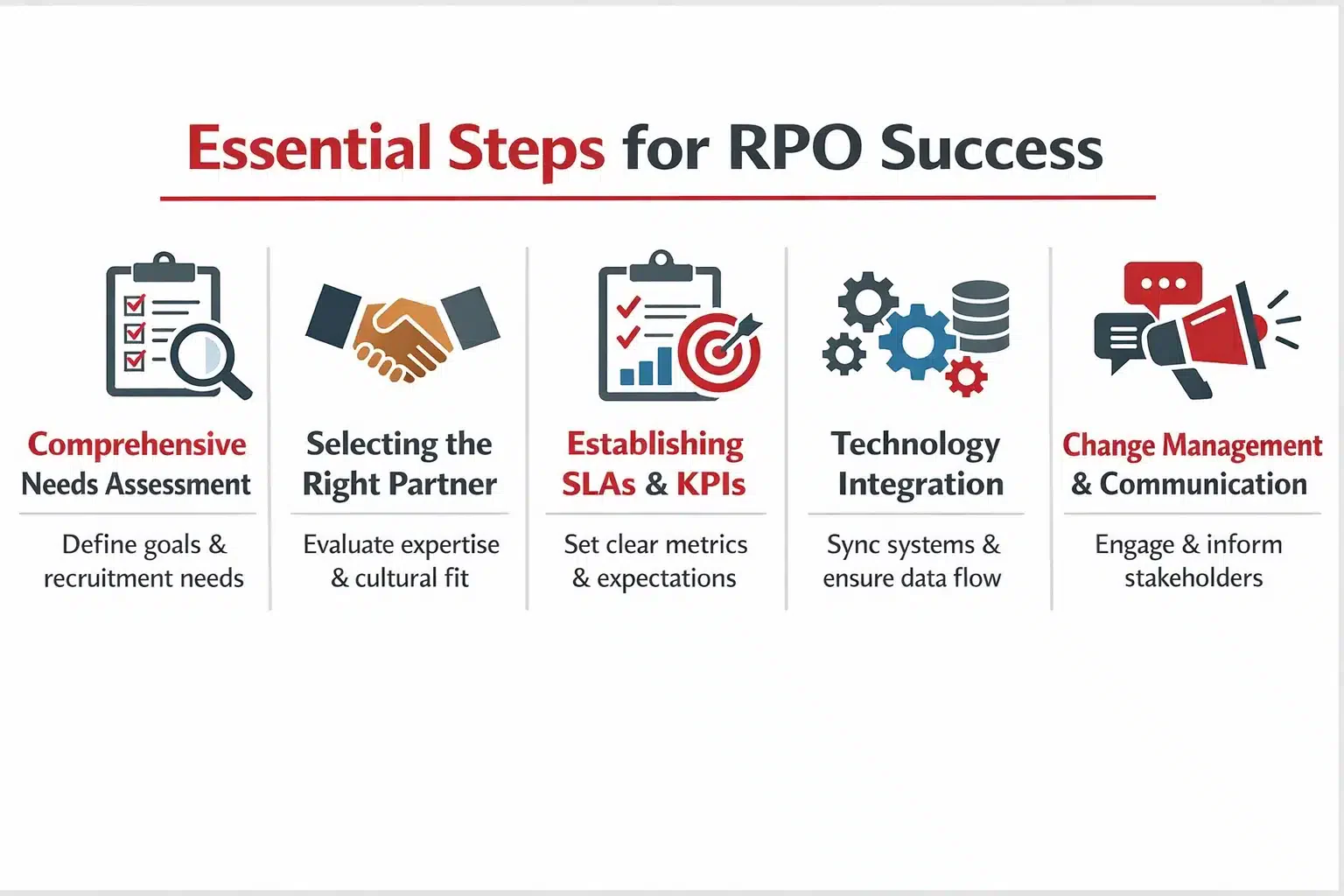
Transitioning to an RPO model requires careful planning and execution. A messy implementation can create friction between internal teams and the external provider.
Following this roadmap ensures seamless integration and maximizes ROI.
1. Comprehensive Needs Assessment
Before engaging a provider, clearly define your recruitment bottlenecks, target metrics such as cost-per-hire, time-to-fill, and retention rates, and the specific scope of the partnership.
Determine upfront whether you need end-to-end support, project-based assistance, or a hybrid model. This clarity prevents scope creep and sets a strong foundation for the engagement.
2. Selecting the Right Partner
Look beyond cost when evaluating potential providers. Assess their industry expertise, technological capabilities, and cultural alignment with your company.
The provider will represent your employer brand in the market, so their core values must closely mirror your own. A misaligned partner can damage your reputation with candidates.
3. Establishing Clear SLAs and KPIs
Draft a robust Service Level Agreement (SLA) that outlines exact expectations, deliverables, and Key Performance Indicators (KPIs).
Metrics should include quality of hire, candidate satisfaction scores, hiring manager satisfaction, and diversity benchmarks. Clear SLAs create accountability and provide a basis for ongoing performance reviews.
4. Technology Integration
Ensure seamless data flow between the provider’s systems and your internal Human Resources Information System (HRIS) or Applicant Tracking System (ATS).
Proper integration eliminates data silos, ensures compliance, and provides real-time visibility into the hiring pipeline. Poor integration is one of the most common causes of RPO implementation failure.
5. Change Management and Communication
Proactively communicate the transition to internal stakeholders, especially hiring managers. Clarify the new workflows and define roles and responsibilities clearly.
Emphasize how the RPO partnership will deliver better talent faster and reduce the administrative burden on internal teams. Early buy-in from stakeholders is critical to a smooth transition.
Common Pitfalls and How to Avoid Them
Even with the best intentions, companies can stumble when deploying an outsourced recruitment strategy. Recognizing these pitfalls early can save significant time, money, and frustration.
Treating the RPO Provider as a Staffing Agency
One of the most frequent mistakes is treating the RPO provider like a traditional staffing agency. When hiring managers view the outsourced team as resume-pushers rather than strategic partners, the relationship fails to reach its full potential.
To prevent this, involve the provider in workforce planning discussions from day one. Share your long-term business goals, hiring forecasts, and growth plans so the provider can align their strategy accordingly.
Treat the RPO team as a true extension of your internal team. Include them in relevant meetings, give them access to key stakeholders, and establish regular communication rhythms to keep the partnership aligned.
Failing to Secure Internal Buy-In
A lack of internal buy-in is another common and costly mistake. When HR teams feel threatened by the outsourcing arrangement, or when hiring managers resist new centralized processes, bottlenecks inevitably follow.
Strong executive sponsorship is essential. When senior leadership visibly champions the RPO partnership, it signals to the broader team that this is a strategic decision, not a threat to their roles.
Transparent communication is equally critical. Clearly articulate that the goal is to augment and empower the internal team, not to replace it. Define new roles, responsibilities, and escalation paths before the engagement goes live.
Neglecting Employer Branding Before Launch
Poorly defined employer branding can severely limit the provider’s ability to attract top talent. An RPO team operates under your company’s banner, and a weak or outdated Employee Value Proposition (EVP) constrains even the most skilled recruiters.
Before launching any major sourcing campaign, work with your RPO partner to audit your current EVP. Identify gaps between what you offer and what candidates in your target market expect.
Refine your messaging, update your careers page, and ensure your social presence reflects the culture you want to project. A compelling employer brand is one of the highest-return investments you can make in talent acquisition.
Advanced Practices in Modern RPO
As the talent acquisition landscape rapidly evolves, leading RPO providers are adopting advanced practices that deliver greater strategic value to their clients.
Predictive Analytics and Talent Intelligence
Modern providers are moving beyond historical reporting to leverage predictive analytics. By analyzing market trends, competitor hiring patterns, and internal turnover data, they can forecast future talent needs.
This allows them to identify the most fertile geographic markets for specific skill sets and build warm talent pools long before a vacancy officially opens.
AI-Driven Sourcing and Programmatic Advertising
Artificial intelligence is fundamentally transforming candidate sourcing. RPO teams use advanced AI algorithms to instantly match candidate profiles with job requirements, drastically reducing manual screening time.
Programmatic job advertising automates the purchasing and placement of job ads across the web, ensuring recruitment marketing budgets are optimized and directed toward platforms most likely to yield high-quality applicants.
Total Talent Management (TTM)
Forward-thinking companies are increasingly embracing Total Talent Management (TTM), a holistic approach that blends RPO for permanent hires with Managed Service Provider (MSP) programs for contingent, freelance, and gig workers.
By breaking down the silos between permanent and temporary hiring, companies gain full visibility into their entire workforce ecosystem, enabling more agile, scalable, and cost-effective talent deployment.
Embedded Diversity, Equity, and Inclusion (DEI)
Top-tier RPO providers are embedding DEI principles directly into the recruitment lifecycle. This includes using augmented writing tools to remove biased language from job descriptions and implementing blind resume screening processes.
Providers also actively source from underrepresented talent communities. By making DEI a structural, measurable component of hiring rather than an afterthought, they help companies build diverse, equitable, and innovative teams.
Leveraging ERP and HR Software Tools
The right software infrastructure is the backbone of a high-performing RPO engagement. Integrating enterprise-grade tools into the recruitment workflow eliminates manual handoffs, reduces errors, and gives all stakeholders real-time visibility.
An HRIS platform centralizes employee data across the full talent lifecycle, from the first candidate interaction through to onboarding and performance management. When connected to the RPO provider’s systems, it creates a single source of truth for all hiring activity.
ERP systems with built-in HRM modules and an advance workforce system go a step further by linking recruitment directly to workforce planning, payroll, and budgeting. This allows HR and finance teams to align headcount decisions with broader business targets in real time.
Applicant Tracking Systems (ATS) and Candidate Relationship Management (CRM) tools manage pipeline activity, automate candidate communications, and track compliance at every stage of the process.
When selecting an RPO partner, verify that their technology stack integrates cleanly with your existing platforms. Poor system compatibility is one of the most common causes of data silos, compliance gaps, and reporting failures in outsourced recruitment engagements.
Conclusion
Recruitment Process Outsourcing has evolved from a simple cost-cutting measure into one of the most powerful strategic tools available to business leaders. As competition for skilled talent intensifies globally, the businesses that win will be those that treat talent acquisition as a strategic priority.
Whether a company is navigating rapid growth, entering new markets, or closing persistent talent gaps, RPO provides the expertise, technology, and scalability to meet those demands.
Partnering with the right RPO provider positions your company to attract, hire, and retain the people who will drive its long-term success. To find the best solution for your business, you can consult our experts and explore the right recruitment strategy with confidence.
Frequently Asked Question
Recruitment Process Outsourcing (RPO) is a form of business process outsourcing where a company transfers all or part of its permanent recruitment function to an external provider, who manages the entire hiring lifecycle on the company's behalf.
A staffing agency fills individual vacancies on a transactional basis, while an RPO provider acts as an embedded extension of the company's HR team. RPO covers the full recruitment lifecycle, from workforce planning and employer branding through to hiring and onboarding.
The main RPO models are Enterprise RPO, which covers the entire recruitment function; Project-Based RPO, which addresses specific short-term hiring needs; Modular RPO, which outsources only selected parts of the process; and Hybrid RPO, which blends internal and external resources.
RPO providers embed compliance and DEI practices into every stage of recruitment. This includes bias-free job description tools, blind resume screening, sourcing from underrepresented communities, and tracking diversity metrics through real-time dashboards.
Integrating an ERP or HRIS with the RPO provider's systems links hiring activity to workforce planning, payroll, and budgeting. It eliminates data silos, ensures compliance, and gives HR and finance teams real-time visibility into the talent pipeline.