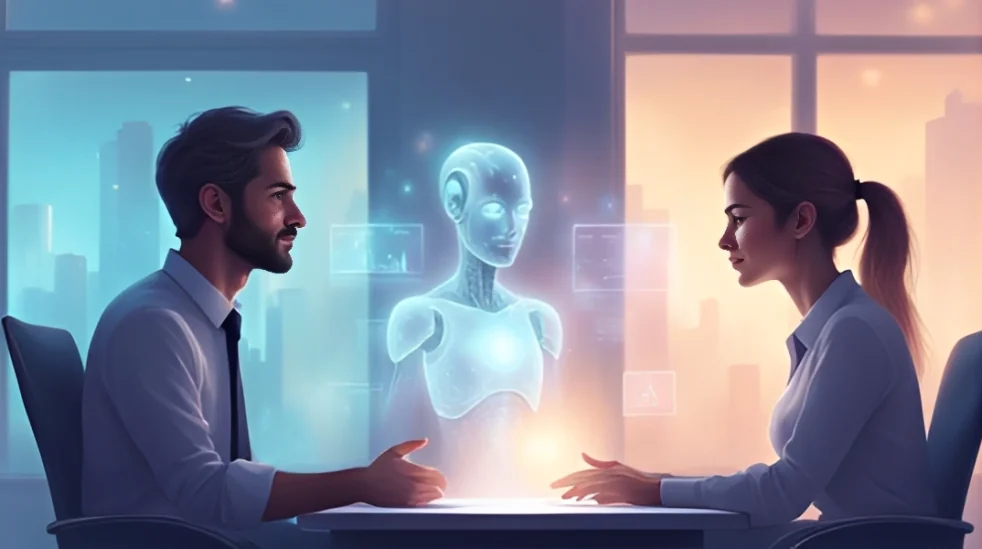




AI for HR is no longer a futuristic concept. For decades, HR departments were buried in paperwork and compliance tasks. Today, AI is redefining the profession by reshaping how businesses attract, develop, and retain talent.
HR professionals are now expected to act as strategic business partners, not administrators. AI makes that shift possible by replacing intuitive decision-making with data-driven insights, automated workflows, and the ability to predict workforce trends before they become problems.
This blog includes business insights on how to utilize AI effectively in AI processes and how you can apply it to your own business.
Key Takeaways
AI in HR applies machine learning, natural language processing, and predictive analytics to automate and enhance HR functions to go beyond basic automation
The way AI is used in HR is to source passive candidates, personalize onboarding, administering pulse surveys, forecasting attrition, and automating employee support through chatbots and virtual assistants.
AI delivers benefits in efficiency, process consistency, cost reduction, and decision-making quality.
Successful implementation starts with auditing workflows for automation opportunities, selecting tools that integrate with existing HRIS infrastructure, and upskilling HR teams to work alongside AI.
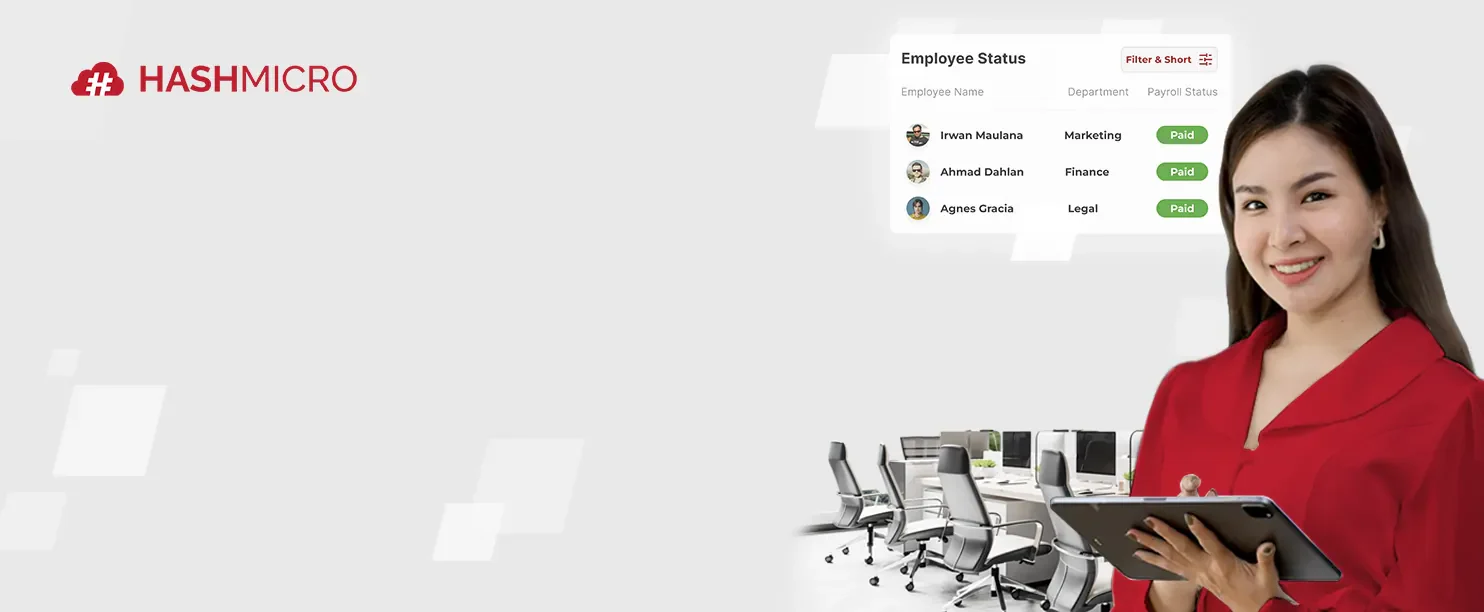
What Is AI in HR?

AI in HR refers to the application of machine learning, natural language processing, deep learning, and predictive analytics to automate and enhance HR functions. These systems can comprehend language, recognize workforce patterns, and make informed recommendations.
AI is dynamic. It can analyze thousands of resumes, identify skills that correlate with high performance, and refine its criteria based on past hiring outcomes. Natural Language Processing (NLP) allows it to understand the sentiment behind employee feedback, not just match keywords.
Ultimately, AI in HR is an enabling technology, processing vast amounts of human capital data at speeds no human team can match, translating that data into actionable insights and serving as an intelligent co-pilot for HR professionals, especially when integrated with an AI-powered HR software solution that centralizes and automates core HR functions.
"AI does not make HR less human. It removes the tasks that were never human to begin with, freeing the people in HR to focus on the work that actually requires them."
How AI Is Used in Human Resources
AI is being applied across every stage of the employee lifecycle. The use cases span recruitment, onboarding, learning, engagement, workforce planning, and employee support, each delivering measurable improvements in efficiency and experience.
1. Recruitment and Hiring
Recruitment has seen the most rapid AI adoption in HR. Traditional hiring is time-consuming and prone to unconscious bias, requiring recruiters to manually screen hundreds of applications for a single role.
AI-powered ATS platforms use NLP to parse resumes contextually, ranking candidates based on job alignment and historical performance data rather than keyword matches alone.
Machine learning also identifies passive candidates across professional networks and portfolios. AI video interviewing tools can analyze word choice, tone, and micro-expressions to assess soft skills and cultural fit.
2. Employee Onboarding and Offboarding
A disorganized onboarding experience leads to early disengagement and high turnover. AI streamlines and personalizes the journey by generating onboarding plans based on role, department, and individual learning pace.
AI chatbots serve as a 24/7 digital resource for new hires, answering questions about policies, benefits, and logistics instantly without requiring HR intervention.
For offboarding, AI sentiment analysis tools evaluate exit survey responses to identify underlying themes and systemic issues across departments, giving HR actionable data to improve retention.
3. Learning and Development
A one-size-fits-all approach to corporate training is ineffective. AI analyzes each employee’s skill set, performance metrics, and career goals to recommend personalized courses, webinars, and microlearning modules.
Generative AI tools help instructional designers rapidly build training materials and interactive scenarios. AI coaching platforms provide real-time feedback on communication, leadership, and project management skills.
4. Employee Engagement and Talent Management
Annual surveys are too infrequent to capture dynamic employee sentiment. AI administers frequent pulse surveys and uses NLP to instantly categorize feedback, identify sentiment trends, and flag emerging issues to HR leadership.
In talent management, these capabilities become even more powerful when supported by an integrated employee appraisal management system that tracks performance consistently and feeds accurate data into AI models.
5. Workforce Planning and HR Analytics
AI-driven HR analytics platforms process historical workforce data alongside external economic indicators and labor market dynamics, allowing HR leaders to model scenarios and forecast future headcount and skill requirements.
AI also supports succession planning by mapping employee skills and performance trajectories against critical leadership roles, surfacing internal candidates who may have been overlooked by traditional evaluation methods.
6. HR Chatbots and Virtual Assistants
HR departments are flooded with repetitive inquiries about vacation balances, payroll, and benefits. AI-powered chatbots integrated into platforms provide instant, 24/7 responses.
Modern conversational AI understands intent even when questions are phrased casually or contain typos. These assistants guide employees through complex processes like insurance enrollment or leave requests, freeing HR for higher-value work.
Benefits of AI in HR
AI delivers benefits that extend far beyond the HR department, positively impacting the business’s bottom line, culture, and long-term competitiveness. Understanding these benefits is essential for building a strong case for adoption.
1. Improved Efficiency and Productivity
The most immediate benefit of AI in HR is a significant increase in operational efficiency. Automating high-volume tasks like resume screening, interview scheduling, data entry, and basic employee queries reduces execution time from hours to seconds.
When HR teams are freed from administrative drudgery, their capacity expands. They can redirect focus toward leadership development, employer branding, and personalized coaching, transforming HR from a reactive service center into a strategic driver.
2. Better-structured HR Processes
Human error is inevitable in manual processes. A missed onboarding step, a compliance requirement overlooked, or a contract typo can trigger operational and legal consequences. AI introduces structure, consistency, and standardization across HR workflows.
AI-driven systems ensure every process follows a predefined, optimized path. The right information reaches the right people at the right time, every time. This consistency ensures all employees receive a fair and uniform experience.
3. Reduced Costs and Administrative Work
While AI requires upfront investment, the long-term ROI is substantial. Automating administrative work lowers operational costs, and reducing time-to-fill open positions directly cuts cost-per-hire and minimizes productivity losses from vacant roles.
AI also mitigates compliance risk by continuously monitoring HR data against labor laws and flagging potential violations before they escalate into fines or legal disputes. Centralizing data through enterprise platforms makes this auditing seamless.
4. More Data-Driven Decision-Making
Historically, HR decisions around hiring and promotions relied heavily on intuition and subjective judgment. While human intuition has its place, it is prone to cognitive bias. AI introduces objective, empirical rigor that was previously unattainable.
Predictive analytics and machine learning allow HR leaders to base strategies on concrete data. Whether identifying turnover root causes, evaluating recruitment channels, or optimizing compensation structures, AI provides the foundation for confident decisions.
AI Tools and Technologies in HR
The HR technology market is saturated with solutions claiming to be AI-powered. Understanding the specific categories of tools available and what drives them is essential for making informed investment decisions.
1. AI Recruiting Platforms
AI recruiting platforms optimize the entire talent acquisition lifecycle, going beyond traditional ATS by embedding intelligent algorithms at every stage. Key features include programmatic job advertising that automatically targets ideal candidates across the web.
These platforms analyze resumes, portfolios, and professional footprints to assign candidate match scores. Many also use conversational AI to pre-screen candidates via chat and automatically schedule interviews based on recruiter availability.
2. Generative AI Tools for HR Teams
Generative AI creates entirely new content based on user prompts, unlike analytical AI, which focuses on pattern recognition. For HR teams, this means faster drafting of job descriptions, interview question banks, policies, and internal communications.
Generative AI also summarizes lengthy documents like performance review notes and compliance manuals, saving significant reading and synthesis time. Used responsibly, it acts as a brainstorming partner that accelerates content creation across the HR function.
3. HR Analytics and Workforce Planning Tools
HR analytics tools aggregate data from payroll, ATS, LMS, and performance management systems into a unified workforce view. Advanced dashboards translate complex metrics into formats that HR leaders and executives can act on immediately.
Their real value lies in predictive capabilities. Machine learning models forecast turnover rates by department, identify future skill shortages, and model the retention impact of different compensation strategies, enabling proactive rather than reactive planning.
4. Software Systems and HR Integration
ERP systems serve as the central data infrastructure that connects every HR function into a single, unified platform. Payroll, recruitment, performance management, compliance, and workforce planning all operate from one source of truth.
Modern ERP platforms increasingly embed AI capabilities directly into their HR modules. This allows businesses to automate workflows, generate real-time workforce reports, and apply predictive analytics without needing a separate standalone tool.
For businesses managing HR at scale, ERP integration is what makes the broader AI tech stack coherent. Implementing a robust system for HRD ensures that all HR processes, from development to performance tracking, are aligned within a single ecosystem.




Challenges and Ethical Considerations of AI in HR
AI adoption in HR comes with significant challenges. Because HR deals directly with people’s livelihoods, careers, and personal data, implementation must be approached with ethical scrutiny and rigorous risk management.
AI Bias and Fairness
The most critical challenge is algorithmic bias. AI learns from historical data, and if that data reflects past human biases, such as consistently hiring male candidates for engineering roles, the AI will treat that pattern as a predictor of success.
The result is a system that inadvertently screens out qualified candidates and amplifies existing inequalities at scale. Auditing algorithms for discriminatory outcomes, using diverse training datasets, and applying explainable AI techniques are all essential.
Fairness in AI is not a one-time fix. It requires continuous monitoring, recalibration, and a deliberate commitment to ensuring that the model’s decisions remain equitable as data and business conditions evolve.
Data Privacy and Security
HR departments hold some of the most sensitive personal data in any business, including banking details, health information, and performance records. AI systems require large volumes of this data, exponentially increasing breach and privacy violation risks.
AI tools must comply strictly with global data protection regulations such as GDPR and CCPA. This requires robust encryption, data anonymization where possible, strict access controls, and transparent communication with employees about how their data is used.
Compliance and Risk Management
The regulatory landscape around AI in employment is rapidly evolving. Governments are introducing legislation targeting automated employment decision tools, with some jurisdictions now requiring independent bias audits and candidate notifications when AI is used.
HR professionals must monitor these legal developments closely. Effective risk management requires a clear AI governance framework that defines acceptable use cases, mandates regular compliance audits, and establishes human oversight protocols for AI-driven decisions.
What to Automate vs What to Keep Human
Determining where automation ends and human judgment begins is a fundamental operational challenge. Over-automating creates a sterile, impersonal employee experience that damages culture and morale in ways that are difficult to reverse.
AI excels at scheduling, parsing resumes, and flagging performance dips. But assessing cultural fit, negotiating offers, and having sensitive conversations with struggling employees require human empathy and judgment that no algorithm can replicate.
How to Implement AI in HR
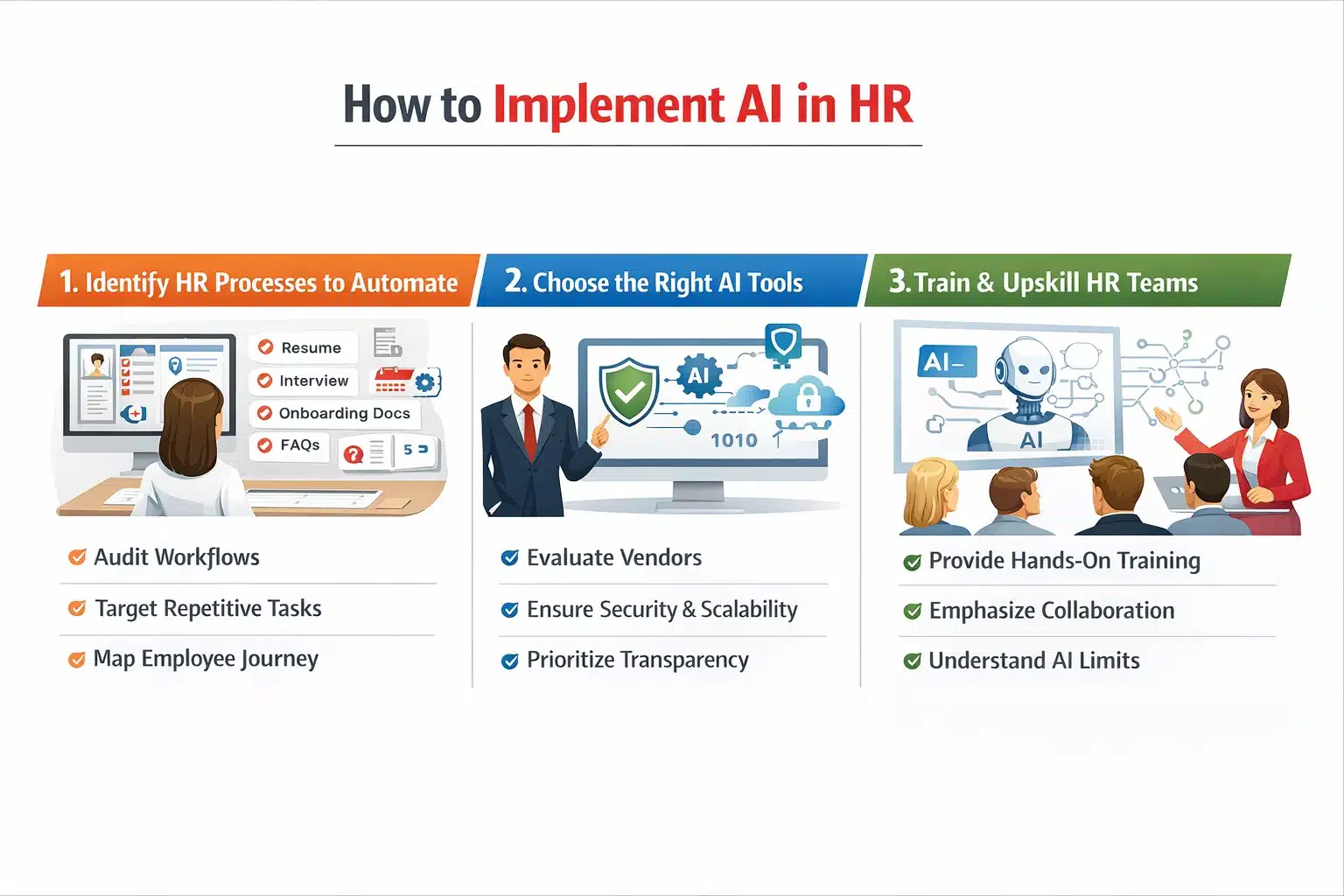
Successfully integrating AI into HR operations requires a strategic, phased approach. Rushing into adoption without a clear plan leads to fragmented systems, poor user adoption, and unrealized ROI.
Step 1: Identify HR Processes That Can Be Automated
The first step is auditing existing HR workflows to identify pain points, bottlenecks, and repetitive tasks that consume a disproportionate amount of time. Look for processes that are data-heavy, rules-based, and prone to human error.
Map the employee journey from recruitment to offboarding and identify where HR spends most of its administrative time. Common starting points include resume screening, interview scheduling, onboarding documentation, and answering tier-one FAQs.
Targeting high-volume, low-complexity tasks first secures quick wins that demonstrate AI’s value and builds the momentum needed to expand into more complex implementations over time.
Step 2: Choose the Right AI Tools
Once target processes are identified, vendor selection must be rigorous. Look for AI solutions that integrate seamlessly with existing HRIS and data infrastructure. A disjointed tech stack creates new data silos and undermines the AI’s effectiveness.
When evaluating vendors, prioritize transparency, security, and scalability. Ask detailed questions about how models are trained, how bias is mitigated, and how data privacy is maintained throughout the system’s operation.
If you’re exploring the right solution for your business, it’s best to get in touch with our experts to receive tailored recommendations based on your HR needs.
Step 3: Train and Upskill HR Teams
Implementing AI is as much a change management exercise as a technological one. The introduction of AI fundamentally alters the day-to-day responsibilities of HR teams, and without proper preparation, adoption will be slow and resistance high.
HR professionals must be upskilled to work alongside AI tools rather than around them. Training should focus on interpreting AI-generated insights, understanding the system’s limitations, and maintaining human judgment where it matters most.
Industry-Specific Use Cases of AI in HR
While the core benefits of AI apply universally, different industries are leveraging these tools to address unique, sector-specific challenges that standard HR approaches cannot solve at the required scale.
- Healthcare: HR departments use AI-driven predictive scheduling to manage complex shift rotations, ensuring labor law compliance while proactively identifying patterns that lead to nurse and physician burnout before they become critical.
- Retail and Hospitality: Conversational AI and automated screening algorithms are transforming high-volume seasonal hiring. Businesses can now process thousands of applications in days rather than weeks, without sacrificing screening quality.
- Technology and Financial Services: AI is being heavily invested in for dynamic skills mapping. These tools identify internal competency gaps and automatically suggest targeted upskilling programs to keep pace with rapid market disruptions.
Advanced Practices in AI for HR
As businesses mature in their AI adoption, they are moving beyond basic chatbots and resume screening toward advanced, predictive practices that fundamentally change how HR operates.
- Predictive Attrition Modeling
Deep learning algorithms analyze subtle behavioral shifts across the workforce, such as changes in communication frequency or shifting project participation patterns.
These signals allow HR to identify employees at high risk of leaving before a resignation is ever submitted. Managers can then intervene proactively with retention strategies tailored to that individual’s specific situation.
- Hyper-Personalized Employee Experiences
Similar to how streaming platforms recommend content, AI curates individualized career paths based on each employee’s learning style, current skill set, and long-term aspirations.
These systems suggest specific internal mentors, stretch assignments, and microlearning modules for each person. The result is an HR function that does not just react to present challenges but actively designs the future of work.
Conclusion
AI is reshaping HR from the ground up, replacing gut-feeling decisions with data-driven insights and automating the administrative work that once consumed entire teams. The impact is measurable across every stage of the employee lifecycle.
The businesses that treat AI as a strategic investment rather than a technical experiment are the ones building more agile, equitable, and people-first HR functions. The technology is ready. The question is whether the commitment to implement it thoughtfully is there.
Your business is not excluded from this technological advancement. As technology became more accessible, the true obstacle is in navigating its utilization. If you are interested in applying AI in your HR department, you can start a free consultation with us today to enhance your business even further.
Frequently Asked Question
AI in HR refers to the application of machine learning, natural language processing, deep learning, and predictive analytics to automate and enhance HR functions. Unlike traditional automation, AI learns from data over time, refining its outputs and enabling HR teams to make more accurate, evidence-based decisions.
AI can reduce bias by using diverse and representative training datasets, applying explainable AI techniques that make decision logic transparent, and continuously auditing algorithms for discriminatory outcomes. However, bias is not eliminated automatically and requires ongoing monitoring and recalibration.
Predictive attrition modeling uses deep learning algorithms to analyze subtle behavioral shifts in employee patterns, such as changes in communication frequency or project participation, to identify employees at high risk of leaving before they resign. This allows managers to intervene with targeted retention strategies.
The best starting points for automation are high-volume, low-complexity tasks such as resume screening, interview scheduling, onboarding documentation, and answering tier-one employee FAQs. These deliver quick wins and build momentum for more complex AI implementations over time.
Basic automation is rules-based and follows fixed instructions without learning or adapting. AI is dynamic. It analyzes data, identifies patterns, refines its criteria based on outcomes, and improves in accuracy over time, making it far more powerful for complex HR functions like talent matching and workforce forecasting.