














A proforma invoice is a preliminary bill that a seller sends before a transaction is confirmed. It outlines estimated costs, item details, and terms, so both parties know what the deal looks like before anything’s finalized.
Buyers use it to see how much they’ll owe once goods or services arrive. It’s common when a deal is agreed in principle, but quantities, specs, or delivery dates still need pinning down.
Think of it as a good-faith preview; it bridges the gap between shaking hands on a deal and sending the official invoice. Below, we’ll break down how proforma invoices work in Philippine business, their legal weight, and how software can take the manual work out of creating them.
Key Takeaways
Proforma invoices help set clear expectations and build trust between trading partners, especially in cross-border transactions.
Using dedicated invoicing tools keeps you compliant with Philippine tax rules (BIR, VAT) while cutting down on billing mistakes and speeding up collections.
Good invoicing software connects smoothly with accounting and ERP modules, so your finance data stays consistent without extra manual work.
What a Proforma Invoice Really Is and How It Works
A proforma invoice and a commercial invoice look similar, but they serve different purposes. The proforma version is your pre-deal estimate; it lays out terms, pricing, and quantities before anything’s final. A commercial invoice, on the other hand, is the actual payment demand you send after delivering goods or services.
For Philippine businesses, particularly those trading internationally or supplying to larger firms, getting your proforma invoicing right builds credibility. It signals to buyers that you’re organized, transparent, and ready to do business on clear terms.
As the fastest-growing economy across Southeast Asia, the Philippines business is projected to grow by 6.2% in 2024, with key sectors like manufacturing contributing 19% to the GDP; the importance of tools like proforma invoices cannot be overstated. For businesses looking to expand their operations, mastering the use of proforma invoices is a strategic move that can facilitate smoother transactions and establish a solid reputation in both domestic and international markets.
1. Proforma Invoice as a Negotiation Tool
Handing a proforma invoice to a potential client early in the conversation does more than show you’re prepared. It puts concrete numbers on the table: pricing, delivery timelines, and payment terms, so negotiations start from specifics instead of vague promises. When both sides have a reference document, it’s easier to discuss adjustments without misunderstandings.
It also works the other way. If you need to justify your pricing or ask for extended payment terms, pointing to a detailed proforma gives your request weight. Both parties walk into the final contract with the same expectations, which cuts down on disputes later.
Say you’re a Cebu-based furniture exporter quoting a bulk order to a buyer in Japan. A proforma invoice that spells out unit costs, freight estimates, and FOB terms gives the buyer confidence to commit, and gives you a paper trail if terms change mid-negotiation.
2. Legal Implications of Proforma Invoices
Proforma invoices aren’t legally binding in the Philippines, but that doesn’t mean they’re insignificant. They work as good-faith estimates that help both parties agree on terms before the deal is locked in. For importers, they’re especially useful at customs, as they provide a preliminary value declaration that’s needed to calculate duties and taxes.
Here’s the thing: under BIR rules, you can’t use a proforma invoice to claim input taxes or treat it as an official accounting record. The Philippines requires a VAT invoice for every sale of goods, so your proforma needs to be clearly labeled as such; it can’t stand in for the real thing. Don’t record it in your books until the transaction is confirmed and you’ve issued a proper sales invoice.
Because of this, accuracy matters. If the proforma and the final VAT invoice don’t match up, say, different unit prices or quantities, you could face complications with the BIR during audits. Understanding how BIR electronic invoicing systems work helps you manage the proforma-to-official transition without compliance gaps.
3. Transitioning from a Proforma Invoice to an Official Invoice
Once you’ve delivered the goods or services, you convert the proforma into an official invoice. This means verifying that order details, quantities, prices, terms match what was actually delivered. The official invoice is what triggers payment and starts the clock on your receivables. Keeping clean records of both documents makes it easier to resolve disputes and maintain a clear transaction trail.
In the Philippines, the BIR requires a VAT invoice for every sale, no exceptions. So while the proforma is great for negotiation, it’s the official invoice that makes the transaction legally binding and tax-compliant. How the customer billing cycle connects invoicing to collections is worth reviewing if you want to tighten up this process end-to-end.
4. Proforma for Domestic Philippine Transactions vs Export and Import Transactions
For domestic transactions, a proforma invoice mainly works as a quotation document. It helps the buyer review pricing, quantities, payment terms, and expected delivery before the final sale is confirmed. In this setup, the focus is usually on commercial clarity, internal approval, and smoother conversion into the final invoice.
For export or import deals, a proforma invoice usually needs more detail. Buyers, brokers, and customs-related processes may rely on it for preliminary valuation, shipment planning, and documentary review, which is why details like freight terms, package information, weight, and Incoterms matter more here than in ordinary local transactions. Philippine customs procedures also recognize proforma invoices in specific documentary contexts, including provisional or simplified processing scenarios
How to Create a Proforma Invoice for a Philippine Business
A proforma invoice should be created before delivery and before the final invoice is issued. In the Philippines, the safest approach is to use a consistent company template so the proforma can later be matched against the actual invoice, delivery documents, and payment terms without re-entering everything from scratch.
- First – start with the seller and buyer details. Add the registered business name, business address, contact details, and TIN where available. Even though a proforma invoice is still a preliminary document, including these details early helps reduce corrections once the transaction moves to a BIR-compliant invoice.
- Second – list the goods or services clearly. Each line should show the item description, quantity, unit price, and subtotal.
- Third – show the tax treatment properly. If the sale is a VATable local sale and the business is VAT-registered, indicate the VAT treatment and show the total clearly. If the transaction is not subject to regular 12% VAT, do not force a VAT line just to make the form look complete.
- Fourth, add the commercial terms. Include payment terms, quote validity date, delivery timeline, and whether freight, insurance, and handling are included. If the transaction involves international shipping, specify the applicable Incoterms rule because that is what clarifies which party carries the cost, responsibility, and risk at each stage of delivery.
- Finally, send the proforma invoice in a format the buyer can review easily, usually PDF by email, and keep a copy linked to the sales order or quotation trail. That makes it easier to update the document if the buyer requests changes and keeps the transition to the final invoice cleaner.
Why Proforma Invoice Software Pays for Itself
Philippine businesses deal with strict tax compliance, BIR-mandated VAT invoices, proper documentation for every sale, and potential audits. Choosing the right invoicing software for Philippine businesses takes the manual work out of this process. It auto-generates proforma and official invoices, applies the correct VAT and withholding tax rates, and keeps everything audit-ready.
When your invoicing tool plugs into your accounting system, month-end reconciliation gets faster, no more re-entering figures or chasing mismatched records. That frees up your finance team to focus on analysis and planning instead of data entry. For growing MSMEs, this kind of efficiency can be the difference between scaling smoothly and drowning in paperwork.
Here’s what good invoicing software actually does for you:
- Keeps you BIR-compliant — auto-generates VAT invoices for every sale, formatted to meet regulatory requirements.
- Cuts billing errors — pulls data directly from the proforma, so the official invoice matches without manual re-entry.
- Speeds up billing — what used to take 20-30 minutes per invoice can drop to under 5 with templates and auto-fill.
- Improves cash flow — faster, more reliable invoicing means clients pay sooner.
- Simplifies month-end — integrates with your accounting system so financial data flows in without duplicate entry.
Several invoicing platforms now cater to Philippine businesses specifically, with features like automated VAT computation, BIR electronic invoicing and reporting compliance, and multi-branch support. Whether you’re a sole proprietor or managing a mid-size operation, these tools scale to fit.
Red Flags: Signs Your Proforma Invoice Process Is Costing You
Not sure if your current process is working? Watch for these warning signs:
- You’re re-creating proforma invoices from scratch every time instead of pulling from templates — this wastes 15-30 minutes per document.
- Final invoices frequently don’t match the proforma (different unit prices, missing items), leading to payment delays or BIR discrepancies.
- You’ve had a customs hold-up because the proforma’s declared value didn’t align with the shipment — a common issue for exporters in CALABARZON and Cebu economic zones.
- Your team can’t easily find past proformas when a client references an old quote, because they’re scattered across email threads and Excel files.
- You’re manually computing VAT (12%) and withholding tax (1-2% for goods, 2% for services) on each proforma instead of auto-calculating.
If two or more of these sound familiar, you’re likely losing time and risking compliance issues that dedicated invoicing software can fix.
Proforma Invoice Example:
| Field | Sample Entry |
| Document Title | Proforma Invoice |
| Reference No. | PI-2026-00125 |
| Date | April 9, 2026 |
| Validity | Valid for 15 days from issue date |
| Seller | ABC Trading Philippines Inc., Makati City, Metro Manila |
| Seller TIN | 123-456-789-000 |
| Buyer | XYZ Retail Solutions, Cebu City |
| Buyer TIN | 987-654-321-000 |
| Item Description | Industrial shelving unit, powder-coated steel, 1200mm x 450mm x 2000mm |
| Quantity | 20 units |
| Unit Price | ₱8,500 |
| Subtotal | ₱170,000 |
| VAT | ₱20,400 (12%), if VAT-registered and VATable |
| Total | ₱190,400 |
| Payment Terms | 50% down payment, 50% before dispatch |
| Delivery Terms | Delivery within 10 working days after confirmation |
| Shipping / Incoterms | FOB Manila Port (for export) / Delivered Cebu Warehouse (for domestic) |
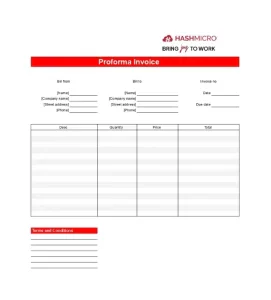
The sample proforma invoice above shows the key components you’ll need: shipper and receiver details, item descriptions, quantities, unit prices, and a financial summary. A well-prepared proforma like this sets expectations clearly, so there’s less back-and-forth once you move to the official invoice.
Pay attention to these three elements:
- Complete contact details for both parties — names, addresses, TIN (Tax Identification Number) where applicable. This is non-negotiable for BIR documentation.
- Itemized pricing — each product or service listed with quantity, unit price, subtotal, applicable VAT (12%), and the grand total.
- Logistics info — transport mode, number of packages, gross weight, and Incoterms (FOB, CIF, etc.) for international shipments.
Getting these right from the proforma stage saves you from corrections and delays when the official invoice is due.
| Component | Status | PH Note |
| Seller name and address | Required | Should be shown clearly so the document can be matched later with the final invoice and business records. |
| Buyer name and address | Required | Important for quotation accuracy, approval, and delivery coordination. |
| TIN | Usually needed | Best included for BIR-ready documentation. It becomes critical once the transaction moves to the final invoice. |
| Invoice number / reference no. | Required | Helps track revisions and link the proforma to the final invoice or sales order. |
| Date and validity period | Required | Prevents disputes when prices or terms change after the quote was sent. |
| Item description | Required | Use specific product or service descriptions, not vague labels. |
| Quantity and unit price | Required | Needed so the buyer can verify the commercial offer before confirmation. |
| Subtotal and total amount | Required | Should be shown clearly to avoid mismatch with the final invoice. |
| VAT line | Conditional | Show 12% only if the sale is VATable and the seller is VAT-registered. Do not force this line for non-VAT or zero-rated treatment. |
| Payment terms | Required | Examples: 50% down payment, balance upon delivery, or 30-day credit terms. |
| Delivery terms | Required | State delivery schedule, lead time, and whether shipping is included. |
| Incoterms | Export-specific | Usually needed for export/import deals, not always for ordinary domestic sales. |
| Gross weight / packages | Export-specific | More relevant when the proforma is used for shipping or customs-related preparation. |
Conclusion
Proforma invoices aren’t just a formality, they’re how Philippine businesses set expectations, build trust with buyers, and lay the groundwork for compliant, dispute-free transactions. Pairing them with the right invoicing tools turns a manual, error-prone process into something that runs on autopilot.
If you’re still creating proformas in Word or Excel and manually converting them to VAT invoices, you’re spending time on work that software handles in seconds. A modern invoicing platform keeps you BIR-compliant and gives your team time back for work that actually grows the business.
Want to see how this works in practice? Check out this breakdown of the best invoicing software options for Philippine businesses to find one that fits your setup.
FAQ for Proforma Invoice
To create a proforma invoice, include essential details such as the buyer’s and seller’s information, a description of the goods or services, pricing, and terms of sale, including payment and delivery details. It’s important to present this information clearly and professionally to ensure all parties understand the transaction and reduce the risk of disputes.
Proforma invoices are crucial for providing clarity on the terms of a sale and helping buyers make informed decisions. They serve as a formal quote, aiding in negotiations and establishing trust between trading partners. Additionally, they are vital for facilitating customs clearance in international transactions, ensuring that all necessary details are communicated upfront.
A proforma invoice should include the names and addresses of both the buyer and seller, the date of issue, a detailed description of the goods or services, unit prices, total charges, applicable taxes, and the terms of sale, such as shipping and payment conditions. It should also specify an expiration date to ensure the terms are timely.
Proforma invoice software enhances billing efficiency by automating the creation of invoices, reducing errors, and speeding up the process. It simplifies the customization of invoices, streamlines workflow, and improves record-keeping. By integrating with accounting systems, it significantly boosts operational efficiency, allowing businesses to focus on growth and customer satisfaction.