







 Limited to 100 registrants

A customer relationship management (CRM) system is software that centralises customer data and interactions across sales, marketing and service. It helps businesses manage leads, automate follow-ups, track opportunities, support customers and analyse performance from one platform.
A CRM system gives a business one place to manage customer details, communication history, sales opportunities and service requests. Instead of keeping this information across spreadsheets, inboxes and separate applications, teams can access a shared customer record and coordinate their next actions.
CRM stands for customer relationship management. The term can describe both the strategy a business uses to manage customer relationships and the software that supports that strategy. This guide explains what CRM software does, how it works, its benefits and limitations, the main CRM types and how to evaluate a suitable system.
For Australian businesses, CRM adoption reflects the broader move towards structured digital customer management. The ABS reported that 17% of Australian businesses used CRM software in 2021–22, showing that more companies are moving away from scattered records and toward more structured customer management.
Key Takeaways
A CRM system brings customer data, sales, and service into one place for better visibility and faster follow-up.
For Australian businesses, CRM helps teams manage customer interactions more efficiently across growing digital channels.
The right CRM system should support your business goals and integrate with other tools for stronger growth.
What is a CRM System?
A CRM system acts as a customer management platform that helps businesses store data, track interactions, and manage relationships in one place. It gives teams clearer visibility to respond faster, follow up properly, and build stronger long-term relationships.
More than just a contact database, a customer relationship management system integrates sales, service, marketing, and account management into one platform. It helps teams stay aligned, reduce manual work, and use customer data more effectively.
Modern CRM systems also support automation, reporting, and integrations with tools like email, social media, and ERP, improving decision-making, productivity, and customer lifetime value.
What Does a CRM System Do?
A CRM system records customer information and turns it into practical workflows for sales, marketing and service teams. Common functions include contact management, lead and pipeline tracking, communication history, task automation, customer support, reporting and forecasting.
1. Sales
CRM systems help sales teams manage leads, track deal progress, schedule follow-ups, and monitor pipeline activity in one place. This gives teams clearer visibility into opportunities and helps reduce missed follow-ups.
2. Marketing
Marketing teams use CRM software to segment audiences, automate campaigns, and track customer engagement across different channels. This helps businesses deliver more targeted communication without relying heavily on manual processes.
3. Customer Service
Customer service functions allow teams to manage support tickets, customer enquiries, and service history more efficiently. Full access to past interactions also helps support teams respond with better context.
4. Analytics
CRM analytics tools turn customer and sales data into dashboards, reports, and performance insights. Businesses can use this information to identify trends, monitor team performance, and support faster decision-making.
How Does CRM Software Work?
A CRM system collects customer data from different channels and stores it in one place. This helps teams see customer history clearly and support better customer relationship management across sales, marketing, and service.
Below is a simple sales processing overview of how CRM systems turn scattered data into actionable insights and daily operations:
- Capture data: The system gathers customer information from websites, emails, calls, and social media.
- Organise records: It stores contact details, interactions, and account history on a single central platform.
- Generate insights: Analytics help teams understand customer behaviour, needs, and opportunities.
- Support team action: Sales, marketing, and service teams use that information to respond faster and work better.
- Improve outcomes: Businesses use customer management systems to personalise campaigns, shorten sales cycles, and resolve issues more efficiently.
Simple CRM workflow example
When a prospect submits an enquiry, the CRM can create a contact record, assign the lead to a salesperson and schedule a follow-up. Subsequent emails, calls, notes and deal-stage changes are stored against the same record. If the prospect becomes a customer, service teams can use that history to provide support without asking the customer to repeat information.
That is why many businesses, including those evaluating CRM systems in Australia, rely on these tools to strengthen customer relationship management and make more informed decisions.
Benefits of a CRM System

A customer relationship management system does more than store contacts, it helps you understand customers, act faster, and run your business more clearly. Many teams start by asking what a CRM system is, then realise its central role in daily operations.
1. Better visibility across every customer and deal
A CRM system gives your team one complete view of every customer, lead, and deal in progress. Instead of searching through emails, spreadsheets, or chat threads, staff can see contact history, deal stage, past interactions, and next steps in one dashboard.
This visibility helps teams using customer management systems spot risks earlier, prioritise opportunities, and avoid missed information. It also supports more consistent customer relations management by giving everyone a shared source of truth.
2. Faster follow-up and higher sales conversion
Speed matters in sales, and crm systems help teams follow up while interest is still high. As a software for sales manager, a CRM helps teams set reminders, track lead activity, and move prospects through the pipeline without relying on memory alone.
That structure reduces delays and keeps promising deals from going cold. As a result, businesses often improve response times, strengthen engagement, and increase conversion rates.
3. More personalised marketing at scale
Modern customer management systems help marketing teams group audiences based on behaviour, interests, purchase history, or engagement level. This makes it easier to send more relevant messages instead of treating every prospect the same way.
Personalised campaigns usually perform better because they speak to real customer needs and timing. With the right CRM system, businesses can scale that personal approach without creating extra manual work.
4. Stronger team collaboration without the back-and-forth
A shared CRM system helps sales, marketing, and service teams stay aligned without constant follow-up messages. Everyone can access the same notes, updates, and customer history, which reduces confusion and repeated work.
This creates smoother handovers between teams, especially when a lead becomes a customer or when an issue needs support. Better collaboration leads to faster decisions and a more connected customer experience.
5. Higher customer retention through consistent service
Customers are more likely to stay when businesses respond with context, accuracy, and consistency. CRM systems help teams remember past concerns, preferences, purchases, and service history, so every interaction feels more informed.
This makes support more reliable and reduces the frustration customers feel when they have to repeat themselves. Over time, better service strengthens trust, loyalty, and retention.
6. Less manual work through automation
One of the biggest advantages of a CRM system is its ability to automate repetitive tasks. Teams can automate follow-up reminders, lead assignments, status updates, reporting, and routine communications that would otherwise take up valuable time.
This reduces admin work and lowers the chance of human error in daily processes. With less time spent on manual tasks, teams can focus more on selling, serving, and building stronger relationships.
7. Why this matters more for Australian businesses specifically
For businesses comparing CRM systems in Australia, these benefits matter as expectations rise while teams work with tighter time and resources. They need systems that support clearer communication, faster service, and more efficient operations.
A strong customer relationship management approach helps businesses stay competitive without losing control as they scale. That is why many local companies now see CRM systems in Australia not as optional tools, but as practical infrastructure for growth.
CRM System Example
Consider a growing wholesaler that receives leads through its website, email and phone calls. Without a CRM, sales staff may maintain separate records and duplicate follow-ups. A CRM can capture each enquiry, show who owns the lead, record quotations and remind staff about the next action. Managers can then review the pipeline while service teams retain access to the customer’s history after a sale.
This example illustrates the operational value of CRM without assuming that every implementation produces the same result. Outcomes depend on data quality, process design, user adoption and integration with existing systems.
Types of CRM Systems and When to Use Them

Not every CRM system serves the same purpose, and choosing the right one depends on how your business manages sales, data, and customer interactions. Different types of CRM systems focus on execution, insight, or collaboration.
Most customer management systems fall into three categories: Operational, Analytical, and Collaborative, with cloud platforms becoming more common.
Operational, analytical, collaborative and strategic CRM describe how a system supports customer management. Cloud-based and on-premise CRM instead describe how the software is deployed. A cloud CRM is accessed online and maintained by the provider, while an on-premise CRM is hosted within the organisation’s own infrastructure.
1. Operational CRM
Operational CRM focuses on automating day-to-day customer-facing activities such as sales, marketing, and service. It helps teams capture leads, track interactions, and manage the full customer journey in a structured way.
Sales automation keeps pipelines organised, marketing automation supports targeted campaigns, and service tools handle enquiries efficiently. For growth-focused businesses, this type of CRM system improves consistency in customer relations management.
2. Analytical CRM
Analytical CRM focuses on turning customer data into insights that support better decisions. Instead of managing daily interactions, it helps businesses understand trends such as customer behaviour, purchasing patterns, and churn risks.
Teams can use these insights to refine strategies, improve targeting, and optimise marketing and sales performance. this type of CRM system is especially useful for companies that want to make data-driven decisions at scale.
3. Collaborative CRM
Collaborative CRM helps different departments share customer information and work more closely together. It removes data silos so sales, marketing, and service teams all access the same customer history and communication records.
This creates a more consistent experience because customers do not need to repeat information across different touchpoints. As part of a broader customer relationship management approach, it improves internal coordination and strengthens overall service quality.
4. Strategic CRM
Strategic CRM focuses on improving customer retention, loyalty, and long-term relationships. Instead of focusing only on transactions, this approach helps businesses better understand customer behaviour and deliver more personalised experiences.
Businesses often use Strategic CRM to strengthen customer engagement, improve retention strategies, and align customer experience initiatives across sales, marketing, and service teams.
5. Cloud CRM for small and growing businesses
Cloud-based CRM systems that Australian businesses commonly use are designed for flexibility, accessibility, and scalability. Teams can access data anytime, anywhere, without relying on complex on-premise infrastructure.
These systems integrate easily with other tools and support businesses that need to scale without high upfront costs. Many organisations use cloud-based customer management systems to improve customer relationship management while staying agile.
6. CRM types at a glance
| CRM type | Main purpose | Suitable for |
|---|---|---|
| Operational CRM | Automating sales, marketing and service workflows | Businesses that need consistent daily processes |
| Analytical CRM | Turning customer data into reports and insights | Data-driven planning, segmentation and forecasting |
| Collaborative CRM | Sharing customer information across teams and channels | Businesses with cross-functional customer journeys |
| Strategic CRM | Supporting retention and long-term customer value | Organisations focused on loyalty and relationship development |
CRM Examples by Industry

Different industries use CRM systems in various ways based on how they manage customers and operations. From retail to construction, these examples show how customer management systems strengthen customer relationship management across industries.
1. CRM examples for retail and hospitality
Retail and hospitality businesses use a CRM system to track customer preferences, purchase history, and visit frequency. This helps teams personalise promotions, loyalty programs, and service interactions to increase repeat visits.
Staff can quickly access customer data to deliver faster, more consistent service across stores or outlets. With crm systems, businesses improve customer relations management while increasing customer lifetime value.
2. CRM examples for manufacturing and services
Manufacturing and service companies use customer management systems to manage long sales cycles, client relationships, and after-sales support. A CRM system helps track enquiries, quotations, contracts, and service history in one place.
Teams can follow up more effectively, manage accounts better, and identify upsell or renewal opportunities. This strengthens customer relationship management and supports more predictable revenue growth.
3. CRM examples for construction businesses
Construction businesses use crm systems to manage project leads, client communication, and tender processes. A CRM system helps track project stages, stakeholder interactions, and contract progress without relying on scattered records.
Teams can coordinate more effectively between sales, project managers, and clients throughout the project lifecycle. This improves customer relations management while reducing delays and miscommunication.
4. Real estate CRM examples in Australia
Real estate agencies rely on CRM systems in Australia to manage property listings, buyer enquiries, and ongoing client relationships. A CRM system helps agents track leads, schedule follow-ups, and maintain communication with buyers and sellers.
It also supports personalised property recommendations based on client preferences and past interactions. For agencies, strong customer relationship management leads to faster deal closures and better long-term client retention.
CRM vs ERP: What’s the Difference?
A CRM system manages customer-facing activities like leads, interactions, and service history, while an ERP system handles internal operations such as finance, inventory, and procurement. CRM focuses on growth, while ERP focuses on operational control.
The difference also appears in daily users. Sales, marketing, and service teams rely on customer management systems to manage relationships and improve customer visibility. In contrast, finance and operations teams rely on ERP for process control and data accuracy.
For Australian businesses, this distinction is also tied to compliance. ERP systems often support tax and record-keeping, while CRM systems store personal data that must follow the Australian Privacy Principles to ensure proper handling and data protection.
| Aspect | CRM | ERP |
| Focus | Customer relationships | Business operations |
| Primary users | Sales, marketing, service | Finance, operations |
| Data type | Customer interactions | Financial and operational data |
| Purpose | Drive revenue and engagement | Improve efficiency and control |
Key Features to Look for in a Modern CRM System
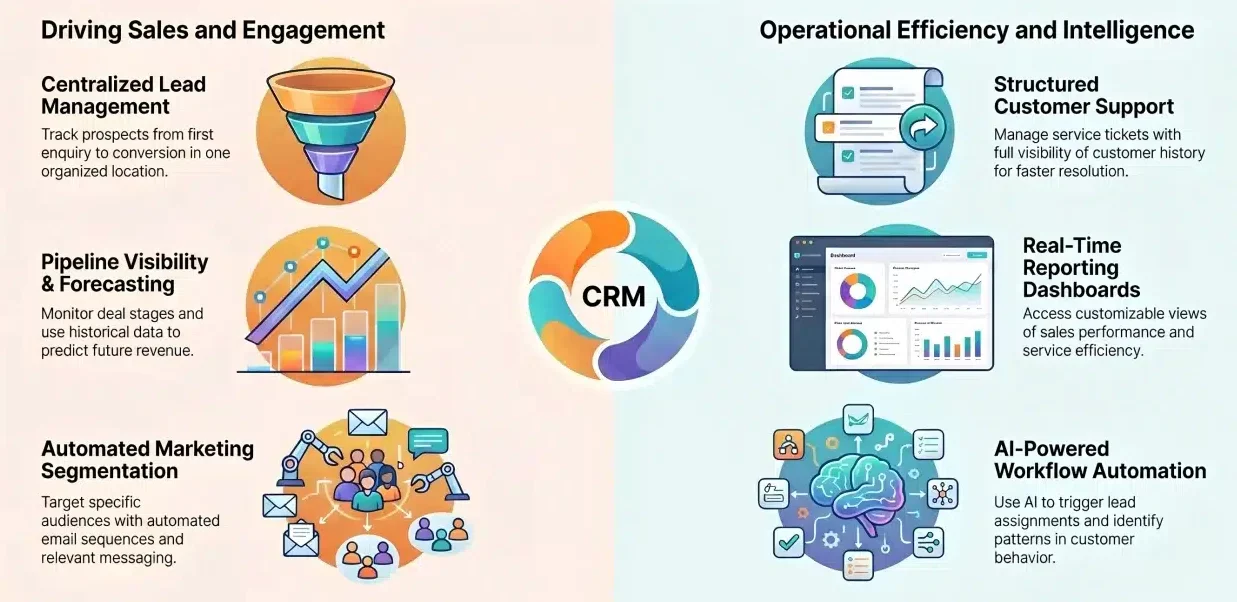
Choosing the right customer relationship management system means focusing on features that improve visibility, speed, and decision-making. These are the core capabilities to prioritise when comparing CRM systems in Australia.
1. Contact and lead management
A CRM system should store and organise all customer and prospect information in one place, including contact details, interaction history, and preferences. It helps teams track leads from first enquiry to conversion without losing context along the way.
Sales teams can prioritise prospects based on readiness, improving focus and efficiency. This feature forms the foundation of strong customer relations management.
2. Sales pipeline tracking and forecasting
Modern crm systems give a clear view of every deal across the pipeline, from initial contact to closing. Teams can track deal stages, monitor progress, and identify bottlenecks early.
Forecasting tools help predict revenue based on current opportunities and historical performance. This allows businesses to plan more accurately and make better sales decisions.
3. Marketing automation and segmentation
Customer management systems help marketing teams segment audiences based on behaviour, demographics, and engagement. Teams can automate campaigns such as email sequences, follow-ups, and targeted promotions.
This ensures messaging stays relevant without adding manual workload. As a result, businesses improve engagement and campaign performance at scale.
4. Customer service and ticket tracking
A strong CRM system includes tools to manage customer support requests in a structured way. Teams can log, assign, and track tickets to ensure issues are resolved quickly and consistently.
Full visibility of customer history helps support teams respond with better context. This improves service quality and strengthens long-term customer relationship management.
5. Reporting and analytics dashboards
Data becomes more useful when teams can see it clearly. CRM systems provide dashboards that display key metrics such as sales performance, customer activity, and service efficiency in real time.
Users can customise views based on their role and priorities. This helps businesses make faster, more informed decisions.
6. AI-powered insights and workflow automation
Advanced crm systems use AI and automation to reduce manual work and improve decision-making. The system can trigger actions such as lead assignment, follow-ups, or notifications in response to specific events.
AI tools also identify patterns, recommend next steps, and highlight opportunities or risks. This allows teams to work smarter and respond more effectively.
7. Mobile access and multi-device usability
Modern CRM systems that Australian businesses use must support access across devices, including mobile, tablet, and desktop. Sales and service teams can update data, check customer history, and respond to enquiries from anywhere.
This flexibility improves responsiveness, especially for field teams or remote work setups. It also ensures that data stays up to date in real time.
8. ERP integration and data centralisation
A CRM system should integrate with ERP and other business tools to create a connected workflow. This ensures customer data flows from sales to operations, billing, and fulfilment without duplication.
Integration reduces errors, improves efficiency, and provides a complete business view. For many organisations, this connection is key to scaling both operations and customer relations management effectively.
Potential limitations of CRM software
A CRM system is not automatically effective simply because it has been installed. Businesses may encounter low user adoption, incomplete records, duplicated data, integration difficulties or excessive customisation. Subscription, implementation, training and support requirements should also be considered.
Clear processes, defined ownership and regular data maintenance are essential. The system should support how teams work rather than add unnecessary administrative steps.
How to Choose a CRM System
The right CRM system should match how your team works and support business goals without adding unnecessary complexity. Start by defining the sales, marketing and service processes the platform must support, then compare systems against practical requirements rather than assuming one product is universally best.
Important criteria include ease of use, integration with email, accounting, ERP and communication tools, automation capability, reporting depth, scalability, mobile access, data migration, security, implementation support and total cost. A suitable CRM should help teams maintain accurate data and complete daily tasks without creating unnecessary administrative work.
Choosing a CRM is about more than comparing features. The best system should match your sales process, integrate with the software you already use, and provide room to grow without driving up long-term costs.
Use the table below to compare CRM options before creating a shortlist.
| Evaluation criteria | What to consider |
|---|---|
| Business size | Does the CRM suit your current team and future growth? |
| Sales complexity | Can it support your sales cycle, approval process, and pipeline? |
| Required integrations | Does it connect with ERP, accounting, marketing, email, or eCommerce platforms? |
| Implementation & support | Does the vendor provide onboarding, training, and local support? |
| Privacy & data residency | Does it meet your security, compliance, and data residency requirements? |
| Total cost | Consider subscription fees, implementation, migration, integrations, training, support, and future upgrades—not just the monthly licence price. |
CRM selection checklist
- Which sales, marketing and service processes must the CRM support?
- How many users and customer records must it accommodate?
- Does it integrate with the business’s existing email, accounting, ERP and communication tools?
- Can teams configure workflows and reports without unnecessary complexity?
- What migration, training and ongoing support are included?
- How does the provider manage access controls, backups and customer data?
- What are the implementation and ongoing costs?
How Much Does a CRM System Cost in Australia?
There is no standard price for CRM software in Australia because vendors use different pricing models. Most cloud CRM platforms charge a monthly subscription per user, while enterprise solutions may offer custom quotes based on the number of users, modules, or business requirements. Feature tiers also affect pricing, with higher plans typically including automation, analytics, AI capabilities, and advanced reporting.
The subscription cost is only part of the investment. Businesses should also budget for implementation, data migration, integrations with existing systems, staff training, ongoing support, and additional storage where required. These costs vary depending on the complexity of the project, the quality of existing data, and the number of business systems that need to connect with the CRM.
A practical way to compare CRM vendors is to calculate the Total Cost of Ownership (TCO) rather than focusing on the licence fee alone.
Total Cost of Ownership (TCO) = Subscription fees + Implementation + Data migration + Integrations + Training + Ongoing support + Additional storage or add-ons
Using this approach helps businesses compare solutions more accurately and avoid unexpected costs after deployment.
How AI Elevates CRM and Customer Relationship Management
Most businesses collect significant amounts of customer data through their CRM system, but few teams use all of it effectively. Sales reps focus on the leads in front of them, service teams work through their open tickets, and marketing measures open rates and clicks. The deeper patterns in customer behaviour often go unnoticed until a deal goes cold or a customer quietly churns.
AI changes that by working through the data continuously, surfacing what would otherwise stay buried, and helping teams act before opportunities are lost.
1. Lead scoring and pipeline prioritisation that removes guesswork
Traditional CRM systems display leads at roughly equal weight, leaving sales teams to decide which to pursue based on instinct and experience. AI-driven lead scoring analyses historical data to identify which prospects are most likely to convert, based on behaviour, engagement patterns, and account signals.
Sales teams can concentrate their time on the leads that score highest rather than working through the full pipeline sequentially. This improves conversion rates and reduces the time reps spend on prospects that are unlikely to progress.
2. Churn prediction and proactive customer retention
Customer churn is rarely sudden. Most customers show early warning signs before they disengage, such as reduced login activity, slower responses to communication, or a drop in order frequency. AI models within a CRM system detect these patterns and flag at-risk accounts before a customer reaches the point of disengaging.
Account managers and service teams receive early alerts so they can reach out with a relevant solution rather than waiting for a cancellation request. For Australian businesses managing ongoing customer relationships, this proactive capability can make a measurable difference to retention outcomes.
3. Conversation intelligence and sentiment analysis
Customer interactions across email, chat, and support tickets carry signals beyond the literal content of each message. AI can analyse tone, language patterns, and response times to assess customer sentiment and surface interactions that need attention before they escalate.
Service managers can use this insight to prioritise responses, monitor team performance, and identify customers who feel frustrated even when no formal complaint has been raised. This makes customer relations management more responsive without adding workload to individual team members.
4. Next best action recommendations based on real account data
Rather than leaving each team member to decide independently what to do after an interaction, AI within a CRM system can recommend the most relevant next step based on the customer's profile, history, and relationship stage. This might include the right timing for a follow-up, which product to raise at renewal, or when to involve a senior account manager.
These recommendations draw on pattern recognition across similar accounts and outcomes, which means they sharpen over time as more data accumulates. Teams benefit from a practical guide to action rather than relying entirely on individual judgement.
5. Personalisation at scale across the full customer base
Marketing teams face a recurring challenge: customers expect relevant communication, but producing personalised messaging at scale is time-consuming. AI helps CRM systems generate personalised outreach, recommend relevant offers, and time communications based on individual behaviour patterns rather than broad audience segments.
Businesses can deliver a more considered experience across large customer bases without a proportional increase in manual effort. For businesses using CRM systems in Australia, this capability matters as customer expectations rise and teams manage more channels with less time.
How Hashy AI Enhances CRM System
HashMicro's CRM module runs on Hashy OS, the platform's integrated AI layer that connects customer data across sales, marketing, service, and account management in real time. Unlike standalone AI tools that require separate setup and data exports, Hashy OS operates directly within the same CRM environment your team already uses.
Teams can surface pipeline health, customer activity trends, and account risks by interacting with Hashy OS directly in the platform. The answers come from your own live CRM records, which means customer relationship management becomes faster and better informed without adding reporting overhead or switching between tools.






Conclusion
A CRM system centralises customer information and helps sales, marketing and service teams coordinate their work. Its main value comes from clearer records, structured follow-ups, workflow automation and more useful reporting.
Before selecting a system, define the processes it must support, the tools it needs to integrate with and the information teams need to access. A suitable CRM should be easy enough for staff to use consistently while remaining scalable as customer activity grows.

FAQ
CRM stands for customer relationship management. It refers to the processes and technology used to manage interactions with prospects and customers.
No. Sales teams commonly use CRM software, but marketing, customer service, account management and leadership teams can also use it to coordinate customer information and activities.
CRM primarily manages customer-facing information and processes, while enterprise resource planning software coordinates broader operational functions such as finance, inventory, procurement and supply chain management. Integrated systems can share information between these areas.
Yes. A small business can use CRM software to organise contacts, manage follow-ups and create a repeatable sales process. The appropriate system depends on its workflow, budget, integration and reporting requirements.
A CRM may store contact details, communication history, lead sources, deal stages, quotations, purchases, service requests, preferences, consent records and assigned tasks. The exact data depends on the organisation’s processes and privacy obligations.
CRM pricing in Australia varies by vendor and is commonly charged per user, per month. The total cost also depends on implementation, data migration, integrations, training, support, and any additional storage or add-ons, so it's important to consider the total cost of ownership rather than the subscription fee alone.
Popular CRM systems include HashMicro, Salesforce, HubSpot, Zoho CRM, Microsoft Dynamics 365, Pipedrive, and Freshsales. Each platform offers different features depending on the size and needs of the business.
A CRM system stores customer information in one place, helping businesses manage leads, track sales activities, automate follow-ups, and monitor customer interactions throughout the sales journey.
Small businesses should choose a CRM that is easy to use, fits their budget, integrates with existing tools such as accounting software, and can scale as the business grows. Reliable implementation and local support are also important considerations.