






One inaccurate estimate can turn a promising construction bid into a margin problem before the project begins. With the Philippines recording ₱56.34 billion in construction value in February 2026 and average construction costs reaching ₱14,882.98 per square meter, contractors relying on manual spreadsheets face greater exposure to cost changes and calculation errors.
Inaccurate estimates can result in underpriced bids, budget overruns, and reduced project profitability. Spreadsheet-based processes also make it harder to update material, labour, and scope assumptions when project conditions change.
Construction estimating software helps contractors organize cost data, calculate project requirements, and prepare more consistent bids. As Statista projects, the Philippine construction software market will grow by 5.23% annually through 2028, marking its importance. This guide compares 15 options available in the Philippines, including PHP pricing context, key strengths and limitations, and a framework for choosing the right solution.
Key Takeaways
Construction estimating software helps contractors create accurate bids by simplifying quantity takeoffs, centralizing project costs, and reducing errors in manual calculations.
Compare leading construction estimating software based on features, pricing, and suitability to find the right solution for different construction business needs.
Explore best construction estimating software options for Philippine contractors, with solutions suited to different project sizes, budgets, and business needs.
What Is Construction Estimating Software?
Construction estimating software is software that enables estimating teams to accurately and efficiently estimate project bid prices. It simplifies tasks such as quantity takeoffs and project scope determination, and keeps material, labor, and equipment costs in one place instead of scattered files. Contractors use it to prepare bids with consistent figures, so pricing decisions rely on current data rather than manual calculations that are easy to miscount across large bills of quantities.
In practice, the system replaces constant switching between spreadsheets, BOQs, and supplier quotes with one working process. It builds a full project budget, measures quantities directly from digital plans, and turns the same cost data into tender documents. Linking estimates to construction inventory records also keeps material planning realistic instead of guesswork. For Philippine contractors, the software should support BIR-compliant invoicing and connect to construction accounting so the same figures are not entered twice.
Benefits of Construction Estimating Software
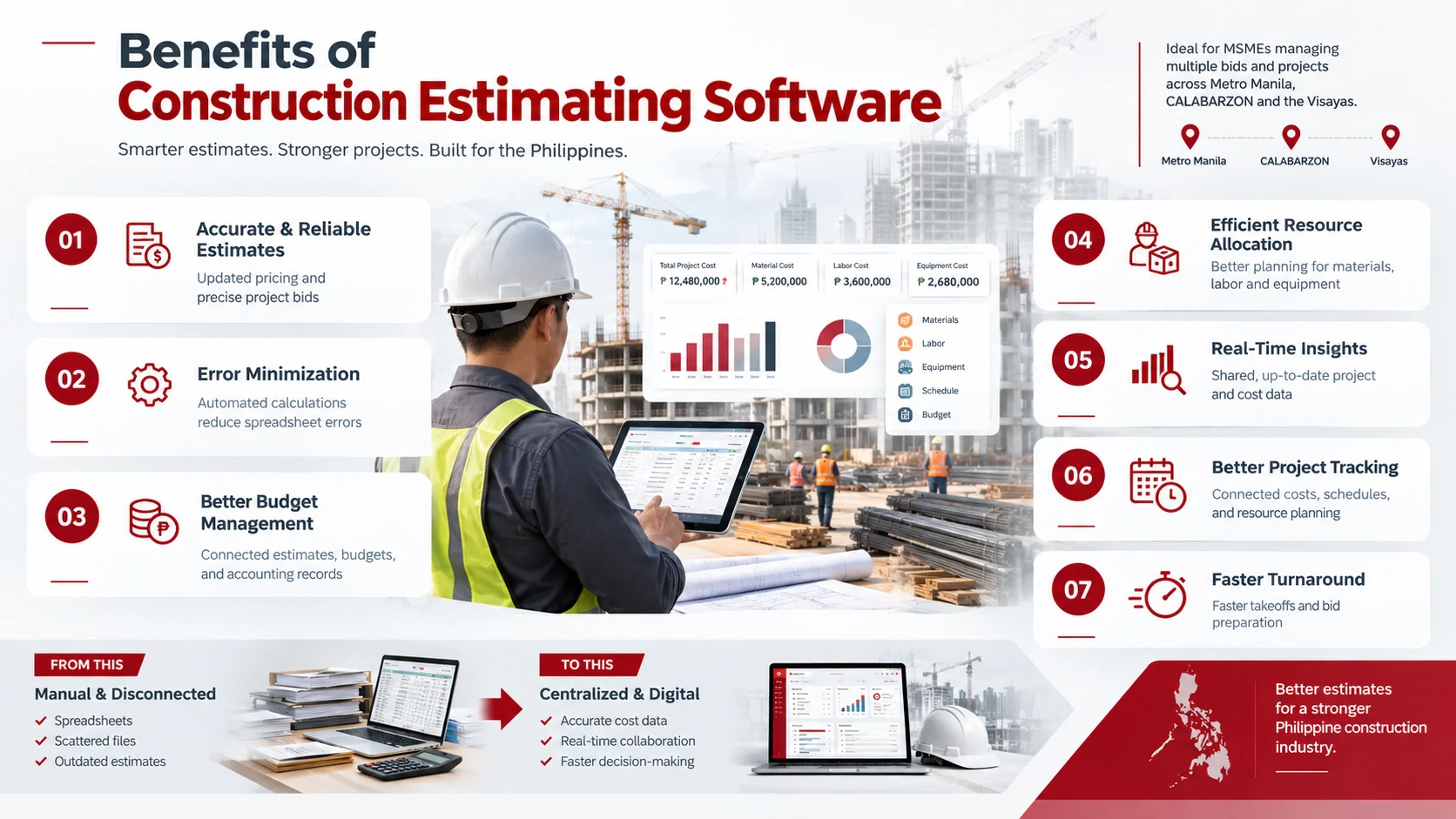
Accurate estimates save money. You already know that. What matters more is how those benefits hold up in Philippine construction conditions, where cement, steel, and lumber prices shift week to week, most firms are MSMEs without a 10-person estimating department, and projects run across Metro Manila, CALABARZON, and the Visayas at the same time. Here is what the software actually changes.
- Accurate and reliable estimates. Ensures project bids are precise and reduces the likelihood of cost overruns. This matters most with Philippine material price volatility, where import fluctuations make manual estimates go stale fast. Tools that connect to updated pricing databases keep your bids realistic, and set a contingency cost buffer per project instead of guessing a flat percentage across every bid.
- Error minimization. Automates complex calculations and removes the human error that creeps into spreadsheet-based takeoffs, which is critical when a small estimating team is handling several bids at once.
- Better budget management. Links estimates with business budgeting software and accounting platforms for real-time expense tracking. For VAT accounting registered and BIR documentation easier, since project expenses stay recorded and traceable instead of scattered across separate files.
- Real-time insights. Delivers up-to-date data and analytics for faster decisions. Cloud-based tools let estimators, project managers, and finance teams working on different sites see the same numbers without chasing email attachments.
- Better project tracking. Connects cost estimation with project schedules and resource planning, which keeps centralized cost control intact when your projects are spread across multiple regions.
- Efficient resource allocation. Improves planning of materials, labor, and equipment so resources are committed based on actual project requirements rather than rough assumptions. For contractors who lease heavy equipment instead of owning it, estimates that connect to equipment rental software keep rental duration and rates inside the project cost, not as a surprise line item later.
- Faster turnaround. Automates takeoffs and generates bids quickly, so smaller MSME teams can produce the output of a much larger estimating department and spot missing resources before they delay the project.
Delivers up-to-date data and analytics for faster decisions. Cloud-based tools let estimators, project managers, and finance teams working on different sites see the same numbers without chasing email attachments.
Full Comparison of Construction Estimating Software
| Brand | Best for | Pros | Cons | Price |
|---|---|---|---|---|
| 1) Contractor Foreman | Best for small–mid contractors needing affordable, customizable estimating | 1) Customizable features 2) Easy-to-understand tools 3) Built-in resource management | 1) Can be overwhelming for small operations 2) Full features require top-tier plan 3) User limits per plan | Starts from $49/Month |
| 2) Buildertrend | Best for builders needing all-in-one project scheduling and client collaboration | 1) Built for construction workflows 2) Easy scheduling tools 3) Client portal availability 4) Accounting integrations | 1) Time-consuming implementation 2) High cost for advanced features 3) Learning curve for some tools | Starts from $499/Month |
| 3) Procore | Best for large contractors needing advanced project controls and analytics | 1) Comprehensive project management 2) Strong analytics and reporting | 1) High implementation cost 2) Requires extensive training | Starts from $375/Month |
| 4) HashMicro | Best for ERP-connected estimating, procurement, and cost control | 1) User-friendly interface 2) Highly customizable 3) Seamless ERP integration 4) Unlimited users 5) Lifetime after-sales support | 1) Implementation timeline varies 2) Trial access may take time due to high demand | Custom Pricing |
| 5) RedTeam | Best for contractors needing robust project workflows and financial control | 1) Robust project controls 2) Strong software integrations 3) Active support community | 1) Complex for new users 2) High initial setup cost | Starts from $729/Month |
| 6) UDA ConstructionOnline | Best for teams needing simple scheduling with core construction features | 1) Easy-to-use interface 2) Strong scheduling capabilities | 1) Limited customization 2) Some features require add-on modules | Starts from $370/Month |
| 7) ClickUp | Best for teams wanting flexible task-based project management | 1) Flexible task and project management 2) Intuitive user experience 3) Strong collaboration tools | 1) AI features not fully optimized 2) Can be confusing for first-time users 3) Not ideal for complex needs | Starts from $7/Month |
| 8) Stack | Best for contractors needing accurate takeoff and estimating tools | 1) Accurate estimating and takeoff 2) Simple interface | 1) High implementation cost 2) Limited maintenance-focused features | Starts from $250/Month |
| 9) Clear Estimates | Best for small contractors needing simple, fast cost estimates | 1) Easy-to-use UI 2) Suitable for small–mid contractors 3) Reliable support | 1) Limited advanced functionality 2) Better suited for smaller projects | Starts from $59/Month |
| 10) PlanSwift | Best for estimators needing detailed digital takeoff accuracy | 1) Low learning curve 2) Accurate digital takeoff 3) Productivity-focused tools | 1) Performance issues on large takeoffs 2) Requires VM for Mac users 3) Time-consuming assemblies | Starts from $59/Month |
| 11) Buildsoft | Best for firms needing advanced 3D takeoff and job analysis | 1) Accurate estimating 2) Advanced 3D takeoff 3) Detailed job analysis | 1) Outdated interface 2) Steep learning curve | Starts from $145.75/Month |
| 12) HeavyBid | Best for large-scale heavy construction estimating | 1) Designed for heavy construction 2) Highly accurate estimates 3) Strong data handling | 1) High cost 2) Complex setup for smaller projects | Contact Vendor |
| 13) Estimator360 | Best for teams needing precise estimating with crew tracking | 1) Precise estimating tools 2) User-friendly interface | 1) Limited integrations 2) Focused mainly on estimating | Starts from $269/Month |
| 14) Sage | Best for contractors needing enterprise-grade estimating accuracy | 1) Accurate estimating 2) Comprehensive feature set | 1) High implementation cost 2) Requires user training | Contact Vendor |
| 15) ProEst | Best for firms needing cloud-based estimating with strong integrations | 1) Cloud-based access 2) Strong estimating tools 3) Easy system integration | 1) Higher cost than alternatives 2) Requires constant internet access | Starts from $416.67/Month |
The right estimating tool depends less on features and more on how firm operates, how many projects you run at once, whether estimating connects to finance, and how much complexity your team can handle. Here is how the options break down by business profile:
- Construction firms needing end-to-end estimating integrated with ERP, finance, and project control: choose HashMicro. A fully integrated ERP that connects estimating with procurement, inventory, and financial reporting in one system. Best for contractors who want cost data to flow straight from the bid into purchasing and accounting, without re-encoding numbers between tools its useful for VAT-registered firms that need traceable records for BIR reporting.
- Builders and contractors needing all-in-one scheduling, client collaboration, and project workflows: choose Buildertrend, Procore, RedTeam. These focus on running the project, not just pricing it: schedules, change orders, document sharing, and a client-facing portal. A good fit for residential and commercial builders who spend as much time coordinating clients and subcontractors as they do preparing estimates these focus on running the project, not just pricing it.
- Small to mid-sized contractors looking for affordable and flexible estimating tools: choose Contractor Foreman, Clear Estimates, Estimator360. Lower cost, faster to learn, and light enough for a lean team to adopt without formal training. Suitable for Philippine MSME contractors who need to move off spreadsheets but cannot justify enterprise licensing or a long implementation.
- Teams focused on accurate takeoff and cost estimation: choose Stack, PlanSwift, Buildsoft. Purpose-built for quantity takeoff, with digital measurement directly from drawings and plans. The right choice when estimating accuracy is the bottleneck and you do not need project management, scheduling, or accounting bundled in.
- Large-scale or heavy construction projects requiring high-precision bidding and data handling: choose HeavyBid, Sage, ProEst. Built for infrastructure, civil works, and heavy construction where bids involve thousands of line items, complex crew and equipment costing, and strict submission formats. Best for firms bidding public infrastructure or large private contracts.
- Teams preferring simple scheduling and lightweight construction features: choose UDA ConstructionOnline, ClickUp. Straightforward task and schedule management without the weight of a full construction platform. A practical starting point for small teams whose main need is visibility and coordination rather than detailed cost engineering.
Top 15 Construction Estimating Software Recommendations
Managing costs and ensuring all construction project estimates are accurate is of utmost importance in the construction industry in the Philippines. Here are the top 15 construction estimate software recommendations to help you keep your budget efficient
1. Contractor Foreman
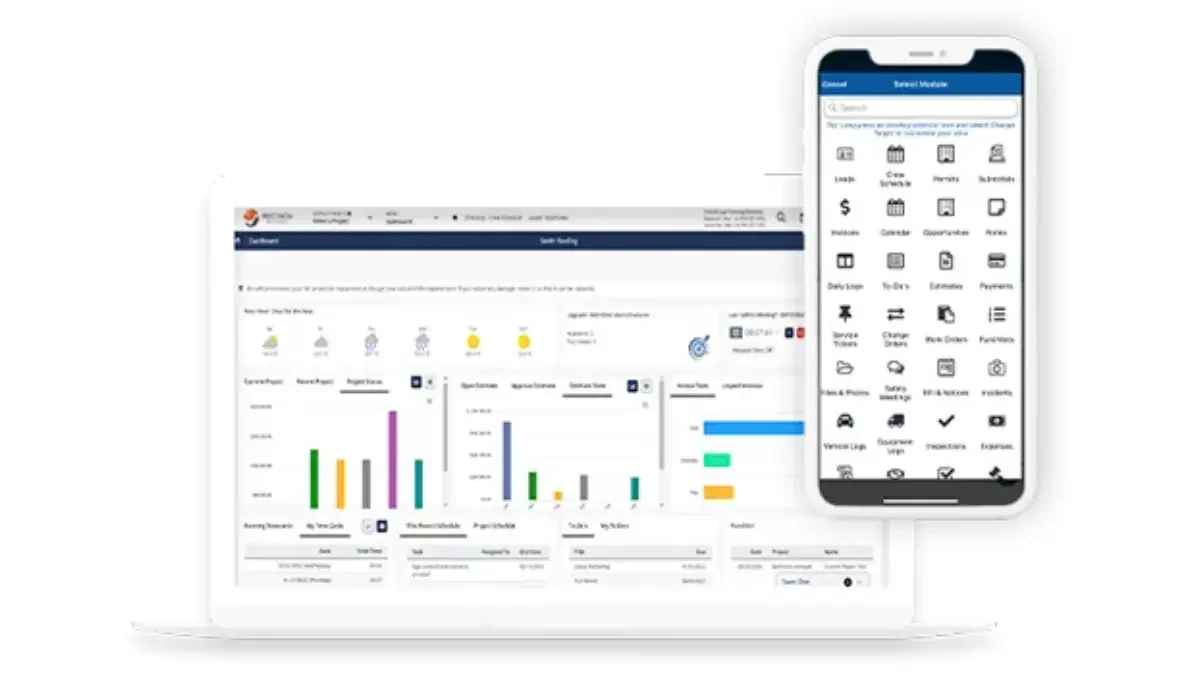
Contractor Foreman is an affordable, all-in-one tool for small to mid-sized contractors. Covers bid management, purchase orders, subcontracts, and real-time cost tracking.
Key capabilities:
- Bid Management
- Purchase Orders
- Sub-Contracts
- Real-time Costs Database
| Pros | Cons |
|
|
Best for: Small contractors who need estimating plus basic project management without a massive investment.
Prices start from: $49/month (~₱2,750/month).
2. Buildertrend
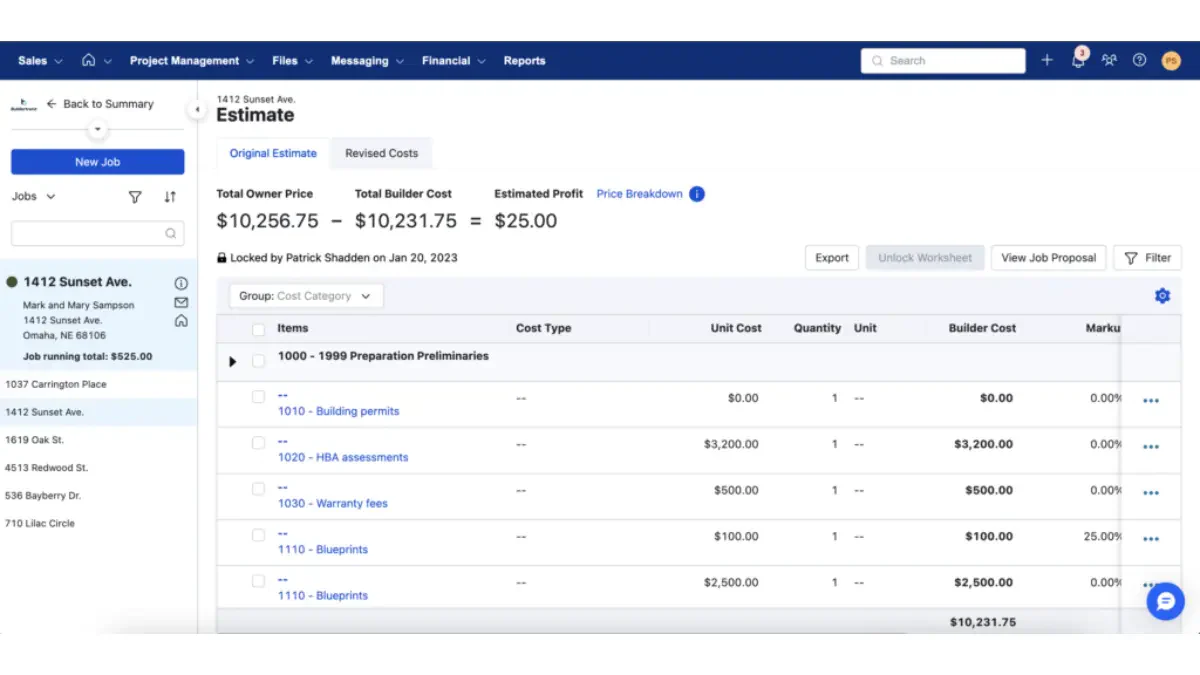
A cloud-based platform built for residential builders and remodelers. Buildertrend covers scheduling, client communication, and estimating in one dashboard. It integrates with QuickBooks and Xero.
| Pros | Cons |
|
|
Best for: Residential builders or renovation teams wanting polished client-facing estimates with built-in scheduling.
Prices start from: From $499/month
3. Procore
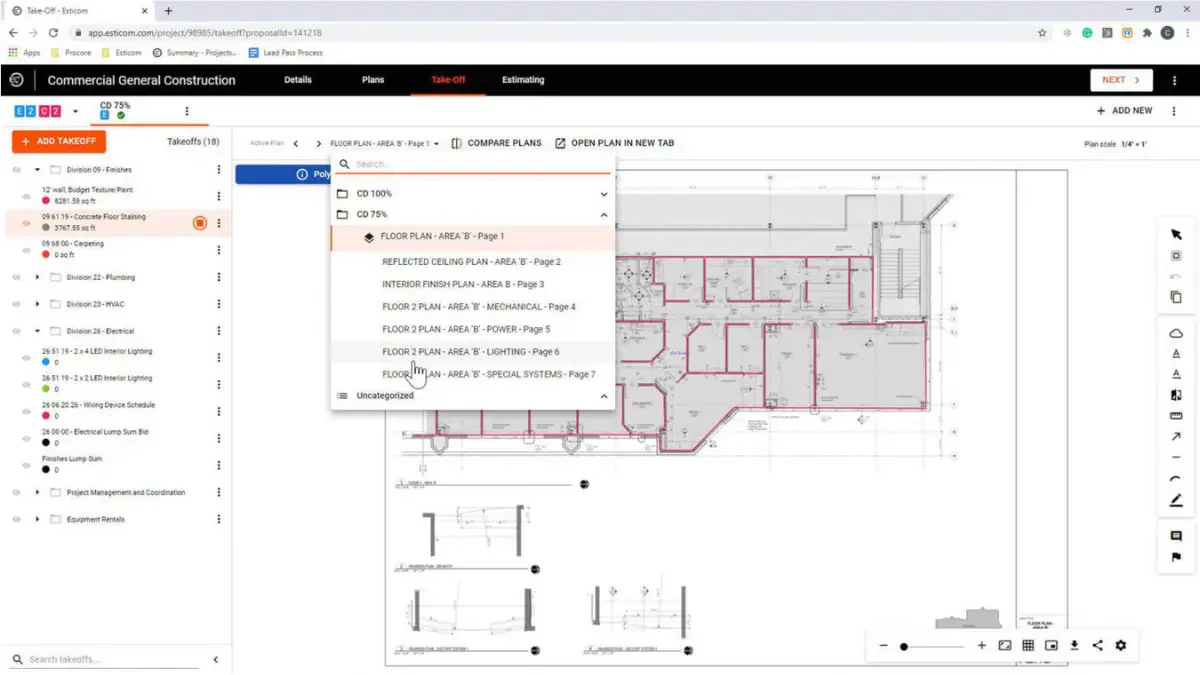
Procore is a heavyweight in construction project management. Its estimating module ties into project controls, quality management, and analytics. All on one platform.
| Pros | Cons |
|
|
Best for: Large contractors or developers managing complex, multi-phase projects where estimating needs to connect tightly with project execution and financial controls.
Pricing: From $375/month (~₱21,000/month).
4. HashMicro
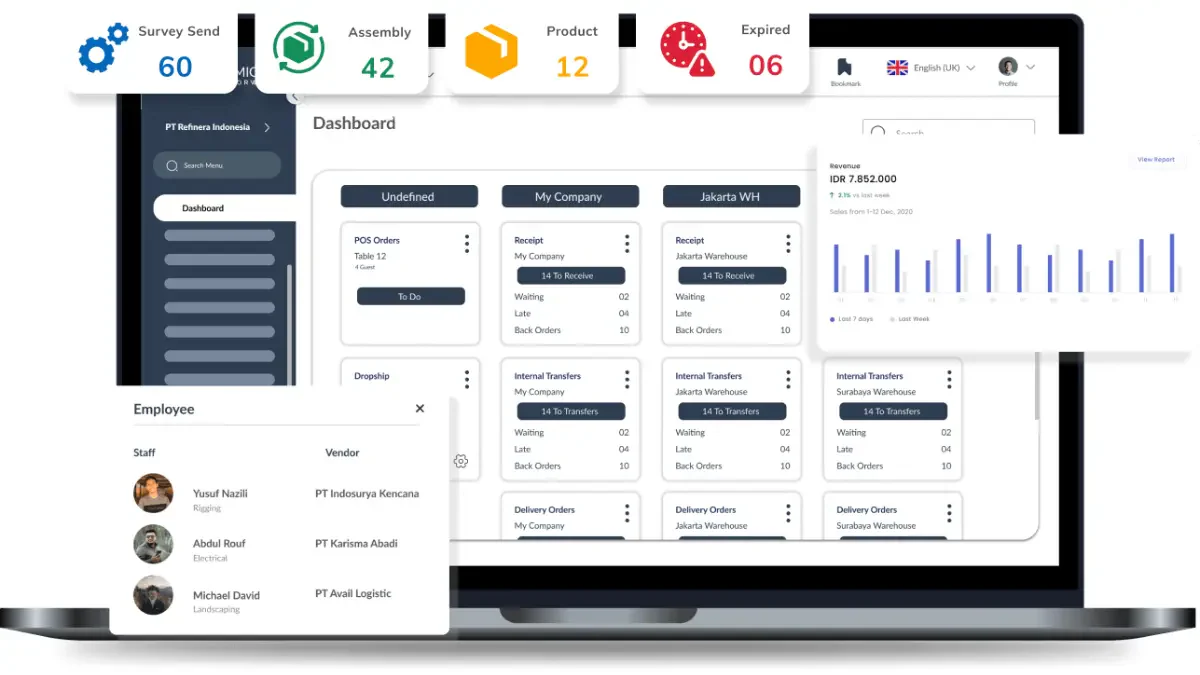
HashMicro’s construction management platform bundles estimating into a full ERP, so your estimates don’t live in isolation. They flow directly into procurement, inventory, and financial reporting.
Key capabilities:
- Budget S Curve tracking
- Automated quantity takeoffs linked to procurement
- Subcontractor and variation order management
- Progressive claim generation
- Risk flagging for cost overruns
- Supports BIR-compliant documentation out of the box.
| Pros | Cons |
|
|
Best for: Mid-to-large Philippine construction firms that want estimating, procurement, accounting, and project management in one system rather than patching together separate tools.
Prices start from: Custom, request a quote. No per-user fee

5. RedTeam
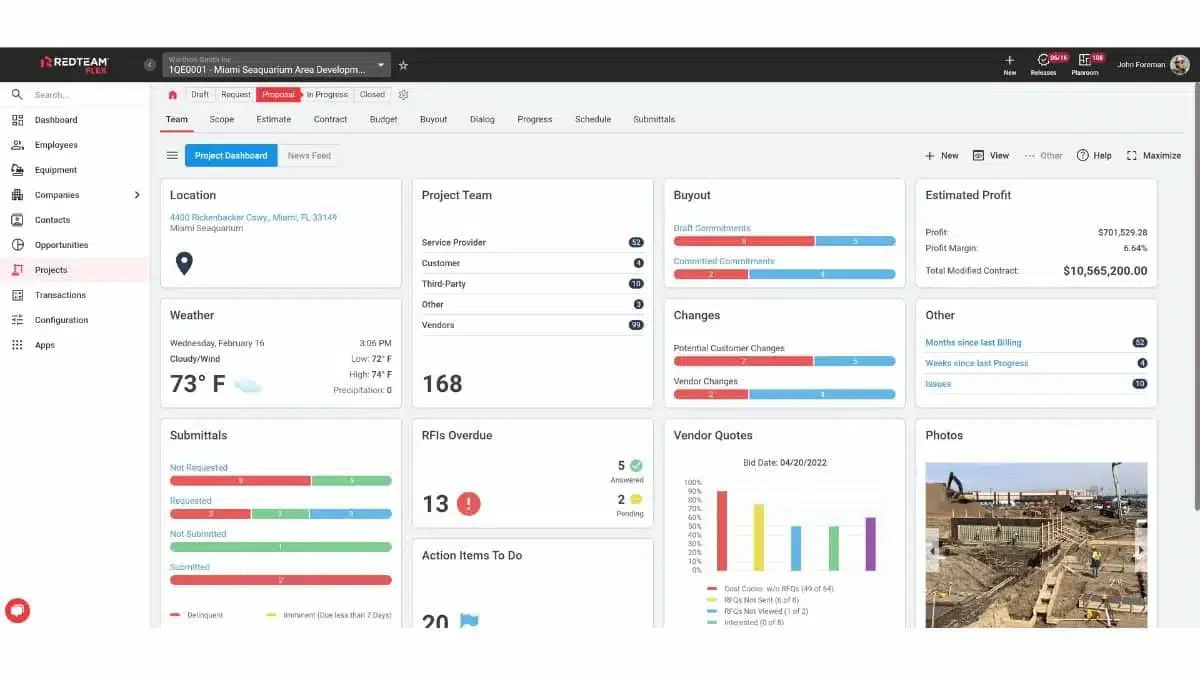
RedTeam is a project controls platform focused on proposals, contracts, and financial discipline. RedTeam treats estimating as part of a broader bid-to-close workflow.
Key capabilities:
- Real-time field data
- Automated workflows
- Proposal packages
- Financial management
| Pros | Cons |
|
|
Best for: Mid-to-large contractors where estimating feeds directly into contract management and financial controls.
Prices start from: $729/month (~₱41,000/month).
6. UDA ConstructionOnline
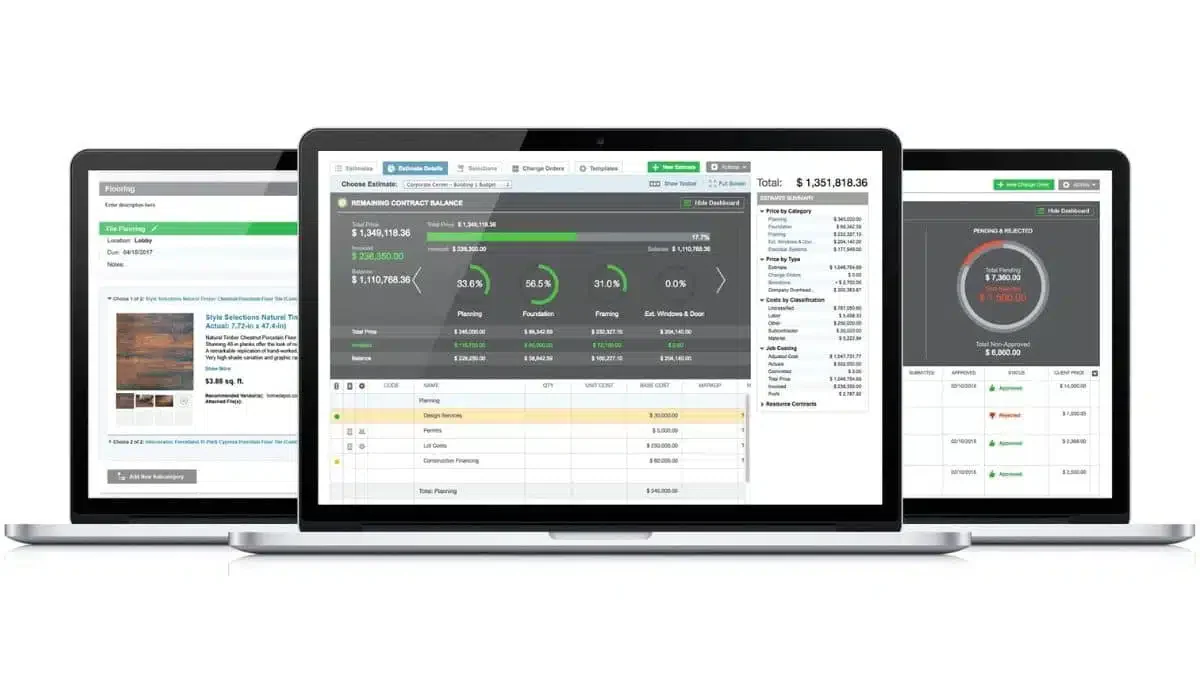
UDA ConstructionOnline is a construction project management platform that offers various features, including equipment maintenance. This software allows users to log maintenance schedules and receive automatic reminders for routine maintenance.
Key capabilities:
- Financials
- Scheduling and calendar management
- Project tracking
- Team management
| Pros | Cons |
|
|
Best for: Teams that value a unified preconstruction process where takeoff changes automatically update estimates and schedules.
Prices start from: $370/month (~₱21,000/month).
7. ClickUp
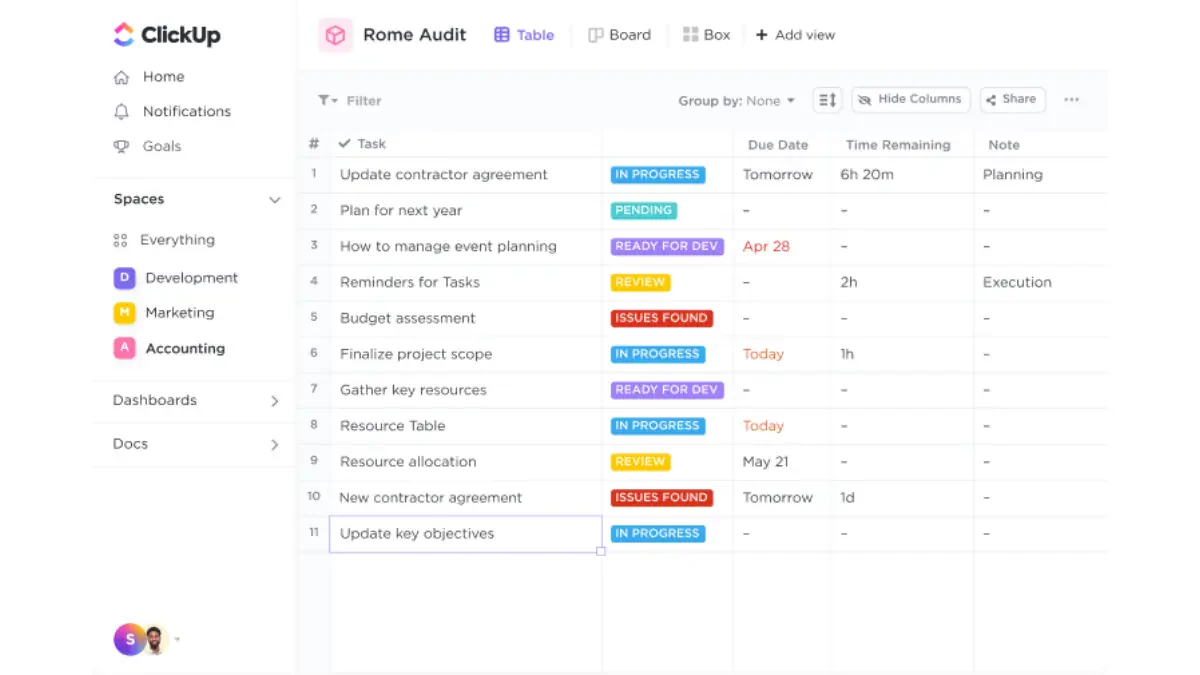
ClickUp offers flexible and customizable project management solutions for the construction inventory industry. Its equipment maintenance features enable users to schedule and track equipment maintenance and monitor equipment conditions in real-time.
Key capabilities:
- Project Management Tools
- Time Management
- Real-Time Reporting and Dashboard
| Pros | Cons |
|
|
Best for: Teams that already have an estimating tool and need better execution tracking, accountability, and team visibility.
Prices start from: From $7/user/month (~₱400/user/month).
8. STACK
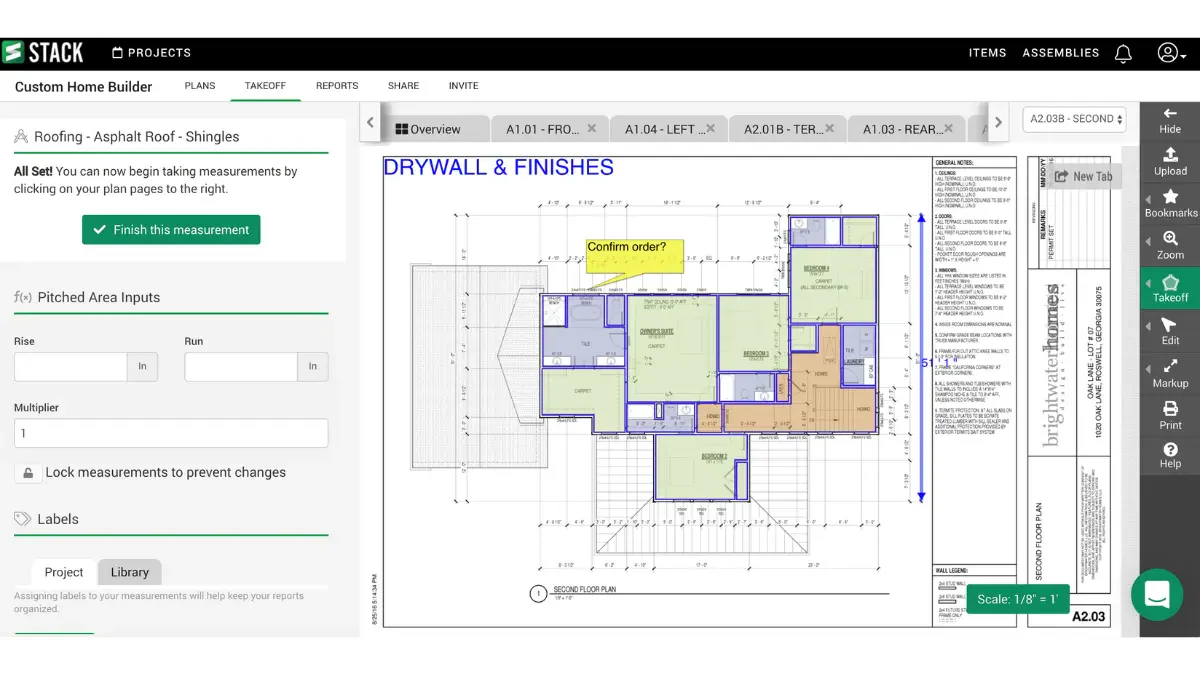
STACK is an estimating and takeoff software that helps contractors accurately measure project needs. Additionally, STACK offers equipment maintenance features, including maintenance scheduling and usage history tracking.
Key capabilities:
- Items & Assemblies
- Customized Estimates
- Filter & Reports
- Subtotals & Grouping
- Alternative Bids
| Pros | Cons |
|
|
Best for: Contractors whose main bottleneck is takeoff speed and bid standardization across multiple estimators.
Prices start from: From $250/user/month (~₱14,000/user/month).
9. Clear Estimates
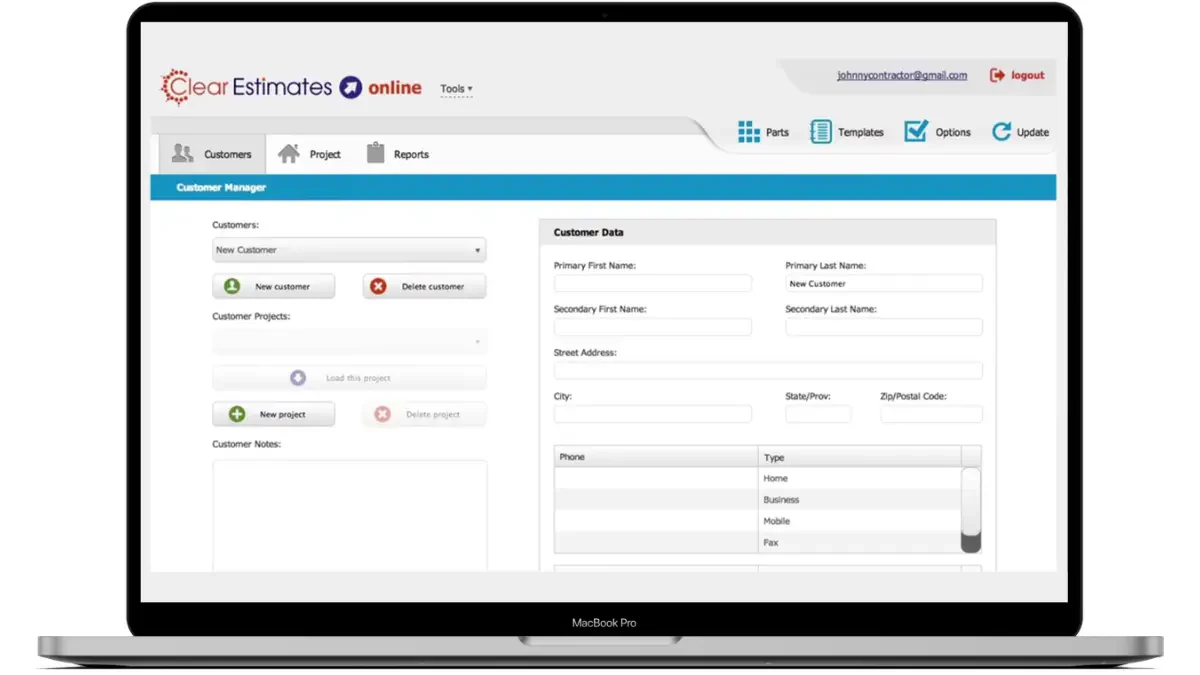
Clear Estimates targets smaller contractors with simpler projects. This software also allows users to manage equipment maintenance by logging maintenance schedules and monitoring equipment usage.
Key capabilities:
- Simplified cost estimating.
- Management of equipment maintenance schedules.
- Integration with various accounting software.
| Pros | Cons |
|
|
Best for: Small contractors who need consistent, fast estimates without the overhead of a full project management suite.
Prices start from: $59/month (~₱3,300/month).
10. PlanSwift by ConstructConnect
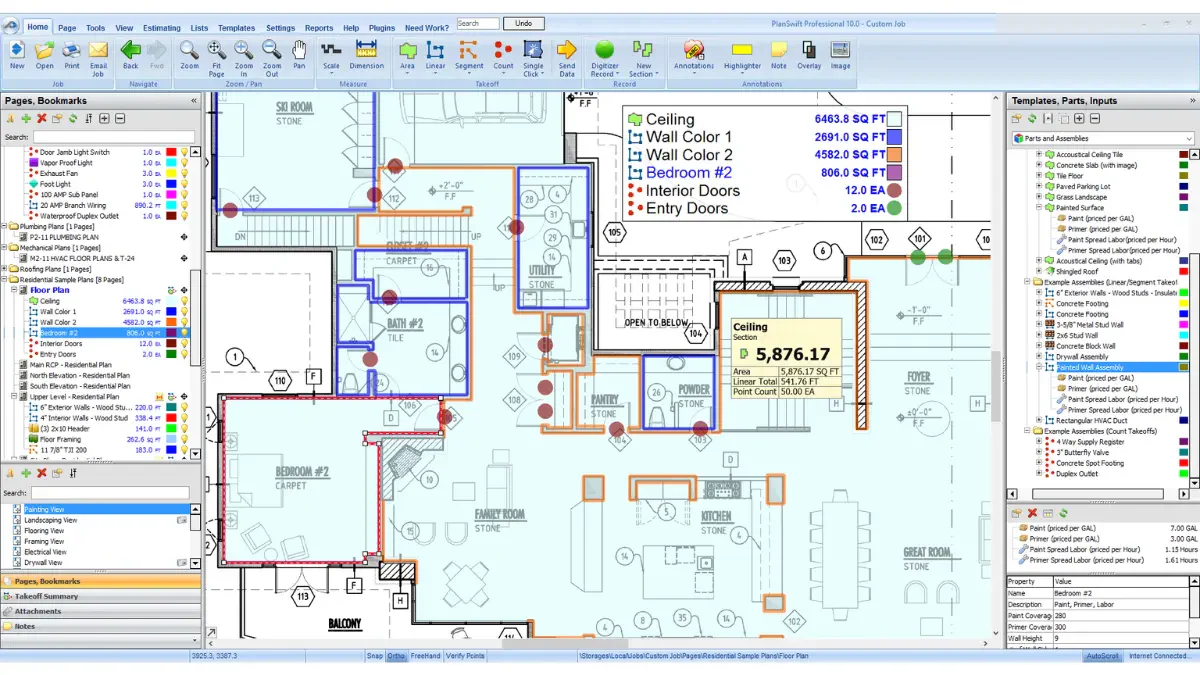
PlanSwift is a takeoff and estimating software that enables users to measure and estimate material needs easily. It also features tools for managing equipment maintenance by keeping track of maintenance records and monitoring equipment usage.
Key capabilities:
- Project Management
- Reporting/Analytics
- Subcontractor Management
- Change Order Management
| Pros | Cons |
|
|
Best for: Estimators who want granular control over measurements and prefer a takeoff-first workflow.
Prices start from: $59/month (~₱3,300/month).
11. Buildsoft
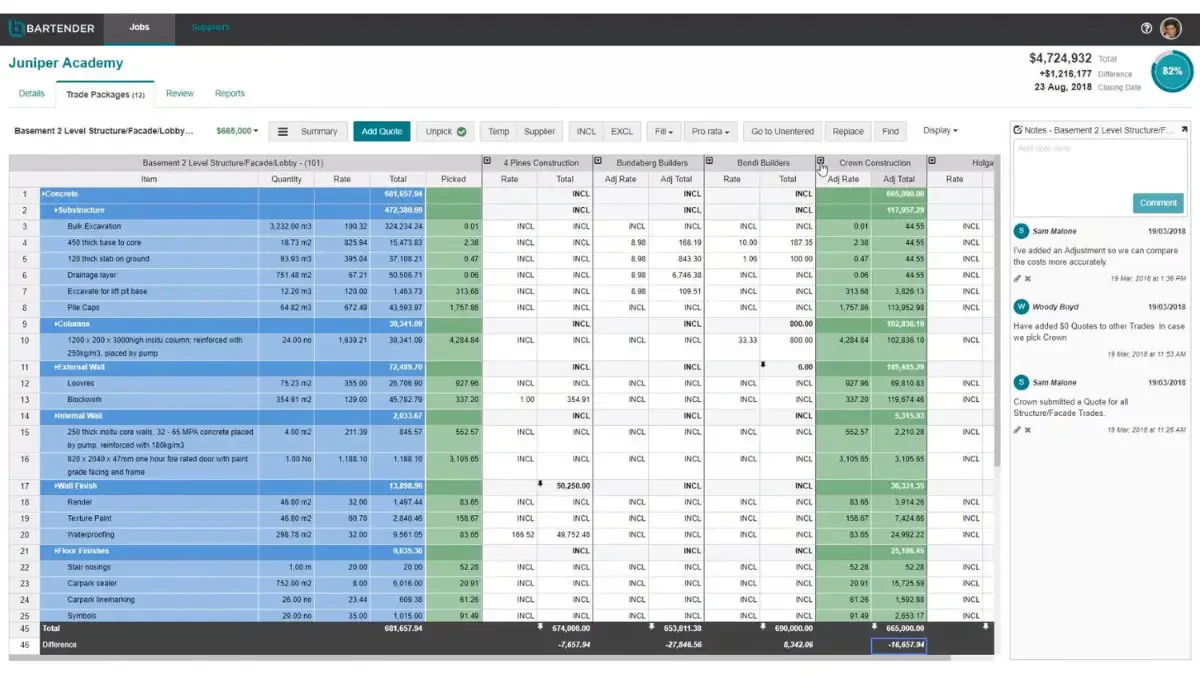
Buildsoft offers estimating and takeoff software that helps contractors plan and manage their projects. Additionally, Buildsoft provides equipment maintenance features, including maintenance scheduling and equipment history tracking.
Key capabilities:
- Natural Estimating
- 3D Takeoff
- Job Analysis
- Reporting
| Pros | Cons |
|
|
Best for: Firms that work with disciplined takeoff and tender documentation where accuracy and standardized outputs are non-negotiable.
Prices start from: $1,749 – $2,000 per year (₱8,200–₱9,400/month).
12. HeavyBid
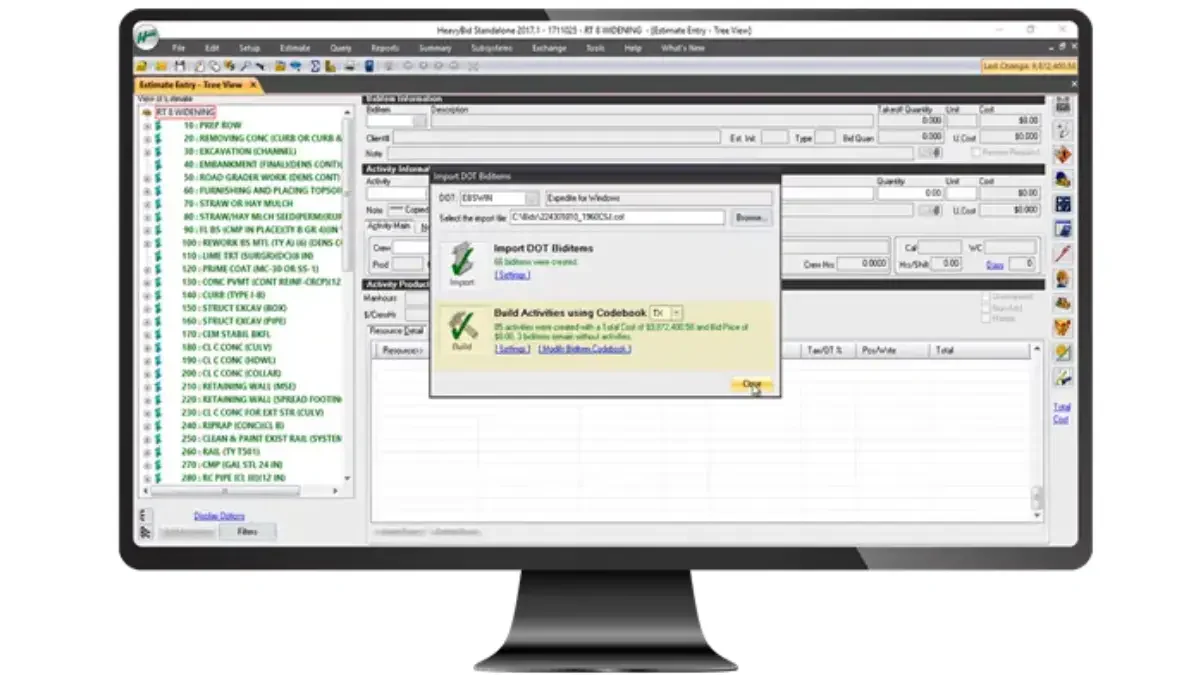
HeavyBid is an estimating software designed for large and heavy construction projects. It also includes equipment maintenance features that assist contractors in scheduling routine maintenance and monitoring equipment tools conditions.
Key capabilities:
- Multiple Estimators
- Data Import/Export
- Custom Proposals
- Project Tracking
| Pros | Cons |
|
|
Best for: Large infrastructure contractors bidding on government or DPWH projects that require high-precision, repeatable cost logic.
Prices start from: Contact vendor for a quote.
13. Estimator360
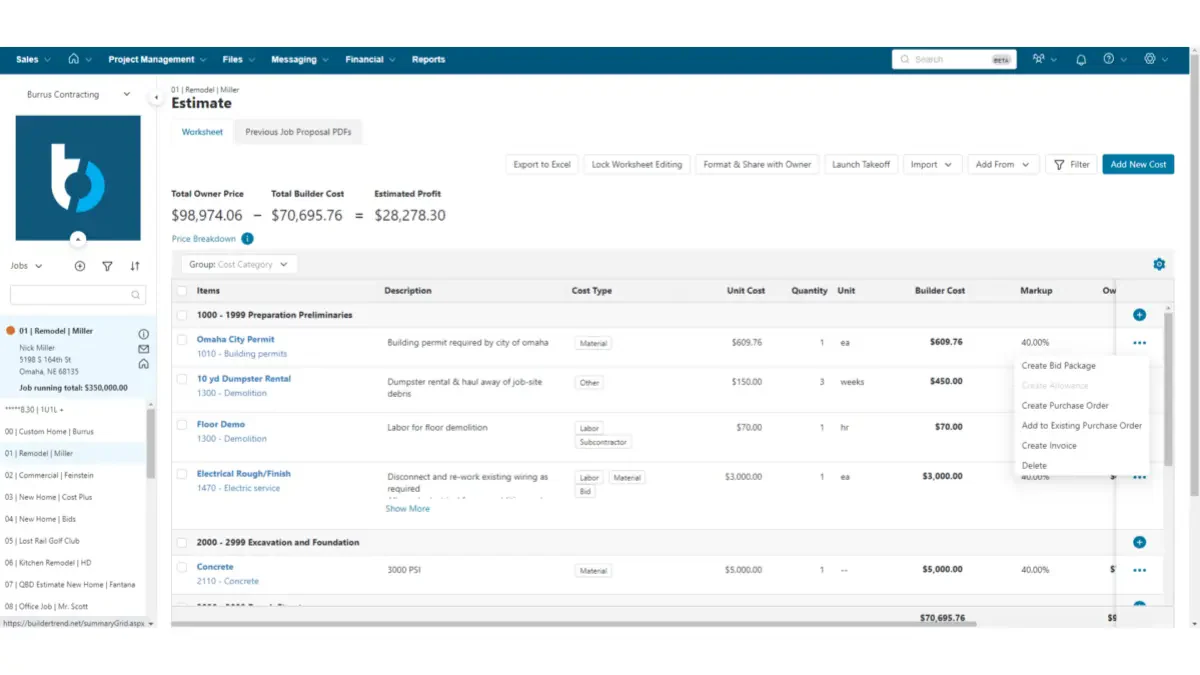 Estimator360 is an estimating software that offers accurate project cost estimation solutions. Additionally, it provides equipment maintenance features, including maintenance scheduling and equipment usage tracking.
Key capabilities:
- Digital Takeoff
- Estimate Generation
- Crew Management
| Pros | Cons |
|
|
Best for: Residential builders or teams that work on similar project types repeatedly and want to templatize their estimates.
Prices start from: $269/month (~₱15,100/month).
14. Sage Estimating
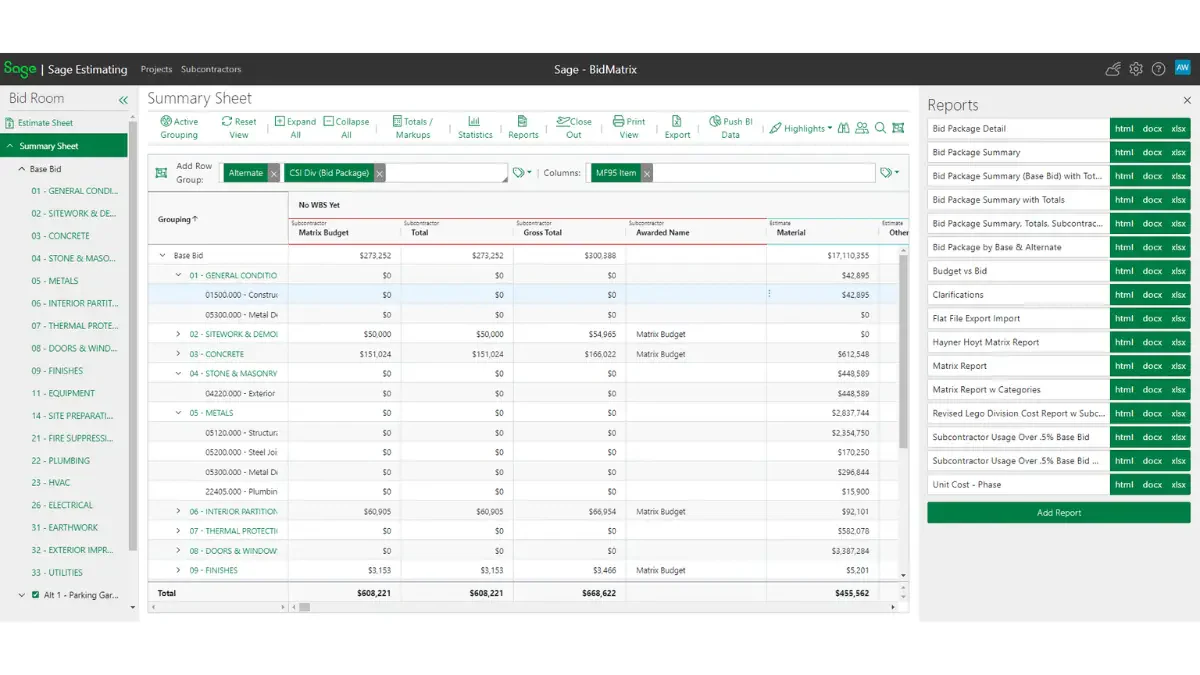 Sage Estimating helps contractors estimate project costs accurately and efficiently. It also includes equipment maintenance features that allow users to schedule routine maintenance and monitor equipment conditions.
Key capabilities:
- Estimates
- Organization
- Bid management
- Lead management
| Pros | Cons |
|
|
Best for: Large contractors with established estimating teams that need enterprise-level standardization and database control.
Prices start from: Contact vendor for a quote.
15. ProEst
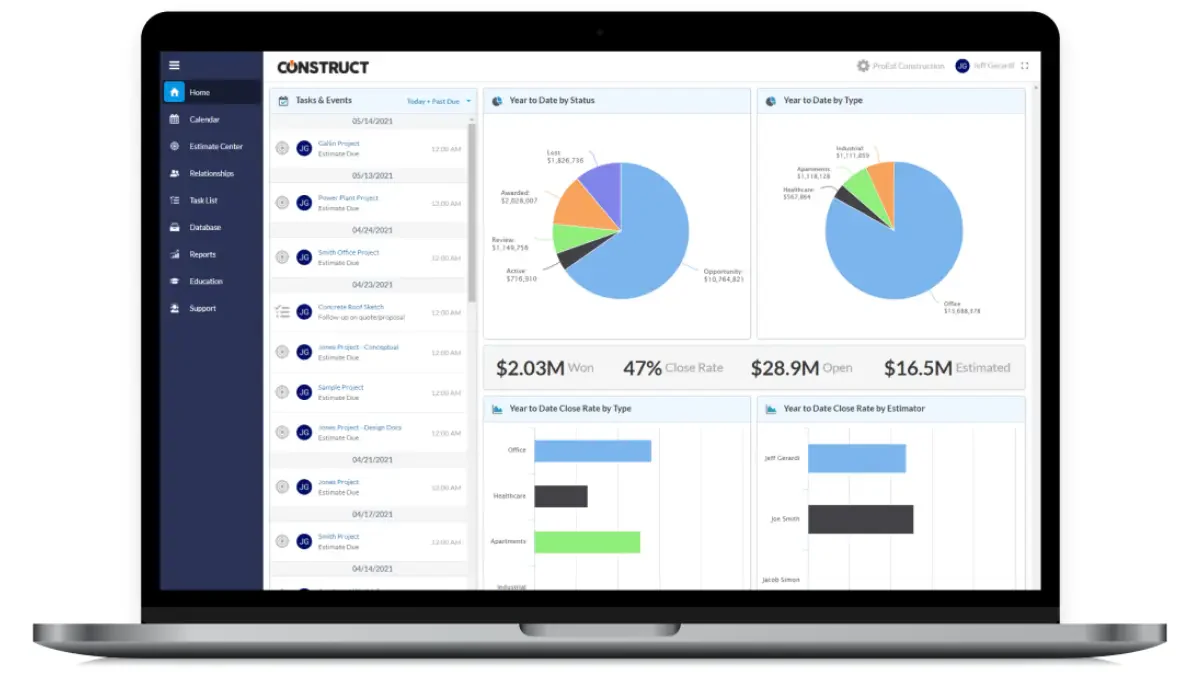
ProEst is a cloud-based estimating software designed to help contractors estimate project costs. Its equipment maintenance features enable users to manage maintenance schedules and track equipment usage history.
Key capabilities:
- Construction Proposals
- Construction Takeoffs
- Construction Reporting
- Conceptual estimating
- Bid management
- Document management
| Pros | Cons |
|
|
Best for: Firms that want centralized, cloud-based estimating with strong bid comparison and preconstruction consistency across projects.
Prices start from: $5,000 per year (~₱23,500/month).
How to Choose the Right Software for You

The wrong estimating tool wastes both time and money. Understanding the key factors to consider will help you make the right decision that aligns with your company’s goals and needs.
Skip the generic advice. Here’s what actually matters for Philippine contractors:
- Does it handle Philippine tax requirements? If you’re VAT accounting registered, you need software that generates BIR-compliant invoices or integrates with an accounting system that does. Ask vendors specifically about Philippine tax support, don’t assume.
- Per-user pricing vs. flat pricing. Many tools charge per seat. If you have 20 people who need access (estimators, PMs, site engineers, finance), per-user pricing at $250/month turns into ₱280,000/month fast. Flat-rate or unlimited-user models like HashMicro’s can save a lot here.
- Cloud vs. desktop. If your project sites have unreliable internet (common outside Metro Manila), a desktop-first tool like PlanSwift may be more practical than a cloud-only platform.
- Can it grow with you? A tool that works for 3 projects won’t necessarily handle 15. Before conducting a feasibility study on your software investment, map out where you expect to be in 2–3 years, not just today.
- Integration with what you already use. Check whether the tool connects with your existing accounting software, your material requisition workflow, and any project management platforms your team already relies on.
Which Construction Estimating Software Suits My Business?
| Business Profile | Recommended Software | Why It Fits |
| Construction firms needing end-to-end estimating integrated with ERP, finance, and project control | HashMicro | Fully integrated ERP system, streamlining estimating, procurement, inventory, and financial reporting for comprehensive project control. |
| Builders and contractors needing all-in-one scheduling, client collaboration, and project workflows | Buildertrend, Procore, RedTeam | Comprehensive scheduling, client collaboration, and project management features. |
| Small to mid-sized contractors looking for affordable and flexible estimating tools | Contractor Foreman, Clear Estimates, Estimator360 | Cost-effective, user-friendly, and flexible estimating features suitable for small-to-mid-sized contractors. |
| Teams focused on accurate takeoff and cost estimation | Stack, PlanSwift, Buildsoft | Designed specifically for accurate takeoff and cost estimation. |
| Large-scale or heavy construction projects requiring high-precision bidding and data handling | HeavyBid, Sage, ProEst | Built for large-scale projects with advanced data handling, high-precision bidding, and robust functionality. |
| Teams preferring simple scheduling and lightweight construction features | UDA ConstructionOnline, ClickUp | Offers simplified scheduling and essential construction management features for teams with basic needs. |
Conclusion
The right estimating software depends on your team size, project complexity, and how tightly you need estimates to connect with your financial and procurement systems. For Philippine contractors, especially MSMEs competing for PCAB-rated projects, the difference between a rough spreadsheet estimate and a software-backed bid can mean winning or losing work.
Start with the quick-pick table above, shortlist 2–3 options that fit your budget and workflow, and request demos before committing. The best software comparison vendors offer a free consultation to help you evaluate fit
.
FAQ About Construction Estimating Software
Estimating in construction is the process of predicting the costs associated with a construction project, including materials, labor, equipment, and other resources needed to complete the work.
Construction estimation provides a clear view of the financial requirements of a project. Accurate estimates support budgeting, resource allocation, and project planning.
Construction estimating software automates cost calculations by combining inputs such as material costs, labor rates, equipment usage, and project timelines.
A Type 4 cost estimate, often called a budget estimate, is usually prepared during the design development stage and provides a more detailed cost forecast with an expected accuracy range of about 15 to 30 percent.
Yes. AI-powered estimating tools can analyze historical data, project size, and material trends to generate estimates faster and reduce manual effort.
Paragraf baru...