













Managing complex projects is challenging, especially when tasks, responsibilities, and deliverables are unclear. As a result, teams may overlook critical work, underestimate effort, or lose alignment with goals. Therefore, a Work Breakdown Structure becomes essential to turn complexity into manageable execution.
According to PMI’s 2023 Pulse of the Profession report, organizations that prioritize power skills like structured planning and scope management reach 72% project success, compared to 65% for others, and they also experience less scope creep (28% vs. 40%). Thus, tools like WBS are vital.
To apply a Work Breakdown Structure effectively, many organizations now use digital project management tools to improve visibility and coordination. For example, HashMicro’s system helps teams turn WBS into actionable plans and real-time tracking so structured planning becomes more efficient.
Key Takeaways
|
What Is a Work Breakdown Structure (WBS)?
Quick Answer: A Work Breakdown Structure (WBS) is a hierarchical, deliverable based method that breaks a large project into smaller, manageable, and measurable components. Its purpose is to clearly show the full scope of work required to achieve the project’s objectives.
The Work Breakdown Structure, or WBS, is a key foundation in effective project management. In simple terms, it is a visual map that breaks the main final deliverable into smaller parts until it becomes a manageable work package, so no work is missed and everyone understands their role.
The easiest way to understand a WBS is to see it as a detailed table of contents. The book title is the final outcome, chapters are major deliverables, sub chapters are components, and each paragraph is a work package. Thus, the team can focus on small sections while still seeing the whole project.
Why Is a Work Breakdown Structure Crucial in Project Management?

Quick Answer: A WBS is crucial because it provides total clarity on the project scope, prevents scope creep, facilitates accurate cost and time estimations, and enhances team accountability by defining each work package specifically.
Adopting a Work Breakdown Structure is not just a best practice but a strategic step that raises a project’s success. Without it, teams often face uncertainty, cost overruns, delays, and unmet expectations. Instead, a WBS aligns all stakeholders on what is and is not included in the project.
By mapping all required work, the WBS becomes the basis for most project planning. From it, resource estimates, schedules, and risk analysis gain greater accuracy. Ultimately, consistent WBS use creates a solid, transparent foundation. Here are key reasons it is invaluable for project managers.
1. Enhances clarity of project scope
By breaking the project into visual components, the WBS reduces ambiguity about what must be achieved. As a result, everyone can see the full scope, focus on agreed deliverables from the start, avoid missed or extra work, and thus keep the project on the right track.
2. Facilitates accurate planning and scheduling
The work packages at the lowest WBS level are ideal for estimating duration and creating schedules. Because each package is clearly defined, managers can build realistic timelines, identify task dependencies, and arrange workflows logically to avoid unnecessary delays using a Gantt chart for project planning.
3. Assists in cost estimation and resource allocation
The WBS provides a structured framework for bottom up cost estimation. By estimating labor, material, and equipment costs for each work package, the total budget becomes more accurate. Additionally, the WBS clarifies resource needs so the right people and tools are assigned at the right time.
4. Prevents scope creep
Scope creep, or adding work outside the initial scope, is a major cause of project failure. However, the WBS defends against it by clearly defining boundaries. Any change request is checked against the WBS, and if it does not fit, it is treated as out of scope and must go through formal approval.
5. Improves team communication and accountability
With a WBS, each work package can be assigned to a specific person or team, creating clear accountability. As a result, everyone knows their responsibilities and how their work supports project success. Moreover, the WBS is a strong visual tool for clearly communicating the big picture.
Key Components of a Work Breakdown Structure
Quick Answer: The main components of a WBS include the final project deliverable at the top level, followed by major phases or sub-deliverables, work packages as the smallest units of work, and the WBS Dictionary, which provides detailed descriptions for each component.
To build an effective Work Breakdown Structure, it is essential to understand its hierarchical elements. This structure flows from a general overview to specific details, so each level adds more information. As a result, every component plays a role in defining and controlling the work.
Understanding each of these components allows the team to build a WBS that is not only complete but also functional as a management tool. A good structure will ensure that every piece of work can be tracked, measured, and its progress easily reported. Here are the key components you need to know when creating a WBS for your project.
1. Level 1: Final project deliverable
This is the peak of the WBS hierarchy and represents the main outcome of the project. Typically, it is a single item describing the project, such as “E-commerce Mobile App Development.” Thus, it becomes the top reference, ensuring all work directly supports this main objective.
2. Level 2: Control accounts
At Level 2, the final project deliverable is broken into major deliverables or phases, often called control accounts, where budgets and schedules are monitored. For an e-commerce app, Level 2 could include UI/UX Design, Backend, Frontend, and Testing & Launch.
3. Level 3 onwards: Work packages
This is the lowest and most critical level for execution. A work package is small enough to estimate, schedule, assign, and control, and it must produce a verifiable deliverable. For example, under UI/UX Design, work packages include Wireframe Creation and Mockup Design.
4. WBS Dictionary
The WBS Dictionary is an often overlooked but crucial document. It gives detailed descriptions for each WBS component, especially work packages, including work scope, deliverables, criteria, estimates, and owners. Thus, it removes ambiguity and ensures a shared understanding of every work element.
How to Create a Work Breakdown Structure (WBS) in 5 Practical Steps

Quick Answer: Creating a WBS starts with identifying the main deliverables, breaking them down into smaller components until they become work packages, applying the “100% Rule” for completeness, creating a WBS Dictionary for details, and finally choosing a suitable visualization format.
Creating a Work Breakdown Structure is a collaborative process that requires input from the entire project team and key stakeholders. The goal is to ensure that the decomposition is accurate, complete, and realistic. Although it may seem complex, the process can be simplified into several logical, easy-to-follow steps.
By following a step-by-step approach, you can ensure that the resulting WBS will be a powerful tool to guide your project from start to finish. This process is not just about breaking down work; it is also about building a shared understanding and team commitment. Here are five practical steps to create an effective WBS.
1. Step 1: Identify the project’s main objectives and deliverables
The first step is to clearly understand the project’s final objective and identify all major deliverables. Then review the scope statement and charter, and involve sponsors, key stakeholders, and senior team members so no deliverable is missed. This forms the basis for Level 1 and Level 2 of your WBS.
2. Step 2: Decompose deliverables into smaller components
Once the main deliverables are identified, begin decomposing each Level 2 deliverable into smaller, manageable components. Continue iterating until you reach work packages that can be finished in a short time and assigned to one person or a small team.
3. Step 3: Apply the “100% Rule”
The “100% Rule” states that all child-level work must cover 100% of its parent, and all work packages must cover 100% of the total scope. Thus, the WBS includes all necessary work with no gaps and no extra, unnecessary work that could cause scope creep.
4. Step 4: Create the WBS Dictionary
As you build the hierarchy, start compiling the WBS Dictionary for each element, especially work packages. For each, record the work description, acceptance criteria, assumptions, constraints, owner, and resource estimates, so later planning and execution become much easier.
5. Step 5: Choose a WBS visualization format
Finally, choose the best format to present your WBS. The most common is a tree diagram that shows parent child relationships. Alternatively, you can use an outline or indented list. Select the format your audience finds easiest for understanding the full project scope.
Turning a Work Breakdown Structure into execution often requires better coordination and progress tracking. For Singaporean businesses, solutions supported by up to 70% CTC grant funding help adopt structured project management systems at a lower cost.


Work Breakdown Structure Examples Across Different Industries
Quick Answer: WBS examples vary by industry. For construction, a WBS can be broken down by phases like design and building. For manufacturing, it can be based on product components. For software development, the WBS is often broken down by features or modules.
The theory behind the Work Breakdown Structure is best understood through practical examples. Since each industry has unique project characteristics, its WBS will differ. By studying real examples, you gain insight and learn how to apply decomposition to your own projects.
The following examples show how a WBS can be adapted for various types of projects, from physical construction to digital product development. Notice how each example always focuses on deliverables (the what), not on activities (the how). Here are some simplified WBS examples for three different industries.
1. WBS example for a construction project: Building a house
Construction projects are ideal for WBS implementation because they have very clear physical phases and deliverables. The structure can be broken down by physical location or work stages.
- Level 1: House Construction
- Level 2: 1.0 Planning & Design, 2.0 Foundation, 3.0 Building Structure, 4.0 Interior, 5.0 Exterior & Landscaping
- Level 3 (under 3.0): 3.1 Wall Framing, 3.2 Roof Framing, 3.3 Exterior Siding
- Level 4 (under 3.1): 3.1.1 First Floor Wall Framing, 3.1.2 Second Floor Wall Framing
2. WBS example for ERP software development
In software development projects, the WBS is often organized by major modules or features to be built. Using HashMicro’s ERP System as an example, the implementation WBS can be broken down into functional modules.
- Level 1: HashMicro ERP System Implementation
- Level 2: 1.0 Requirements Analysis, 2.0 Accounting Module Configuration, 3.0 Manufacturing Module Configuration, 4.0 CRM Module Configuration, 5.0 Training & Go-Live
- Level 3 (under 2.0): 2.1 Chart of Accounts Setup, 2.2 Financial Reports Configuration, 2.3 E-Faktur Integration
- Level 4 (under 2.1): 2.1.1 Account Data Import, 2.1.2 Account Structure Validation
3. WBS example for a manufacturing project: Production of a new bicycle model
For a manufacturing project, the WBS can be structured based on the main product components to be assembled. This is very helpful in managing the supply chain and production processes, such as in industries like semiconductor manufacturing or 3D printing.
- Level 1: Production of Bicycle Model X
- Level 2: 1.0 Design & Prototyping, 2.0 Frame, 3.0 Drivetrain System, 4.0 Wheelset, 5.0 Final Assembly
- Level 3 (under 2.0): 2.1 Frame Material Procurement, 2.2 Cutting & Welding, 2.3 Painting & Finishing
- Level 4 (under 2.2): 2.2.1 Main Tube Cutting, 2.2.2 Joint Welding
Common Mistakes to Avoid When Creating a WBS
Quick Answer: Common mistakes when creating a WBS include inconsistent levels of detail (too detailed or too general), neglecting to create a WBS Dictionary, confusing deliverables with activities, and not involving the team in its creation process.
Although the Work Breakdown Structure is powerful, its creation is still vulnerable to errors that reduce its effectiveness. These often come from misunderstanding its purpose or rushing decomposition. However, knowing these pitfalls helps you avoid them so your WBS truly supports the project.
By avoiding these errors, you can ensure the resulting WBS is a solid, reliable tool that genuinely helps in managing the project. The quality of a good WBS will directly impact the quality of the overall project planning and execution. Here are some of the most common mistakes and how to avoid them.
1. Inconsistent level of detail
One common mistake is detailing some parts too deeply while leaving others too general, which unbalances planning and control. Instead, apply the 8/80 rule, where each work package takes 8 to 80 hours. According to the Project Management Institute, this keeps decomposition consistent and manageable.
2. Neglecting the WBS Dictionary
Many teams create attractive WBS diagrams but forget the WBS Dictionary. As a result, work packages may be interpreted differently, causing confusion and rework. Therefore, ensure each WBS element has clear descriptions, acceptance criteria, and other key details in the dictionary.
3. Mixing the “what” with the “how”
A WBS must focus on deliverables, or what must be produced, not on activities, or how to produce them. For example, “Market Analysis Report” is a proper deliverable, while “Conducting Market Research” is an activity that belongs in the project schedule, not in the WBS.
4. Not involving the team in its creation
Creating a WBS in isolation, without involving the team that will do the work, is a recipe for failure. The execution team provides better estimates and ownership, while their involvement also helps spot potential issues or nonconformance early.
Optimize Your Project Management with Solutions from HashMicro
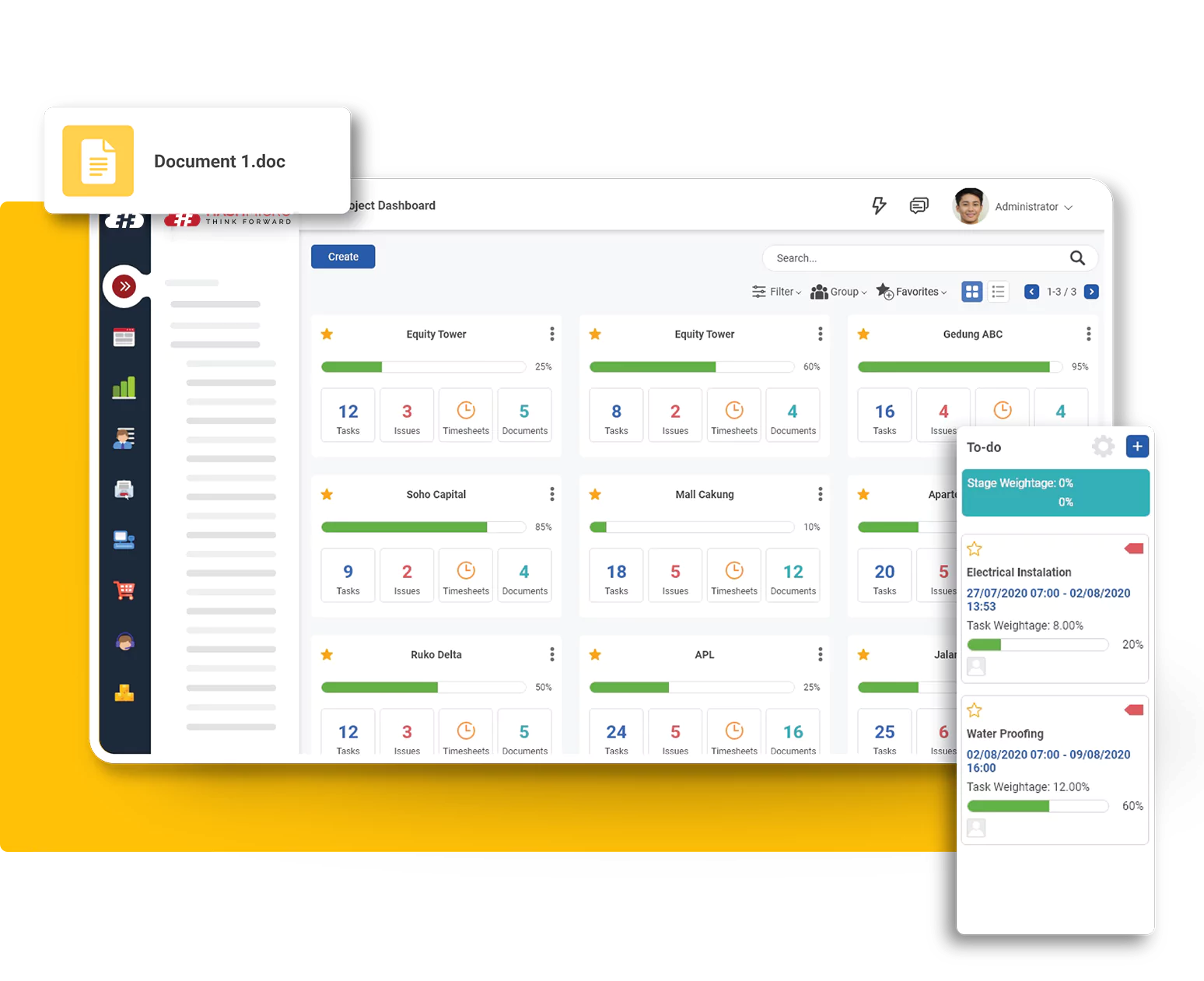
HashMicro provides an integrated ERP system that automates and simplifies business processes, including project management. With this comprehensive solution, companies can reduce reporting delays, cut manual errors, and track project status in real time for more efficient execution.
Through its advanced project management module, companies can process tasks faster, cut human error, and get real-time data. The system offers automated approvals, progress tracking, and integration with accounting so every transaction is recorded correctly and finances stay visible.
HashMicro’s system offers full integration between modules, so data from accounting, inventory, procurement, and sales is connected. This improves visibility across operations and ensures decisions rely on accurate, up to date information for better project execution.
Features of HashMicro’s Project Management Software:
- Budget S-Curve Management: Provides a comprehensive view of budget planning versus actual spending through S-curve visualization, helping to identify trends and spending patterns that need attention.
- In-Depth Job Estimates (RAB): Manages cost budgets, contracts, and implementation budgets comprehensively and integrates them into the project management system for accurate financial control.
- Gantt Chart Visualization: Allows teams to easily schedule, track, and manage project timelines and task dependencies with an intuitive and interactive Gantt chart interface.
- Real-Time Project Dashboard: Offers a customizable dashboard that provides real-time insights into project metrics, performance, budget, and material usage for faster, data-driven decisions.
- Integration with Accounting & Procurement: Seamlessly integrates with accounting and procurement systems to track project costs, manage invoices, and streamline the purchasing of materials and services.
With HashMicro, your company can enhance operational efficiency, data transparency, and business process automation. To see how our solutions can concretely help your business, feel free to try our free demo now.
Conclusion
A Work Breakdown Structure helps managers turn complex projects into clear, manageable components. By defining scope, structuring deliverables, and avoiding common mistakes, teams plan more accurately, reduce execution risks, and improve scheduling, budgeting, and accountability.
To support WBS execution, HashMicro Project Management Software provides an integrated system for task tracking, budgeting, and progress monitoring. Its features enable better coordination, real-time visibility, and tighter cost control across projects. This helps managers translate structured planning into consistent project outcomes.
If you want to manage projects more effectively and apply WBS with greater control, book a free demo with HashMicro today. See how the system can support your planning, execution, and reporting needs.

FAQ about Work Breakdown Structure
-
What is the difference between a WBS and a Gantt Chart?
A WBS focuses on breaking down the project scope into deliverables (what needs to be done), while a Gantt Chart focuses on scheduling those activities on a timeline (when it needs to be done). The WBS is a key input for creating a Gantt Chart.
-
How detailed should a WBS be?
The ideal level of detail extends down to the work package level, which is the smallest unit of work that can be independently estimated, scheduled, and managed. A common rule of thumb is the ‘8/80 rule,’ where each work package should take between 8 and 80 hours to complete.
-
Who is responsible for creating the WBS?
The project manager leads the creation of the WBS, but the process must be collaborative. It is crucial to involve project team members, subject matter experts, and relevant stakeholders to ensure the resulting WBS is accurate, complete, and realistic.
-
How does a WBS help in managing project risks?
By breaking down the project into small components, the WBS helps the team identify potential risks at a more granular level. Each work package can be individually analyzed for risks, allowing for the early and specific development of mitigation strategies before they become major issues.
-
Can the WBS be changed after the project starts?
Ideally, the WBS should be stable after it is approved. However, if there is a formally approved change in scope (through a change control process), the WBS must be updated to reflect that change. This must be well-documented to maintain the integrity of the project plan.