










 Limited to 100 registrants

In Singapore, where infrastructure, facilities, and industries operate with clockwork precision, maintenance management is the silent engine that keeps everything running smoothly.
From high-rise buildings to advanced manufacturing plants, efficient maintenance practices ensure safety, reduce downtime, and prolong asset life. However, with rising operational costs and increasing demand for reliability, how are Singaporean businesses coping?
Continue reading this article as we will examine how modern maintenance management, driven by technology and strategic planning, is revolutionising the way assets are maintained in the Lion City.
Key Takeaways
Maintenance management in Singapore refers to the systematic process of organising, planning, and carrying out maintenance tasks to ensure the optimal performance and durability of tangible assets.
Maintenance management can be divided into various types, each with its strategy and goal.
To achieve effective maintenance management, organizations must establish reliable and innovative maintenance management plans.
HashMicro Maintenance Software is designed to streamline not only production but also asset and equipment maintenance, a critical part of operational efficiency.

What is Maintenance Management?
Maintenance management in Singapore refers to the systematic process of organising, planning, and carrying out maintenance tasks to ensure the optimal performance and durability of tangible assets, including machinery, buildings, infrastructure, and equipment.
This includes not only regular maintenance but also predictive and preventative techniques that lower repair costs and decrease downtime in a highly advanced and competitive economy like Singapore.
Types of Maintenance Management

Maintenance management can be divided into various types, each with its own strategy and goal. Depending on their sector and operational requirements, companies in Singapore frequently employ a combination of these maintenance types, where accuracy, efficiency, and accountability are crucial.
Here are the main types of maintenance management:
-
Preventive maintenance
In Singapore, this is the most common strategy. To prevent equipment failure before it occurs, it entails periodically planned maintenance tasks, such as inspections, lubrication, and part replacements.
For example, the building management team implements preventive maintenance for its centralised air conditioner system. Given Singapore’s hot and humid climate, maintaining air conditioning systems is crucial not only for comfort but also for energy efficiency and tenant satisfaction.
-
Predictive maintenance
Predictive maintenance software, which utilizes equipment condition monitoring, is conducted using sensors, data analytics, and artificial intelligence (AI) to anticipate equipment failures before they occur.
In Singapore’s manufacturing and logistics industries, where downtime can be costly, this strategy is gaining popularity because it reduces unexpected outages and extends the lifespan of assets.
For example, predictive maintenance is one of the most routine and regulated maintenance activities, especially in Housing & Development Board (HDB) estates and high-rise commercial buildings.
Due to high usage and strict safety standards, elevator systems are subject to regular preventive checks under the Building and Construction Authority (BCA) guidelines.
-
Reliability-centered maintenance
Reliability-Centered Maintenance (RCM) is a strategic maintenance approach that focuses on ensuring physical assets continue to perform their intended functions reliably, efficiently, and safely.
Instead of implementing a unified maintenance strategy, RCM examines each asset separately, determining the best maintenance approach based on the asset’s operational importance and the potential consequences of failure.
For example, Singapore Airlines Engineering Company (SIAEC) implements reliability-centered maintenance to ensure that its aircraft fleet operates safely, efficiently, and without unexpected breakdowns, prioritizing criticality, failure consequences, and cost-effectiveness.
Key Strategies for Effective Maintenance Management
To achieve effective maintenance management, organizations must establish reliable and innovative maintenance management plans. In Singapore, the following are the key strategies for efficient maintenance management:
-
Implement a Computerized Maintenance Management System (CMMS)
All maintenance information, work orders, schedules, and asset records are centralized in a CMMS. Allows for quicker responses, more efficient planning, and real-time tracking.
The implementation of CMMS is a logical step toward smart maintenance, given the solid digital infrastructure and government support for Industry 4.0.
-
Root Cause Analysis (RCA)
Instead of treating the signs of failure, employ an RCA to investigate thoroughly and identify the root causes of the failure.
These root causes can be identified and addressed to prevent future failures. It’s about enhancing the overall dependability of production processes and utilizing failures as an opportunity for innovation.
-
Adopt data-driven decision making
KPIs such as maintenance cost ratios, mean time to repair (MTTR), and mean time between failures (MTBF) can be monitored with analytics. Budgets, spare component stocks, and scheduling are all enhanced through data insights.
Curious about how effective your maintenance management is? Explore HashMicro’s pricing plans to find the perfect solution tailored to your business needs and get up to 70% funding from the CTC Grant.

Enhance your Business Operation with HashMicro Maintenance Management Software
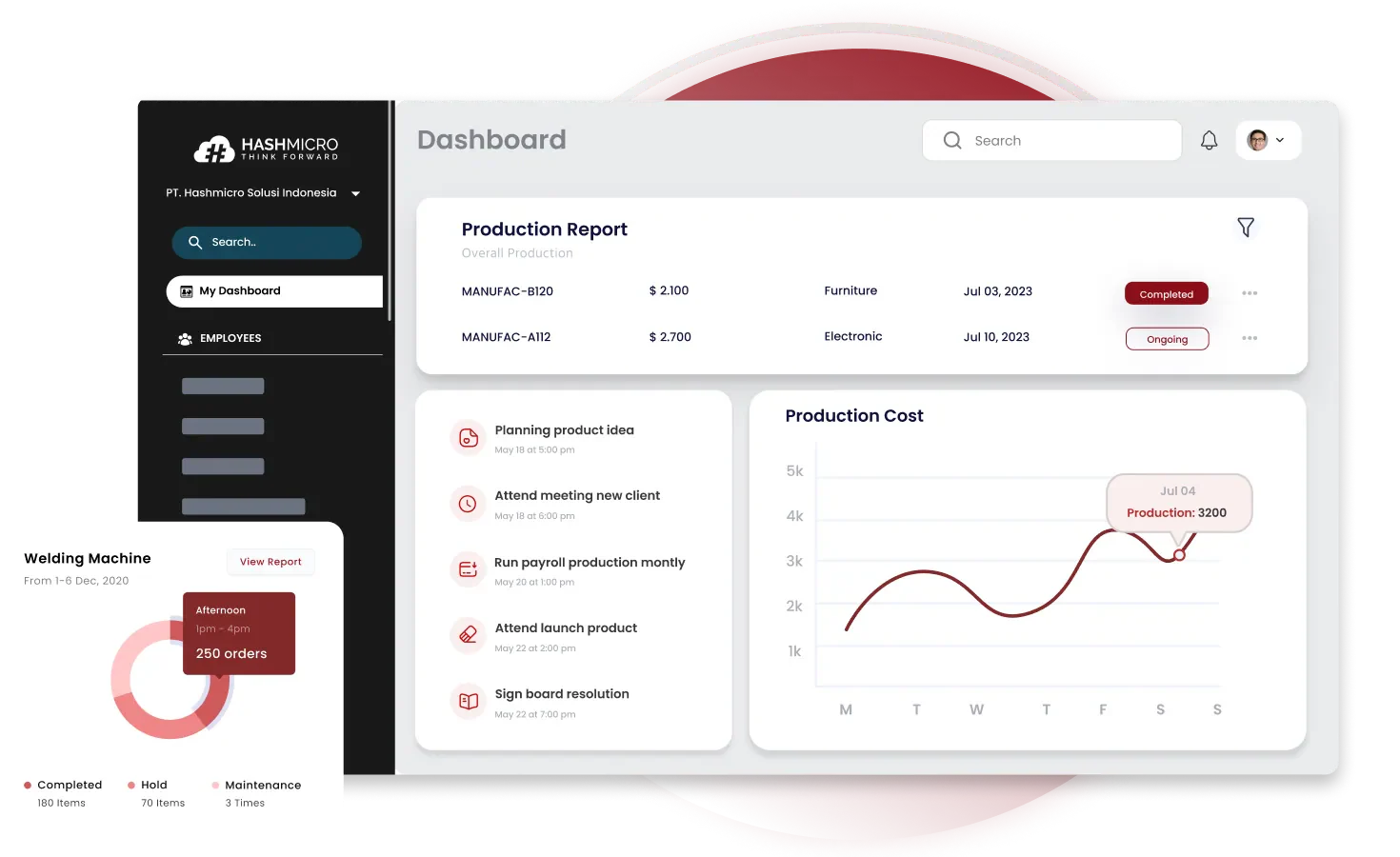
HashMicro is a leading Singapore-based Enterprise Resource Planning (ERP) software provider, founded in 2015. It offers a wide range of customizable, cloud-based solutions designed to help businesses automate operations, enhance productivity, and make better decisions.
HashMicro Maintenance Software is designed to streamline not only production but also asset and equipment maintenance, a critical part of operational efficiency.
HashMicro’s maintenance system doesn’t just manage production; it empowers your team to prevent equipment breakdowns, reduce downtime, and optimise asset lifespan, all from one centralised platform.
Here are the key features from HashMicro that support effective maintenance management:
- Automated maintenance scheduling: The system allows you to set routine maintenance schedules for all your machinery and production assets. It sends timely reminders and generates work orders, ensuring that preventive maintenance is never missed.
- Real-time asset tracking: track the status, usage hours, and performance of each machine in real-time. This helps identify wear and tear early, enabling timely servicing before breakdowns occur.
- Maintenance history records: Hashmicro maintains a digital log of every maintenance activity, including the spare parts used, technician details, and repair costs. This data helps in analysing recurring issues and improving long-term maintenance planning.
- Integration with Inventory and Procurement: Need Replacement Parts? The system is integrated with inventory and procurement modules, allowing it to automatically track spare parts availability and trigger reordering, thereby reducing equipment downtime.
- Cost control and reporting: With detailed maintenance cost reports and KPIs, such as MTTR (mean time to repair), you can analyse performance and make more informed budgeting decisions.
- Supports predictive maintenance: Hashmicro’s system can be linked with IoT sensors or machine monitoring tools, enabling predictive maintenance by detecting anomalies in real-time and reducing the risk of unexpected failures.
Conclusion
Effective maintenance management requires establishing a proactive, data-driven approach that ensures operational reliability, safety, and cost-effectiveness, rather than only fixing equipment when it breaks.
To support this, HashMicro provides efficient departmental interaction, strong automation, and real-time tracking.
HashMicro Maintenance Management System helps companies take charge of their maintenance procedures with greater precision and reduced manual work, from planning preventive maintenance to managing spare parts and evaluating performance data.
Try our free demo to see how HashMicro can benefit your company and get yourself up to 70% of the CTC Grant today!

FAQ About Maintenance Management
The key objectives of maintenance management include: Improving asset reliability and performance, as well as minimizing maintenance costs by focusing on preventive rather than reactive maintenance. Decreasing equipment downtime and failures through proactive maintenance.
Maintenance managers are responsible for all activities related to the repair and replacement of equipment and facilities that support an organization’s operations. They also ensure the proper functioning of these assets while coordinating with other departments to optimize the company’s overall resource utilization.
Recruit, train, and supervise maintenance technicians and mechanics. Oversee repairs and maintenance to ensure accurate and timely completion. Ensure proper recordkeeping of repairs and maintenance. Ensure compliance with all health and safety regulations.