




Managing the complex production of MEMS often involves handling delicate micro-components and ensuring strict quality standards. Without precise control, these challenges lead to costly errors and inefficiencies in the fabrication process.
Fortunately, implementing advanced manufacturing software streamlines operations and ensures high-yield production. In this article, I will explain what MEMS is and how it transforms modern industry.
Read on to discover how this technology works and how it can give your business a competitive advantage.
Key Takeaways
|

What Is MEMS (Micro-Electro-Mechanical Systems)?
Before diving into technical definitions, it helps to understand why MEMS matter in modern manufacturing and industrial systems.
Definition and Core Concepts
MEMS (Micro-Electro-Mechanical Systems) are miniature devices that combine mechanical components, sensors, actuators, and electronics on a single silicon-based substrate. They are fabricated using semiconductor manufacturing techniques, which allows MEMS devices to be produced at high precision and scale.
In manufacturing contexts, MEMS are commonly used to sense motion, pressure, temperature, vibration, or chemical changes with extreme accuracy.
How MEMS Bridges Mechanical and Electrical Systems
What makes MEMS distinctive is their ability to translate physical movement into electrical signals, and vice versa. Mechanical elements such as micro-springs, diaphragms, or cantilevers respond to real-world forces, while integrated circuits process those responses digitally.
This tight integration enables real-time feedback, automated control, and closed-loop systems in applications such as industrial equipment monitoring, robotics, and precision manufacturing lines.
Scale Comparison: Human Hair vs. MEMS Devices
To put MEMS into perspective, a single human hair is roughly 70 micrometers wide. Many MEMS components operate at the micrometer or even nanometer scale, making them invisible to the naked eye.
Despite their size, these devices perform highly reliable mechanical functions millions of times over their lifespan, which is why they are increasingly embedded in modern manufacturing systems that demand both precision and durability.
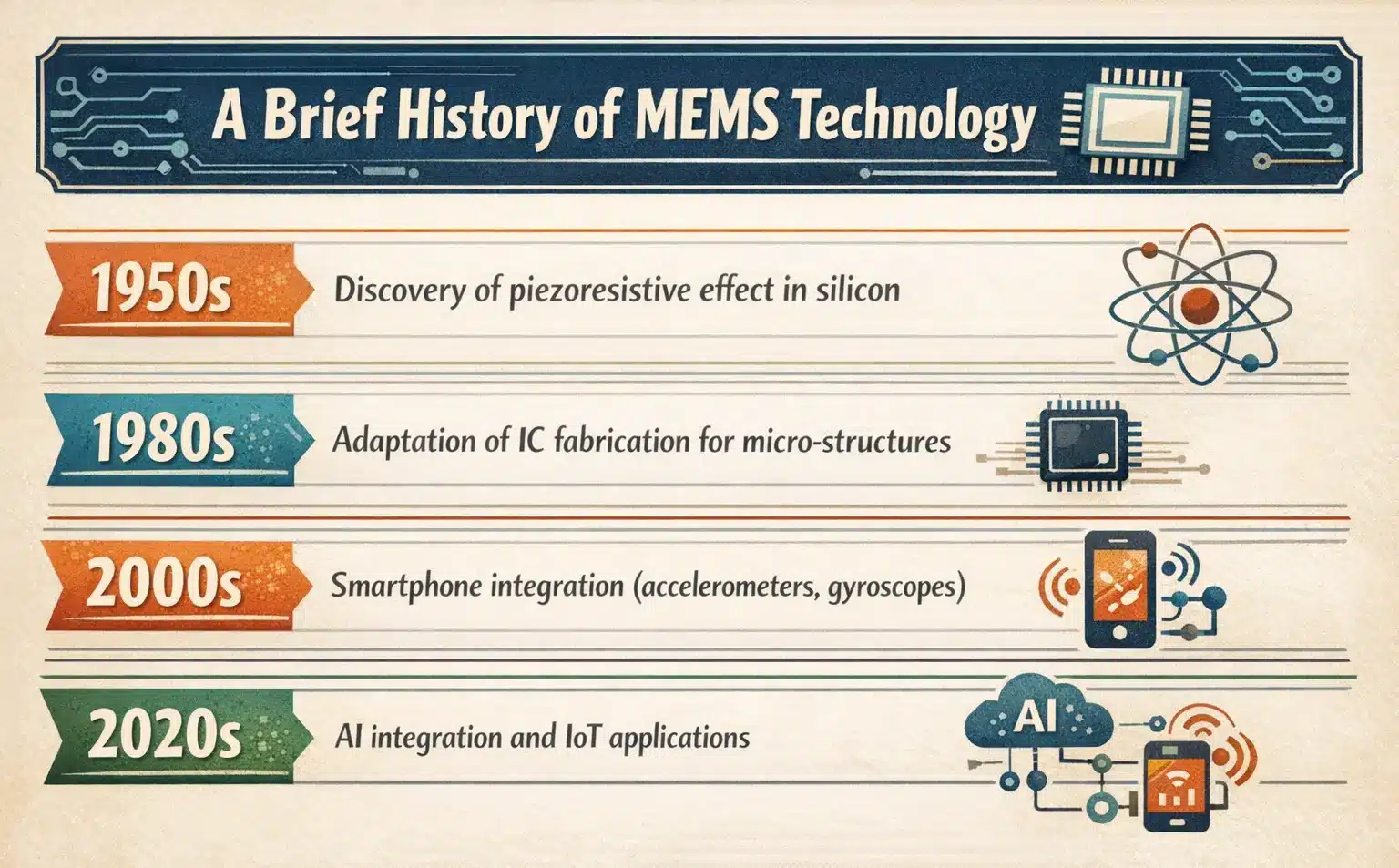
A Brief History and Evolution of MEMS Technology
How MEMS Devices Are Made
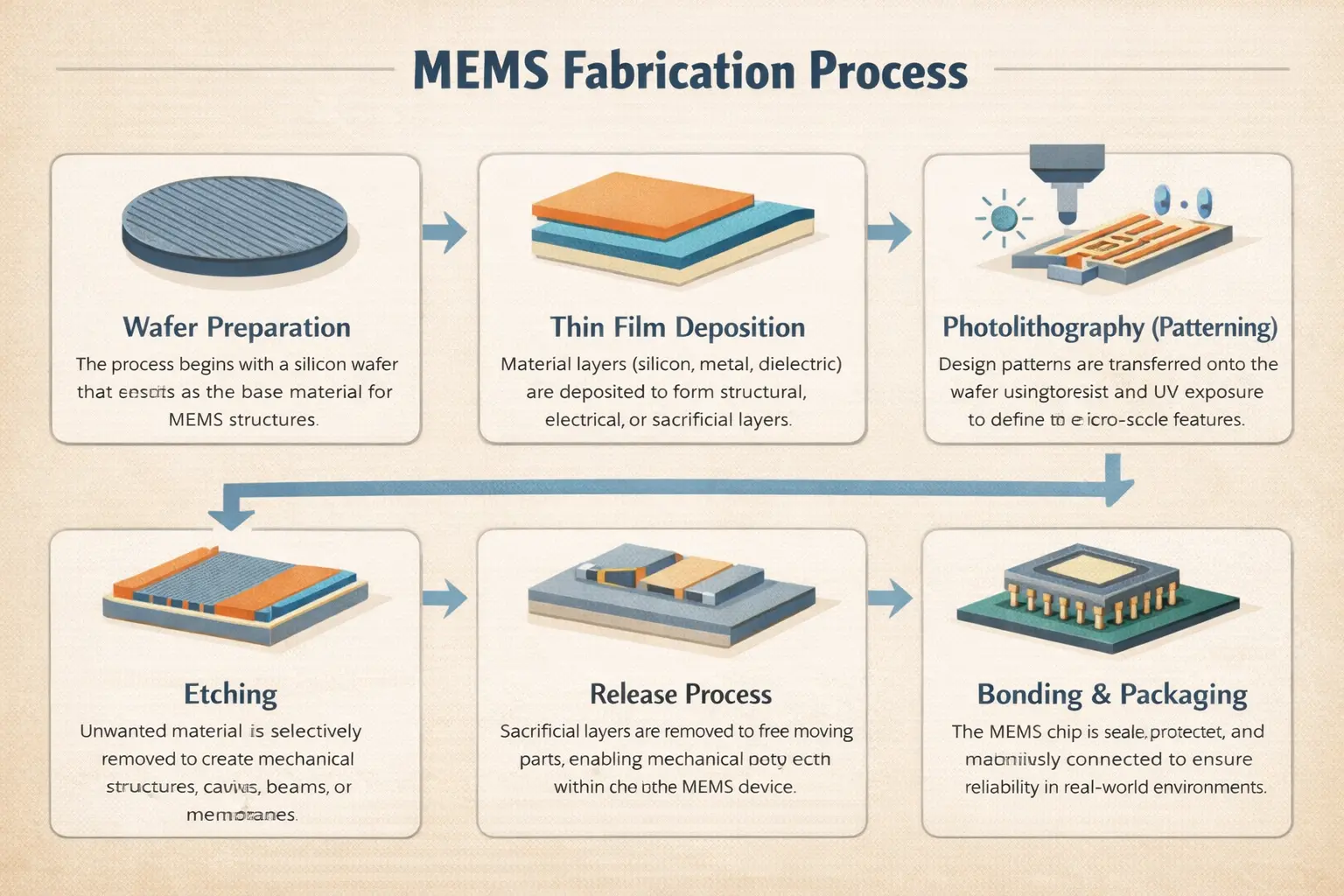
Understanding how MEMS devices are fabricated helps explain why they behave differently from conventional mechanical components. Instead of being assembled part by part, MEMS structures are built layer by layer at the microscopic scale, using techniques adapted from semiconductor manufacturing.
Micromachining Techniques
MEMS fabrication relies on micromachining methods that shape silicon and related materials into functional mechanical structures.
- Surface Micromachining: This technique builds MEMS components by depositing and patterning thin films on the surface of a silicon wafer. Sacrificial layers are later removed to release movable parts such as beams, cantilevers, or membranes. Surface micromachining is widely used for sensors and actuators that require fine mechanical motion.
- Bulk Micromachining: Bulk micromachining removes material directly from the silicon substrate to form deeper structures like cavities, channels, or diaphragms. This method is commonly applied in pressure sensors and inertial devices where mechanical strength and thickness are critical.
- LIGA Process: LIGA (Lithographie, Galvanoformung, Abformung) combines deep X-ray lithography, electroplating, and molding to produce high-aspect-ratio microstructures. Although less common than silicon-based methods, LIGA is used for MEMS components that require extreme precision and vertical sidewalls.
Key Fabrication Steps
Regardless of the micromachining approach, MEMS devices typically follow a core set of fabrication stages.
Also Read: Explanation of Manufacturing Overhead Cost and How to Lower Them
Types of MEMS Devices and Their Applications
MEMS technology broadly falls into two functional categories: sensors, which detect physical changes from the environment, and actuators, which respond by performing a mechanical action. Together, these components enable compact, energy-efficient systems across consumer electronics, automotive, healthcare, and industrial applications.
Sensors
MEMS sensors convert physical signals into electrical data with high precision at micro scale. They are the most widely deployed MEMS devices today.
-
Accelerometers
Used to measure acceleration, tilt, and vibration. Commonly found in smartphones for screen rotation and motion tracking, as well as in automotive systems for airbag deployment and vehicle stability control. -
Gyroscopes
Detect angular velocity and orientation. These sensors are critical for navigation systems, drone flight control, image stabilization in cameras, and augmented or virtual reality devices. -
Pressure Sensors
Measure force exerted by gases or liquids. Applications include automotive engine management, tire pressure monitoring, medical devices (such as blood pressure monitors), and industrial process control. -
Microphones
MEMS microphones convert sound waves into electrical signals. Their small size, durability, and low power consumption make them standard in smartphones, hearing aids, smart speakers, and voice-controlled devices.
Actuators
MEMS actuators perform controlled mechanical movement in response to electrical input, enabling precise action at micro scale.
-
Micro-mirrors
Used in digital light processing (DLP) projectors and LiDAR systems. These mirrors tilt rapidly to direct light, enabling high-resolution imaging and distance sensing. -
Micro-pumps
Control the movement of small fluid volumes. They are widely used in medical and biomedical devices, including drug delivery systems, lab-on-a-chip platforms, and diagnostic equipment. -
RF Switches
Enable signal routing in radio frequency systems. MEMS RF switches are valued in telecommunications for their low signal loss, high isolation, and suitability for 5G and satellite communication applications.
Together, MEMS sensors and actuators form the foundation of many modern smart systems, enabling real-time sensing, control, and automation in compact and cost-efficient designs.
MEMS Applications by Industry
| Industry | Common MEMS Devices | Key Applications | Why MEMS Matters |
|---|---|---|---|
|
Consumer Electronics |
Accelerometers, gyroscopes, microphones | Smartphones, wearables, gaming devices, AR/VR | Enables compact design, motion sensing, voice input, and low power consumption |
|
Automotive |
Pressure sensors, accelerometers, gyroscopes |
Airbag systems, tire pressure monitoring (TPMS), vehicle stability control, ADAS |
Improves safety, vehicle control, and real-time response under dynamic conditions |
|
Healthcare and Medical Devices |
Pressure sensors, micro-pumps, microphones |
Blood pressure monitors, drug delivery systems, hearing aids, diagnostic devices |
Supports precise measurement, miniaturization, and patient-friendly medical solutions |
|
Industrial and IoT |
Accelerometers, pressure sensors, gas sensors |
Predictive maintenance, equipment monitoring, smart factories |
Enables real-time condition monitoring and data-driven maintenance decisions |
|
Aerospace and Defense |
Gyroscopes, accelerometers, micro-mirrors |
Navigation systems, inertial measurement units (IMUs), surveillance and targeting |
Provides high reliability, precision, and performance in extreme environments |
Challenges of MEMS Adopting and How to Overcome Them
MEMS manufacturing combines microelectronics precision with mechanical complexity, creating a distinct set of challenges that differ from conventional semiconductor production. These constraints influence cost structures, scalability, and time-to-market.
-
High initial capital investment
MEMS fabrication requires advanced equipment such as photolithography tools, deposition systems, and etching equipment. The upfront cost of building or accessing a MEMS-capable fabrication facility is substantial, especially for small and mid-sized manufacturers. -
Strict cleanroom requirements
Many MEMS processes must be carried out in cleanroom environments to prevent contamination at the microscale. Maintaining cleanroom standards (ISO Class 5–7) adds ongoing operational and compliance costs. -
Yield management at microscale
Small defects at the micrometer level can render entire devices unusable. Variations in material stress, etching depth, or alignment can significantly impact yield, making process control and consistency critical. -
Testing and calibration complexity
Unlike purely electronic components, MEMS devices often require mechanical, thermal, and environmental testing. Calibrating sensors and actuators across operating conditions increases testing time and cost. -
Packaging and integration challenges
MEMS packaging must protect delicate microstructures while preserving performance. Issues such as hermetic sealing, thermal expansion mismatch, and integration with electronics can complicate design and manufacturing.
Together, these challenges explain why MEMS manufacturing demands careful planning, specialized expertise, and rigorous process control to achieve both technical reliability and economic viability.
Conclusion
Understanding how MEMS works helps businesses make more informed decisions when adopting or developing MEMS-based solutions. As applications continue to expand alongside AI and IoT, the ability to evaluate MEMS capabilities and constraints becomes increasingly important for long-term scalability and product reliability.
If you are exploring MEMS solutions and want to ensure the approach fits your technical requirements and production goals, you can start with a free consultation with our experts to discuss the most suitable direction for your use case.

FAQ about MEMS
-
What is the main difference between sensors and MEMS?
A sensor is any device that detects input from the physical environment. MEMS, on the other hand, is a specific technology used to build sensors (and actuators) at the microscale by integrating mechanical and electrical components on a silicon chip, resulting in devices that are extremely small and highly efficient.
-
Why are MEMS so important for smartphones?
MEMS play a crucial role in enabling core smartphone functions, such as automatic screen rotation (accelerometers), more accurate GPS navigation (gyroscopes), camera image stabilization, and clear audio capture (silicon microphones), all while keeping devices slim and energy-efficient.
-
Are MEMS manufacturing processes expensive?
The initial investment required to build a MEMS fabrication facility is very high. However, because MEMS use wafer-based processes similar to semiconductors, thousands to millions of devices can be produced simultaneously, which makes the cost per unit very low when manufactured at large volumes.
-
How does software help manage MEMS production?
Software such as ERP systems helps streamline the complexity of MEMS production by providing a centralized platform for production planning, material tracking, quality control management at every stage, and real-time yield analysis to quickly identify and resolve issues.
-
Which industries will be most affected by MEMS in the coming decade?
Healthcare (through Bio-MEMS and point-of-care diagnostics), automotive (with autonomous driving and electrification), and the Internet of Things (IoT) for smart homes and smart cities are expected to undergo the most significant transformation driven by advancements in MEMS technology.