













An army marches with its stomach, and a store profits with its capability to sell. Throughput rate is the scale that determines whether a business succeeds or fails. Even with the efficiency of modern equipment, many operations fail to meet demand due to slow workflows and hidden bottlenecks. This is where understanding throughput rate becomes essential for managers aiming to improve output with no cost at all.
The failure of the iconic DMC-12 sports car was an example of how not reaching a sufficient throughput rate can end a business. What was once a promising product became a disaster as delays in the supply chain and production difficulties left the company outcompeted. So, understanding throughput rate is essential if you want to achieve production efficiency.
Key Takeaways
|
What is Throughput Rate?
Throughput rate measures the time needed to make a unit of products or to provide a complete service within a certain time frame. In a nutshell, It is the effective speed at which a system generates defect free output that has passed all stages and is ready for the next step, which is to be sold.
That is why a precise understanding of throughput rate matters; it reveals a company’s true productive capacity rather than the optimistic theoretical potential. When throughput rate is tracked systematically, it enables management to identify structural bottlenecks, refine process flow, and base operational decisions on measurable data instead of assumption.
1. Definition of throughput rate
The throughput rate is a Key Performance Indicator (KPI) showing how fast a system produces sellable units. It only counts finished, quality output, not defects or items in rework. Therefore, it reflects real operational effectiveness and shows how well inputs become revenue generating products.
2. Key components in throughput rate
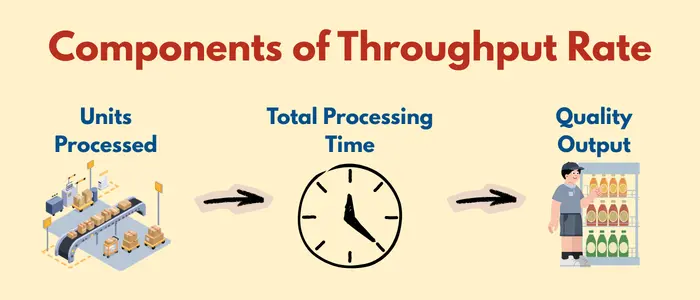
To fully understand throughput rate, you must know its three key components. First, units processed refers to all the items entering the system in a specific time in a specific time regardless of whether they ultimately meet quality standards. Second, total processing time covers all the work and downtime within the time allocated for production. Finally, quality output represents the units that have qualified and are completed in a condition that allows them to move forward, whether to the next production stage, delivery, or final sale.
3. Throughput rate vs cycletime
Cycletime, while on the surface it may seem similar, refers to only the time required for a process to produce a single unit from start to finish, it focuses on the efficiency of a single process in making an individual product. Throughput rate on the other hand sees the bigger picture; it’s a metric that looks into how the entire production system effectively produces quality outputs which can be sold in a specific amount of time.
4. Throughput rate vs output
Although often used interchangeably, throughput rate and output are fundamentally different. Output is the total units produced in a period, regardless of quality. In contrast, throughput rate counts only units that finish the process, meet quality standards and are ready for shipment, so it better reflects real productivity.
The Importance of Measuring Throughput Rate for Business
 Around 70% of startups fail due to their inability to adapt and change with the changing market. This would include their failure in reforming their production system. Intuition alone is no longer enough, companies need accurate data and metrics to guide strategy, especially in operations.
Therefore, measuring throughput rate becomes a vital diagnostic tool for monitoring the health, speed and efficiency of your business engine. By monitoring throughput, companies can shift from reactive to proactive, anticipating issues before they hurt costs and customer satisfaction. In addition, it fosters a culture of continuous improvement and ensures every process step delivers maximum value.
1. Identifying bottlenecks
One key benefit of measuring throughput rate is its ability to clearly reveal bottlenecks in your workflow. A bottleneck is a stage with lower capacity that slows production. Managing bottlenecks is central to process improvement, since it guides focus to the areas that need it most.
2. Improving operational efficiency and productivity
Throughput rate directly reflects operational efficiency, and higher throughput means more efficient processes. By making it a primary KPI, you motivate teams to simplify workflows, cut waste and reduce delays, so you can produce more quality output with the same or fewer resources and lower costs.
3. A basis for better strategic decision-making
Accurate throughput data gives leaders a solid basis for smarter strategic decisions. It guides production planning, delivery scheduling and customer commitments. In addition, it helps project realistic capacity, set achievable targets and allocate budgets to initiatives with the greatest impact.
4. Increasing profitability and customer satisfaction
Ultimately, operational improvements aim to boost financial results and customer relationships, and throughput rate directly affects both. By increasing throughput, you speed up time to market, raise customer satisfaction and loyalty, cut labor costs per unit and improve cash flow and profitability.
Formula and How to Calculate Throughput Rate
After understanding the importance of throughput rate, the next step is to learn how to calculate it accurately. The formula is simple and easy to grasp. However, the real challenge is collecting consistent, accurate data, since results depend on the quality of what you input.
Calculating throughput rate regularly gives you a performance baseline to benchmark future improvements. Without concrete numbers, it is hard to know if changes help. Therefore, you should learn the basic formula, see a real example and explore a few useful variations.
1. The basic throughput rate formula
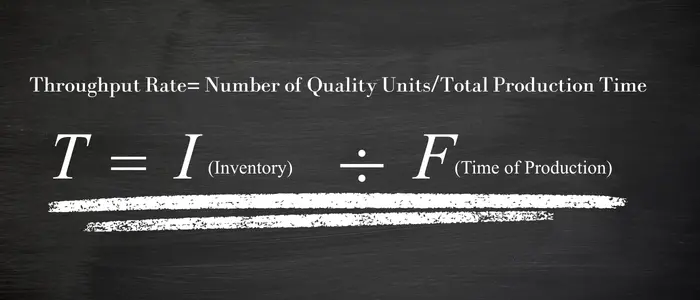
The basic throughput rate formula is simple: divide the number of successfully produced units by total production time. Importantly, this means only finished products that pass quality checks, while total time includes the full period with any downtime and breaks for a realistic view.
Formula:
2. A simple example of throughput rate calculation
To give a clearer picture, consider a toy assembly factory that runs one 8 hour shift, or 480 minutes. During that time, the line produces 200 toys that meet quality standards. Therefore, its throughput rate is 200 units divided by 8 hours making the throughput rate 25 units per hour.
Calculation:
T = 200 Units (I) / 8 hours (F) = 25 units per hour
This means the effective speed of that production line is 25 units of quality toys every hour.
3. Practical steps to measure throughput rate
Effectively measuring throughput rate requires a systematic approach with accurate, consistent data. First, define a clear measurement period. Second, set strict criteria for a completed unit. Then record completed units in that period and calculate using the formula for analysis over time.
Effective Strategies to Increase Throughput Rate

Knowing your current throughput rate is only the starting point. The main goal is to keep improving it, since even small gains improve efficiency, costs and customer satisfaction. Instead of pushing people or machines beyond capacity, you work smarter by optimizing every part of an interconnected workflow.
This improvement process starts by identifying and eliminating waste, reducing unplanned downtime and ensuring a smooth flow of materials and information. By applying the right strategies, you can systematically remove inefficiencies and build a leaner, faster and more reliable process.
1. Applying the Theory of Constraints (TOC)
The Theory of Constraints (TOC) focuses on finding and managing the main bottleneck that limits system performance. Its core idea is that throughput is set by the slowest part. Therefore, TOC applies five steps to manage constraints.
2. Reducing cycle time
Cycle time is the total time to complete one unit from start to finish. By reducing cycle time, you automatically increase throughput, since more units finish in the same period. Therefore, you should remove non value adding steps like waiting, extra movement and unnecessary inspections.
3. Automating repetitive and manual processes
Repetitive manual tasks are time consuming and prone to human error, which can lower throughput. Therefore, identifying and automating these tasks with machinery, robotics or software boosts productivity, ensures consistency and speed, and frees people for higher value work.
4. Implementing preventive maintenance
Unexpected machine downtime is a major killer of throughput in manufacturing. Instead of waiting for breakdowns, implement regular preventive maintenance to inspect, clean and service equipment. This proactive approach cuts sudden failures, extends machine life and keeps production running smoothly.
5. Optimizing inventory management
Poor inventory management, from stockouts to overstocking, can hurt throughput. A lack of raw materials stops production, while excess work in progress, or pipeline inventory, slows movement. Therefore, use practice like JIT and demand forecasting so consignment inventory and other materials arrive exactly when needed without buildup.
The Role of Technology in Optimizing Throughput Rate
 Before modern computing everything took a longer time and required more effort. All records are handwritten in thick books and most of the counting still required a lot of human computing. But today we have software like sheets which combine all those different data into one neat digital book. Yet, there are still drawbacks in system like sheets.
This is where the newest ERP system comes in; It provides a centralized platform to manage all operations. With real time data, managers can monitor production, track each unit from start to finish and analyze patterns for improvement. Therefore, a comprehensive ERP system is key to tackling these challengers.
1. ERP (Enterprise Resource Planning) systems
An ERP system acts as the digital backbone of operations, linking production, inventory, sales and finance. In terms of throughput, it gives end to end workflow visibility, so you can track orders, monitor cycle times, spot delays and generate detailed performance reports.
2. Integrated manufacturing software
For manufacturing companies, dedicated manufacturing software is a powerful tool for boosting throughput on the production floor. It improves planning and scheduling so machines and labor are used optimally, while real time WIP tracking reveals bottlenecks and supports quick schedule adjustments when conditions change.
3. Inventory management systems
As discussed, raw material availability is crucial for smooth production and stable throughput. Modern inventory systems automate stock tracking, send alerts at reorder points and support demand forecasting. Consequently, they help you avoid stockouts, prevent overstacking and maintain optimal material flow.
As production processes become more complex, having centralized visibility and automated workflows is essential to maintaining a consistent throughput rate. For Singapore manufacturers, solutions that qualify for up to 70% CTC grant support make it easier to adopt production management systems while managing implementation costs.
Conclusion
Throughput rate is a key metric for understanding how efficient production systems turn inputs into completed output. By measuring it accurately and identifying bottlenecks, businesses can improve productivity, reduce delays, and operate more predictably without increasing resources.
Modern advancement in digital software like the ERP system also provided companies with the ability to automate their production systems. By utilising it businesses can improve the production systems thus improving the production efficiency which ultimately increased the throughput rate.
FAQ about Throughput Rate
-
What is the main difference between throughput and cycle time?
Throughput is a rate of output (number of units per time period), while cycle time is a measure of time (time taken to complete one unit). They are inversely related; if you reduce your cycle time, your throughput rate will naturally increase.
-
What is the most effective way to identify a bottleneck?
The most effective method is to map your workflow and measure the cycle time or work-in-progress (WIP) queue at each stage. The stage with the longest cycle time or a consistently piling queue is your bottleneck. ERP systems can automate this by providing real-time performance data.
-
Does a high throughput rate always mean good performance?
Generally, yes, but it must be balanced with quality. A high throughput rate is meaningless if many of the products are defective. The metric should always measure ‘quality’ or ‘passed-inspection’ units. Chasing speed at the expense of quality will ultimately harm your business.
-
How often should I measure and analyze the throughput rate?
The frequency depends on your business and production cycle. For fast-paced environments, daily or even per-shift measurement might be necessary. For longer processes, weekly or monthly could suffice. The key is consistency, so you can track trends and measure the impact of any changes.