




Across many production environments, manufacturing practices have changed significantly over the past few years. Product designs continue to grow more complex, development timelines become shorter, and market expectations shift more quickly than before. Under these conditions, traditional production methods often struggle to remain flexible.
3D printing offers a more adaptable approach. Components can be produced directly from digital designs without lengthy mold preparation. When design changes occur, adjustments can be made faster without disrupting the overall production workflow.
By understanding how 3D printing is used in manufacturing, the role of this technology becomes clearer as part of modern production practices rather than a short term technological trend.
Key Takeaways
|
How 3D Printing Is Used in Modern Manufacturing Processes
In manufacturing operations, 3D printing follows an additive approach that builds components layer by layer using digital design files. This method differs from conventional processes that rely heavily on molds or material removal from solid blocks.
Design changes can be applied directly at the digital stage and tested without time consuming retooling. For industries with short product life cycles or frequent customization requirements, this flexibility simplifies development and effective production planning.
In manufacturing environments that emphasize product quality, workplace safety, and production documentation, including those commonly found across Southeast Asia, this approach supports innovation while remaining aligned with established industrial practices.
Why 3D Printing Enables Capabilities That Were Previously Difficult to Achieve
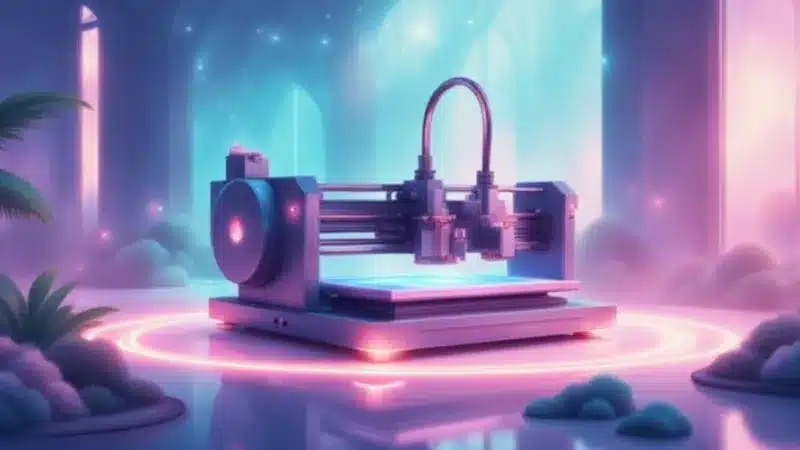
Before 3D printing became widely adopted, many designs had to be simplified to match tooling limitations and machining constraints. Complex internal features, lightweight structures, and unconventional shapes often required multiple parts and additional assembly steps.
With 3D printing, many of these constraints no longer apply. Components with internal channels, hollow structures, or complex geometries can be produced in a single process. This reduces the need for extra tooling and minimizes repetitive production stages. innovations reshaping how products are built
As a result, design and production teams can explore new ideas more freely while still meeting the consistency and quality expectations required in regulated manufacturing environments.
How 3D Printing Is Applied Across Different Manufacturing Industries
The way 3D printing is applied varies depending on industry requirements and production objectives.
1. Automotive Manufacturing
In automotive environments, 3D printing is commonly used to produce functional prototypes such as brackets, housings, and interior components. Early testing helps identify design issues before mass production begins. The technology also supports the creation of custom assembly tools and fixtures that improve accuracy on the production line, contributing to streamlining vehicle production workflows.
2. Aerospace and High Precision Manufacturing
In industries that demand high precision, 3D printing enables the production of lightweight components with complex internal structures. This approach improves material efficiency while meeting strict quality and documentation standards.
3. Healthcare Manufacturing
Within healthcare manufacturing, 3D printing supports the production of customized medical devices and surgical guides. Digital design workflows align closely with traceability and documentation requirements, supporting ensuring product safety through traceability systems that are essential in regulated medical production.
4. Industrial Equipment and Tooling
For day to day manufacturing operations, 3D printing is often used to create jigs, fixtures, and replacement parts. Digital storage of designs allows parts to be produced on demand, helping reduce downtime and reliance on physical inventory while applying lean principles to reduce production waste.
3D Printing Methods Commonly Used in Manufacturing
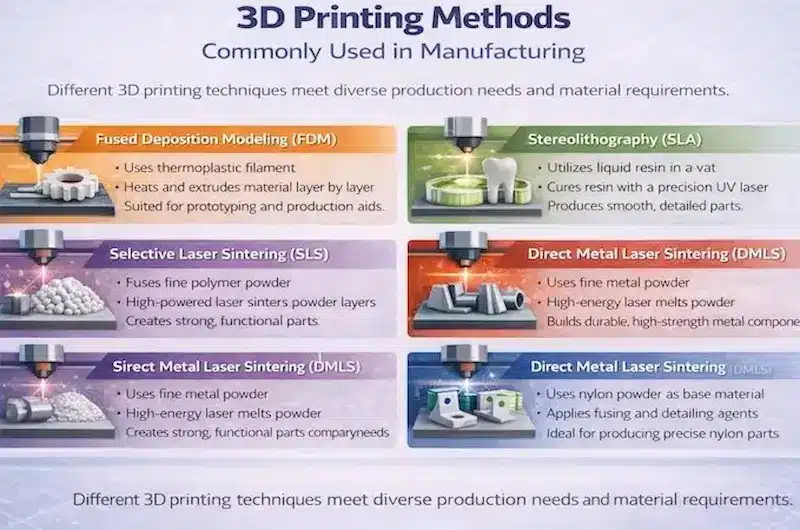
3D printing encompasses multiple methods, each suited to different materials, precision requirements, and production objectives.
1. Fused Deposition Modeling (FDM)
This method uses melted thermoplastic filament to produce functional prototypes and production aids.
2. Stereolithography (SLA)
SLA employs precision lasers to cure liquid resin, resulting in high-detail components with smooth surface finishes.
3. Selective Laser Sintering (SLS)
High-powered lasers fuse polymer powder into solid structures without additional support materials.
4. Direct Metal Laser Sintering (DMLS)
This method produces high-strength metal components for applications requiring advanced mechanical performance.
5. Multi Jet Fusion (MJF)
MJF enables consistent and precise production of nylon components, supporting medium-volume manufacturing requirements.
Benefits of Integrating 3D Printing with Manufacturing Systems
Integrating 3D printing into centralized manufacturing systems improves operational visibility and coordination. This approach reduces data fragmentation and aligns additive manufacturing workflows with broader production objectives.
1. Integrated data management
Design and production data are consolidated within a unified digital environment, enabling organizations to support gaining insights through production data analysis.
2. Real-time material tracking
Material usage monitoring supports what goes into each finished product while also improving inventory planning and procurement accuracy.
3. Coordinated production scheduling
Printing tasks align more effectively with traditional manufacturing operations, aligning resources and timelines across the shop floor.
4. Accurate cost calculation
Detailed tracking of machine usage and material consumption improves cost estimation accuracy.
5. Process traceability for compliance
End-to-end documentation supports audit requirements in regulated industries while meeting international quality benchmarks.
The Future of 3D Printing in the Global Manufacturing Landscape

The development of 3D printing is currently moving towards closer integration with supporting technologies such as artificial intelligence and automation. This approach has led to the emergence of practices such as generative design, distributed manufacturing, and the use of more sustainable materials as part of the evolution of additive manufacturing.
This direction of development also reflects the industry’s need to improve operational efficiency and maintain long-term competitiveness. The application of more integrated and sustainability-oriented technologies helps keep production processes in line with evolving technical standards and industry practices.
1. Integration of Generative Design into Production Processes
The use of artificial intelligence supports the development of generative design, enabling component geometries to be created based on specific performance parameters. This approach allows for lighter and more efficient structures while expanding design possibilities beyond the limits of conventional manual methods.
2. The Shift Toward Distributed Manufacturing Models
Manufacturing development increasingly points toward more decentralized production models located closer to the point of use. On-demand production across multiple locations reduces dependence on global supply chains while helping shorten delivery times and limit the environmental impact associated with long-distance logistics.
3. The Emergence of 4D Printing Technologies
Advances in material innovation continue to extend additive manufacturing beyond traditional 3D printing toward 4D printing concepts. In this approach, printed materials can change shape or properties over time, creating opportunities for products that adapt to environmental conditions or specific functional requirements.
4. Adoption of Sustainable Circular Economy Principles
Circular economy principles increasingly influence additive manufacturing through the use of recycled and bio-based printing materials. Closed-loop material management allows production waste to be reprocessed into new printing materials, supporting waste reduction and more efficient resource utilization.
5. Automation of Post-Printing Processes
Automation advancements enable the integration of post-printing systems that handle cleaning, drying, and finishing tasks with greater consistency. This approach reduces reliance on manual labor, lowers production costs per unit, and increases overall manufacturing throughput.
Operational Management Challenges in Additive Manufacturing
The adoption of 3D printing introduces new operational management challenges. Additive manufacturing involves interconnected processes related to digital design, materials, equipment, and production scheduling. Without structured management, coordination across these elements can become inefficient.
Material management remains a primary concern due to the diversity of materials involved. In addition, machine condition monitoring and maintenance planning play essential roles in ensuring consistent production performance. Comprehensive process visibility supports more informed decision-making and operational control.
-
Generative design integration
AI algorithms will automatically generate optimized part geometries based on performance constraints. Engineers will use this to create organic, lightweight structures that are impossible to design manually.
-
Distributed manufacturing models
Production will increasingly shift to decentralized hubs closer to the end consumer. Companies will print spare parts locally on-demand, drastically reducing global shipping emissions and logistics times.
-
Emergence of 4D printing
Research is advancing in materials that change shape or properties over time after printing. This could lead to self-assembling furniture or medical implants that adapt to bodily growth.
-
Sustainable circular economy
The focus on circular economy will drive the use of recycled and bio-based printing materials. Manufacturers will adopt closed-loop systems where waste is reprocessed into filament for new prints.
-
Automated post-processing
Robotic systems will handle cleaning, curing, and finishing tasks to reduce manual labor. This automation will significantly lower the cost per part and speed up the total production throughput.
Conclusion
3D printing has become an increasingly relevant part of modern manufacturing practices. By enabling more flexible design approaches and alternative production methods, the technology helps address challenges that traditional manufacturing often struggles to handle.
Through its application across different industries and production stages, 3D printing demonstrates how manufacturing processes can adapt to evolving design requirements, shorter development cycles, and established quality standards. Understanding these aspects allows the technology to be viewed realistically as part of an ongoing shift in how manufacturing is carried out today.
FAQ About 3D Printing Manufacturing
-
What is 3D printing in manufacturing, and how is it different from traditional methods?
3D printing, or additive manufacturing, builds parts layer by layer from digital design files. Traditional manufacturing often relies on molds, tooling, or subtractive methods that remove material. The key difference is how the part is formed: additive methods add material only where needed, which can support complex geometries with less dependence on specialized tooling.
-
When does 3D printing make sense in manufacturing?
3D printing is commonly used when the design changes often, when geometry is complex, when low-volume production is needed, or when producing tooling aids such as jigs and fixtures. It can also fit cases where lead times for tooling are a bottleneck in development.
-
What can 3D printing do that traditional manufacturing struggled to do?
It can produce complex internal channels, lattice structures, and integrated assemblies that are difficult or costly to create using conventional tooling and machining. These designs often require fewer assembly steps because features can be built into a single print.